How to Embed Risk Controls Directly into DevOps and CI/CD Pipelines


Join thousands of professionals and get the latest insight on Compliance & Cybersecurity.
Summary
- Manual compliance processes create a "compliance tax," often costing engineering teams over 40-60 hours per framework for manual evidence collection.
- Adopting a "DevRiskOps" mindset that embeds automated controls into the CI/CD pipeline can reduce the cost of fixing issues by up to 40% by catching them earlier.
- Key actions include implementing Policy as Code (PaC), integrating automated security scanners (SAST, SCA), and securing pipeline access and secrets.
- Use a Continuous Control Monitoring (CCM) platform to automate evidence collection and ensure compliance posture is maintained in real-time after deployment.
You're a DevOps engineer focused on optimizing deployment frequency when suddenly the sales team promises a client SOC2 compliance. Now you're reading control frameworks at midnight, trying to figure out how to manually screenshot AWS settings for auditors.
Sound familiar?
The core conflict is clear: DevOps culture prizes speed, automation, and frequent delivery, while traditional GRC (Governance, Risk, and Compliance) is often manual, periodic, and seen as a roadblock. This friction creates significant pain, with many engineers noting, "Every time we try to implement compliance checks, it adds friction to our deployment process."
But what if compliance could actually enable speed rather than impede it? Instead of treating risk and compliance as an afterthought, we must embed automated controls directly into the CI/CD pipeline. This isn't about slowing down; it's about building security and compliance in from the start, enabling you to move faster with confidence.
The "Compliance Tax": Why Traditional Risk Management Clashes with DevOps
Traditional compliance processes create what many engineers call a "compliance tax" - a hefty toll paid in engineering hours. One DevOps engineer reported spending over "400+ hours manually documenting infrastructure configurations" and described the process as "antithetical to everything we try to achieve in DevOps - it was manual, error-prone, and didn't scale."
This disconnect creates several critical challenges:
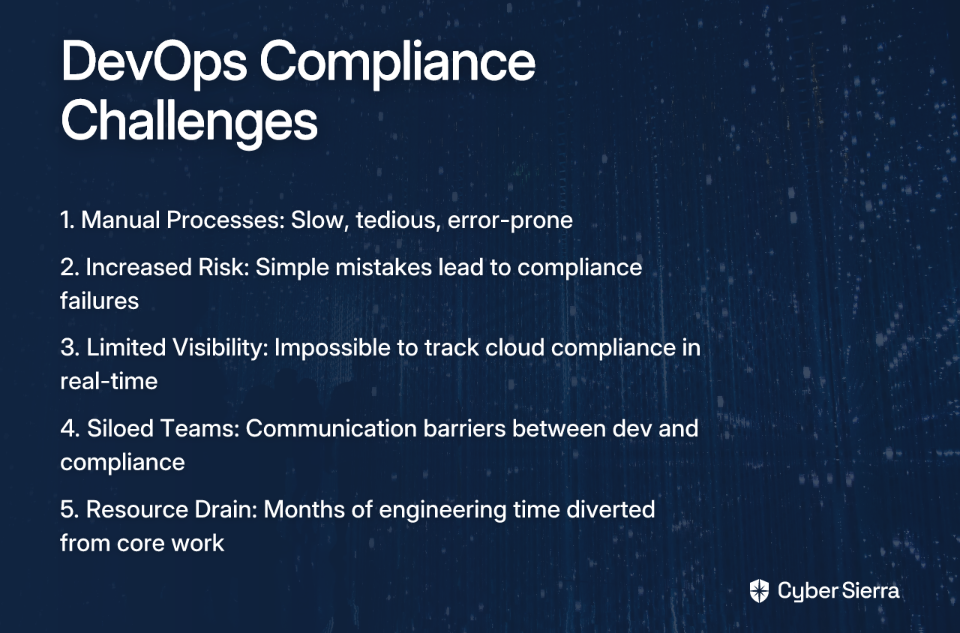
- Manual Processes: Slow, tedious, and prone to human error
- Increased Risk of Error: Simple mistakes can lead to significant compliance failures and financial penalties
- Lack of Visibility: It's nearly impossible to manually track the compliance posture of complex cloud systems in real-time
- Siloed Teams: A wall between developers, operations, and compliance teams hinders communication and creates bottlenecks
The resource drain is substantial. Another engineer noted that tackling SOC2 and ISO 27001 simultaneously cost "three months of engineering time that could have been spent on infrastructure improvements or reliability work."
The Paradigm Shift: Adopting a DevRiskOps Mindset
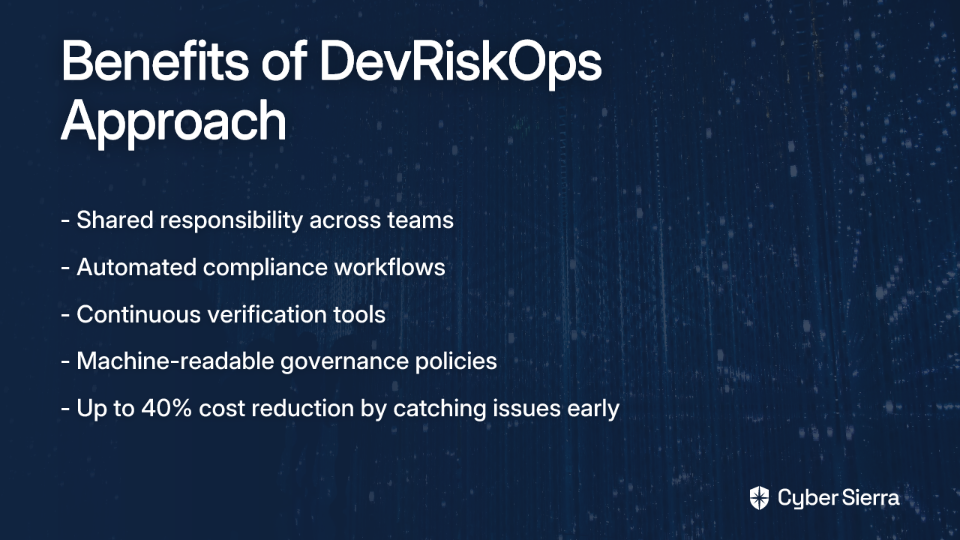
To bridge this gap, we need a fundamental mindset shift toward what Deloitte calls "DevRiskOps" - a structured approach to integrate risk management directly into the DevOps environment. This approach is built on four pillars:
- People: Cross-functional teams with shared responsibility for security and compliance
- Process: Automated workflows that incorporate compliance checks
- Technology: Tools that enable continuous compliance verification
- Governance: Clear policies that are machine-readable and automatically enforced
The core of this approach is "Shifting Left" - moving security and compliance checks earlier in the development lifecycle. According to research by ValueX2, shifting left can reduce the cost of fixing issues by up to 40% by catching them before they reach production.
The ultimate goal is to move from periodic, manual audits to continuous compliance, where adherence to standards like GDPR, HIPAA, SOC 2, and ISO 27001 is verified automatically and constantly.
Know Your Enemy: Top 10 Security Risks in Your CI/CD Pipeline
Before embedding controls, you must understand the threats. CI/CD pipelines automate delivery, but they also expand the attack surface. The OWASP CI/CD Security Cheat Sheet provides a clear framework of the top risks you need to protect against:
- Insufficient Flow Control Mechanisms: Weak protection of the pipeline workflow
- Inadequate Identity and Access Management: Poor access controls for CI/CD components
- Dependency Chain Abuse: Compromised third-party components or libraries
- Poisoned Pipeline Execution (PPE): Unauthorized code execution within pipelines
- Insufficient Pipeline-Based Access Controls: Excessive pipeline privileges to production
- Insufficient Credential Hygiene: Improper management of secrets and credentials
- Insecure System Configuration: Misconfigurations in pipeline infrastructure
- Ungoverned Usage of Third-Party Services: Unvetted external services in the pipeline
- Improper Artifact Integrity Validation: Lack of verification for build artifacts
- Insufficient Logging and Visibility: Limited monitoring of pipeline activities
A Practical Guide to Embedding Risk Controls in Your Pipeline
Step 1: Define Policies and Map Risks to Controls
Start by collaborating with security, legal, and compliance teams to define clear, machine-readable policies. Map specific risks (like those from the OWASP list) to tangible controls within your CI/CD pipeline. For example, the risk of "Insufficient Credential Hygiene" maps to controls that scan for hardcoded secrets.
This mapping helps everyone understand what risks you're addressing and how they relate to specific compliance requirements like SOC2 or ISO 27001.
Step 2: Implement Policy as Code (PaC) and Infrastructure as Code (IaC)
Codify your compliance rules and infrastructure configurations. This makes compliance repeatable, version-controlled, and auditable - directly addressing the pain of "ensuring a cloud config is compliant at deploy time."
- Infrastructure as Code: Use tools like Terraform or CloudFormation to define infrastructure
- Policy as Code: Implement using tools like Open Policy Agent (OPA) or HashiCorp Sentinel to enforce rules automatically
For example, you can write a policy that prevents the creation of public S3 buckets or ensures all EC2 instances have proper encryption. Tools like Checkov and Bridgecrew provide static analysis of IaC files to catch misconfigurations before deployment.
Step 3: Secure Your Pipeline Infrastructure and Access (IAM)
Apply the Principle of Least Privilege to all parts of the CI/CD pipeline, including the SCM, build server, and cloud environments:
- Source Control: Use protected branches in Git and require reviews before merges. Enforce commit signing to ensure code provenance.
- Secrets Management: Never store secrets in code. Use dedicated secrets management tools like HashiCorp Vault or AWS Secrets Manager.
- Pipeline Configuration: Ensure build servers have minimal permissions and are regularly patched.
- Tooling: Use tools like GitLeaks and Git-Secrets to prevent secrets from being committed.
Step 4: Automate Security and Compliance Scanning
Integrate automated scanners directly into your pipeline stages (build, test, deploy) to provide immediate feedback to developers:
- Static Application Security Testing (SAST): Scan source code for vulnerabilities with tools like SonarQube
- Software Composition Analysis (SCA): Check for vulnerabilities in open-source dependencies with tools like Snyk
- Container Scanning: Examine container images for known vulnerabilities using Prisma Cloud
- Compliance Scanning: Verify configurations against compliance benchmarks with tools like Chef InSpec
Step 5: Ensure Artifact and Dependency Integrity
Protect your software supply chain by verifying the integrity of all dependencies and build artifacts:
- Use immutable dependency references (e.g., using hash sums in package manager lock files)
- Implement code signing to ensure the authenticity of your software artifacts
- Consider frameworks like in-toto and Sigstore for securing the software supply chain
Beyond Deployment: The Critical Role of Continuous Control Monitoring (CCM)
Pipeline controls are just the beginning. As one DevOps engineer noted, "We need to ensure that our cloud configurations comply with regulations during runtime, not just at deployment time." This is where Continuous Control Monitoring (CCM) becomes essential.
CCM is a proactive approach using technology for ongoing, automated oversight of controls to ensure their effectiveness in real-time. This is critical because misconfigurations or "compliance drift" can happen post-deployment. According to IBM's Cost of a Data Breach Report, the average time to identify and contain a data breach is 277 days, highlighting the danger of periodic, manual checks.
This is where dedicated platforms become essential. Hooking a GRC tool into your pipeline can be a major challenge, as many are not API-friendly. A modern platform like Cyber Sierra is designed for this integration. Its Continuous Control Monitoring (CCM) module provides ongoing visibility into your security controls, automates evidence collection, and detects exceptions in near real-time. Instead of wondering about your compliance posture, you get a single source of truth, turning compliance from a periodic headache into a continuous, automated process.
Key features that address DevOps pain points include:
- Automated evidence gathering for frameworks like SOC2 and ISO 27001
- A central controls repository with near real-time updates
- Integration with your tech stack to continuously monitor cloud configurations and other digital assets
The Payoff: Reclaiming Engineering Time and Building Trust
The benefits of embedding risk controls into your CI/CD pipeline are substantial. One engineer reported: "Manual compliance work for a typical startup takes 40-60 hours of engineering time per framework. With proper automation, I managed to drop to 10-15 hours - mostly spent on initial setup and reviewing automated findings."
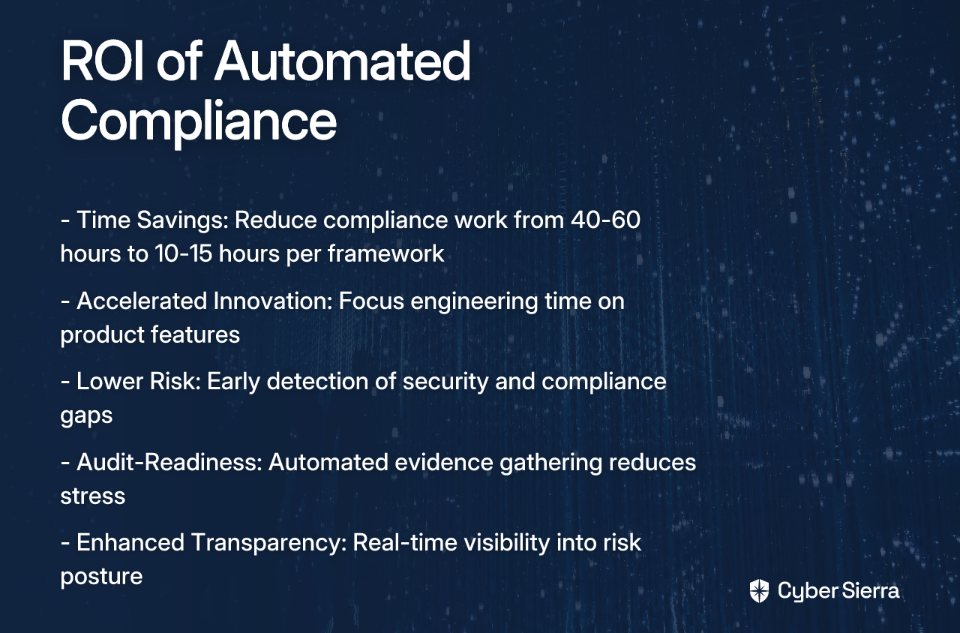
Other key benefits include:
- Accelerated Innovation: Frees up valuable engineering time to focus on product features and reliability
- Reduced Risk: Early and continuous detection of security flaws and compliance gaps
- Audit-Readiness: Automated evidence gathering makes audits faster and less stressful
- Enhanced Transparency: Provides all stakeholders with a real-time, data-driven view of the organization's risk posture
Build Resilient Systems at Speed
Embedding risk controls into CI/CD is not a barrier to speed but a fundamental enabler of it. By adopting a DevRiskOps mindset, leveraging automation with Policy as Code, and implementing Continuous Control Monitoring, teams can transform compliance from a manual, feared event into an integrated, continuous part of their workflow.
The ultimate goal is to build a development lifecycle where the secure and compliant way is also the easiest way. When that happens, compliance becomes an accelerator rather than a tax – allowing you to build resilient systems at speed while maintaining the trust of your customers and regulators.
Remember, in the modern development landscape, security and compliance aren't checkboxes – they're competitive advantages that should be woven into the fabric of your delivery pipeline from the very beginning.
Frequently Asked Questions (FAQ)
What is DevRiskOps?
DevRiskOps is an approach that integrates risk management and compliance activities directly into the DevOps lifecycle. Instead of treating compliance as a separate, manual step at the end of the process, DevRiskOps embeds automated controls and shared security responsibility throughout development, from coding to deployment and monitoring.
How can I automate compliance in my CI/CD pipeline?
You can automate compliance by implementing Policy as Code (PaC) and integrating automated security scanning tools. PaC tools like Open Policy Agent (OPA) enforce rules on infrastructure configurations, while scanners for SAST (SonarQube), SCA (Snyk), and IaC (Checkov) automatically check for vulnerabilities and misconfigurations at different pipeline stages.
Why is Continuous Control Monitoring (CCM) important if I have pipeline controls?
Continuous Control Monitoring (CCM) is crucial because it tracks your compliance posture in real-time after deployment, catching configuration drift and runtime issues that pipeline controls miss. While pipeline controls ensure compliance at deployment, CCM provides ongoing assurance that systems remain compliant in a dynamic cloud environment.
What are the first steps to embedding risk controls into a DevOps workflow?
The first step is to define your compliance and security policies as code and map specific risks to automated controls. Start by collaborating with security and compliance teams to codify a critical rule, such as preventing public S3 buckets or scanning for hardcoded secrets, and integrate that check into your CI/CD pipeline to build momentum.
How does automating compliance help with audits like SOC 2?
Automating compliance drastically simplifies SOC 2 audits by continuously and automatically collecting evidence. Instead of manually taking screenshots and gathering logs, an automated system provides auditors with a reliable, version-controlled trail proving that controls are consistently operating, which makes the audit process faster and less error-prone.
What are the biggest security risks in a CI/CD pipeline?
According to OWASP, the biggest security risks include insufficient credential hygiene (leaked secrets), dependency chain abuse (vulnerable third-party libraries), and insecure system configurations. Other major risks are inadequate identity and access management and a lack of proper logging and visibility into pipeline activities.