



Engaging Cybersecurity Awareness Programs for Employees


Join thousands of professionals and get the latest insight on Compliance & Cybersecurity.
You've just rolled out your mandatory annual security training. It's comprehensive, covers all compliance requirements, and leadership is satisfied. There's just one problem: your employees are calling it "Security Theater" behind your back, clicking through slides as fast as possible, and treating your phishing tests like a game of "gotcha" they're destined to lose.
Sound familiar? Traditional cybersecurity awareness often feels like punishment to employees – tedious modules, public shaming for failed phishing tests, and fear-based messaging that creates anxiety rather than action.
"Snarky cybersecurity folks can sometimes be their own worst enemy in this situation," noted one cybersecurity professional on Reddit. When security teams focus on catching mistakes rather than building skills, they create resentment instead of resilience.
The good news? It doesn't have to be this way. The most effective security awareness programs are those employees genuinely enjoy – where learning feels like play, mistakes are treated as growth opportunities, and security becomes a shared mission rather than a dreaded chore.
Laying the Foundation: Strategic Planning for Success
Before jumping to fun activities, successful programs start with strategic groundwork:
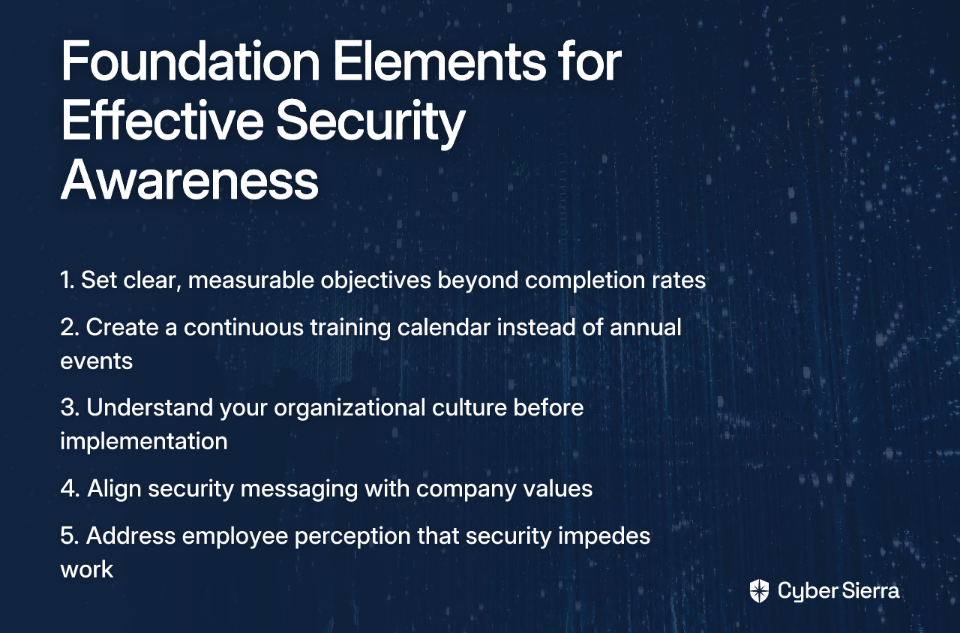
1. Plan With Clear Objectives
Begin by assessing your organization's current security posture and identifying specific behaviors you want to change. Are phishing attacks your biggest vulnerability? Password hygiene? Data handling practices?
Set measurable objectives beyond simple completion rates. According to the SANS Institute, organizations with clear training roadmaps reduce incident response times by 35% compared to those with ad-hoc approaches.
Security awareness isn't a one-time event but a continuous journey. Map out a calendar of varied activities throughout the year rather than cramming everything into a single annual training.
2. Understand Your Culture First
Before training employees, you need to understand them. Anonymous surveys can reveal how people currently perceive security initiatives and identify pain points.
Gartner reports that businesses investing in this cultural understanding see a 25% increase in participation compared to those that don't. One critical finding from such assessments is often that employees view security as something that impedes rather than enables their work.
Align your security messaging with your organization's core values and mission. If your company prides itself on innovation, frame security as enabling safe innovation rather than restricting it.
The Engagement Engine: Proven Tactics to Make Security Training Fun
Now for the heart of the matter – transforming dull compliance exercises into engaging experiences that employees actually look forward to:
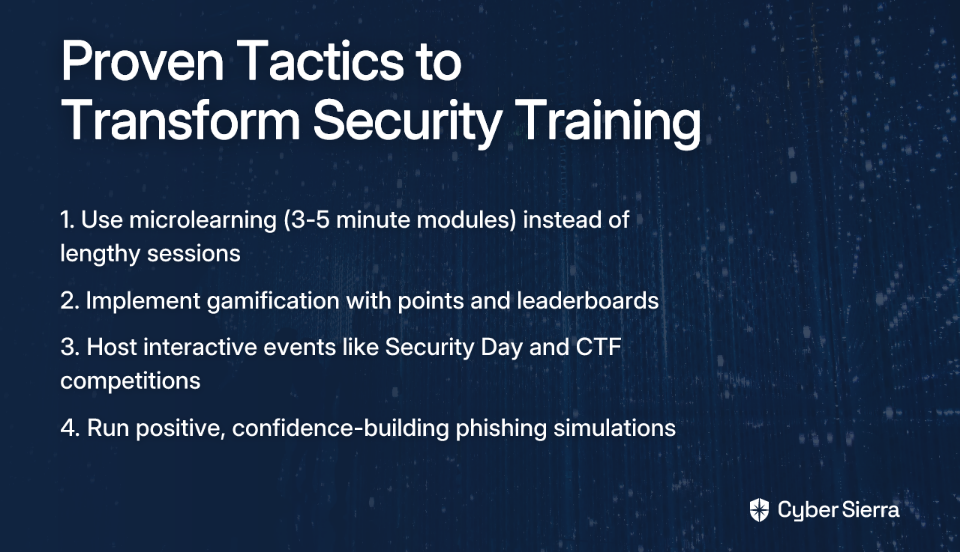
1. Embrace Microlearning
Ditch the two-hour annual training session. Research from CybSafe shows that microlearning improves knowledge retention by up to 50% compared to traditional methods.
Break content into 3-5 minute modules focused on specific threats or behaviors. These bite-sized lessons can be delivered throughout the year, reinforcing key concepts without overwhelming employees.
AwareGO offers excellent examples of engaging microlearning videos that communicate serious security concepts in relatable, often humorous ways.
2. Gamify Everything
Gamification isn't just trendy – it works. The "Super Mario Effect," as described by engineer Mark Rober in his TED Talk, shows that when failure is framed as part of the learning process rather than something to be ashamed of, people persist longer and learn more.
Leaderboards and Points: Create friendly competition by awarding points for completing training, correctly reporting phishing attempts, and other positive security behaviors. AES Corporation saw employee engagement in security training jump from 10% to 70% after implementing a gamified program, according to Hoxhunt.
Meaningful Rewards: One organization described on Reddit created a system where correctly reporting any security incident entered employees into a monthly prize draw. The winners were announced in the company newsletter, driving both participation and readership of security communications.
3. Host Creative, Hands-On Events
Some of the most memorable and effective security training happens outside traditional formats:
"Security Day": One Reddit user described transforming their company's typically boring security awareness day into an interactive event with stations demonstrating real-world attacks:
- Live demos showing how easily a USB Rubber Ducky can compromise a machine
- Phishing email analysis workshops
- Lockpicking stations to teach physical security principles
Capture the Flag (CTF) Competitions: Set up team-based cybersecurity challenges where employees compete to solve security puzzles. "Everyone got really involved and it was a great way to get them interested in cybersecurity," reported one cybersecurity professional.
Security Theater Movie Nights: Some companies have found success hosting screenings of security-themed movies or documentaries (like "The Social Dilemma") followed by guided discussions about the security principles demonstrated.
4. Run Positive Phishing Simulations
Phishing simulations are valuable, but their implementation makes all the difference. The goal isn't to trick employees but to build their detection skills and confidence.
Start with obvious phishing emails that are easy to spot, allowing employees to experience success. Gradually increase difficulty as skills improve. This approach builds confidence rather than creating anxiety.
As one consultant noted on Reddit, "The clients that go along with very easy to detect phishing emails all report employees' satisfaction, and better awareness" compared to those using difficult "gotcha" simulations.
Cultivating a Security-Positive Culture
Individual training activities only work within a supportive cultural context:

1. Create Psychological Safety
This is perhaps the most critical element of an effective security program. Employees must feel safe to report mistakes or potential incidents without fear of blame or public shaming.
Avoid toxic practices like publicly identifying employees who fail phishing tests. Instead, normalize mistakes as learning opportunities. The security team's response to an incident should be supportive and educational, not punitive.
2. Make Security Visible and Collaborative
One company described on Reddit created a creative approach to laptop security: "If you leave your laptop open, others are encouraged to message in a specific channel on Slack." This peer-based approach transformed security from a top-down mandate into a collaborative community effort.
3. Measure What Matters
Move beyond tracking completion rates to metrics that reflect actual behavior change:
- Phishing Reporting Rate: What percentage of simulated (and real) phishing emails are reported?
- Dwell Time: How quickly do employees report suspicious activities?
- Engagement Metrics: Are employees participating in voluntary security activities?
According to CISA's Cybersecurity Awareness Program, effective security is a shared responsibility. When measurements focus on collective improvement rather than individual failures, the entire organization becomes more resilient.
Your Next Steps
Building an effective security awareness program is less about technology and more about people. The goal is to transform security from a chore into a shared mission that employees actually enjoy participating in.
Start small – pick one or two engaging ideas like a simple CTF competition or a gamified reporting system. Test, learn, and expand based on what resonates with your specific culture.
Remember that the most secure organizations aren't those with the most punitive policies, but those where employees feel personally invested in protecting their shared digital environment. By making security fun, relevant, and psychologically safe, you'll build not just awareness but advocacy – and that's the true foundation of a resilient security culture.
Frequently Asked Questions
Why do traditional security awareness programs often fail?
Traditional programs often fail because they are perceived as punishment. They typically rely on fear-based messaging, tedious compliance-focused modules, and "gotcha" phishing tests that create resentment and anxiety rather than building skills. This approach makes employees disengage and view security as a chore to be avoided.
What is the most effective way to make cybersecurity training fun?
The most effective way to make cybersecurity training fun is to incorporate elements of play and competition through gamification. This involves using leaderboards, awarding points for positive security behaviors, and offering meaningful rewards. Gamification reframes learning from a chore into an engaging challenge, which significantly boosts participation and knowledge retention.
How can I create a security-positive culture in my organization?
The foundation of a security-positive culture is creating psychological safety. This means ensuring employees feel safe to report potential security incidents or mistakes without fear of blame or public shaming. When the security team responds with support and education instead of punishment, it builds trust and encourages everyone to be more vigilant.
What are some good examples of engaging security awareness activities?
Good examples of engaging activities include hands-on, interactive events. Consider hosting a "Security Day" with live hacking demos, lockpicking stations to teach physical security, and team-based "Capture the Flag" (CTF) competitions. These events make abstract security concepts tangible, memorable, and fun.
How often should employees receive security awareness training?
Security awareness training should be a continuous effort, not a single annual event. Best practices favor a microlearning approach, where short, 3-5 minute training modules are delivered throughout the year. This method reinforces key concepts regularly without overwhelming employees and leads to much better long-term knowledge retention.
How do you measure the success of a security awareness program?
Measure success by tracking behavior change, not just training completion rates. Key metrics include the phishing reporting rate (what percentage of suspicious emails are reported by employees), incident response time, and engagement levels in voluntary security activities. These metrics provide a clear picture of your program's impact on the organization's actual security posture.
For more ideas and resources, sign up for the CISA Community Bulletin or explore gamification strategies from providers like AwareGO.
