What to Look for in an Enterprise IRM Platform


Join thousands of professionals and get the latest insight on Compliance & Cybersecurity.
Summary
- Integrated Risk Management (IRM) platforms are essential for moving beyond basic compliance to strategically manage modern cyber threats, complex regulations, and supply chain risks.
- Key features to look for include multi-framework governance, dynamic risk assessment, integrated third-party risk management (TPRM), and continuous control monitoring (CCM).
- The right platform automates manual tasks and uses AI to shift your security posture from reactive, periodic checks to proactive, real-time risk management.
- Cyber Sierra’s AI-enabled GRC platform unifies these capabilities, providing a single source of truth to automate compliance and proactively manage risk.
You've been there—stuck with enterprise risk software that promised the world but delivered a digital nightmare. The features were sparse (despite being specified in scope statements), bugs were constant, and the vendor's "maintenance" costs added insult to injury.
The stakes are too high to make the wrong choice. As cyber threats multiply, regulations tighten (GDPR, HIPAA, PCI DSS), and supply chains grow more complex, organizations need more than just a basic GRC tool. You need a comprehensive Integrated Risk Management (IRM) platform that breaks down departmental silos and provides a unified view of risk across your enterprise.
As defined by industry experts, IRM is a "continuous process incorporating a risk-aware culture and technologies across an organization to enhance security through governance, risk management, and compliance" (Panorays). Unlike traditional GRC approaches, IRM moves beyond simple compliance to enable strategic, data-driven risk decisions.
This guide serves as your comprehensive checklist of essential capabilities to look for in an enterprise IRM platform—helping you save time, money, and future headaches.
The Foundation: Core Capabilities of a Modern IRM Platform
Comprehensive Governance and Compliance Management
A robust IRM platform must manage multiple compliance frameworks simultaneously from a single, unified interface. Look for a solution that can handle:
- Multi-framework support for standards like SOC2, ISO 27001, GDPR, HIPAA, PCI DSS, and others relevant to your industry (ZenGRC)
- Automated policy lifecycle management from creation and distribution to tracking and updates (ServiceNow)
- Detailed audit trails and comprehensive report generation to simplify the audit process
- Control mapping capabilities that show how a single control can satisfy multiple framework requirements
Cyber Sierra's GRC module excels in this area, automating data collection and reporting across multiple frameworks while reducing compliance fatigue—making your organization perpetually audit-ready.
Dynamic Risk Assessment and Management
The heart of any IRM platform is its ability to identify, assess, and prioritize risks in real-time. Essential features include:
- Customizable risk assessment methodologies that align with your organization's risk appetite and industry standards
- Business impact analysis tools to understand the potential consequences of various risks and inform response strategies (ServiceNow)
- Flexible risk matrices that can be tailored to different departments or risk categories
- Automated risk scoring based on multiple factors including threat intelligence, vulnerability data, and business context
This capability directly addresses a common pain point: understanding "what features are essential in the incident response process, up to risk mapping and monitoring."
Integrated Third-Party Risk Management (TPRM)
With supply chain attacks on the rise, your IRM platform must systematically assess and mitigate risks posed by third-party vendors. Look for:
- Automated vendor assessment capabilities including questionnaire distribution and analysis
- Risk-based prioritization of vendors based on access levels, data handling, and criticality to operations
- Continuous monitoring of vendor security postures rather than point-in-time assessments
- Integration with external threat intelligence to identify emerging vendor risks
Cyber Sierra's TPRM module stands out by providing 24/7 visibility into vendor compliance, moving beyond static questionnaires to deliver proactive insights into supply chain risks.
Seamless Integration and Scalability
An effective IRM platform must integrate with your existing IT and security infrastructure. This addresses the essential requirement that "IT makes sure it integrates well into the existing and planned IT portfolio." Key integration points include:
- SIEM systems for security event correlation
- Identity management solutions for access control
- IT service management platforms for workflow orchestration
- Asset management databases for comprehensive visibility
- Business intelligence tools for enhanced reporting
Additionally, ensure the platform is built to scale, accommodating increased data volume and complexity as your organization grows (ZenGRC).
Actionable Dashboards and Reporting
What good is collecting risk data if you can't make sense of it? Your IRM platform should feature:
- Intuitive dashboards providing real-time visibility into your organization's risk and compliance posture
- Configurable views for different stakeholders (executive-level overviews for the C-suite, detailed operational views for risk managers)
- Performance analytics for anticipating trends and improving resource allocation (ServiceNow)
- Automated reporting capabilities that generate board-ready materials and regulatory documentation
These features align with Gartner's IRM attribute of "Communication & Reporting" which establishes clear channels regarding risk impacts across the organization (Panorays).
From Reactive to Proactive: The Power of Continuous Monitoring and Automation
Continuous Control Monitoring (CCM)
Traditional GRC approaches rely on periodic, point-in-time assessments that create dangerous visibility gaps. Modern IRM platforms leverage CCM to provide real-time assurance that controls are functioning effectively.
According to MetricStream, "CCM enables real-time alerts and quicker remediation by continuously verifying the effectiveness of financial, technological, and internal controls." (MetricStream)
A robust CCM implementation should follow these key steps:
- Identify Key Controls: Use industry frameworks like COSO or COBIT 5 to identify critical controls for monitoring.
- Define Control Objectives: Establish clear goals for what controls should achieve.
- Implement Automated Testing: Develop automated tests or metrics to monitor controls.
- Create Management Processes: Outline procedures for managing alerts and incidents.
Cyber Sierra's Continuous Control Monitoring (CCM) module excels in this area, building a central controls repository with near real-time updates and automated control testing. This transforms security from a series of periodic checks into a continuous, proactive process.
Automation and AI-Powered Insights
The volume and complexity of risk data have outpaced human capacity to process it manually. An effective IRM platform must leverage automation to:
- Reduce manual, tedious GRC processes like evidence collection and report generation
- Streamline workflows for incident response, compliance verification, and risk assessment
- Free up teams to focus on high-value strategic tasks rather than administrative burden
Leading platforms are now incorporating AI and predictive analytics to enhance risk management through:
- Pattern recognition to identify emerging risks before they materialize
- Predictive risk scoring based on historical and environmental data
- Automated remediation recommendations tailored to your organization's context
- Natural language processing to analyze policies, controls, and compliance requirements
Beyond the Spec Sheet: Evaluating the Vendor and Long-Term Partnership
User Experience (UX) and Adoption
A powerful platform is useless if it's too complex for your team to use effectively. Evaluate the platform's user interface with these questions:
- Is it intuitive enough for users with varying technical expertise?
- Does it require extensive training, or can users become productive quickly?
- Does it support role-based views and access controls?
- Can workflows be customized to match your organization's processes?
As ZenGRC notes, "User adoption is the most critical success factor for any IRM implementation."
Customer Support and Training
This point directly addresses the pain of dealing with buggy software and high vendor maintenance costs. Before committing, evaluate:
- The vendor's support model (dedicated account manager vs. general helpdesk)
- Available training resources (documentation, videos, live sessions)
- The community of users (forums, user groups, conferences)
- Support SLAs and escalation processes
Additional Integrated Capabilities
Consider platforms that offer a broader suite of tools that contribute to a holistic risk management program. A unified platform can provide additional value beyond core IRM functions.
For example, Cyber Sierra integrates core IRM functions with:
- Threat Intelligence for comprehensive attack surface management
- Employee Security Training to strengthen the human firewall through interactive training and phishing simulations
- Cyber Insurance guidance to ensure proper coverage and streamline the application process
This creates a cohesive security ecosystem rather than forcing you to juggle disconnected point solutions.
Making the Right Choice: Your IRM Selection Checklist
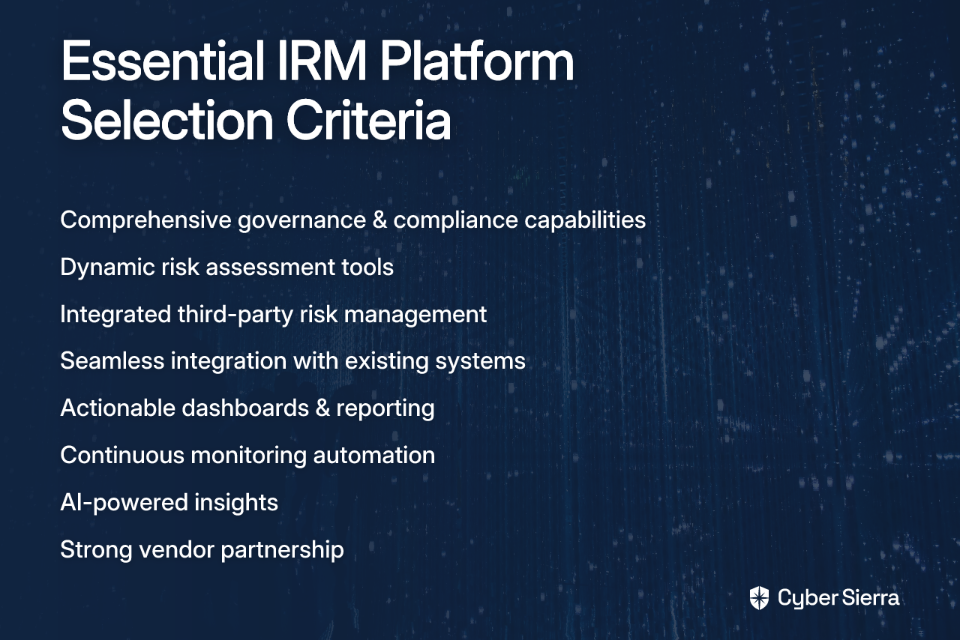
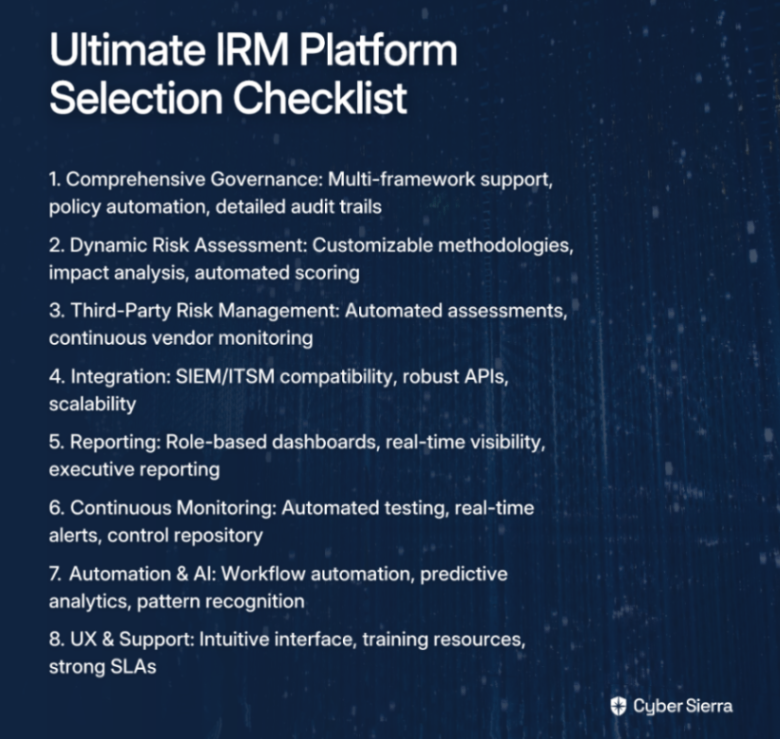
When evaluating enterprise IRM platforms, use this condensed checklist to ensure you're covering all critical bases:
Conclusion
Selecting the right IRM platform is more than a procurement decision—it's a strategic investment in organizational resilience. The wrong choice can lead to wasted resources, unmanaged risks, and compliance gaps, while the right platform transforms how your organization perceives and manages risk.
By focusing on comprehensive governance, dynamic risk assessment, third-party risk management, and continuous monitoring, you can select a platform that delivers lasting value. The ideal solution should reduce manual effort through automation, provide actionable intelligence through advanced analytics, and scale with your organization's evolving needs.
Today's most effective platforms move beyond traditional GRC to provide a unified, real-time view of your risk landscape. AI-enabled platforms like Cyber Sierra are built to provide this single source of truth, integrating GRC, continuous monitoring, and vendor risk management to move your organization from a reactive stance to proactive, intelligent risk management.
Remember that the ultimate goal isn't just compliance or risk mitigation—it's building a risk-aware culture where informed decisions drive business value and operational resilience. The right IRM platform should be your partner in this journey, not just another tool in your technology stack.
Frequently Asked Questions
What is the difference between GRC and IRM?
Integrated Risk Management (IRM) is an evolution of traditional Governance, Risk, and Compliance (GRC). While GRC often focuses on siloed compliance and audit activities, IRM provides a holistic, real-time view of risk across the entire organization, integrating various risk functions to enable strategic, data-driven decision-making.
Why is Integrated Third-Party Risk Management (TPRM) a critical IRM feature?
Integrated TPRM is critical because supply chain and third-party vendor breaches are a primary source of cyber attacks. An effective IRM platform moves beyond static questionnaires to provide continuous monitoring of vendor security postures, helping you proactively identify and mitigate risks posed by partners, suppliers, and contractors who have access to your data or systems.
How does an IRM platform simplify compliance and audits?
An IRM platform simplifies compliance and audits by automating data collection, mapping controls across multiple regulatory frameworks (like SOC2, ISO 27001, and GDPR), and maintaining detailed audit trails. This reduces manual effort, minimizes compliance fatigue, and ensures your organization is perpetually audit-ready with comprehensive, easily generated reports.
What are the key benefits of continuous control monitoring (CCM)?
The key benefit of Continuous Control Monitoring (CCM) is that it transforms security from periodic checks into a proactive, real-time process. Instead of relying on point-in-time assessments, CCM continuously verifies that security controls are functioning effectively, providing instant alerts on deviations and allowing for quicker remediation before a gap can be exploited.
How does an IRM platform integrate with other systems?
A modern IRM platform is designed to integrate seamlessly with your existing IT and security infrastructure. This is typically done through robust APIs that connect to systems like your SIEM for event correlation, identity management solutions for access control, ITSM platforms for workflows, and asset databases for a complete view of your environment. This integration breaks down data silos and enriches your risk analysis.
What should I look for in an IRM vendor beyond the platform's features?
Beyond features, you should evaluate the vendor as a long-term partner. Key factors include the platform's user experience (UX) and ease of adoption, the quality and responsiveness of their customer support, available training resources, and a clear product roadmap. A strong vendor partnership ensures you get maximum value from your investment over time.