



How to Escape GRC Hell Without Starting Over



Join thousands of professionals and get the latest insight on Compliance & Cybersecurity.
You dread Mondays. Your days are filled with endless documentation, checklists, and compliance frameworks that make you question your life choices. The weekend can't come fast enough, and when Sunday evening rolls around, that familiar knot of anxiety returns to your stomach.
Sound familiar? You're stuck in GRC Hell.
"I'm not learning anything new and feel stuck/stagnant. I WANT OUT!" This sentiment, echoed across forums by frustrated GRC professionals, captures the quiet desperation of those trapped in governance, risk, and compliance roles that have become soul-crushing rather than fulfilling.
But here's the good news: You don't have to start your career over to escape. The technical cybersecurity role you crave is more accessible than you think, and your GRC background isn't a liability—it's your secret weapon.
Why Your GRC Background is Actually a Superpower
First, let's acknowledge the reality: GRC work can feel disconnected from the "real action" of cybersecurity. While your technical colleagues are hunting threats and battling attackers, you're updating spreadsheets and preparing for audits.
According to AWS, GRC is a structured approach that aligns IT with business objectives while effectively managing risk and meeting compliance requirements. It breaks down into:
- Governance: The policies and frameworks guiding your organization
- Risk Management: Identifying and mitigating financial, legal, and security risks
- Compliance: Ensuring adherence to regulations like HIPAA, PCI-DSS, or GDPR
Here's what most people miss: While technical teams know how to implement controls, you understand why they're necessary from business, risk, and legal perspectives. This comprehensive viewpoint gives you a strategic advantage that purely technical professionals often lack.
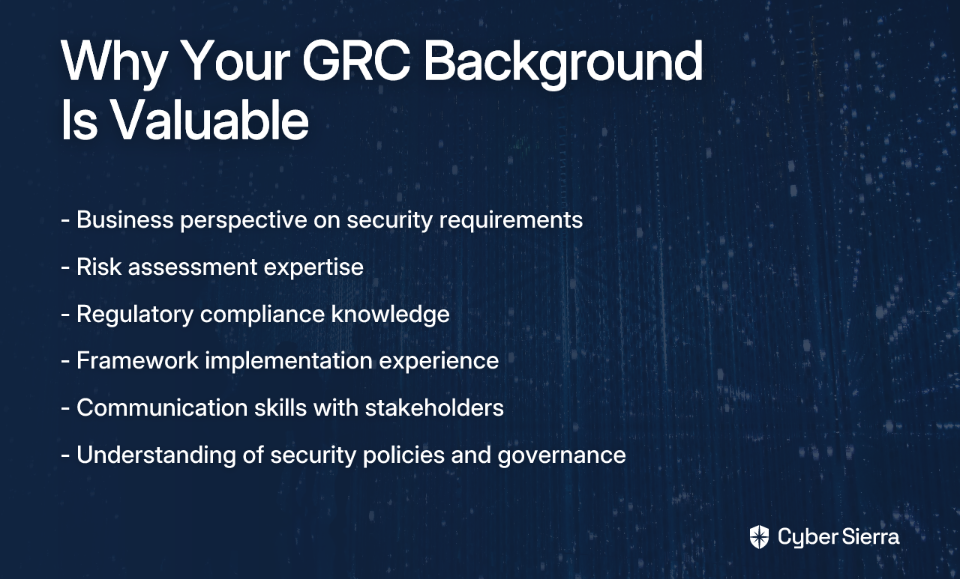
In other words, you already speak the language of the business. Now you just need to add some technical fluency.
Your Four-Step Escape Plan to a Technical Role
Step 1: Leverage Your GRC Knowledge for a SOC Role
The Security Operations Center (SOC) is often the perfect bridge from GRC to technical work. Why? Because your existing knowledge directly translates:
- Your Risk Management expertise helps prioritize alerts. That malware alert on the CEO's laptop? You instinctively understand why it's more critical than one on an isolated test server.
- Your Compliance knowledge of NIST frameworks explains why certain logs must be monitored and how incidents must be handled and reported.
- Your Governance background helps you understand the policies behind firewall rules and access controls.
Start by reframing your resume to highlight these transferable skills:
Instead of: "Managed compliance documentation for NIST 800-53." Write: "Analyzed system security controls against the NIST 800-53 framework to identify critical vulnerabilities and recommend risk mitigation strategies for incident response teams."
This simple reframing demonstrates how your GRC experience directly applies to SOC and other technical cybersecurity roles.

Step 2: Get Your Hands Dirty: Build a Career-Changing Homelab
The biggest objection hiring managers have about GRC professionals transitioning to technical roles is the lack of hands-on experience. A homelab solves this problem entirely.
Here's how to build a basic but impressive cybersecurity homelab:
Hardware Requirements:
- Virtualization Software: VMWare Workstation 17 Pro (or VirtualBox)
- Host Machine Specs: 32 GB RAM, 6-core processor, and at least 270 GB of free disk space
Virtual Network Setup:
- In VMWare, go to
Edit > Virtual Network Editor - Create a "Host-Only" network adapter for an isolated lab environment
- Configure it with IP Address
172.16.1.2and Subnet Mask255.255.255.0
Core Software Components (The "Four Horsemen" of Your Lab):
- Firewall (pfSense): Download Community Edition 2.7.0. This will be your virtual network's router and firewall.
- SIEM/IDS (Security Onion): Download version 2.4.10. This is your all-in-one platform for threat hunting, log analysis, and intrusion detection.
- Attacker Machine (Kali Linux): Download the latest installer. This VM contains hundreds of tools for penetration testing.
- Vulnerable Target (Metasploitable2): A deliberately insecure Linux VM for you to practice attacking legally. Download here.
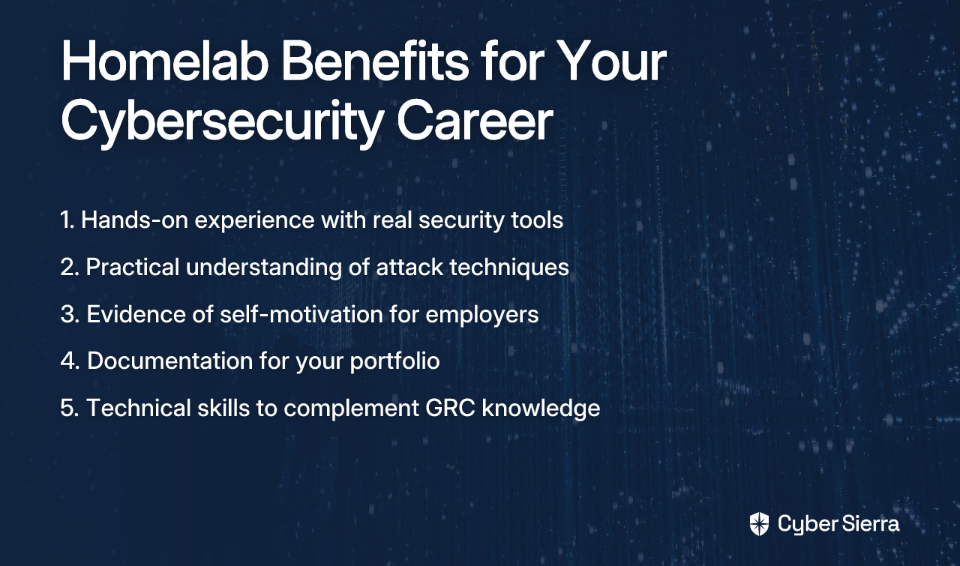
Your First Project: Install and configure all four VMs on your host-only network. Use Kali to launch a basic attack against Metasploitable2. Then, log into Security Onion and find the alerts generated by your attack. Document this process with screenshots—you now have hands-on experience with SIEM and IDS tools to add to your resume.
This practical experience is invaluable when applying for SOC, Incident Response, or Vulnerability Management positions.
Step 3: Certify Your Ambition: Strategic Certifications for the Pivot
Certifications are your signal to employers that you're serious about this transition. With cybersecurity jobs projected to grow by 33% between 2023 and 2033, the right certifications make you highly competitive.
Based on successful transitions from GRC to technical roles, focus on this powerful trio:
- CompTIA Security+:
- Level: Foundational (but non-negotiable)
- Why: It's the universal language of security and gets you past HR filters
- Cost: ~$425
- Potential Roles: Security Engineer ($157,496), IT Auditor ($89,468)
- CompTIA CySA+ (Cybersecurity Analyst):
- Level: Intermediate
- Why: Tailor-made for SOC roles, covering threat and vulnerability management, cyber incident response, and security analytics
- Directly aligns with your goal of transitioning to a SOC position
- Certified Ethical Hacker (CEH):
- Level: Intermediate
- Why: Teaches you to think like an attacker—essential for any defensive role
- Cost: $950-$1,199
- Requirements: Two years of infosec work experience (your GRC job counts!) or official training
- Potential Role: PenTest specialist ($137,195)
Note: Park advanced certs like CISSP or CISA for now. They're more aligned with senior GRC/audit/management roles, not your goal of hands-on technical work.
Step 4: Network Intelligently: The Internal Transfer Strategy
The path of least resistance is often within your own company. Your GRC role gives you legitimate access to technical teams—use it strategically.
Actionable Steps for Internal Networking:
- Identify Key People: Find the managers of the SOC, Incident Response, or Vulnerability Management teams.
- Use Your GRC Role as a Bridge: Schedule a meeting with a technical manager, framing it as a GRC inquiry: "Hi, I'm on the GRC team, and I'm assessing the risks associated with our web applications. I'd love to spend 15 minutes understanding how your team monitors for threats against them to make my report more accurate."
- Show, Don't Just Tell: During the conversation, express your passion for the technical side. Mention you're studying for the CySA+ and have built a homelab with Security Onion to understand their world better.
- Ask for an Opportunity: Inquire about shadowing an analyst for an hour or helping with low-priority ticket analysis. This makes you a known quantity when a position opens up.
As one cybersecurity professional advised on Reddit, "Find a mentor. Find a local user group or two and develop your professional network." This strategy works because it leverages relationships rather than formal applications.
Confronting the Fears: Pay Cuts, Burnout, and Starting Over
Let's address the common fears that might be holding you back:
Fear #1: "I'll have to take a huge pay cut."
This fear is valid, but an internal lateral move may involve no pay cut at all. For external moves, your GRC background + new certs + homelab experience position you above a true entry-level candidate. The long-term earning potential in technical roles like Security Engineer ($157k+) or Pen Tester ($137k+) often surpasses GRC salaries.
Fear #2: "SOC is just another form of hell with high burnout."
This is a legitimate concern. As one cybersecurity veteran with 10 years in SOC/DFIR noted, he was "plagued with mental health issues" due to the toll of the work.
The solution is to be selective. Vet potential employers carefully. Ask about analyst-to-endpoint ratios, on-call schedules, and turnover rates during interviews. Remember, "technical role" doesn't just mean SOC. Vulnerability management, threat intelligence, and application security often offer better work-life balance.
Fear #3: "I'm starting from scratch."
This is the biggest misconception. You are not starting over. Your GRC foundation provides business and risk context that takes purely technical people years to learn. You are pivoting and adding technical skills to an already valuable professional profile.
You're Not Starting Over, You're Leveling Up
The feeling of being trapped in GRC isn't a sign that you've made a career mistake—it's evidence that you're ready for growth.
By following this plan—leveraging your GRC knowledge, building a homelab, earning targeted certifications, and networking strategically—you're not escaping a bad situation; you're strategically advancing your career to become a more well-rounded, valuable, and fulfilled cybersecurity professional.
Your compliance knowledge, risk assessment skills, and understanding of regulatory frameworks are assets that will serve you well in any technical role, from SOC analyst to incident responder. Combined with your new technical skills, they make you not just a candidate but a standout in the cybersecurity field.
The path out of GRC Hell doesn't require starting over. It just requires a strategic pivot—one that you're now equipped to make.

Frequently Asked Questions
What is the best first technical role for someone in GRC?
The best first technical role for a GRC professional is often a Security Operations Center (SOC) Analyst. This role is an ideal bridge because your GRC skills in risk management and compliance translate directly to prioritizing security alerts and understanding incident response procedures. For example, your knowledge of NIST frameworks helps you understand why certain logs are monitored, giving you a head start over purely technical beginners.
How can I get hands-on cybersecurity experience without a technical job?
You can get hands-on cybersecurity experience by building a personal homelab. A homelab is a safe, isolated environment where you can practice real-world technical skills. A powerful setup includes virtualization software (like VMWare or VirtualBox) running a firewall (pfSense), a SIEM/IDS (Security Onion), an attacker machine (Kali Linux), and a vulnerable target (Metasploitable2). This allows you to launch, detect, and analyze cyberattacks, providing concrete experience for your resume.
What certifications are best for moving from GRC to a technical role?
The best certifications for transitioning from GRC to a hands-on role are CompTIA Security+, CompTIA CySA+, and Certified Ethical Hacker (CEH). Security+ provides the foundational knowledge, CySA+ is specifically designed for analyst roles and threat management, and CEH teaches you to think like an attacker, which is crucial for any defensive position. It's wise to focus on these before pursuing senior-level certs like CISSP, which are more aligned with management.
Why is a GRC background valuable for a technical cybersecurity role?
A GRC background is extremely valuable because it provides the business and risk context that purely technical professionals often lack. While technical teams know how to implement security controls, your GRC experience helps you understand why they are necessary from a business, legal, and regulatory standpoint. This strategic viewpoint allows you to better prioritize threats, communicate with stakeholders, and align security efforts with business objectives.
Do I need to take a pay cut to switch from GRC to a technical role?
Not necessarily. While it's a common fear, you may not have to take a pay cut, especially if you make a lateral move within your current company. For external roles, your unique blend of GRC experience, new certifications, and homelab projects positions you above a standard entry-level candidate. Furthermore, the long-term earning potential in technical roles like Security Engineer or Penetration Tester often exceeds that of many GRC positions.
How do I transition within my current company from GRC to a technical team?
To transition internally, leverage your current GRC role to build relationships with technical teams. You can schedule meetings with managers of the SOC or incident response teams under the pretext of a GRC inquiry, such as understanding their processes to improve a risk assessment. During these conversations, express your passion for their work, mention your homelab projects and certifications, and ask for opportunities to shadow an analyst or assist with low-priority tasks.
