10 Essential Tools Every Modern CISO Needs in Their Security Stack


Join thousands of professionals and get the latest insight on Compliance & Cybersecurity.
Summary
- Modern security teams often manage over 80 different security tools, which creates operational inefficiency and critical security gaps.
- To shift from reactive firefighting to strategic leadership, CISOs must build a cohesive program around 10 essential security categories.
- A unified platform approach reduces incident response times and delivers a significantly higher ROI compared to managing multiple disconnected point solutions.
- Consolidating core functions like GRC, continuous monitoring, and vendor risk management on a single platform like Cyber Sierra provides the visibility and automation to build a modern, proactive security program.
You've set up countless security tools across your organization. Yet, juggling "83 different security solutions from 29 vendors" still feels overwhelming. You're tired of the endless spreadsheet collaboration ("Joe, I need the Tech Review sheet when you're done"), the disjointed systems, and the nagging feeling that despite all this technology, critical security gaps remain.
Sound familiar?
Today's Chief Information Security Officers (CISOs) face unprecedented challenges. The role has evolved from purely technical gatekeeper to strategic business leader, with responsibilities spanning regulatory compliance, vendor management, board reporting, and protecting against increasingly sophisticated threats.
Yet many security leaders find themselves trapped in tactical firefighting mode, unable to elevate to the strategic level their organizations desperately need. The culprit? An ineffective, fragmented security technology stack.
This article outlines the 10 essential security tool categories that every modern CISO needs to build a cohesive, effective security program that enhances business resilience rather than hindering it.
1. Integrated Governance, Risk, and Compliance (GRC) Platform
The foundation of any effective security program is visibility and governance. Before investing in specialized security tools, CISOs need a centralized command center that provides a single source of truth for the organization's security posture.
Traditional GRC—managed via spreadsheets, SharePoint, and "copies of emails with the word 'APPROVED' in the body"—is a recipe for audit fatigue and strategic blindness. An integrated GRC platform automates and unifies risk management, compliance adherence, and governance processes.
Cyber Sierra's platform offers a comprehensive GRC solution that automates data collection, risk assessments, and reporting for frameworks like SOC2, ISO 27001, HIPAA, and GDPR. It eliminates manual work and consolidates critical security functions, moving security from periodic, manual checks to proactive, near real-time risk management.
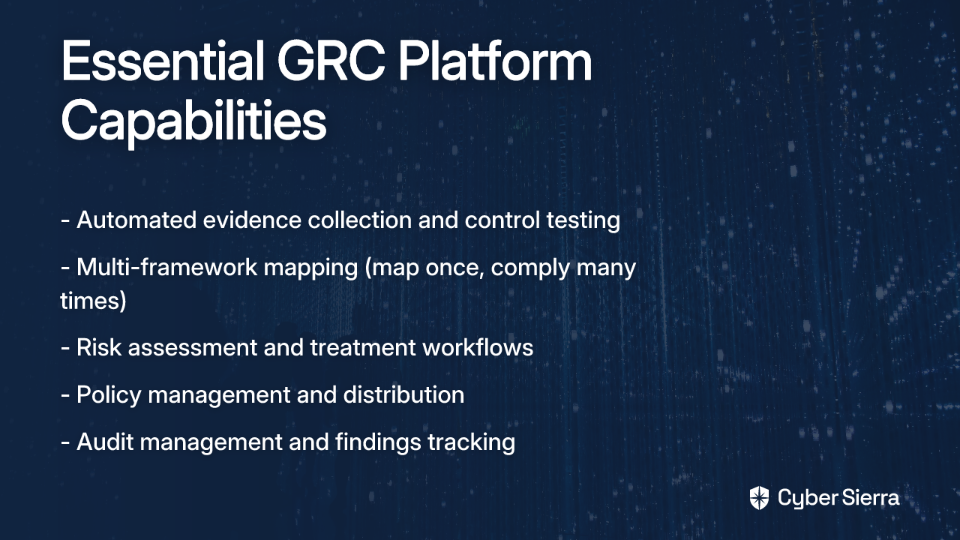
Key capabilities to look for in a GRC platform:
- Automated evidence collection and control testing
- Multi-framework mapping (map once, comply many times)
- Risk assessment and treatment workflows
- Policy management and distribution
- Audit management and findings tracking
2. Continuous Control Monitoring (CCM)
Periodic point-in-time assessments are no longer sufficient in today's dynamic threat environment. CCM tools provide ongoing, automated verification that security controls are functioning as intended.
"We bought a GRC tool and it didn't deliver as promised," is a common refrain among security leaders. Many tools claim continuous monitoring but deliver glorified spreadsheets with manual attestation requirements.
True CCM platforms like Cyber Sierra's CCM module build a central controls repository, detect exceptions in real-time, and eliminate the need for manual evidence gathering that plagues compliance managers.
A robust CCM solution should:
- Connect to your technology stack to automatically test controls
- Alert on control failures and deviations
- Provide real-time visibility into security posture
- Support multiple compliance frameworks
3. Third-Party Risk Management (TPRM)
Your security is only as strong as your weakest vendor. With supply chain attacks increasing, a comprehensive TPRM program is essential.
Traditional vendor assessment approaches involving spreadsheet questionnaires sent annually offer limited protection. Modern TPRM solutions streamline the entire vendor lifecycle, from onboarding to continuous monitoring.
Cyber Sierra's TPRM module simplifies vendor risk assessment with automated questionnaires and continuous monitoring, addressing the massive risk in the supply chain. This is crucial as point-in-time assessments are no longer sufficient.
Effective TPRM tools should:
- Automate vendor questionnaires and risk scoring
- Maintain a central repository of vendor documentation
- Continuously monitor vendor security posture changes
- Integrate with GRC for a unified risk view
4. Identity and Access Management (IAM)
With remote work and cloud adoption, identity has become the new perimeter. IAM tools ensure that only the right people have access to the right resources at the right time.
Key components of a robust IAM solution include:
- Multi-factor Authentication (MFA): A non-negotiable layer of defense against credential theft
- Single Sign-On (SSO): Improves user experience while centralizing access control
- Privileged Access Management (PAM): Secures and manages accounts with elevated permissions
- Identity Governance: Ensures access rights align with job responsibilities
According to IBM, 19% of all breaches start with compromised credentials. Implementing strong IAM controls is one of the most effective ways to reduce your attack surface.
5. Endpoint Detection and Response (EDR) / Extended Detection and Response (XDR)
Traditional antivirus is insufficient against today's sophisticated attacks. EDR provides deep visibility into endpoints (laptops, servers) to detect and respond to suspicious activity in real-time. XDR extends this capability across networks, cloud, and email for unified threat detection.
Modern EDR/XDR tools offer:
- Real-time monitoring of endpoint activity
- Behavioral analysis to detect unknown threats
- Automated response capabilities to contain threats
- Threat hunting features for proactive defense
The ability to quickly detect and contain endpoint threats is critical, as the average cost of a data breach increases the longer it takes to identify and contain.
6. Security Information and Event Management (SIEM)
Your security tools generate millions of alerts. A SIEM aggregates log data from across your entire IT infrastructure, analyzes it to identify potential threats, and provides a centralized dashboard for incident response.
An effective SIEM solution should:
- Collect and normalize logs from diverse sources
- Correlate events to identify potential incidents
- Provide real-time alerting on suspicious activity
- Support compliance reporting requirements
- Offer threat intelligence integration
Modern SIEM solutions increasingly incorporate security orchestration and response (SOAR) capabilities to automate incident handling workflows.
7. Vulnerability Management & Threat Intelligence
You can't protect what you don't know is vulnerable. Vulnerability management tools proactively scan your systems, network, and applications for weaknesses before attackers can exploit them.
When integrated with threat intelligence, these tools help you prioritize remediation based on actual exploitation in the wild.
Cyber Sierra's Threat Intelligence module provides a comprehensive security scorecard, vulnerability scanning, and insights to manage risk proactively, connecting vulnerabilities directly to your GRC posture.
Look for solutions that offer:
- Network and cloud infrastructure scanning
- Web application vulnerability assessment
- Prioritization based on severity and exploitability
- Integration with patch management workflow
8. Cloud Security Posture Management (CSPM)
Cloud misconfigurations are a leading cause of data breaches. CSPM tools continuously monitor cloud environments (AWS, Azure, GCP) for security policy violations and compliance risks.
Essential CSPM capabilities include:
- Continuous compliance monitoring against standards like CIS Benchmarks
- Detection of misconfigurations (e.g., public S3 buckets, open security groups)
- Automated remediation and drift prevention
- Integration with DevOps pipelines for "shift left" security
9. Employee Security Awareness Training
The "human firewall" remains one of your most vulnerable attack vectors. Phishing, social engineering, and simple human errors are responsible for a significant percentage of breaches.
Effective security awareness platforms like Cyber Sierra's Employee Security Training offer:
- Interactive training modules on topics like phishing, password hygiene, and data handling
- Simulated phishing campaigns to test and reinforce learning
- Reporting dashboards to track progress and identify high-risk users
- Just-in-time training triggered by risky behaviors
Building a security-conscious workforce is not a one-time event but an ongoing process that requires consistent reinforcement and measurement.
10. Cyber Insurance Management
Cyber insurance has evolved from a financial backstop to a critical component of risk management. Insurers now have stringent requirements for cyber hygiene, and premiums are directly tied to your security posture.
Tools that help manage this process, like Cyber Sierra's Cyber Insurance module, are invaluable for:
- Assessing coverage needs based on risk posture
- Automating the collection of evidence required by insurers
- Streamlining the application and renewal process
- Demonstrating security control effectiveness to secure better premiums
By connecting your real-time security posture (from CCM and GRC modules) directly to the insurance application process, you can demonstrate robust hygiene and potentially reduce premiums.
The Power of Platform: Moving Beyond Tool Sprawl
Remember the 83 tools and 29 vendors mentioned earlier? This isn't just a management headache; it's a security risk. Disconnected tools create data silos, increase operational costs, and slow down incident response.
According to IBM research, organizations that adopt a unified platform approach see significant advantages:
- Faster Response: Reduce time to detect incidents by 72 days and time to contain them by 84 days
- Higher ROI: Achieve an average ROI of 101%, compared to just 28% for those using a collection of point solutions
- Improved Efficiency: Break down silos, automate manual tasks, and provide a single pane of glass for a holistic view of risk
As one Reddit user lamented, "I'm convinced they are all scams and it's an entire racket. They all cost absurd amounts." This sentiment reflects the frustration many security leaders feel when investing in disjointed tools that fail to deliver on their promises.
This is why platforms like Cyber Sierra are gaining traction. By consolidating essential security functions into a single, intelligent platform, they help CISOs move from tactical firefighting to strategic security leadership.
Build Your Strategic, Unified Security Stack Today
The role of the CISO has fundamentally changed. Success is no longer measured by the number of tools deployed, but by the ability to manage risk strategically and enable the business securely.
Leaving behind the chaos of spreadsheets and disjointed systems is the first step toward becoming a truly strategic CISO. By consolidating essential functions like GRC, TPRM, and CCM into a single, intelligent platform, you can transform your security program from a reactive cost center into a proactive business enabler.
Stop wrestling with tool sprawl and audit fatigue. Discover how an AI-enabled, unified platform can give you the visibility and automation you need to build a world-class security program. See how Cyber Sierra simplifies security and compliance with a free demo.
As your organization's security leader, your technology choices determine whether you remain trapped in tactical mode or elevate to the strategic role your business needs. Choose wisely.
Frequently Asked Questions
What are the most essential security tools for a modern CISO?
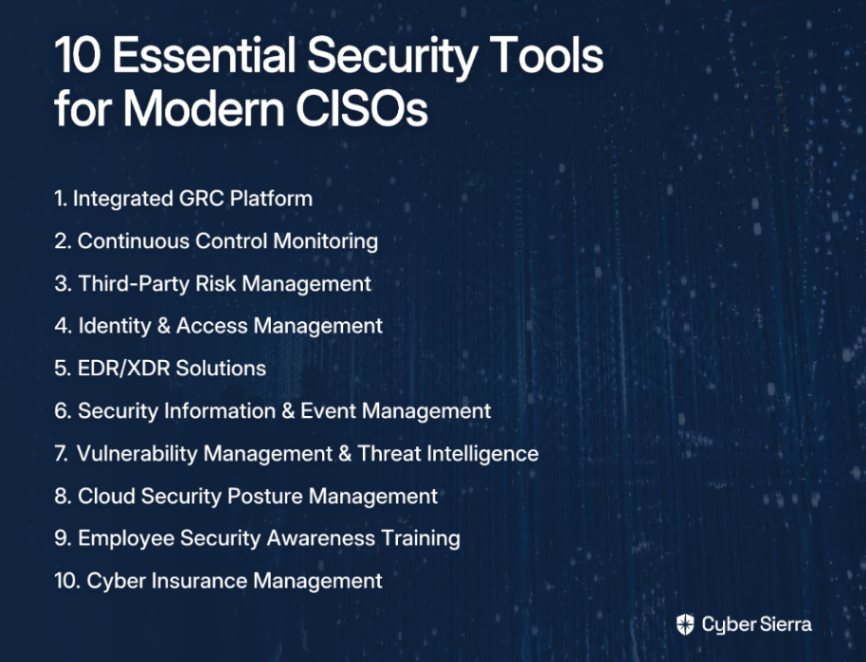
The 10 essential security tool categories for a modern CISO are: Integrated GRC, Continuous Control Monitoring, Third-Party Risk Management, IAM, EDR/XDR, SIEM, Vulnerability Management, Cloud Security Posture Management, Employee Security Training, and Cyber Insurance Management. These tools form a cohesive security program that moves beyond tactical firefighting to strategic risk management, providing visibility and control across the entire organization.
Why is an integrated GRC platform considered a foundational tool?
An integrated Governance, Risk, and Compliance (GRC) platform is foundational because it acts as a centralized command center, providing a single source of truth for an organization's entire security posture. Before deploying specialized tools, a CISO needs visibility. A GRC platform automates risk management and maps controls to multiple compliance frameworks, replacing manual spreadsheets and enabling a proactive approach to security.
How does a unified security platform help a CISO become more strategic?
A unified security platform helps a CISO become more strategic by consolidating data, automating manual tasks, and providing a holistic, real-time view of risk. This frees them from tactical firefighting to focus on business-aligned security initiatives. Instead of managing dozens of disconnected tools, a CISO can use a single platform to see the interplay between GRC, vendor risk, and control effectiveness, facilitating better board reporting and smarter resource allocation.
What is Continuous Control Monitoring (CCM) and why is it important?
Continuous Control Monitoring (CCM) is an automated process that continuously verifies that security controls are implemented and operating effectively, replacing outdated point-in-time assessments. It's critical because threats and IT environments are constantly changing. CCM provides real-time alerts on control failures, ensuring ongoing compliance and eliminating the audit fatigue associated with manual evidence gathering.
How can a CISO effectively manage third-party and supply chain risk?
A CISO can effectively manage third-party risk by implementing a modern Third-Party Risk Management (TPRM) solution that automates the entire vendor lifecycle, from onboarding and risk assessment to continuous monitoring. Traditional annual questionnaires are insufficient. An effective TPRM tool streamlines assessments, maintains a central vendor repository, and continuously monitors their security posture for a unified view of risk.
Is it better to use a single unified security platform or multiple best-of-breed tools?
For most organizations, a single unified security platform is better because it reduces complexity, breaks down data silos, and improves incident response times, leading to a higher return on investment. While best-of-breed tools may offer deep functionality in one area, managing dozens of them creates operational overhead and security gaps. Research shows that organizations with a unified approach detect and contain breaches significantly faster.