



Top 10 Continuous Controls Monitoring Tools CISOs Should Evaluate

Join thousands of professionals and get the latest insight on Compliance & Cybersecurity.
Summary
- Traditional point-in-time security audits are no longer sufficient, as they create dangerous visibility gaps where controls can fail silently between assessments.
- Continuous Controls Monitoring (CCM) offers a proactive solution by using technology to automatically and continuously verify that security controls are effective in near real-time.
- When selecting a CCM tool, prioritize features like automated evidence collection, real-time alerts, broad integrations with your tech stack, and support for multiple compliance frameworks.
- Unified platforms like Cyber Sierra’s Continuous Control Monitoring (CCM) integrate CCM with GRC and threat intelligence to automate evidence collection and ensure you're always audit-ready.
You've set up your security controls, implemented the latest frameworks, and your team is working tirelessly to maintain compliance. But when audit time comes, you're still scrambling to gather evidence, wondering if those controls have been effective all along. Or worse—you discover controls have failed silently for months, leaving your organization vulnerable.
"We had our eye on a continuous compliance/monitoring tool that works in the background without much fuss," shares a frustrated GRC professional on Reddit. "One that does checks in real time, catches issues, and just works without us having to keep an eye on it the whole time."
If this sounds familiar, you're not alone. Today's CISOs face a daunting challenge: maintaining continuous compliance across increasingly complex environments while dealing with limited resources and growing regulatory demands.
The CISO's Dilemma: Why Point-in-Time Audits Are No Longer Enough
Traditional point-in-time assessments leave dangerous gaps in your security posture. The days between audits represent an unknown risk landscape where controls can fail silently, exposures can grow undetected, and your organization remains vulnerable.
Continuous Controls Monitoring (CCM) offers a strategic shift from this reactive approach to a proactive, automated, and continuous one. CCM utilizes technology for ongoing, automated oversight of an organization's controls to ensure they're effective in mitigating risks and maintaining compliance with regulations in near real-time.
This approach has become critical because:
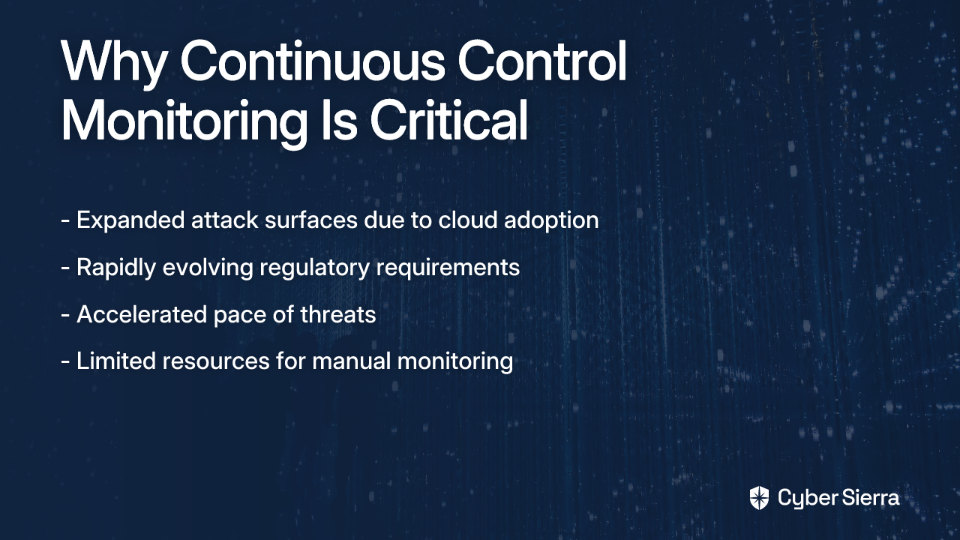
- Cloud adoption and distributed workforces have expanded attack surfaces dramatically
- Regulatory requirements continue to multiply and evolve rapidly
- The pace of threats has accelerated, requiring constant vigilance
- Resource constraints make manual monitoring impractical for most security teams
As one Reddit user with a small security team but "big infrastructure, big compliance requirements, big AWS footprint, Snowflake, etc." notes, finding the right CCM solution can be game-changing for audit readiness and overall security posture.
Top 10 Continuous Controls Monitoring (CCM) Tools for 2024
Let's examine the leading CCM solutions that should be on every CISO's evaluation shortlist:
1. Cyber Sierra
Best for: Organizations of all sizes seeking a unified, AI-enabled platform to automate and simplify their entire cybersecurity and compliance program.
Cyber Sierra stands out by offering a comprehensive cybersecurity platform that moves beyond basic CCM to integrate governance, risk, compliance, third-party risk management, and threat intelligence into a cohesive solution.
Key Features:
- Continuous Control Monitoring (CCM): Builds a central controls repository with near real-time updates from your technology stack. Provides clear visibility into security posture through continuous monitoring and delivers actionable risk intelligence across multiple compliance frameworks (NIST, ISO 27001, PCI DSS, GDPR, etc.).
- AI-Enabled Automation: Automates control testing, validation, and evidence collection, minimizing manual effort. As one user noted about similar precision in automation, "Their AI features are not flashy and they're precise, a pleasant addition."
- Integrated GRC & TPRM: Seamlessly integrates Governance, Risk & Compliance and Third-Party Risk Management to streamline audits and reduce compliance fatigue.
- Threat Intelligence & Attack Surface Management: Offers network and cloud infrastructure vulnerability scanning to proactively identify risks.
Cyber Sierra directly addresses the need for a "hands-off" solution that provides unified visibility and control while automating the tedious aspects of compliance management.
2. MetricStream
Best for: Enterprises looking to improve cloud usage and compliance through autonomous monitoring, especially with AWS.
Key Features:
- Comprehensive GRC platform focused on automated testing and monitoring
- Seamless integration with cloud environments like AWS
- Advanced reporting and risk remediation capabilities
3. Pathlock
Best for: Organizations needing to monitor financial and business process controls within transactional applications like SAP and Oracle.
Key Features:
- Specializes in risk quantification and transaction monitoring
- Manages business process controls to detect violations and prevent fraud in real-time
- Provides comprehensive coverage for ERP systems and financial applications
4. ServiceNow GRC
Best for: Organizations already invested in the ServiceNow ecosystem seeking to integrate GRC and risk processes seamlessly.
Key Features:
- Leverages the robust ServiceNow platform for automation of risk assessments
- Provides policy and compliance management integrated with IT workflows
- Offers incident response tracking within the familiar ServiceNow interface
5. Hyperproof
Best for: Teams looking for a user-friendly way to monitor critical controls across various departments and streamline the assessment process.
Key Features:
- Provides continuous monitoring capabilities with configurable frequency
- Streamlines evidence collection and assessment processes
- Offers intuitive dashboards for compliance status visibility
6. Qualys
Best for: Organizations prioritizing cloud-based security and vulnerability management alongside compliance monitoring.
Key Features:
- Well-known cloud platform providing continuous vulnerability monitoring
- Offers threat detection and automated compliance reporting
- Supports a wide range of regulations and frameworks
7. Panaseer
Best for: Security teams focused on active security posture management and gaining a data-driven view of their cyber assets.
Key Features:
- Automates security posture management by correlating data from various security tools
- Provides comprehensive cyber asset management
- Offers evidenced remediation tracking for compliance purposes
8. XM Cyber
Best for: Organizations seeking comprehensive cyber risk management with a focus on attack path analysis.
Key Features:
- Offers real-time threat detection by simulating attacks
- Provides automated remediation guidance
- Prioritizes risks based on their potential impact on critical assets
9. LogicGate
Best for: GRC teams wanting to build and automate custom compliance and risk workflows without coding.
Key Features:
- Flexible, no-code platform that allows users to create customizable workflows
- Provides real-time dashboards for risk and compliance visibility
- Offers adaptable solutions for various compliance frameworks
10. RSA Archer
Best for: Large enterprises needing a highly comprehensive and established GRC suite for end-to-end risk management.
Key Features:
- Extensive GRC platform with modules for audit management and compliance
- Includes business resiliency capabilities and vendor risk management
- Offers powerful integration capabilities and customizable dashboards
How to Choose the Right CCM Tool for Your Organization
Selecting the right CCM solution requires careful consideration of your specific needs. As one Reddit user lamented about their experience with a popular tool: "Wiz compliance is very generic... how do you fine-tune it?" To avoid this common frustration, use this checklist for evaluation:

- Automated Data Collection and Monitoring: Does the tool automatically collect evidence from your tech stack (e.g., AWS, cloud apps, security tools)? Automation is key to achieving true continuous monitoring without overwhelming your team.
- Real-Time Threat Detection & Alerting: The tool should provide immediate alerts on control failures and anomalies. One user described their ideal tool as one that "does checks in real time, catches issues and just works."
- Integration Capabilities: Ensure the solution integrates with your existing security ecosystem (SIEM, vulnerability scanners, etc.). For organizations with "big AWS footprint, Snowflake, etc.," native integrations are particularly important.
- Customization and Scalability: Can the tool be fine-tuned to your specific controls, or is it a "generic" solution? Will it scale as your organization and compliance requirements grow?
- Compliance Framework Management: Does it support the multiple frameworks you need to adhere to (SOC 2, ISO 27001, HIPAA, etc.) and simplify reporting for "audit readiness"?
- Ease of Use and Vendor Support: Is the interface intuitive? Is there strong customer support and training available to ensure a smooth implementation? As one Reddit user shared about their preferred solution: "It ended up being the most hands-off once it was set up."
- Total Cost of Ownership (TCO): Assess initial and recurring costs against the expected benefits in risk reduction and operational efficiency. This addresses common concerns about cost versus value that many security professionals express when evaluating new tools.
Beyond Monitoring: Building a Culture of Continuous Compliance
While implementing a CCM tool is crucial, truly effective security programs also require:
- Executive buy-in: Ensure leadership understands the value of continuous monitoring versus point-in-time assessments.
- Cross-functional collaboration: Break down silos between security, IT, compliance, and business units to create a unified approach to risk management.
- Ongoing training: Invest in security awareness and specialized training to build a culture where compliance is everyone's responsibility.
- Regular review and adaptation: Continuously evaluate the effectiveness of your controls and monitoring approach as threats and regulations evolve.
Conclusion
Moving from periodic audits to continuous control monitoring is no longer optional for organizations serious about cybersecurity and compliance. The right CCM tool can transform your security program from reactive to proactive, providing real-time visibility, automating tedious tasks, and helping you stay ahead of threats and regulatory requirements.
While many tools offer point solutions, a unified platform like Cyber Sierra provides a holistic view, integrating CCM with GRC, TPRM, and threat intelligence to deliver unparalleled visibility and control. This comprehensive approach addresses the fundamental challenge expressed by many security professionals: finding a solution that "works in the background without much fuss" while providing the depth and breadth of coverage required in today's complex environments.
Ready to move beyond manual checklists and achieve continuous compliance? Schedule a free demo of Cyber Sierra's Continuous Controls Monitoring platform to see how it can transform your approach to security and compliance.

Frequently Asked Questions
What is Continuous Controls Monitoring (CCM)?
Continuous Controls Monitoring (CCM) is an automated approach to cybersecurity and compliance that uses technology to continuously assess and validate the effectiveness of an organization's security controls in near real-time. Instead of relying on periodic, point-in-time audits, CCM provides ongoing visibility into your security posture, ensuring that controls are working as intended to mitigate risks and maintain compliance with regulations like SOC 2, ISO 27001, and GDPR.
Why is Continuous Controls Monitoring important for modern businesses?
Continuous Controls Monitoring is important because it closes the dangerous visibility gaps left by traditional point-in-time audits. In today's complex IT environments with widespread cloud adoption and evolving cyber threats, controls can fail silently between audits. CCM provides a proactive security model by offering real-time alerts on control failures, automating evidence collection for audits, and enabling organizations to maintain a consistent state of compliance and security readiness.
How does a CCM tool automate compliance?
A CCM tool automates compliance by integrating with your organization's technology stack (e.g., cloud providers like AWS, security tools, SaaS applications) to automatically gather evidence that security controls are in place and operating effectively. It automates tasks such as control testing, validation, and evidence collection, significantly reducing the manual effort required from security and GRC teams. This frees up resources and ensures you are always prepared for an audit.
What is the difference between CCM and SIEM?
CCM and SIEM (Security Information and Event Management) serve different but complementary purposes. A SIEM tool primarily focuses on collecting, aggregating, and analyzing log data from various sources to detect security threats and incidents in real-time. In contrast, a CCM tool focuses on validating that your security controls are correctly configured and continuously effective in meeting compliance requirements. While a SIEM is reactive to threats, a CCM is proactive in ensuring your defenses are working.
How do I choose the right CCM solution for my organization?
To choose the right CCM solution, you should evaluate several key factors based on your specific needs. Look for a tool that offers broad integration capabilities with your existing tech stack, supports the compliance frameworks you adhere to (e.g., NIST, PCI DSS), provides real-time alerting on control failures, and can scale with your organization's growth. It's also critical to consider ease of use, customization options, and the total cost of ownership to ensure the solution provides long-term value.
Can CCM tools help with specific frameworks like SOC 2 or ISO 27001?
Yes, a key benefit of modern CCM tools is their ability to help with specific compliance frameworks. Leading platforms map their automated control tests to the requirements of multiple frameworks like SOC 2, ISO 27001, PCI DSS, HIPAA, and GDPR. This simplifies audit preparation by automatically collecting the necessary evidence for each control, streamlining the reporting process, and providing auditors with a clear, consolidated view of your compliance posture.
Note: The tools mentioned in this article have been selected based on market research, user feedback, and industry analysis. Organizations should conduct their own evaluations to determine which solution best fits their specific needs and requirements.
