



How to Benchmark Your GRC Maturity Against Industry Standards


Join thousands of professionals and get the latest insight on Compliance & Cybersecurity.
Summary
- Fewer than 15% of organizations have mature Governance, Risk, and Compliance (GRC) programs, yet those that do can achieve over 200% ROI.
- A mature GRC program transforms your role from a tactical enforcer into a strategic advisor by providing data-driven insights that cut through organizational politics.
- Benchmark your GRC maturity by conducting a self-assessment, defining key metrics (KPIs & KRIs), and performing a gap analysis to create an actionable improvement roadmap.
- Accelerate your GRC maturity by leveraging automation; platforms like Cybersierra's GRC solution can automate evidence collection, streamline audits, and provide real-time visibility.
You've spent countless hours setting up policies, documenting controls, and chasing stakeholders for evidence—all while being cast as the organizational "bad guy" enforcing rules nobody seems to appreciate. The politics are exhausting, technical teams question your expertise, and sometimes you wonder if all this manual effort is actually moving the needle on your organization's security posture.
If this sounds familiar, you're not alone. The reality is that fewer than 15% of organizations worldwide have developed mature governance, risk, and compliance (GRC) capabilities. The good news? A mature GRC program can transform your role from compliance enforcer to strategic advisor—and benchmarking your current maturity is the first step toward getting there.
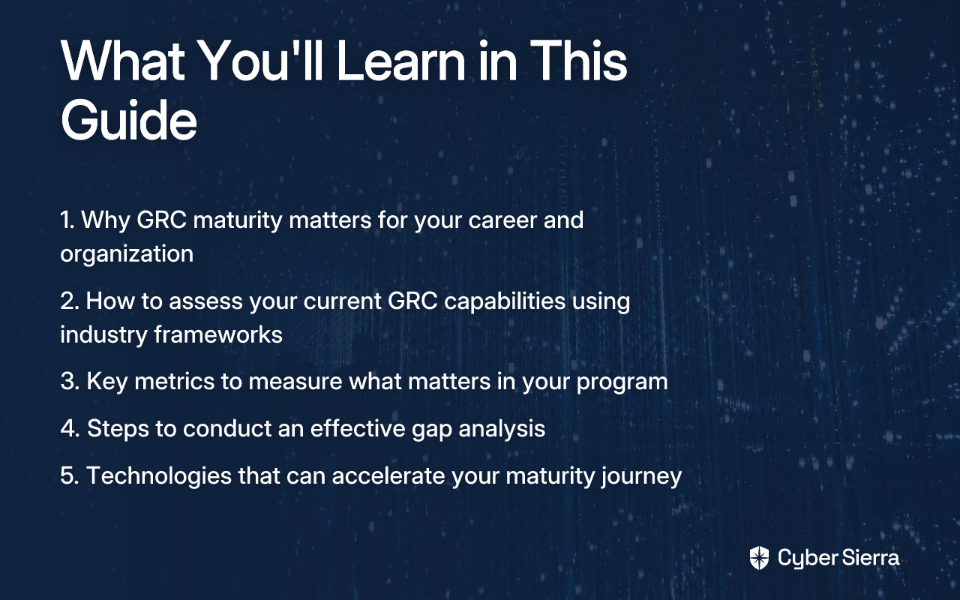
This guide will walk you through a practical, step-by-step approach to benchmarking your GRC maturity against industry standards, helping you understand where your organization stands and how to create a roadmap for improvement.
Why GRC Maturity is More Than Just a Buzzword
Before diving into benchmarking methodologies, let's be clear about why GRC maturity matters in tangible terms:
From Enforcer to Influencer
A mature GRC program shifts the conversation from enforcing rules to providing data-driven risk insights. Instead of being the person who always says "no," you become the strategic advisor who helps the organization make informed decisions based on risk data.
As one cybersecurity professional noted in a Reddit discussion, "Engineers by default think you are an idiot and you will work up from there." Mature GRC programs help bridge this gap by providing objective data rather than subjective opinions.
Cutting Through the Politics
The same discussion highlighted that "there is an obscene amount of politics that happens before they agree to fix/improve something." A mature GRC program provides objective benchmarks and metrics that can dismantle political roadblocks by clearly demonstrating risk exposure and compliance gaps.
When your recommendations are backed by standardized frameworks and quantifiable metrics, they become harder to dismiss as merely opinions or preferences.
The Financial Case for Maturity
The ROI of mature GRC is substantial:
- Integrated GRC strategies can yield over 200% ROI over five years
- Organizations lose approximately $1 trillion annually to errors and misconduct that could be prevented through mature GRC programs
- Companies adopting compliance technology save an average of $1.02 million in costs
These figures, reported by Cycore Secure, make a compelling business case for investing in GRC maturity.
Decoding GRC Maturity Models: Finding Your Place on the Map
GRC maturity models provide standardized frameworks for assessing capabilities and planning improvements. While several models exist, one widely adopted framework is the OCEG GRC Capability Model (also known as the "Red Book").
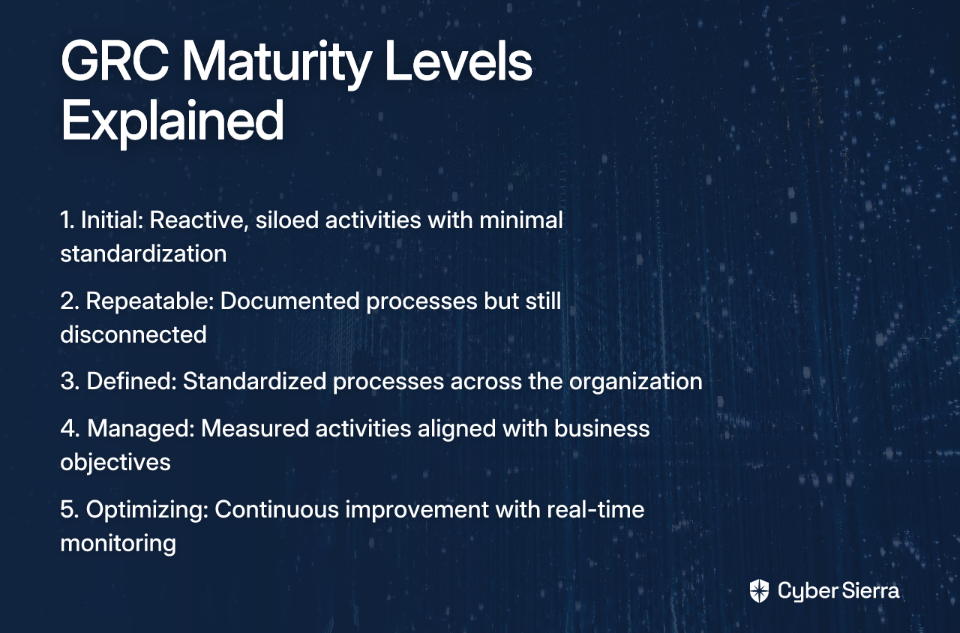
The OCEG model typically outlines five maturity levels:
- Initial (Ad hoc): GRC activities are reactive, siloed, and lack standardization
- Repeatable (Fragmented): Some processes are documented and repeatable, but remain disconnected
- Defined (Integrated): GRC processes are documented and standardized across the organization
- Managed (Aligned): GRC activities are measured, controlled, and aligned with business objectives
- Optimizing (Intelligent): Continuous improvement is embedded, with proactive risk management and real-time monitoring
Other relevant frameworks that can inform your maturity assessment include:
- NIST Cybersecurity Framework (CSF): A risk-based approach for managing cybersecurity risk that can be used to assess security program maturity (NIST)
- ISO 31000: A principles-based model for integrating risk management across the organization (ISO)
Understanding these models helps establish a common language and framework for assessing your current state and planning your maturity journey.
Your 3-Step Guide to Benchmarking GRC Maturity
Step 1: Conduct a Thorough Self-Assessment
Begin with a comprehensive evaluation of your current GRC capabilities:
Examine governance structures:
- Who are the key stakeholders in your GRC program?
- Are roles and responsibilities clearly defined and understood?
- How effective are your communication processes for risk and compliance issues?
Assess risk management processes:
- How are risks identified, categorized, and prioritized?
- Is your risk management process aligned with the organization's risk appetite?
- Do you have a formal risk register with clear ownership and remediation timelines?
Evaluate compliance management:
- Which regulations are applicable to your organization?
- Are internal policies current and aligned with external requirements?
- Are your reporting capabilities sufficient for both internal and external audits?
This assessment should involve key stakeholders from across the organization to ensure a comprehensive view of your current state.
Step 2: Utilize Metrics to Measure What Matters (KPIs & KRIs)
Effective benchmarking requires objective measurements. The key is distinguishing between Key Performance Indicators (KPIs) that measure program effectiveness and Key Risk Indicators (KRIs) that measure risk exposure.
When defining metrics, apply SMART principles (Specific, Measurable, Actionable, Relevant, Timely) and consider these examples:
KPI examples:
- Time to close audit findings
- Percentage of employees completing security training
- Number of policy exceptions granted
- Average time to respond to compliance requests
KRI examples:
- Number of high-risk vulnerabilities unpatched after 30 days
- Rate of phishing simulation failures
- Number of third parties with access to sensitive data
- Frequency of control testing failures
These metrics provide quantifiable data points for tracking progress and comparing against industry benchmarks.
Step 3: Perform a Gap Analysis
With your assessment complete and metrics established, the next step is identifying gaps between your current state and desired maturity level:
Define the scope: Focus on specific regulations (e.g., GDPR, SOC2) or processes (e.g., vendor onboarding) rather than trying to tackle everything at once.
Collect documentation: Gather policies, procedures, risk registers, and control evidence to support your analysis.
Identify gaps: Compare your current state (from the self-assessment) against the desired future state or industry standard (from the maturity models).
Create a focused action plan: Prioritize high-risk areas first to deliver the most impact. Break down the plan into manageable phases with clear ownership and timelines.

Accelerating Maturity with Automation and AI
One of the most significant pain points in GRC is the manual nature of many processes. As one professional put it in a Reddit thread, "Some people really like excel forms"—but most don't.
Modern GRC maturity increasingly depends on leveraging automation and AI to move beyond periodic, manual checks to continuous, real-time monitoring. 62% of organizations report improved compliance efficiency with AI-enhanced GRC processes.
Key technologies driving GRC maturity include:
Continuous Control Monitoring (CCM)
CCM provides real-time visibility into security controls, detecting gaps automatically instead of relying on point-in-time assessments. Gartner predicts that by 2025, over 50% of major enterprises will use AI for this purpose.
Platforms like Cyber Sierra's Continuous Control Monitoring (CCM) module centralize controls, automate testing, and provide a single source of truth, drastically reducing manual evidence gathering for audits. This moves security from periodic, manual checks to continuous, automated verification—a hallmark of mature GRC programs.
Integrated GRC Platforms
Managing multiple compliance frameworks (SOC2, ISO 27001, HIPAA, etc.) manually is inefficient and error-prone. Modern GRC platforms automate data collection, risk assessments, and reporting across frameworks.
An integrated solution, such as Cyber Sierra's GRC platform, can streamline these complex requirements, making your organization audit-ready and reducing compliance fatigue. The platform automatically maps controls across frameworks, eliminating redundant work and providing a unified view of your compliance posture.
Intelligent Third-Party Risk Management (TPRM)
Third-party risk is a significant concern for many organizations. As one cybersecurity professional noted, "you can't trust the third party didn't just lie" during assessments. AI-driven TPRM automates vendor assessments and provides continuous monitoring of vendor security posture.
Cyber Sierra's TPRM module simplifies this entire lifecycle, from onboarding to continuous monitoring, ensuring your supply chain doesn't become your biggest vulnerability. The platform automates questionnaire processes, prioritizes vendors based on risk, and provides near real-time visibility into vendor compliance.
From Assessment to Action: Building Your GRC Improvement Roadmap
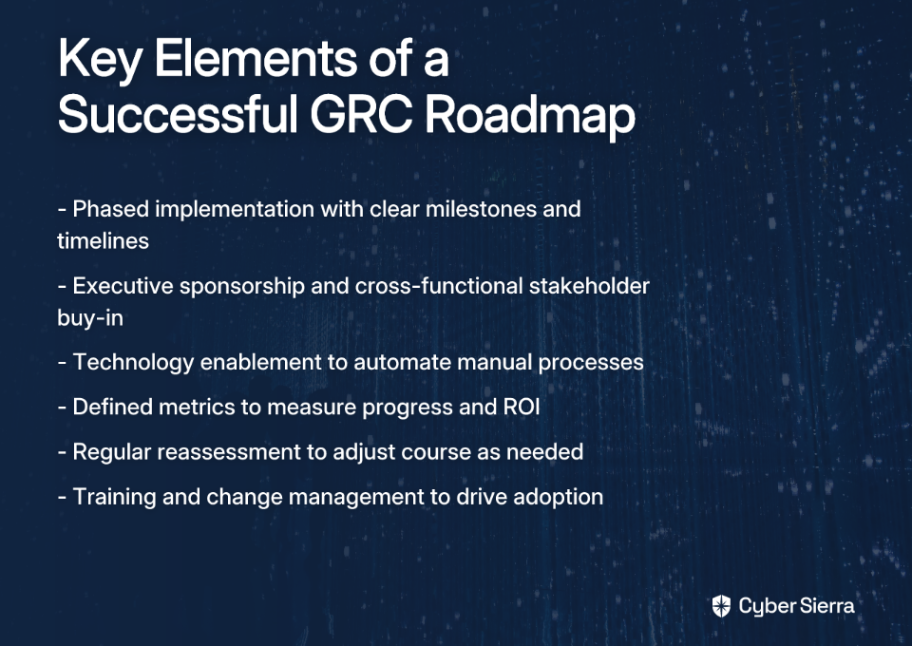
Benchmarking is only valuable if it leads to actionable improvements. Here's how to translate your gap analysis into a concrete plan:
Set Actionable Goals
Use your assessment results to define clear, prioritized objectives. For example:
- Implement automated control testing for critical systems within six months
- Establish a centralized policy management system by Q3
- Reduce the time to close high-risk audit findings by 50%
Foster Cross-Functional Buy-In
GRC is a team sport. Share your data and plan with leadership and other departments to align resources and priorities. This directly tackles the "politics" that often delay improvements.
Present your benchmark findings to executives in terms of business risk and opportunity, not just technical compliance requirements. When stakeholders understand how mature GRC supports their objectives, resistance decreases.
Prioritize High-Impact Projects
Focus on quick wins that address critical risks or deliver immediate efficiency gains. This builds momentum and demonstrates value early in your maturity journey.
For example, automating evidence collection for your most time-consuming compliance activities can quickly demonstrate ROI while building support for more extensive improvements.
Conclusion: From Benchmark to Business Advantage
Benchmarking your GRC maturity is not a one-time project but a continuous cycle of assessment, action, and improvement. By following the three-step process outlined here—self-assessment, metrics definition, and gap analysis—you can create a clear roadmap for advancing your program.
As you progress in your maturity journey, your role will transform from a tactical function to a strategic business enabler. Instead of being seen as the "bad guy" enforcing rules, you'll become a trusted advisor helping the organization navigate complex risk landscapes.
The most mature GRC programs leverage the right frameworks, processes, and technology to transform GRC from a burden into a competitive advantage. By benchmarking your current state and systematically closing gaps, you can join the elite 15% of organizations with truly mature GRC capabilities—and deliver significant value to your organization in the process.
Frequently Asked Questions
What is a GRC maturity model?
A GRC maturity model is a standardized framework used to assess an organization's Governance, Risk, and Compliance capabilities against a defined set of levels, from ad-hoc and reactive to fully optimized and proactive. These models, such as the OCEG GRC Capability Model, provide a clear roadmap for improvement by outlining specific characteristics for each stage of maturity. This allows organizations to benchmark their current state, identify gaps, and plan strategic enhancements to their GRC programs.
Why is improving GRC maturity important?
Improving GRC maturity is important because it transforms GRC from a cost center into a strategic business advantage, leading to better decision-making, reduced risk, and significant financial ROI. A mature GRC program helps professionals shift from being rule enforcers to strategic advisors who provide data-driven insights. It cuts through organizational politics with objective data, reduces losses from errors and misconduct, and can yield an ROI of over 200% by integrating risk management with business objectives.
How do you measure GRC maturity?
You can measure GRC maturity by conducting a three-step benchmarking process: perform a thorough self-assessment of current capabilities, define relevant metrics (KPIs and KRIs) to track performance and risk, and conduct a gap analysis against a chosen maturity model. The self-assessment involves evaluating governance structures, risk management processes, and compliance activities. Metrics should be SMART (Specific, Measurable, Actionable, Relevant, Timely) to provide objective data. The final gap analysis compares your current state to your desired future state, forming the basis of your improvement roadmap.
What are the typical levels in a GRC maturity model?
GRC maturity models typically feature five levels: Initial (ad-hoc and reactive), Repeatable (some processes are documented but siloed), Defined (standardized processes across the organization), Managed (activities are measured and aligned with business goals), and Optimizing (proactive, continuous improvement). As an organization matures, processes become more standardized, integrated, and data-driven. The highest level, Optimizing, is characterized by the use of real-time monitoring and predictive analytics to manage risk proactively.
What is the role of automation in GRC?
Automation plays a critical role in advancing GRC maturity by replacing manual, error-prone tasks with continuous, real-time monitoring and streamlined workflows, which significantly improves efficiency and provides more accurate risk insights. Technologies like Continuous Control Monitoring (CCM) automate evidence collection for audits, integrated GRC platforms centralize compliance management across multiple frameworks, and AI-driven tools enhance third-party risk management. This frees up GRC professionals to focus on strategic risk analysis rather than manual data gathering.
What is the first step to creating a GRC improvement roadmap?
The first step to creating a GRC improvement roadmap is to conduct a comprehensive self-assessment and gap analysis to clearly understand your current state and identify the specific areas that require improvement. Before you can plan your journey, you need to know your starting point. This initial analysis provides the foundational data needed to define actionable goals, prioritize high-impact projects, and secure cross-functional buy-in by presenting a clear, data-backed case for change.
