



Your Risk Register is a Data Dump. Here's How to Fix It.


Join thousands of professionals and get the latest insight on Compliance & Cybersecurity.
You're sitting in yet another risk review meeting, watching executives' eyes glaze over as you present the latest risk register update. The colorful charts and graphs look impressive, but everyone in the room knows the truth: it's just raw vulnerability scan data presented nicely, without context or actionable insights.
"I can see the looks on people's faces in these meetings and it's just a waste of time," as one GRC professional put it. And you know why - without tying risks to business functions, threat scenarios, and existing mitigations, it's just a colorful scan report that fails to drive meaningful action.
If this sounds painfully familiar, you're not alone. Most risk registers have devolved into static data dumps that security teams maintain for compliance rather than value. But it doesn't have to be this way.
The Anatomy of a Broken Risk Register
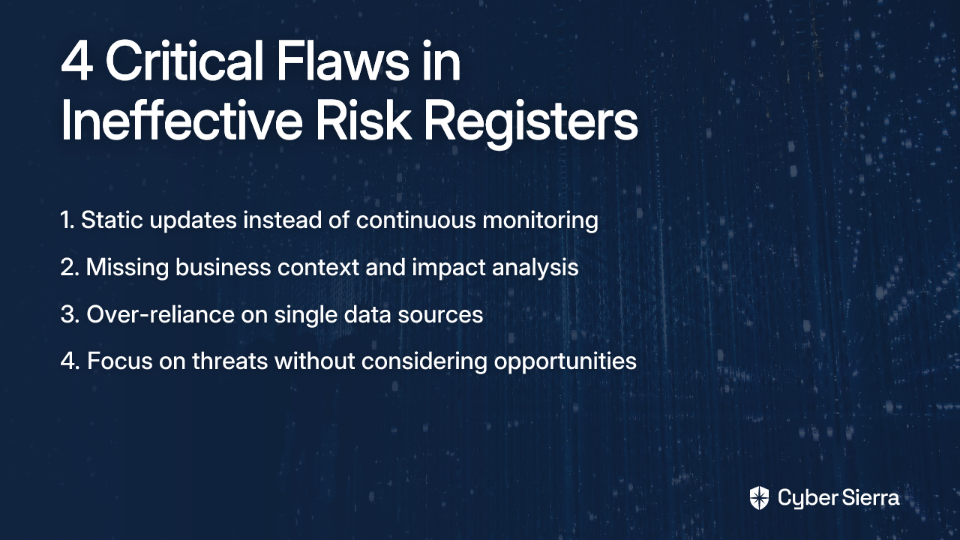
Before we can fix your risk register, we need to diagnose what's making it ineffective. Most failing risk registers share these critical flaws:
1. It's a Static List, Not a Living Document
Most registers are updated quarterly or annually rather than evolving with your threat landscape. This static approach fails to capture emerging threats and creates a false sense of security. When risks are only revisited during scheduled reviews, your organization remains vulnerable in the interim.
2. It Lacks Business Context
The most fatal flaw in most risk registers is presenting risks without context. Your register shows a risk but fails to answer leadership's most important question: "A risk to what?"
When executives ask, "What does this vulnerability actually mean for the business? What's the potential impact if it gets exploited?" your register should provide clear answers—not just technical details that mean nothing to non-technical stakeholders.
3. It Operates in a Silo
Many risk registers suffer from over-reliance on single data sources, particularly vulnerability scan results, while ignoring other crucial inputs. As one practitioner noted, typical registers "lack ingestion of risks from things the scanner doesn't see" and have "no threat modeling, no context into compensating controls, just data presented nicely."
This siloed approach creates dangerous blind spots in your security posture.
4. It Focuses Exclusively on Threats, Ignoring Opportunities
A comprehensive view of risk includes both potential failures and opportunities for improvement. Most registers neglect the latter, presenting a skewed, purely negative picture that fails to engage business leaders interested in growth and innovation.
Redefining the Goal: What a Risk Register Should Be
At its core, a risk register should be a dynamic risk management tool used to "identify, analyze, and solve risks before they become problems," ensuring all information is accessible to stakeholders. It should drive strategic decisions, not just document compliance efforts.
An effective risk register must contain these essential components for each risk:
- Risk identification: A unique, clear identifier
- Risk description: A detailed explanation of the risk scenario
- Risk category: Classification by type (e.g., Security, Operational, Strategic)
- Risk likelihood: Probability of occurrence
- Risk analysis/impact: Potential effect on business functions
- Risk mitigation plan: Specific actions to address the risk
- Risk priority: A score or level to guide focus
- Risk ownership: The person responsible for managing the risk
- Risk status: The current state of the risk
With this foundation in mind, let's transform your data dump into a strategic asset.

The Fix: A Step-by-Step Guide to Transforming Your Data Dump
Step 1: Shift from Static Lists to Dynamic Monitoring
The Problem: Your risk register is a point-in-time snapshot updated infrequently.
The Solution: Integrate risk management into daily and weekly decision-making processes.
How to Implement:
- Adopt a Dynamic Risk Assessment (DRA) approach with continuous monitoring
- Implement automated tools that provide real-time risk updates
- Set up alerts for significant changes in risk factors
- Review high-priority risks weekly, not just quarterly
For third-party risks, this means using a risk exchange with real-time monitoring to get alerts on emerging threats, allowing for proactive management before an issue escalates.
Step 2: Inject Context by Tying Risks to Business Objectives
The Problem: Your register lists vulnerabilities without explaining their business impact.
The Solution: For every risk, explicitly link it to a business function, asset, or objective.
How to Implement:
Asset-Based Risk Assessment (ABRA):
- Identify your organization's most critical assets (data, systems, people)
- Evaluate risks specifically in terms of their potential impact on those assets
- Prioritize security measures based on business value
Threat-Based Risk Assessment (TBRA):
- Identify specific threat scenarios (e.g., a ransomware attack on your ERP system)
- Model the impact across affected business functions
- Document how the scenario could affect core mission/business functions
By mapping risks to business context, you transform abstract vulnerabilities into concrete scenarios that non-technical leaders can understand and prioritize.
Step 3: Broaden Your Risk Inputs Beyond the Vulnerability Scanner
The Problem: Your register relies too heavily on vulnerability scan data.
The Solution: Create a holistic view by integrating multiple sources of risk information.
Additional Inputs to Add:
- Threat Intelligence: Incorporate external threat data relevant to your industry
- Internal Self-Audit: Perform systematic reviews to identify risks that scanners miss
- Penetration Test Results: Include findings from regular penetration testing and red teaming exercises
- User Behavior Analytics: Monitor for insider threats and unusual access patterns
- Third-Party Risk: Assess vendor and partner security postures
- Project & Operational Risks: Document risks related to business processes and initiatives
This multi-faceted approach ensures your risk register captures the full spectrum of potential threats, not just those visible to automated scanners.

Step 4: Implement Risk Tiering with Defensible Assessment Methods
The Problem: Your register uses subjective, inconsistent risk ratings.
The Solution: Move beyond simplistic "High/Medium/Low" labels to a more nuanced approach.
How to Implement:
- Quantitative Analysis: Where possible, calculate the Annualized Loss Expectancy (ALE) to quantify risk in financial terms
- Use Ranges Instead of Point Estimates: Express likelihood and impact as ranges (e.g., "10-15% probability" instead of "12%")
- Apply Risk Tiering: Group risks into tiers based on their potential to impact core business functions
- Consider Compensating Controls: Factor in existing mitigations when assessing residual risk
This approach creates abstraction where needed while maintaining the detail required for technical teams, allowing you to communicate effectively at different levels of the organization.
Making it Stick: Fostering a True Risk-Aware Culture
1. Establish a Risk Awareness Committee
Create a cross-functional team that meets regularly to review and discuss emerging risks, ensuring alignment between security and business objectives. This committee should report directly to the CISO and include representatives from key business units.
2. Tailor Your Reporting to Different Stakeholders
The board of directors needs a different view than the IT security team. Develop reporting templates that:
- Show executives how risks relate to business strategy and risk appetite
- Give technical teams actionable remediation steps
- Provide middle management with progress metrics on risk treatment initiatives
3. Integrate with Your Zero Trust Strategy
Align your risk register with your zero trust architecture implementation by documenting how each control addresses specific risks, reinforcing the connection between security investments and risk reduction.
4. Leverage Standards Like NIST 800-53
Map your risks and controls to established frameworks like NIST 800-53 to demonstrate compliance while maintaining focus on your organization's specific risk landscape and adversarial threats.

From Data Janitor to Strategic Advisor
When your risk register transforms from a static data dump into a living, business-aligned tool, you elevate your role from data janitor to strategic advisor. By connecting risks to business objectives, adopting robust assessment methods, and fostering a culture of risk awareness, you provide the critical intelligence your organization needs to navigate uncertainty.
The true value of a risk register isn't in the data it holds but in the conversations it drives and the decisions it informs. A well-designed risk register helps stakeholders understand not just what could go wrong, but what that means for the business and what can be done about it—all while considering the risk owner's interests and organizational priorities.
By implementing these changes, you'll transform your risk register from a compliance checkbox into a strategic asset that drives meaningful risk management across your organization. And instead of glazed eyes at your next risk review, you'll see engaged stakeholders ready to make informed decisions based on your insights.
