



Future of Compliance via Multi-Agent Automation


Join thousands of professionals and get the latest insight on Compliance & Cybersecurity.
You've spent countless hours gathering evidence for compliance audits, manually tracking multiple frameworks, and still worry that you're missing critical security gaps. The tedious back-and-forth with auditors drains your resources, and the constant worry about maintaining compliance between audit cycles keeps you up at night. What if your compliance program could run itself with minimal human intervention while providing better coverage than ever before?
The Evolution of Compliance: From Manual Processes to Intelligent Automation
Traditional compliance processes have long been characterized by labor-intensive manual work—spreadsheets tracking hundreds of controls, endless email chains requesting evidence, and point-in-time assessments that quickly become outdated. This approach is not only inefficient but also leaves organizations vulnerable to compliance gaps between audit cycles. As regulatory requirements grow more complex and cybersecurity threats evolve, organizations find themselves stretched thin trying to maintain compliance across multiple frameworks like SOC 2, ISO 27001, NIST, and PCI-DSS. The manual approach simply doesn't scale, and compliance fatigue is a real concern for teams trying to keep pace.
"The efficiency of the audit process can be improved significantly by alleviating the burden of evidence gathering," notes a cybersecurity professional on Reddit, highlighting a pain point experienced by compliance teams worldwide.
Enter Multi-Agent Automation: A New Paradigm
Multi-agent automation represents the next frontier in compliance management—a paradigm shift that promises to transform how organizations approach regulatory requirements and security posture management.
What Are Multi-Agent Systems?
A multi-agent system (MAS) comprises multiple AI agents working together autonomously to achieve compliance objectives. Unlike single AI solutions that might handle one aspect of compliance, multi-agent systems distribute specialized tasks across multiple agents that collaborate, communicate, and coordinate their activities.
According to IBM's research on multi-agent systems, these systems offer several key advantages:
- Specialization and expertise: Different agents can specialize in specific compliance domains or frameworks
- Resilience: If one agent fails, others can continue functioning
- Scalability: Systems can grow to accommodate more complex compliance requirements
- Adaptive learning: Agents can learn from each other and enhance their collective intelligence
However, there's notable skepticism about whether these systems offer significant advantages over single powerful AI solutions. As one technology professional questioned on Reddit: "Do we actually need multi-agent AI systems? Couldn't a single powerful AI handle the same tasks more efficiently?"
How Multi-Agent Systems Transform Compliance
Despite the skepticism, multi-agent systems are poised to revolutionize compliance in several key ways:
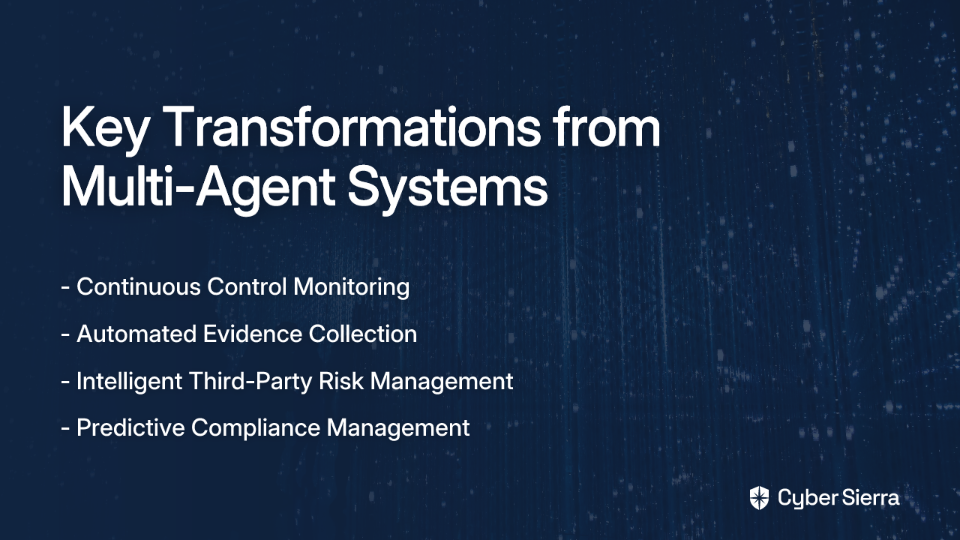
1. Continuous Control Monitoring Instead of Point-in-Time Assessments
Traditional compliance relies on periodic assessments that provide only a snapshot of compliance status. Multi-agent systems enable continuous control monitoring by deploying specialized agents to:
- Monitor control effectiveness in real-time
- Detect anomalies and control failures immediately
- Generate automated evidence of control operation
- Provide near real-time compliance dashboards
This shift from periodic to continuous monitoring is transformative. According to Secureframe's compliance automation trends, continuous compliance monitoring "allows organizations to maintain an active understanding of their compliance posture at all times, rather than scrambling to prepare for annual assessments."
2. Automated Evidence Collection and Management
One of the most time-consuming aspects of compliance is gathering and organizing evidence for audits. Multi-agent systems can automate this process through:
- Specialized evidence collection agents that interface with various systems
- Documentation agents that organize and standardize evidence
- Validation agents that verify evidence completeness and accuracy
- Presentation agents that package evidence for auditor consumption
"The tedious and inefficient evidence gathering process during audits" is a major pain point identified by compliance professionals. Automation in this area alone can dramatically reduce the burden on compliance and IT teams.
3. Intelligent Third-Party Risk Management
As organizations rely more heavily on third-party vendors, managing vendor compliance becomes increasingly complex. Multi-agent systems can transform this process through:
- Vendor assessment agents that automate questionnaire distribution and analysis
- Continuous monitoring agents that track vendor security postures
- Risk assessment agents that evaluate vendor risk levels
- Remediation agents that track vendor compliance issues to resolution
4. Predictive Compliance Management
Perhaps the most exciting capability of multi-agent systems is their potential for predictive compliance management. By analyzing patterns and trends, these systems can:
- Predict potential compliance failures before they occur
- Identify emerging regulatory requirements that may impact the organization
- Recommend proactive measures to maintain compliance
- Optimize resource allocation for compliance activities
Lucinity's research on AI in compliance suggests that "proactive compliance monitoring transitions the focus from reactive to proactive compliance strategies," enabling organizations to stay ahead of regulatory requirements rather than constantly playing catch-up.
Challenges and Limitations
Despite their potential, multi-agent systems for compliance face several significant challenges:
Integration Complexity
"The majority of existing companies have legacy systems that may not integrate well with multi-agent architectures," notes one industry observer. This integration challenge is a major hurdle for organizations considering multi-agent compliance solutions. Integration issues can manifest as:
- Difficulties connecting with legacy systems that lack modern APIs
- Data format inconsistencies between systems
- Authentication and authorization complexities
- Performance bottlenecks when systems interact
Cost and Resource Requirements
The high cost of implementing sophisticated multi-agent systems is another barrier to adoption. As one cybersecurity professional noted, "High costs and complexity of compliance automation tools make them less appealing," particularly for smaller organizations with limited budgets.
Balancing Automation with Human Oversight
There are legitimate "concerns about AI disrupting established control systems and the dependency on human intervention." Any successful multi-agent compliance system must maintain appropriate human oversight while still delivering automation benefits.
As one industry professional expressed on Reddit: "There will always be a need for human intervention in these systems, especially when they malfunction or face unexpected scenarios."
Skepticism About AI Reliability
Many compliance professionals remain skeptical about AI's ability to handle compliance tasks accurately. This skepticism is not unfounded—AI systems can make mistakes, particularly when dealing with nuanced regulatory requirements or unusual situations.
A financial compliance expert noted: "Skepticism about the ability of AI to accurately handle compliance tasks without errors" remains a significant concern in regulated industries.
Best Practices for Implementation
For organizations looking to leverage multi-agent automation for compliance, consider these best practices:
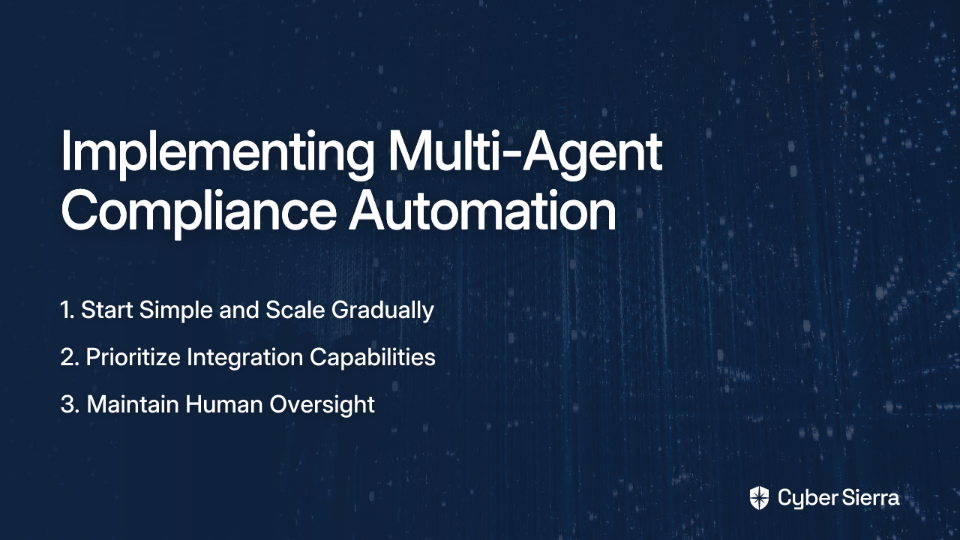
1. Start Simple and Scale Gradually
Rather than attempting to implement a complex multi-agent system all at once, start with simpler automation solutions that address specific pain points:
- Implement evidence collection automation first
- Add continuous monitoring capabilities incrementally
- Gradually introduce more sophisticated agents as your organization adapts
This approach aligns with the recommendation to "explore simpler compliance automation solutions that integrate well with existing systems to reduce manual workload and costs."
2. Prioritize Integration Capabilities
When evaluating multi-agent compliance solutions, prioritize those with robust integration capabilities:
- Look for pre-built connectors to common enterprise systems
- Ensure the solution has a well-documented API
- Verify compatibility with your existing technology stack
- Test integration thoroughly before full deployment
3. Maintain Human Oversight
Design your multi-agent compliance system to include appropriate human oversight:
- Implement approval workflows for critical compliance decisions
- Establish clear escalation paths for unusual situations
- Provide transparency into agent decision-making processes
- Train staff to work effectively with automated systems
Real-World Applications: Cyber Sierra's Approach
Cyber Sierra exemplifies the application of multi-agent principles in its AI-enabled cybersecurity platform. By seamlessly integrating specialized modules that function like coordinated agents, it addresses multiple facets of compliance management:
- The Continuous Control Monitoring (CCM) module acts as a specialized agent that provides real-time visibility into security controls, transforms manual checks into automated monitoring, and creates a unified source of truth for control effectiveness.
- Their Third-Party Risk Management (TPRM) component functions as a dedicated agent for vendor risk, automating assessments and providing continuous monitoring of third-party security postures—directly addressing the growing complexity of supply chain compliance.
- The Governance, Risk & Compliance (GRC) module serves as a coordinator agent that automates data collection across multiple compliance frameworks (SOC2, ISO 27001, HIPAA, etc.), eliminating the manual burden of maintaining multiple framework mappings.
This integrated approach demonstrates how specialized agents can work together to transform compliance from a periodic, manual effort into a continuous, automated process.

The Future of Compliance: Human-AI Collaboration
The future of compliance isn't about replacing humans with multi-agent systems—it's about creating effective human-AI collaborations that leverage the strengths of both:
- AI agents handle routine, repetitive tasks, data collection, and continuous monitoring
- Human experts focus on strategic decisions, unusual cases, and relationship management
- The combined approach delivers more comprehensive compliance coverage with less effort
As Gartner's Future of Compliance 2030 research suggests, the most successful compliance programs will be those that effectively blend human expertise with technological capabilities.
Conclusion
Multi-agent automation represents the next evolution in compliance management, offering organizations the potential to transform from reactive, labor-intensive approaches to proactive, continuous compliance monitoring. While skepticism about these systems is understandable, the potential benefits—reduced manual effort, continuous compliance visibility, and proactive risk management—make them worth exploring for organizations seeking to modernize their compliance programs. By starting with simple automation, prioritizing integration capabilities, and maintaining appropriate human oversight, organizations can begin to realize the benefits of multi-agent compliance automation while mitigating the associated risks and challenges. The future of compliance isn't just automated—it's intelligently orchestrated by specialized agents working in harmony with human experts to deliver more effective, efficient, and comprehensive compliance management than ever before.
Frequently Asked Questions
What is multi-agent automation in the context of compliance?
Multi-agent automation in compliance refers to a system where multiple specialized AI agents work collaboratively to manage and streamline regulatory requirements and security posture. Unlike a single AI solution, these systems distribute tasks like continuous control monitoring, evidence collection, and risk assessment across different agents, each an expert in its domain, to achieve comprehensive compliance objectives.
How can multi-agent systems enhance compliance efficiency?
Multi-agent systems significantly enhance compliance efficiency by automating traditionally manual and time-consuming tasks. They enable continuous control monitoring instead of periodic checks, automate the collection and management of audit evidence, streamline third-party risk management, and can even predict potential compliance failures, allowing for proactive interventions. This reduces manual effort, minimizes human error, and provides real-time visibility into compliance status.
What are the primary challenges when adopting multi-agent systems for compliance?
The primary challenges include integration complexity with existing legacy systems, the initial cost and resource requirements for implementation, and the need to balance automation with essential human oversight. Additionally, skepticism about AI reliability and its ability to handle nuanced compliance tasks accurately without errors can be a hurdle.
How can a business begin implementing multi-agent compliance automation?
A business can begin by starting simple and scaling gradually. Instead of a full-scale overhaul, focus on automating specific high-pain areas first, such as evidence collection or continuous monitoring for a single framework. Prioritize solutions with strong integration capabilities to work with existing systems and ensure that human oversight is maintained throughout the process.
Will multi-agent systems replace human compliance professionals?
No, multi-agent systems are not intended to replace human compliance professionals but rather to augment their capabilities. The future of compliance lies in human-AI collaboration, where AI agents handle routine, data-intensive tasks, and human experts focus on strategic decision-making, managing exceptions, interpreting complex regulations, and stakeholder engagement. This synergy leads to more effective and comprehensive compliance.
Why use multi-agent systems for compliance instead of a single, powerful AI?
Multi-agent systems offer advantages like specialization, resilience, and scalability that can be more beneficial for complex compliance environments than a single AI. Different agents can specialize in specific compliance domains (e.g., SOC 2, ISO 27001) or tasks (e.g., evidence gathering, log analysis). This distributed approach can also offer more resilience, as the failure of one agent may not cripple the entire system, and it allows for more targeted and scalable deployment of AI capabilities.
