



Gamification in Security Training: Does It Actually Work?


Join thousands of professionals and get the latest insight on Compliance & Cybersecurity.
You've sat through another mindless security awareness training (SAT) video. You've clicked through those predictable slides. You've reluctantly completed that annual compliance quiz. And like most of your colleagues, you've probably forgotten 90% of the content within days.
Meanwhile, your security team is frustrated because despite all the training investments, employees still click on phishing emails, use weak passwords, and bypass security protocols when they're in a hurry.
Sound familiar?
The problem isn't a lack of security training—it's that most traditional approaches simply don't work. As one security professional bluntly put it: "none of it actually considered how people learn." This leads to what many organizations experience: security training becoming just another box to tick "for insurance purposes" rather than creating meaningful behavioral change.
But there's a growing alternative that's challenging the status quo: gamification. Beyond the buzzword, is there actual substance to this approach? Does transforming security training into an engaging, game-like experience actually improve security outcomes?
Let's cut through the marketing hype (which, as many security professionals note, "all sounds the same") and examine what the evidence really tells us about gamified security awareness training.
What is Gamification in Security Training? (And What It Isn't)
First, let's clarify what we're talking about. Gamification isn't about playing Fortnite at work or turning serious security topics into trivial games. It's the strategic application of game mechanics and psychological principles to security education.
Effective gamified security training typically includes:
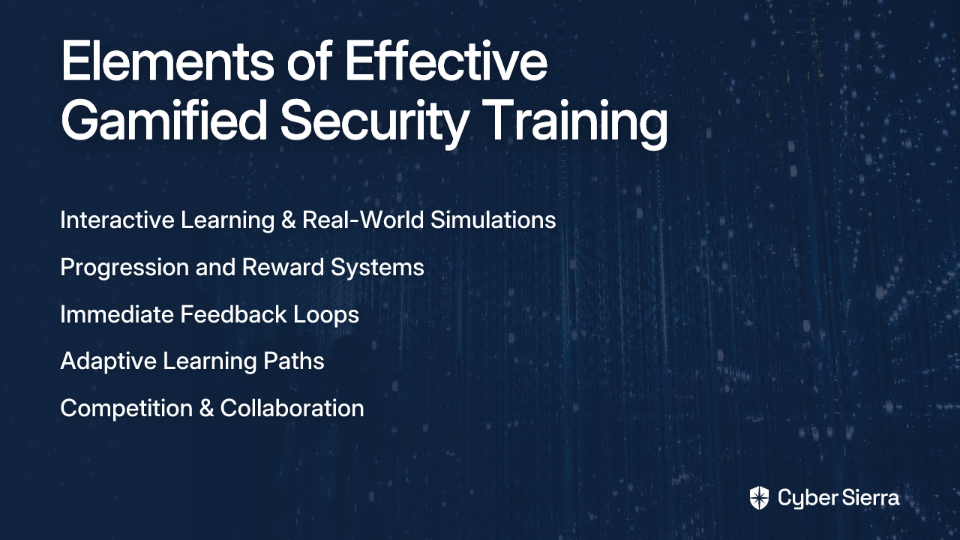
- Interactive Learning & Real-World Simulations: Instead of passive videos, users engage with realistic scenarios like identifying and reporting simulated phishing attacks that mimic actual social engineering tactics.
- Progression and Reward Systems: Learners advance through increasingly challenging levels while earning points, badges, and recognition for demonstrating proper security behaviors.
- Immediate Feedback Loops: Users receive instant guidance after actions (like failing or correctly reporting a simulated phish), answering the critical question: "if someone falls for a simulated phish.... then what?"
- Adaptive Learning Paths: Training difficulty adjusts based on individual performance, keeping content challenging but achievable for both security novices and experts.
- Competition & Collaboration: Leaderboards and team challenges foster both friendly competition and collaborative learning across departments.
These elements don't replace substantive security content about phishing, social engineering, email security, or cloud security—they enhance how that content is delivered and retained.
The Science Behind Why Gamification Works
The effectiveness of gamified security training isn't just marketing hype; it's grounded in established behavioral science.
BJ Fogg's Behavior Model provides a useful framework for understanding why gamification works:
Behavior = Motivation + Ability + Prompt
Gamified security awareness training works because it:
- Increases Motivation through rewards and recognition
- Enhances Ability through micro-learning and practice
- Delivers effective Prompts through simulated threats and challenges
Research published in ScienceDirect confirms that gamification significantly enhances knowledge retention and reduces cognitive load by breaking complex topics (like multi-factor authentication or BYOD policies) into manageable, interactive challenges. Organizations using microlearning—a key component of many gamified platforms—have improved retention rates by up to 50%, according to CybSafe research.
Perhaps most importantly, studies consistently show that engagement is the crucial mediator between training techniques and actual knowledge retention. As one security professional put it, "engagement of the learners trumps all." Gamification has been shown to boost overall employee engagement by 60% and productivity by 43% according to Pluralsight Research.
The Proof: Measurable Impact and Real-World Results
Unlike traditional training that often lacks robust metrics, gamified security training can demonstrate clear ROI with C-level-friendly data, addressing the need for "good reporting what you don't have to translate for c level."
Key Metrics That Matter
Effective gamified training tracks metrics like:
- Phishing Reporting Rate: The percentage of simulated phishing emails actively reported
- Real Threat Detection Rate: Actual malicious emails caught and reported
- Failure/Click Rate: Users who fall for simulated attacks
- Dwell Time: How quickly users report suspicious content
- Resilience Ratio: The ratio of reported emails to failed ones (a powerful indicator of a strong security culture)
Case Study: Real Results
The numbers are compelling:
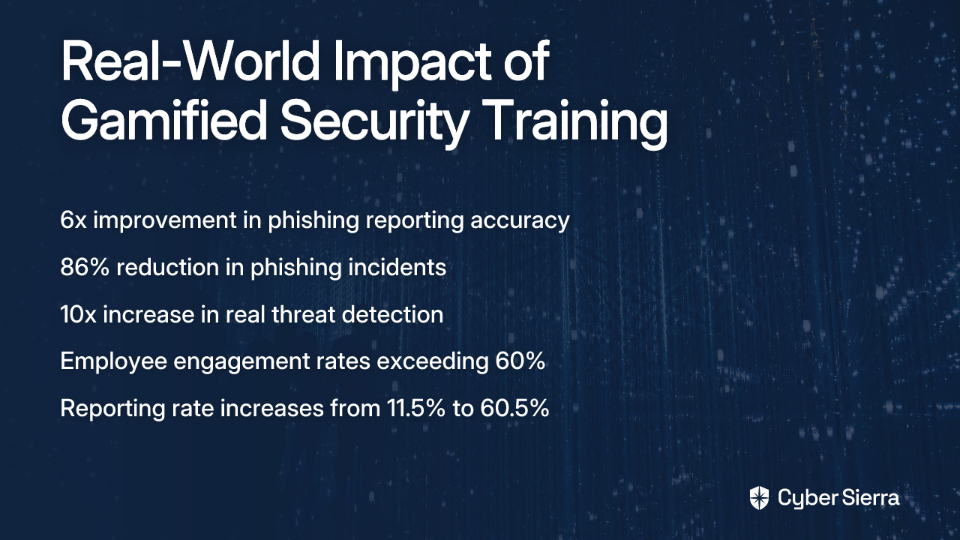
Hoxhunt Platform Results:
- 6x improvement in phishing reporting accuracy within 6 months
- 86% reduction in phishing incidents across organizations
- 10x increase in real threat detection within a year
- Training engagement rates exceeding 60%, compared to dismal rates for traditional methods
AES Corporation (CSO50 Award Winner): After implementing gamified training, employee engagement soared from 10% to 70%, leading to measurable behavioral change around email security and recognition of social engineering tactics. This transformation earned AES a prestigious CSO50 award for security innovation.
Fortune 500 Company Transformation:
- Reporting rate increased from 11.5% to 60.5%
- Failure rate dropped from 7.6% to 1.6%
- Resilience ratio skyrocketed from 1.5 to 38
These aren't just vanity metrics—they translate to real risk reduction. With the human element contributing to 82% of data breaches according to Verizon's 2023 DBIR, these improvements represent significant security enhancements.
Addressing Skepticism: "Is This Not Business Focused?"
A common criticism of gamification is that it seems gimmicky or "not business focused" enough for serious enterprise security. This concern deserves addressing.
Balancing Fun and Education
Effective gamification isn't about prioritizing entertainment over learning. The core of any successful program must remain realistic scenarios and relevant security content about compliance training, dark web monitoring, and core cyber hygiene practices. Game mechanics simply make this critical content more engaging and memorable.
As Harvard Business Review notes in their analysis of gamified training, "The key is to ensure that the gamification elements are tightly aligned with the actual learning objectives and desired behaviors, rather than being merely decorative."
Sustaining Engagement Long-Term
Another legitimate concern is whether gamification can maintain momentum beyond the initial novelty. This is where "a good content refresh cycle" becomes crucial. Gamification isn't a one-time implementation but requires continuous program management with:
- Fresh content addressing evolving threats like new phishing techniques
- Updated simulations that mirror current social engineering tactics
- Progressive challenges that grow with employee skill levels
- Integration with LMS platforms for seamless delivery
Gamification as Part of a Holistic Strategy
The most successful implementations position gamification as one powerful tactic within a larger security culture strategy that includes:
- Leadership Buy-in: Executive participation that signals the importance of security
- Psychological Safety: A non-punitive environment where employees feel safe to report mistakes and actual threats
- Personalization: Tailoring content to specific roles and regional threats
- Integration with Technical Controls: Complementing behavioral training with robust email filters and MFA implementation
From Compliance Checkbox to Proactive Security Culture
The ultimate goal of security awareness training isn't compliance—it's creating a human firewall that actively defends against threats. When implemented correctly, gamification transforms security from something employees endure to something they actively participate in.
Unlike traditional SAT approaches that often become "tick a box for insurance purposes" exercises, gamified training engages employees in ongoing security practices that address real threats like phishing, social engineering, and email scams.
The data is clear: gamification works. It drives engagement, improves knowledge retention, and most importantly, creates measurable security behavior change. Organizations that have embraced this approach are seeing dramatic improvements in their security posture through active threat reporting, reduced vulnerability to phishing, and stronger overall cyber hygiene.
As threats continue to evolve—particularly around cloud security and BYOD environments—security training must move beyond passive consumption to active participation. Gamification provides a proven framework for making this transition, turning security awareness from a compliance burden into a competitive advantage.
The question isn't whether your organization can afford to implement gamified security awareness training. Given the overwhelming evidence of its effectiveness, the real question is whether you can afford not to.
Frequently Asked Questions
What is gamified security awareness training?
Gamified security awareness training is a modern approach that uses game-like elements such as points, leaderboards, and interactive challenges to teach cybersecurity concepts. It transforms passive learning into an active experience, using realistic simulations (like phishing attacks) and immediate feedback to improve knowledge retention and build better security habits, rather than just fulfilling compliance requirements.
Why is gamified training more effective than traditional security training?
Gamified training is more effective because it significantly increases employee engagement, which is the key to knowledge retention and real behavioral change. Unlike traditional methods that are often passive and quickly forgotten, gamification taps into behavioral science principles. It boosts motivation with rewards, makes learning easier with interactive, bite-sized content, and provides immediate feedback, leading to measurable improvements in phishing reporting and a stronger security culture.
How does gamification actually reduce security risks?
Gamification reduces security risks by turning employees into an active line of defense, proven by key metrics like increased threat reporting rates and lower phishing failure rates. By providing continuous, hands-on practice, employees get better at spotting and reporting real threats like phishing and social engineering attempts. Case studies show organizations using gamification see dramatic reductions in successful phishing attacks and up to a 10x increase in the detection of real malicious emails, directly lowering the risk of a data breach.
Is gamified security training just for fun, or is it serious enough for enterprise environments?
While engaging, effective gamification is a serious educational tool designed for enterprise environments, not just entertainment. The core of any successful program is realistic, up-to-date security content covering critical topics like phishing, compliance, and social engineering. Game mechanics are strategically used to make this essential content more memorable and to drive desired behaviors. The focus is always on achieving measurable security outcomes, not just on "fun."
How do you keep employees engaged with gamified training over the long term?
Long-term engagement is maintained through a continuous program management strategy that includes constantly refreshed content and progressively challenging material. A successful gamified program is not a one-time event. It requires regular updates with new training modules that address evolving threats, fresh simulations that mimic current attack techniques, and adaptive learning paths that adjust to each employee's skill level, ensuring the training remains relevant and challenging over time.
What key metrics should you track to measure the success of a gamified security program?
Key success metrics go beyond simple completion rates and focus on behavioral changes, such as the phishing reporting rate, failure/click rate, and the overall resilience ratio. The most important metrics demonstrate a stronger security posture. These include tracking the percentage of simulated phishes reported versus failed (resilience ratio), the speed at which users report threats (dwell time), and the number of real malicious emails caught by employees. These data points provide clear, C-level-friendly evidence of ROI.
[Note: This article references findings from multiple sources including Verizon's Data Breach Investigations Report, Harvard Business Review, ScienceDirect research studies, and documented case studies from organizations implementing gamified security training. The conclusions align with both academic research and real-world implementation results.]
