



The Art of 'Good Enough': Better GRC Reporting Is Simpler



Join thousands of professionals and get the latest insight on Compliance & Cybersecurity.
You've spent countless hours meticulously documenting every vulnerability, compliance gap, and risk scenario. Your risk register is a masterpiece of thoroughness. The data is impeccable, the analysis robust. And yet, when you present your findings to leadership, you're met with glazed eyes, shallow nods, and that dreaded phrase: "Just send me the deck; I'll review it later."
Sound familiar? You're not alone.
As GRC professionals, we're often caught in a frustrating paradox: the more precise and comprehensive our reports, the less impact they seem to have. We're "tired of people not giving a damn about [our] risk management" despite pouring our expertise and effort into creating technically perfect assessments.
The Tyranny of Precision: Why 'Perfect' GRC Reports Fail
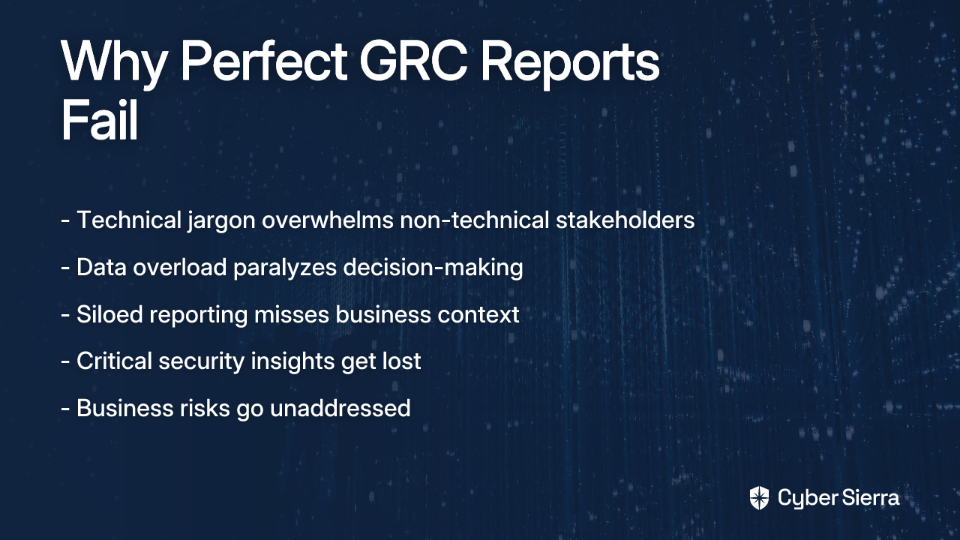
The hard truth is that our obsession with technical precision often works against us. Our meticulously crafted risk assessments, packed with detailed metrics and compliance checkboxes, frequently fall flat for three key reasons:
Technical jargon overwhelms non-technical stakeholders. Board members and executives don't speak the language of CVEs, control frameworks, and compliance citations. When faced with technical terminology, many simply disengage, viewing the GRC team as the "'Department of No'" rather than strategic partners.
Data overload paralyzes decision-making. When stakeholders are bombarded with exhaustive data points and granular metrics, they struggle to extract actionable insights. As one practitioner notes, the "obsession with precision and granularity" often obscures "what exact decision this report needs to influence."
Siloed reporting misses the business context. Technical reports that don't connect to strategic objectives reinforce the perception that GRC operates in isolation from business goals. Many professionals lament not understanding earlier "how cybersecurity, risk and general technology fits into the business."
The result? Critical security insights get lost, business risks go unaddressed, and GRC professionals remain frustrated that their expertise isn't translated into organizational action.
The 'Good Enough' Philosophy: A New Paradigm for GRC
There's a better approach—one that might feel counterintuitive to technically-minded GRC professionals. It's the philosophy of "good enough" reporting.
To be clear, "good enough" doesn't mean sloppy, incomplete, or inaccurate. Rather, it's about creating representations of risk that are sufficient for their primary purpose: driving informed business decisions.
This concept has solid scientific grounding. In cognitive science, researchers have found that our brains naturally create representations that are merely "'good enough' (GE)" for the context, using "simple heuristics" over complex algorithms to process meaning efficiently. In other words, human comprehension doesn't require perfect information—it requires relevant, accessible information that serves the immediate need.
Research from the RAND Corporation on safety assessment further supports this approach. Their studies concluded that "No single best approach exists" for measuring complex systems. Instead, a combination of measurements, processes, and thresholds provides a more thorough and understandable assessment. The parallel to GRC reporting is clear: sometimes a simplified, multi-faceted view is more effective than a single, hyper-precise metric.

The lesson? Effective GRC communication isn't about technical perfection—it's about "sacrificing precision in favor of user-experience and user-alignment."
The Playbook: How to Create 'Good Enough' GRC Reports
Let's explore how to put this philosophy into practice with actionable steps for creating GRC reports that drive real impact:
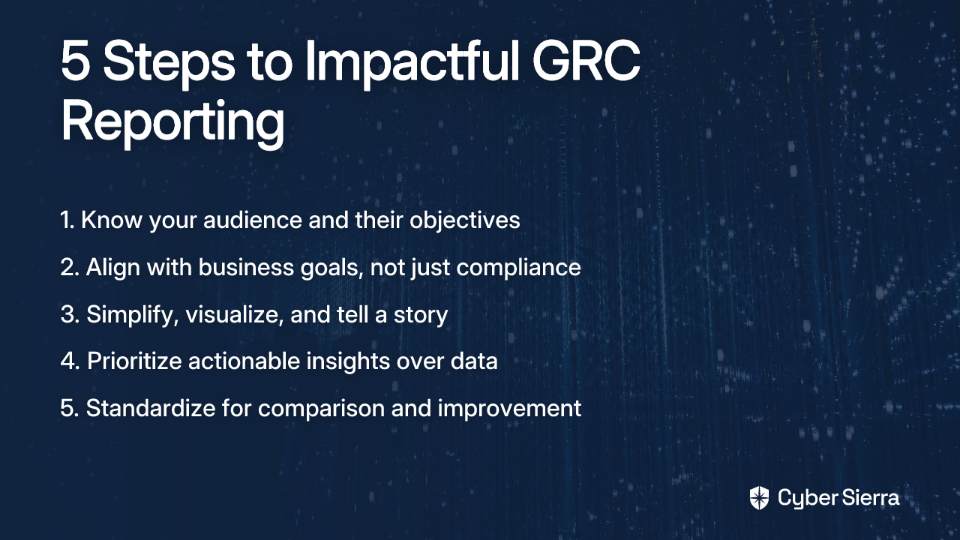
Step 1: Know Your Audience and Their Objectives
Begin by understanding who will consume your report and what decisions they need to make. Different stakeholders have different priorities:
- Board members want high-level risk posture and trends
- C-suite executives need strategic insights tied to business objectives
- Department heads require operational risks relevant to their areas
Don't assume all audiences need the same level of detail. As one GRC professional noted, success comes from recognizing "stakeholder objectives which you might or might not align with" and tailoring your approach accordingly.
Action: Before creating any report, explicitly identify the key decisions it should influence. Meet with stakeholders to understand their specific needs, information preferences, and decision-making processes.
Step 2: Focus Beyond Compliance; Align with Business Goals
Compliance is just one component of an effective risk program. To elevate your reporting, connect GRC insights directly to business outcomes and strategic objectives.
Rather than emphasizing "we're 98% compliant with framework X," highlight how your risk management activities support business growth, protect revenue streams, or enable new initiatives. This transition from compliance bottleneck to business enabler is what transforms GRC from the "Department of No" to a valued strategic partner.
Action: For each risk or compliance issue you report, explicitly connect it to a business goal or objective. Frame security trade-offs in terms of business impact, not just technical risk.
Step 3: Simplify, Visualize, and Tell a Compelling Story
Technical complexity is the enemy of understanding. The most effective GRC reports use simplified language, strong visualizations, and narrative structure to make complex data digestible.
According to Centraleyes, "Using graphs and charts makes data more engaging and easier to interpret" while "contextualizing data in a narrative form helps highlight risks, impacts, and necessary strategic decisions."
Action: Replace technical jargon with business language. Use color-coded dashboards, trend lines, and comparative visuals to illustrate risk posture. Structure reports as narratives with a clear beginning (current state), middle (key risks and opportunities), and end (recommended actions).
Step 4: Prioritize Actionable Insights Over Exhaustive Data
Decision-makers don't need to see every data point—they need the insights that matter most. Modern business intelligence and GRC tools can help by providing high-level, actionable metrics such as:
- Financially quantified risk scores that present risk in clear dollar terms
- Third-party risk summaries that visualize vendor risk
- Budget allocation reports that assess security investment effectiveness
The goal is to extract meaningful signals from the noise of data-quality issues and technical details.
Action: For every data point you include, ask: "Does this help the stakeholder make a better decision?" If not, consider removing it or moving it to an appendix.
Step 5: Standardize for Comparison and Continuous Improvement
Inconsistent reporting makes it difficult to track progress and identify trends. A standardized approach to GRC reporting enables meaningful comparisons over time and demonstrates the value of your risk program.
The RAND Corporation emphasizes the importance of "uniform presentation of evidence" to ensure consistency in assessment. In GRC, this translates to consistent metrics, formats, and evaluation methodologies that allow stakeholders to track changes meaningfully.
Action: Develop report templates with standard metrics that enable quarter-to-quarter and year-to-year comparisons. Maintain audit-ready documentation of your methodology to ensure consistency and defensibility.
The Payoff: The Transformative Impact of 'Good Enough' Reporting
Embracing the "good enough" approach to GRC reporting delivers significant benefits:
Improved & Faster Decision-Making: When stakeholders can quickly grasp risk posture and implications, they make better decisions more efficiently. Streamlined reports provide clarity that facilitates confident action.
Enhanced Stakeholder Engagement: By focusing on "better alignment/aggregation/UX in reports," you win the internal competition for attention. No more reports that sit unread in inboxes—stakeholders actively seek and use your insights because they're valuable and accessible.
Increased Operational Efficiency: This approach "frees up a ton of time and effort" for the GRC team, allowing professionals to focus on high-impact risk management activities instead of endless report refinement. Policy management becomes more effective when policies are clearly tied to business risks.
Stronger Reputation & Trust: When GRC professionals communicate in business terms and deliver actionable insights, they build credibility and trust. The function transforms from a technical necessity to a strategic asset.

From Technical Expert to Strategic Partner
The journey from technical specialist to strategic advisor isn't easy. It requires us to challenge our own assumptions about what makes a "good" GRC report and embrace a new paradigm that values communication as much as technical accuracy.
Yes, deep technical knowledge matters. Understanding quantification engines, risk assessment methodologies, and technical considerations remains essential. But the real game-changer for your GRC career isn't one more certification—it's learning how to navigate business culture, communicate value, and become an indispensable part of the business conversation.
As one experienced professional reflected, "the real impact comes once we can explain security trade-offs to non-technical leadership." That's the art of "good enough"—knowing when precision serves the purpose and when simplicity better serves the stakeholder.
By mastering this balance, you transform GRC reporting from a compliance exercise into a powerful tool for organizational influence. You stop being merely a technical expert and become something far more valuable: a trusted advisor who helps the business navigate risk with confidence.
The irony is striking but true: sometimes, doing less detailed work creates more meaningful impact. In GRC reporting, as in many aspects of business, simplicity isn't just good enough—it's better.
Frequently Asked Questions
What is 'good enough' GRC reporting?
"Good enough" GRC reporting is an approach that prioritizes clear, actionable insights for business leaders over exhaustive technical detail. It involves creating reports that are sufficient to drive informed decisions by focusing on user experience and alignment with business objectives rather than perfect, granular precision.
Why do highly detailed GRC reports often fail to make an impact?
Highly detailed GRC reports often fail because they overwhelm non-technical stakeholders with jargon, cause decision paralysis through data overload, and lack a clear connection to business context. When leadership cannot easily understand the strategic implications, critical security insights get lost, and the report is often ignored.
How can I make my GRC reports more effective for a leadership audience?
To make your reports more effective for leadership, focus on storytelling, visualization, and business relevance. Use simple, color-coded dashboards and charts instead of dense tables. Frame risks in terms of business impact (e.g., financial loss, project delays) and connect your recommendations directly to strategic goals.
Does 'good enough' reporting mean sacrificing accuracy?
No, "good enough" reporting does not mean being inaccurate or sloppy. It means sacrificing unnecessary precision for the sake of clarity and impact. The underlying data and analysis must still be robust and defensible, but the final report presented to stakeholders is simplified to highlight what is most important for their decision-making process.
What's the first step to creating a 'good enough' GRC report?
The first and most critical step is to know your audience and their objectives. Before you begin writing, identify who the report is for and what specific decisions they need to make based on your findings. A brief conversation with key stakeholders can ensure your report is tailored to their needs from the start.
How do I balance simplified executive reports with the need for detailed audit evidence?
The key is to separate the presentation layer from the underlying data. Maintain your detailed, audit-ready documentation and comprehensive risk register internally. For executive reports, create a high-level summary or dashboard that pulls from this detailed data but presents only the most critical, actionable insights. The full data set can be available as an appendix or upon request for deeper dives or audit purposes.
