



3 Governance Risk Compliance Platforms With Real-Time Risk Dashboards

Join thousands of professionals and get the latest insight on Compliance & Cybersecurity.
Summary
- Managing compliance manually is inefficient and leaves security teams scrambling for outdated evidence before audits.
- Modern GRC tools shift from periodic checks to Continuous Control Monitoring (CCM), offering real-time visibility into your security posture.
- Key features to seek in a GRC platform include automated evidence collection, multi-framework mapping, and real-time risk dashboards.
- Cyber Sierra's GRC platform provides this continuous visibility by unifying GRC automation, control monitoring, and threat intelligence in a single environment.
Managing compliance across SOC 2, ISO 27001, HIPAA, and PCI DSS simultaneously isn't just complicated — it's exhausting. The weeks before an audit turn into a scramble to chase control owners, collect screenshots, and reconcile evidence that's already out of date before the auditor even opens their laptop.
Meanwhile, Chief Information Security Officers (CISOs) are under growing pressure to answer "how secure are we?" for their boards. But with security data scattered across dozens of tools, the honest answer is often "we're not sure." Static reports are outdated the moment they're generated.
That's where real-time risk dashboards become critical. This article covers three Governance, Risk, and Compliance (GRC) platforms that go beyond periodic snapshots — providing the continuous visibility teams need to shift from reactive firefighting to proactive risk management.
What Makes a GRC Platform Worth Using in 2025
Before comparing platforms, it helps to understand what separates modern GRC tools from legacy approaches.
A GRC platform provides a structured way to align IT operations with business goals while managing organizational risk and maintaining regulatory compliance. According to AWS's GRC overview, it integrates three interconnected components: governance (the policies and frameworks guiding business decisions), risk management (identifying and mitigating threats), and compliance (adhering to laws, regulations, and internal standards).
The critical shift in modern platforms is the move from point-in-time assessment to Continuous Control Monitoring (CCM). Traditional GRC relies on quarterly or annual reviews — snapshots that miss everything that changes in between. Real-time dashboards, powered by CCM, surface control failures and compliance gaps as they happen, enabling remediation before they become audit findings or incidents.
Gartner's research on GRC identifies advanced data visualization and risk event management as essential capabilities for generating the kind of board-ready reporting that security leaders now need to produce routinely.
Key Features To Look For
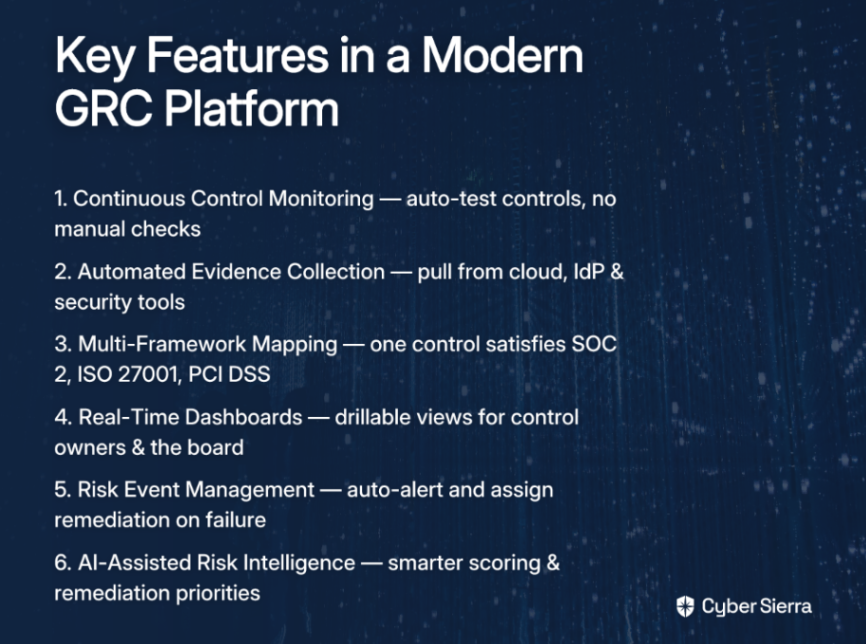
Not all governance risk compliance platforms deliver the same level of real-time insight. Here are the capabilities that matter most:
3 GRC Platforms With Real-Time Risk Dashboards
With those criteria in mind, here are three platforms that stand out for their real-time visibility and continuous monitoring capabilities.
1. Cyber Sierra
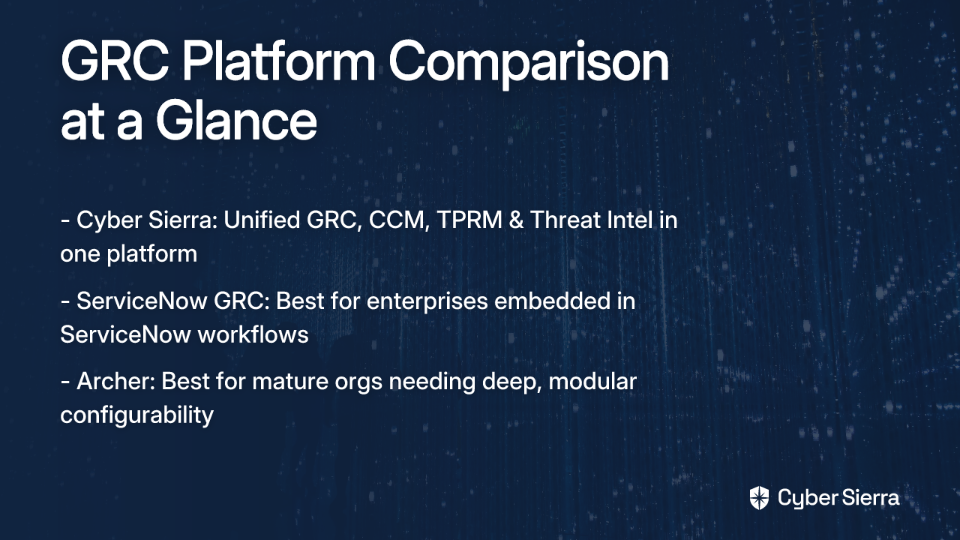
Best for: Enterprises needing a unified platform that combines GRC automation, Continuous Control Monitoring, Third-Party Risk Management (TPRM), and threat intelligence in a single environment.
Supported frameworks: SOC 2, ISO 27001, HIPAA, PCI DSS, GDPR, PDPA, NIST CSF, and custom frameworks.
Key differentiator: Unified platform covering GRC, CCM, TPRM, threat intelligence, and employee security training — most competitors address only one or two of these areas.
Cyber Sierra's GRC automation platform is built around the premise that compliance confidence requires continuous visibility, not periodic audits. Its real-time dashboard provides an ongoing view of control effectiveness, risk posture, and compliance status across multiple frameworks simultaneously — addressing the common frustration that automation tools fall apart when an organization's setup is anything other than standard.
One of Cyber Sierra's strongest differentiators is its CCM module, which continuously tests and validates controls, builds a central controls repository, and delivers actionable risk intelligence. Rather than collecting evidence in the weeks before an audit, teams have an always-on audit trail that auditors can access on demand.
Cyber Sierra is recognized as a Sample Vendor in the Gartner® Hype Cycle™ for Cyber-Risk Management, 2024, and is accredited by the Cyber Security Agency of Singapore (CSA) as a trusted service provider.
Key features:
- Continuous control monitoring. Near real-time testing and validation of security controls across frameworks, with automated exception detection and anomaly alerting.
- Automated data collection. Evidence is pulled automatically from cloud providers, identity systems, and security tools — eliminating manual evidence gathering before audits.
- Multi-framework management. Controls can be mapped and managed across SOC 2, ISO 27001, HIPAA, PCI DSS, and GDPR simultaneously, reducing duplicated effort from framework overlap.
- Integrated threat intelligence. Cyber Sierra's threat intelligence module connects compliance controls to real-world vulnerabilities through network and cloud scanning — something most GRC-only tools don't offer.
- Third-party risk management. The TPRM module provides continuous vendor monitoring and automated assessments, moving beyond point-in-time questionnaires.
2. ServiceNow GRC
Best for: Large enterprises already running on the ServiceNow platform that want to embed risk and compliance management into existing IT service management workflows.
Supported frameworks: Supports a broad range of standard and custom frameworks through extensive configuration options.
Key differentiator: Native integration with the ServiceNow ecosystem, enabling risk and compliance checks to be embedded directly into operational workflows.
ServiceNow Governance, Risk, and Compliance is a strong fit for organizations where IT operations already run through ServiceNow. Its real-time monitoring works by embedding compliance checks into the same workflows used for incident response, change management, and IT operations. This tight integration means that control failures can trigger automated workflows that are already familiar to the teams responsible for remediation.
As highlighted in MetricStream's overview of tools, ServiceNow's no-code playbooks and incident response capabilities are a meaningful differentiator for enterprises that need compliance to be operationally connected — not siloed in a separate tool.
The trade-off is that ServiceNow GRC's full value is realized only when an organization is already invested in the broader ServiceNow platform. For teams outside that ecosystem, the learning curve and configuration requirements can be substantial.
Key features:
- Workflow-embedded monitoring. Risk and compliance checks run within existing ServiceNow operational workflows, reducing context-switching and increasing control owner accountability.
- Policy and compliance management. Automates policy lifecycles, control testing schedules, and issue tracking from a centralized interface.
- Enterprise risk management. Advanced capabilities for identifying, assessing, and continuously monitoring strategic, operational, and IT risks.
- Vendor risk management. Modules for managing the full third-party risk lifecycle, from vendor onboarding through offboarding and ongoing monitoring.
3. Archer
Best for: Mature, enterprise-scale organizations that require a highly configurable GRC solution to manage complex, multi-domain risk and compliance programs.
Supported frameworks: Highly adaptable; supports numerous regulatory frameworks and internal control structures through modular design.
Key differentiator: Enterprise-grade configurability and modular deployment, allowing organizations to build a GRC solution around their specific risk domains and compliance obligations.
Archer has long been a staple in large enterprise GRC programs, and its strength lies in depth. Organizations can select specific application modules — Audit Management, Business Resiliency, Third Party Governance, IT Risk Management — and configure them to match complex internal processes. As Drata's review of tools notes, this modularity makes Archer a natural fit for organizations with mature security programs and the dedicated resources needed to configure and maintain the platform.
That configurability is both Archer's strength and its limitation. One sentiment echoed in practitioner discussions reflects a broader truth about enterprise GRC tools: "if yours is anything other than cookie cutter, their automations won't work." Archer tends to be the exception — but it requires significant investment in setup and ongoing administration to get there.
Its dashboards and reporting tools are powerful, offering consolidated risk views that can be tailored for control owners, risk committees, and board-level audiences. For organizations that need to manage risk across operational, strategic, IT, and third-party domains in a single platform, Archer provides the structure to do it.
Key features:
- Integrated risk management. Comprehensive views of risk across operational, strategic, and IT domains, with support for quantitative and qualitative risk assessment methodologies.
- Customizable dashboards. Reporting and visualization tools configurable for different stakeholder audiences, from technical control owners to executive leadership and audit committees.
- Third-party governance. Streamlined workflows for vendor risk assessments, due diligence, and ongoing third-party monitoring.
- Audit management. Automates the full audit lifecycle, from planning and fieldwork through reporting and issue remediation tracking.
Shift From Reactive to Real-Time GRC
The weeks before an audit don't have to be a mad scramble for screenshots and spreadsheets. The core takeaway from any modern GRC evaluation is this: effective compliance management isn't about periodic checks, but continuous visibility.
This shift is powered by two key capabilities:
- Automated evidence collection. Pulls proof directly from your cloud and security tools, eliminating manual data gathering.
- Real-time risk dashboards. Give you an always-on view of your control status, so you can fix issues as they happen, not just before an audit.
Your next step: Identify the single most time-consuming task in your current audit prep process. Is it chasing control owners? Is it capturing screenshots? That bottleneck is the perfect place to focus your evaluation of a new GRC platform.
When you're ready to replace that manual work with automated control monitoring, you can book a personalized demo to see how Cyber Sierra unifies GRC, risk, and threat intelligence on a single platform.
Frequently Asked Questions
What is a GRC platform?
A GRC platform is a tool that helps organizations align IT with business goals, manage risk, and stay compliant with regulations. It integrates governance, risk management, and compliance into a single, structured system to streamline audit preparation and improve security posture.
Why is continuous control monitoring important in a GRC tool?
Continuous Control Monitoring (CCM) is crucial because it provides real-time visibility into your security controls. Unlike periodic audits, which are just snapshots, CCM automatically tests controls continuously, catching failures as they happen so you can fix them before they become audit issues.
How do I choose the right GRC platform for my business?
To choose the right GRC platform, first assess your specific needs. Consider your company size, existing workflows (like ServiceNow), and the number of compliance frameworks you manage. Look for features like automated evidence collection, multi-framework mapping, and real-time dashboards.
What is the main difference between Cyber Sierra, ServiceNow GRC, and Archer?
The main difference lies in their focus. Cyber Sierra offers a unified GRC, CCM, and threat intelligence platform. ServiceNow is best for companies already in its ecosystem, embedding GRC into IT workflows. Archer is a highly configurable, modular solution for large enterprises.
Can a GRC platform automate the entire audit process?
A GRC platform cannot fully replace an auditor, but it dramatically automates audit preparation. By continuously collecting evidence and monitoring controls, it provides an always-on audit trail. This streamlines the process, reduces manual effort, and helps you stay audit-ready year-round.
How does multi-framework mapping work in a GRC platform?
Multi-framework mapping allows you to link a single security control to requirements across multiple standards (like SOC 2, ISO 27001, and PCI DSS). This prevents duplicating work, as evidence collected for one framework can automatically satisfy requirements for another.
