



GRC Implementation Cost: What Enterprises Actually Pay in 2026

Join thousands of professionals and get the latest insight on Compliance & Cybersecurity.
- The quoted licence fee for a GRC platform is just one part of the total cost, with systems integrator fees, customisation, and maintenance often significantly increasing the budget.
- Security leaders must account for four key cost drivers: platform licences, implementation services, customisation work, and ongoing internal and external support.
- Legacy GRC platforms frequently lead to 50-70% budget overruns due to hidden costs like SI scope creep, major upgrade projects, and the need for dedicated internal staff.
- AI-native GRC platforms like Cyber Sierra reduce total cost of ownership by eliminating expensive SI engagements and providing numerous integrations from day one for faster, more predictable deployment.
The licence cost in a GRC vendor's proposal is rarely the number that matters. When a CISO or VP of IT receives a quote for $108,000 or $180,000, that figure typically covers only the platform licence — the most visible slice of a much larger expenditure. The real GRC implementation cost includes systems integrator fees, customisation and integration work, and multi-year maintenance obligations that can collectively dwarf the licence itself.
This breakdown covers what GRC implementation actually costs across three platform tiers, so security and risk leaders can build a realistic 3-year budget before signing anything. Understanding the full GRC implementation picture is the single most important step a buyer can take before committing to a platform.
The Four Components of GRC Implementation Cost
Before comparing platforms, it helps to have a universal framework. The total cost of GRC implementation breaks down into four distinct buckets — and the licence is almost always the smallest.
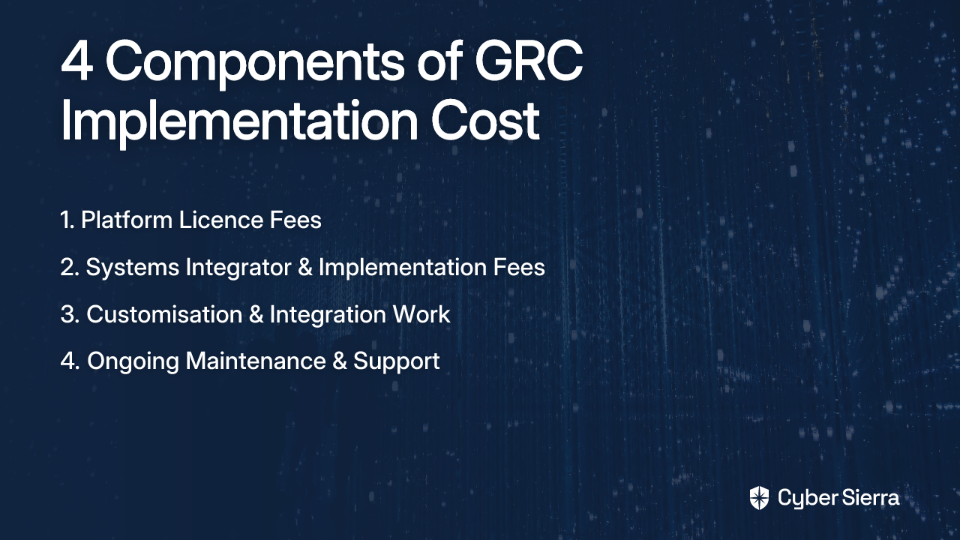
1. Platform Licence Fees
This is the line item on the vendor's proposal. Pricing is typically structured around user count, module selection, or subscription tier.
According to Sprinto's GRC pricing analysis, annual licence costs range from $20,000 to over $150,000 depending on organisation size and feature requirements. Specific examples illustrate the range: MetricStream can reach $180,000 for a 36-month term, while IBM OpenPages starts at approximately $108,000 for three modules.
2. Systems Integrator and Implementation Fees
For legacy platforms, this is where the GRC implementation cost truly escalates. SI and implementation fees can add 50% to 200% of the annual licence fee.
This work is typically handled by Big 4 advisory firms or Tier 1 SIs, each billing at rates that compound quickly during a multi-month engagement.
3. Customisation and Integration Work
This component covers tailoring workflows to match specific organisational requirements and connecting the GRC platform to existing tooling via API. A recurring frustration heard from practitioners is that platforms like ServiceNow GRC require specialist developers even for basic configuration changes.
As one security professional noted on Reddit, "You need ServiceNow developers to make basic changes in the tool." That dependency inflates the GRC consulting cost significantly. Integration projects alone can add $5,000 to $50,000 to the first-year budget.
4. Ongoing Maintenance and Support
Annual vendor support contracts typically run 17% to 22% of the licence cost, a line item that is easy to overlook during initial negotiations.
Beyond vendor fees, there is the internal headcount cost. Practitioners consistently note that maintaining a GRC tool is "a full time job" for a dedicated analyst or engineer. That salary expense belongs in any honest GRC total cost of ownership calculation.
GRC Implementation Cost by Platform Tier
The weight of each cost component shifts significantly depending on platform architecture. The following comparison covers three distinct tiers to help leaders model expected GRC software implementation cost across a 3-year horizon.
| Factor | Legacy Enterprise (Archer, OpenPages, MetricStream, ServiceNow IRM) | Modern Cloud-Native (Hyperproof, Drata, Vanta) | AI-Native Enterprise (Cyber Sierra) |
|---|---|---|---|
| Typical Licence Cost | High ($100K+ annually) | Low to Moderate ($7K-$25K) | Moderate (competitive ACV) |
| SI / Implementation Fees | Very high (often exceeds licence cost) | Low to none | None required for standard deployment |
| Customisation Need | High (specialist developers required) | Low (limited flexibility) | Low (140+ day-1 integrations) |
| Time-to-Value | 12–24 months | 1–3 months | 2–4 months |
| 3-Year TCO | Highest | Low | Moderate (high ROI) |
| Best Fit | Complex, multi-departmental risk programs | Compliance automation (SOC 2, ISO 27001) | Integrated risk and compliance for regulated enterprises |
Tier 1: Legacy Enterprise Platforms
Platforms like Archer, OpenPages, MetricStream, and ServiceNow IRM are powerful and comprehensive, but built on older architecture that demands significant services investment. The ServiceNow GRC implementation cost, for example, is rarely just the licence.
Organisations that choose ServiceNow often do so because it is bundled into a broader enterprise agreement, not because it is the right tool for GRC specifically. As one practitioner noted, "The primary appeal is getting it bundled in with the other modules, i.e., cost." That bundling decision routinely leads to costly SI engagements and persistent configuration headaches.
Legacy GRC platform cost overruns are documented at 50–70% above initial project budgets. When six-figure SI scopes expand mid-engagement, the cost of GRC implementation can exceed the original business case.
Tier 2: Modern Cloud-Native Platforms
Platforms like Hyperproof, Drata, and Vanta were built for speed. The entry-level GRC platform cost is accessible, and time-to-value is measured in weeks rather than months.
The trade-off is depth. These tools are optimised for evidence collection around frameworks like SOC 2 and ISO 27001, but lack the enterprise risk management capabilities that regulated industries require. For organisations with complex TPRM, regulatory tracking, or multi-framework needs, the initial low GRC software implementation cost can give way to significant tooling gaps.
Tier 3: AI-Native Enterprise Platforms
AI-native platforms like Cyber Sierra represent a different cost model entirely. Enterprise-grade GRC platform functionality is delivered through modern, API-first architecture, meaning standard deployments do not require an SI engagement.
With numerous integrations available from the outset, the customisation and integration costs that inflate legacy GRC implementation cost are substantially reduced. This approach provides a concrete path to a lower-overhead GRC cost model, a point illustrated in Cyber Sierra's customer case studies.
Hidden Costs That Derail GRC Budgets
Even well-prepared budgets get derailed. Knowing where GRC implementation cost overruns typically originate is critical before committing to a platform or signing a services Statement of Work.
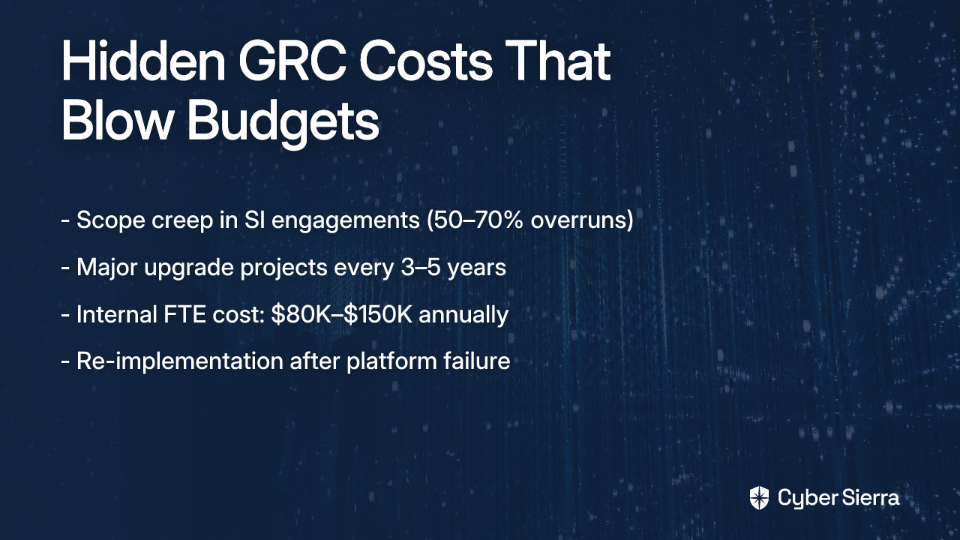
Scope Creep in SI Engagements
This is the primary driver of the 50–70% cost overruns associated with legacy platforms. As the implementation team maps existing workflows during discovery, new requirements emerge that were not captured in the original scope.
Each change request extends the engagement timeline and adds billable hours. CISOs who have been through a legacy GRC deployment often describe the SI relationship as one where the meter is always running.
Major Upgrade Projects
Legacy GRC platforms commonly require a significant version upgrade every three to five years. These are not minor patches, as they often require a re-scoping exercise, regression testing, and a fresh round of configuration work.
In practice, this is a partial re-implementation carrying a budget comparable to the original project. The GRC consulting cost for these cycles is rarely budgeted in Year 1, but it belongs in any 3-year total cost of ownership model.
Internal Resource Allocation
The FTE cost of the GRC analyst or engineer who manages the platform day-to-day is frequently absent from board-level budget discussions. Practitioners regularly describe GRC tool functionalities demanding a dedicated in-house resource to keep workflows current, manage user access, and handle framework updates.
At a fully loaded employee cost, this represents a significant annual expense that can exceed the platform licence itself.
Re-Implementation Risk
High churn is a defining characteristic of the GRC tool market. As one experienced GRC practitioner observed, "I can see why these vendors have high churn because they rarely meet expectations in the long term after the sale." When a platform fails to adapt to real workflows, teams revert to spreadsheets, and the organisation is left writing off the sunk cost and restarting the evaluation process. This re-implementation scenario effectively doubles the cost of GRC implementation for the affected organisation.
The pattern is consistent. Practitioners report that "GRC tools do not effectively automate processes, leading to reliance on spreadsheets," and that "the process is chaotic with too many frameworks and policies scattered across platforms." Both outcomes represent a failed GRC investment, not just a disappointing one.
How to Build a Defensible 3-Year GRC Budget
The following template gives CISOs and VP-level IT leaders a practical structure for presenting a complete GRC implementation cost to a CFO or board. Each year reflects a distinct cost profile.
Year 1: Implementation and Deployment
Formula: Y1 Cost = Platform Licence + SI Fees + Customisation/Integration + Internal Training
For legacy platforms, a conservative approach is to budget non-licence costs at 1.5x to 2x the annual licence fee. If the licence is $120,000, the Year 1 GRC software implementation cost should be presented as $300,000 to $360,000 minimum, before internal headcount.
For platforms that eliminate SI requirements, the Year 1 total cost of GRC implementation drops substantially. The freed budget can be redirected toward internal training and workflow configuration.
Year 2: Stabilisation and Maintenance
Formula: Y2 Cost = Platform Licence + Annual Support Fee (17–22%) + Minor Customisations
Year 2 is typically more predictable. The GRC platform cost stabilises around the licence plus vendor support. Budget a small allocation (5–10% of Year 1 services spend) for adding new workflows or minor integrations as the team reaches operational maturity with the platform. For AI-native platforms, this line item is minimal given the breadth of pre-built integrations available from day one.
Year 3: Optimisation and Potential Upgrade
Formula: Y3 Cost = Platform Licence + Annual Support Fee + Upgrade Costs (if applicable)
Before finalising the Year 3 budget, ask the vendor directly: is a major version upgrade scheduled within the next 36 months? If yes, budget for associated services work. For legacy platforms, this can add $100,000 to $200,000 to the Year 3 GRC consulting cost line. For cloud-native and AI-native platforms operating on continuous delivery models, major upgrade projects are effectively eliminated.
The AI-Native Budgeting Advantage
The budget model changes materially when the platform is architected to remove variable cost drivers. With Cyber Sierra, the Year 1 GRC implementation cost is lower by design with no required SI engagement, numerous pre-built integrations, and faster time-to-value.
The Annual Contract Value of a platform like Cyber Sierra is frequently comparable to the cost of a single Big 4 consulting engagement. The difference is that the platform delivers continuous value and automation across every subsequent year, rather than a one-time advisory output. This structural cost advantage compounds into a meaningfully lower GRC total cost of ownership by Year 3.
From Hidden Fees to a Predictable GRC Budget
The license fee on a GRC proposal is just the starting point. The real costs hide in systems integrator fees, scope creep, and internal headcount, which can double or even triple your initial budget. Legacy platforms, in particular, are built on an expensive services model that makes predictable budgeting nearly impossible.
Your next step is to map your own GRC costs, or a potential vendor's proposal, against the four key drivers from this article: licence, implementation, customization, and support. Identify where the variable costs are.
If you're tired of budgeting for expensive services instead of value-driving technology, it might be time for a new approach. See how an AI-native platform delivers enterprise-grade GRC without the hidden fees. Book a transparent pricing demo to see how Cyber Sierra makes your total cost of ownership clear from day one.
Frequently Asked Questions About GRC Implementation Cost
What is the true cost of a GRC implementation?
The true cost of a GRC implementation includes the platform licence plus systems integrator fees, customisation, integration work, and ongoing maintenance. The licence is often the smallest part, with services adding 50-200% of the licence cost, plus the salary of an internal administrator.
Why are legacy GRC platforms so expensive to implement?
Legacy GRC platforms are expensive due to their outdated architecture, which requires significant investment in systems integrators (SIs) for setup, customisation, and upgrades. This leads to lengthy, costly engagements that can exceed initial project budgets by 50-70% or more.
How can I accurately calculate the 3-year GRC total cost of ownership (TCO)?
To calculate a 3-year TCO, budget for the initial licence and implementation fees in Year 1, ongoing support fees (17-22% of licence) in Year 2, and potential major upgrade costs in Year 3. For legacy platforms, budget implementation services at 1.5-2x the annual licence fee.
What are the biggest hidden costs in a GRC budget?
The biggest hidden costs are scope creep in SI engagements, major platform upgrades every 3-5 years, and the salary for a full-time internal GRC administrator. Scope creep alone can cause 50-70% cost overruns, significantly inflating the total cost of ownership beyond the initial quote.
How do AI-native GRC platforms reduce implementation costs?
AI-native platforms reduce costs by eliminating the need for expensive systems integrator engagements and providing extensive pre-built, day-1 integrations. Their modern, API-first architecture allows faster deployment and removes the variable costs tied to customisation and major upgrades.
What percentage of a GRC budget should be allocated to services vs. the licence?
For legacy platforms, allocate 60-70% of your Year 1 budget to services (implementation, customisation) and only 30-40% to the licence. Modern, AI-native platforms flip this model, as no required SI fees mean the budget is primarily for the platform licence that delivers continuous value.
