



Mastering Cross-Reference Maps in GRC Documents



Join thousands of professionals and get the latest insight on Compliance & Cybersecurity.
You've been tasked with implementing a new compliance framework at your organization. As you dig into the requirements, you're overwhelmed by the sheer volume of controls across multiple standards. How do you organize this chaos? How can you possibly track which internal controls satisfy which external requirements without duplicating efforts or missing critical elements?
If this scenario feels painfully familiar, you're not alone. Many GRC professionals describe this exact situation as "super confusing when I first started" and feel "thrust into" compliance initiatives without clear guidance.
Fortunately, there's a powerful solution: the cross-reference map. This critical but often misunderstood tool transforms compliance chaos into strategic clarity - and this comprehensive guide will show you exactly how to master it.
What is a Cross-Reference Map and Why is it Critical?
A cross-reference map (sometimes called a compliance map) is a table that aligns your organization's internal controls with the requirements of multiple external regulations and frameworks. It serves as a single source of truth for your compliance program.
Think of it as the Rosetta Stone of compliance - translating between different "languages" of regulations to show how a single control in your organization can satisfy requirements across NIST governance risk standards, ISO 27001, PCI-DSS, and other frameworks simultaneously.
The Problems it Solves
Without a proper mapping approach, organizations typically face:
The Strategic Benefits
When properly implemented, cross-reference maps deliver:
- Optimized Compliance: Streamlined audits and reduced redundant efforts
- Enhanced Risk Mitigation: Active identification and remediation of gaps
- Efficient Reporting: A centralized repository of mapped controls expedites audits
- Resource Optimization: Less time spent on compliance, more on strategic initiatives
The Foundation: Preparing to Build Your Map
Before diving into the mapping process, establish a solid foundation with these three preparatory steps:
1. Assemble Your Compliance Team
Cross-reference mapping isn't a solo task. Involve:
- IT security specialists
- Compliance experts
- Legal representatives
- Key department stakeholders (HR, Finance, Operations)
Create a RACI matrix (Responsible, Accountable, Consulted, Informed) to clarify roles and prevent confusion during the mapping process.
2. Define Your Regulatory Universe
Identify all regulations, standards, and frameworks that apply to your organization. This might include:

This step is crucial for professionals who "don't even know what's appropriate to ask for" when beginning compliance work.
3. Inventory Your Existing Controls
Before creating new controls, document what you already have:
- Policies, standards, and SOPs (Standard Operating Procedures)
- Technical controls implemented in your systems (firewall rules, access controls, SIEM alerts)
- Existing documentation from previous audits or assessments
The Step-by-Step Guide to Creating Your Cross-Reference Map
With your foundation in place, it's time to build your cross-reference map. Follow these steps for success:
Step 1: Create Your Central Control Library
Your control library forms the first column of your map—it's your organization's unique set of controls that will be mapped to various frameworks.
Pro-Tip: Start with a widely recognized framework like the NIST Cybersecurity Framework as your foundation. This approach makes it easier to map to other frameworks later.
For each control in your library, include:
- Unique Identifier (e.g., AC-01)
- Descriptive Name (e.g., Unique User Identification)
- Control Objective
- Control Owner
- Implementation Status (Implemented, Not Implemented, In Progress)
Step 2: Build the Cross-Reference Map Table
This is where the actual mapping happens. Create a spreadsheet or use a GRC tool with the following structure:
| Internal Control ID | Control Description & Objective | Control Owner | Implementation Status | Evidence Location | NIST CSF Mapping | ISO 27001 Mapping | PCI DSS Mapping | Notes/Gaps |
|---|---|---|---|---|---|---|---|---|
| AC-01 | All users are issued a unique ID for identification and accountability | IT Department | Implemented | link-to/access-control-sop.pdf | PR.AC-1 | A.9.2.1 | 8.1.1, 8.2.1 | Reviewed Q1 2024 |
| SC-01 | Third-party software is monitored for vulnerabilities | Security Ops | In Progress | link-to/trm-policy.pdf | ID.RA-5, PR.IP-12 | A.15.2.1 | 6.1, 6.2 | New tool needed for automated scanning. Gap identified. |
This table structure transforms abstract requirements into a practical, actionable tool that connects your internal controls to external frameworks.
Step 3: Deep Dive - Mapping to the NIST Cybersecurity Framework (CSF)
Let's explore mapping with the NIST CSF as an example. Many professionals feel NIST CSF is "overkill," but understanding its structure makes mapping straightforward.
The NIST CSF is built on five core functions:
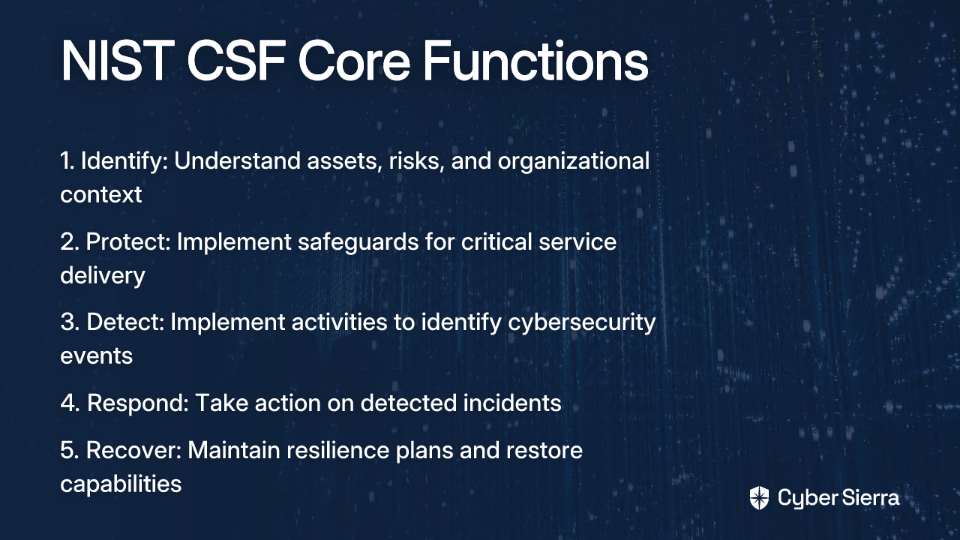
Mapping Example: Your internal control AC-01 (Unique User IDs) maps to NIST CSF Subcategory PR.AC-1, which stands for "Identities and credentials are managed for authorized devices and users" under the Protect function.
The mapping should be based on the control's intent and implementation details. When mapping, use the official NIST CSF documentation to ensure accuracy.
Step 4: Analyze Gaps and Document Rationale
With your initial mapping complete:
- Identify empty cells in your map. These represent potential compliance gaps where a control is needed.
- Document your rationale. For every mapping, explain why you believe Control X satisfies Requirement Y. This documentation is critical during audits.
- Implement remediation plans for identified gaps, using SMART criteria (Specific, Measurable, Achievable, Relevant, Time-bound) to create actionable tasks.
Tools and Best Practices for Mastery
As you become more proficient with cross-reference mapping, consider these approaches and best practices:
Choosing Your Approach
Manual (Spreadsheets)
Many organizations begin with spreadsheets for mapping. While this approach works for smaller compliance programs, it becomes error-prone and difficult to maintain as your regulatory universe expands.
Leverage Harmonized Frameworks
Tools like the Secure Controls Framework (SCF) and Unified Compliance Framework (UCF) provide pre-built mappings between common frameworks, reducing the manual effort required to create these connections.
GRC Platforms (The Modern Solution)
GRC platforms automate the mapping process and provide powerful capabilities:
- ServiceNow GRC and Archer for enterprise environments
- Drata, Vanta, and OneTrust for compliance automation
- Real-time monitoring of control effectiveness
- Centralized dashboards for compliance status
- Automated evidence collection
Technical Peek: How GRC Tools Work
Under the hood, GRC platforms store mappings in database tables (conceptually similar to Oracle's XREF_DATA table). These tools use functions to populate, update, and query these relationships at runtime, allowing for dynamic reporting and analysis without manual lookups.
This approach allows for reverse-engineering of compliance requirements—starting with a specific framework requirement and instantly seeing which internal controls satisfy it, along with their implementation status.
Best Practices for Success
Focus on Common Controls First
Target controls that appear across multiple frameworks to maximize efficiency. For example, access control requirements appear in virtually every framework from NIST governance risk standards to ISO 27001.
Document Implementation and Evidence
Don't just map—note how the control is implemented and where to find the evidence. Link to specific CMDB entries, reports, or SOP documents to streamline future audits.
Engage Auditors Early
Share your mapping approach with auditors to get feedback before audit time. This prevents surprises and ensures your mapping methodology meets their expectations.
Define Your Terms
For maximum clarity in your policies and standards, explicitly reference verb meanings. RFC 2119 defines the precise meaning of terms like MUST, SHOULD, and MAY in technical documentation. Using these standardized terms reduces ambiguity in your evergreen documents and simplifies policy maintenance.
Continuous Monitoring and Updates
Treat your cross-reference map as a living document that requires regular review:
- Update mappings when regulations change
- Revise as internal controls evolve
- Review after each audit for improvement opportunities
Conclusion: Achieving Principled Performance
A well-executed cross-reference map is more than a document—it's a strategic asset that transforms compliance from a reactive, fragmented task into a proactive, unified program. By building and maintaining a comprehensive map, you:
- Streamline audits and assessments
- Enhance your security posture
- Create transparency across the organization
- Move toward a culture of "principled performance"
For professionals pursuing managerial SANS certification or similar credentials, mastering cross-reference maps demonstrates your ability to translate technical controls into business value.
Remember that compliance is not the end goal—it's a byproduct of good governance. Your cross-reference map helps ensure that every control serves a purpose, every requirement is satisfied, and your organization can navigate the complex world of compliance with confidence and clarity.
By following the steps outlined in this guide, you can transform compliance chaos into strategic alignment, allowing your organization to meet its regulatory obligations while optimizing resources and enhancing security.
