



Why Every GRC Platform Sucks (And What CISOs Actually Use Instead)

Join thousands of professionals and get the latest insight on Compliance & Cybersecurity.
You've just signed the purchase order for that shiny new GRC platform. The vendor promised it would streamline your compliance processes, centralize risk management, and provide the executive dashboards your board has been demanding. Fast forward six months, and reality has set in: bloated implementation costs, confused team members, and a growing realization that you've spent seven figures on a system that's more hindrance than help.
Sound familiar? You're not alone.
"I know a lot of CISOs (many hundreds) and not one of them wakes up in the morning and says 'OMG, I'm so glad I spent 2 million dollars on Archer,'" shares one brutally honest security leader in a recent Reddit discussion.
The governance, risk, and compliance technology landscape continues to evolve rapidly, with vendors promising revolutionary solutions to your compliance headaches. Yet behind the slick demos and feature checklists lies an uncomfortable truth: most GRC platforms fundamentally fail to deliver on their promises, leaving organizations with expensive digital paperweights and frustrated security teams.
This article dives into why these platforms consistently underperform, examining the real experiences of CISOs who've been burned by GRC implementations. More importantly, we'll explore what seasoned security professionals are actually using instead—practical alternatives that deliver results without breaking the bank or crushing team morale.
The Four Horsemen of GRC Platform Failure
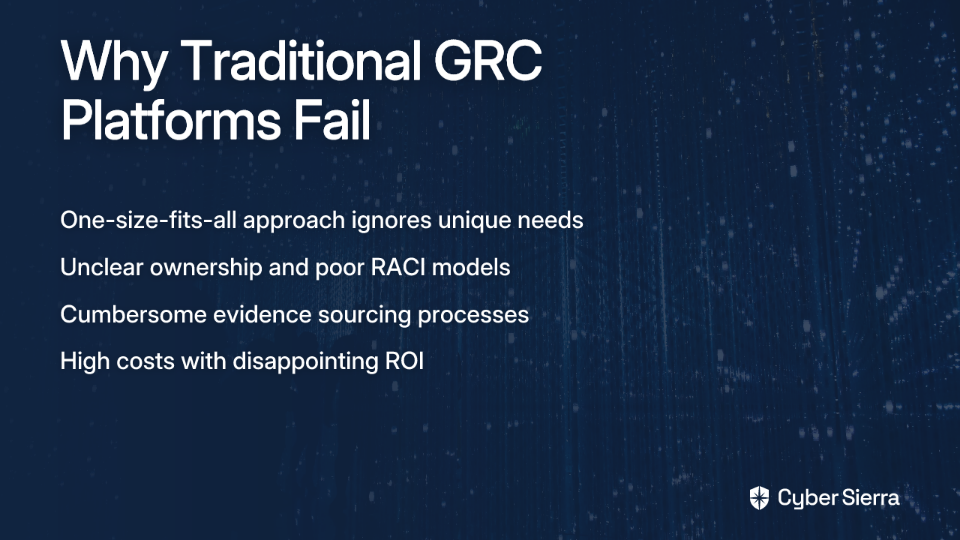
1. The "One-Size-Fits-All" Trap
Most GRC platforms are built on a dangerous assumption: that your organization's risk landscape, compliance requirements, and security processes will neatly fit into their pre-defined categories and workflows.
"Every GRC tool seems to adopt a one-size-fits-all approach that fails to account for our specific risks and compliance needs," laments one cybersecurity professional. This rigidity forces organizations to adapt their processes to fit the tool, rather than the other way around.
The reality is that effective governance and compliance processes must be tailored to your organization's unique regulatory environment, industry requirements, and operational structure. When a platform constrains your ability to implement these customizations, it undermines the very workflows it claims to improve.
Platforms like RSA Archer are frequently criticized for being "overbuilt for security needs," requiring extensive configuration that delays return on investment and complicates daily usage. What begins as a solution eventually becomes another problem to solve.
2. The Ownership Black Hole
GRC implementations frequently collapse due to a fundamental issue: unclear ownership and poor RACI models. Without clearly defined roles for who is Responsible, Accountable, Consulted, and Informed in each process, GRC initiatives quickly become organizational orphans.
"The RACI models provided are too generic and don't fit our specific organizational structure," explains one security leader. "There's no clear ownership of processes, leading to inconsistencies in execution."
This ownership vacuum creates a dangerous scenario where compliance tasks fall through the cracks, risk assessments remain incomplete, and the platform gradually devolves into an expensive repository of outdated information.
James Wade, CISO at MCS, highlights this challenge: "We were a very siloed company... each doing their own thing." Without clear ownership structures bridging these silos, even the most sophisticated GRC platform will fail to deliver a unified risk posture.
3. The Evidence Sourcing Nightmare
At its core, GRC is about demonstrating compliance through evidence collection and validation. Yet this fundamental function becomes a painful bottleneck in most platforms.
"We struggled with evidence sourcing and validation; the platforms make it too cumbersome," shares a frustrated security professional. What should be a streamlined process of collecting, reviewing, and linking evidence to controls instead becomes a bureaucratic nightmare of manual uploads, broken integrations, and duplicated efforts.
This inefficiency doesn't just waste time—it actively undermines compliance efforts. When evidence collection becomes too burdensome, teams inevitably cut corners, documentation quality suffers, and the organization's compliance posture weakens despite significant investments in GRC technology.
4. The Money Pit: High Costs, Low ROI
Perhaps the most damning indictment of traditional GRC platforms is their dismal return on investment. These systems typically come with jaw-dropping price tags—often in the millions for enterprise implementations—yet frequently fail to deliver commensurate value.
"I wasted $2M on Archer and it barely met our needs; complete disappointment," confesses one CISO. This financial disappointment is compounded by weak reporting capabilities that fail to provide actionable insights.
"The reporting features are weak; they don't provide the insights we need for decision-making," notes another security leader. This shortcoming directly contradicts what Parrish Gunnels, CISO of Sunflower Bank, identifies as a critical need: tools that "translate technical risks into business priorities, facilitating better board decision-making."
When a platform fails at this fundamental task of transforming data into insights, its value proposition collapses regardless of how many features it offers or compliance frameworks it supports.
The CISO's Toolkit: What Actually Works?
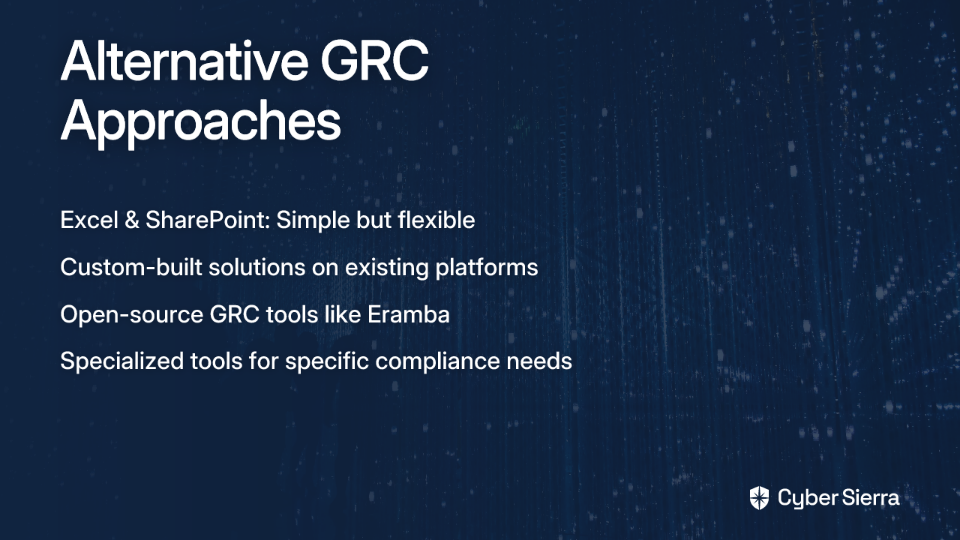
Faced with the consistent disappointment of traditional GRC platforms, what are savvy security leaders using instead? The answers might surprise you.
1. Back to Basics: The Surprising Power of Excel and SharePoint
While vendors might scoff at the notion, many CISOs are finding that tried-and-true tools like Excel and SharePoint offer superior flexibility and value compared to dedicated GRC platforms—particularly for small to mid-sized organizations.
"We use Excel for most of our governance needs because it's flexible and cost-effective," reports one security leader. This back-to-basics approach offers several advantages:
- Unmatched Flexibility: Excel can be adapted to virtually any process or framework without the constraints of pre-defined workflows.
- Universal Accessibility: No specialized training required—most employees already know how to use these tools.
- Cost Efficiency: Leverages existing software licenses rather than requiring additional expenditure.
- Integration Potential: Modern SharePoint and Excel tools offer automation capabilities through Power Automate and other Microsoft integrations.
For organizations tired of complex implementations and restrictive platforms, this pragmatic approach delivers immediate usability without the traditional GRC headaches.
2. The Custom-Built Approach
Some organizations are finding success by building custom GRC solutions on platforms they already use and understand. NetSuite, for instance, has emerged as a viable foundation for custom-built GRC functionality.
These tailored solutions offer precise alignment with business processes and seamless integration with existing ERP and IT systems, effectively addressing the "siloed information" problem that plagues many commercial GRC implementations.
The custom approach works particularly well for organizations with unique compliance requirements or specialized workflows that commercial platforms struggle to accommodate. While it requires more upfront development effort, the resulting solution typically delivers higher user adoption and better long-term value.
3. The Rise of Open-Source: Flexible, Focused, and Community-Driven GRC
Open-source GRC tools are gaining significant traction as cost-effective alternatives to commercial platforms. Leading this movement is Eramba, a mature open-source GRC platform that offers robust capabilities for policy management, risk assessments, and compliance.
"Switching to Eramba has simplified our risk management process significantly," reports one security professional. While Eramba does have a "steep learning curve" and focuses primarily on information security, its flexibility and cost advantages make it an increasingly popular choice.
Other specialized open-source offerings include:
- CISO Assistant: A lighter, user-friendly tool designed specifically for security officers, focusing on control tracking and task assignment.
- VerifyWise: A specialized tool built for the growing field of AI governance, featuring capabilities for AI risk management and compliance with emerging frameworks like the EU AI Act.
These open-source alternatives offer the customization and flexibility that commercial platforms often lack, backed by active communities that continuously improve and extend their capabilities.
Making the Right Choice: A Pragmatic Framework
The uncomfortable truth about GRC tools is that there is no universal "best" solution. The right choice depends entirely on your organization's specific context: size, maturity, regulatory pressures, and technical environment.
Rather than starting with a vendor comparison, begin by clearly defining your requirements:
- Assess Your Needs First: Before evaluating any tool, document your risk management processes, compliance requirements, and RACI model. Understand what you actually need before getting distracted by feature lists.
- Start Simple: Don't default to the most expensive platform. Evaluate if Excel/SharePoint can meet your immediate needs before committing to complex implementations.
- Prioritize Usability and Collaboration: Choose tools your team will actually use. As Jessica Sandy, IT GRC Manager at The University of Chicago notes about their focused GRC solution: "Moving from manual processes to using Isora was a breath of fresh air. What used to take months is now automated, reliable, and defensible."
- Consider Focused Solutions: If your needs are specific (e.g., IT risk, AI governance), explore specialized tools rather than platforms trying to do everything.
The Path Forward
The GRC technology landscape is littered with expensive failures and disappointed customers, but it doesn't have to be this way. By prioritizing practical solutions that fit your specific needs—whether that's Excel, a custom build, or an open-source platform—you can avoid becoming another "$2M Archer regret" statistic.
Effective GRC isn't about having the most expensive platform; it's about establishing clear processes, ownership, and selecting tools that support rather than hinder your team's work. As Deana Robinson from Sonoco Products wisely observes, the goal should be a "structured system that alerts us proactively" instead of creating more work.
In the end, the best GRC solution might not be what vendors are selling—it's what actually works for your organization's unique requirements and culture.
