



7 Governance Risk and Compliance Software Built for Regulated Industries


Join thousands of professionals and get the latest insight on Compliance & Cybersecurity.
Summary
- Generic GRC platforms often require months of manual configuration for regulated industries, creating a time-consuming and frustrating compliance process.
- The most effective GRC tools for BFSI, HealthTech, and Manufacturing provide pre-built templates for frameworks like PCI DSS and HIPAA, deep audit trails, and continuous control validation.
- Prioritize platforms that offer real-time, automated monitoring over periodic manual checks to proactively identify and fix compliance gaps before an audit.
- Cyber Sierra's GRC platform is built for regulated industries, offering pre-mapped controls and continuous monitoring to streamline audit readiness.
If you've ever tried to shoehorn a generic GRC platform into a heavily regulated environment, you already know the pain. You're handed a flexible, "configurable" tool — and then spend the next six months configuring it. Or worse, you bring in a consultant to map your PCI DSS controls by hand, only to recreate the same exercise when an ISO 27001 audit rolls around.
The truth is, most GRC tools are built for generic enterprise use, leaving verticals like Banking, Financial Services & Insurance (BFSI), HealthTech, and Manufacturing to fill the gaps themselves. This frustration is common, with compliance professionals often describing the process as a "mess" due to conflicting requirements from too many teams. Starting a GRC program from scratch — without pre-built frameworks, pre-mapped controls, or automated evidence collection — is one of the most frustrating and time-consuming challenges in the industry today.
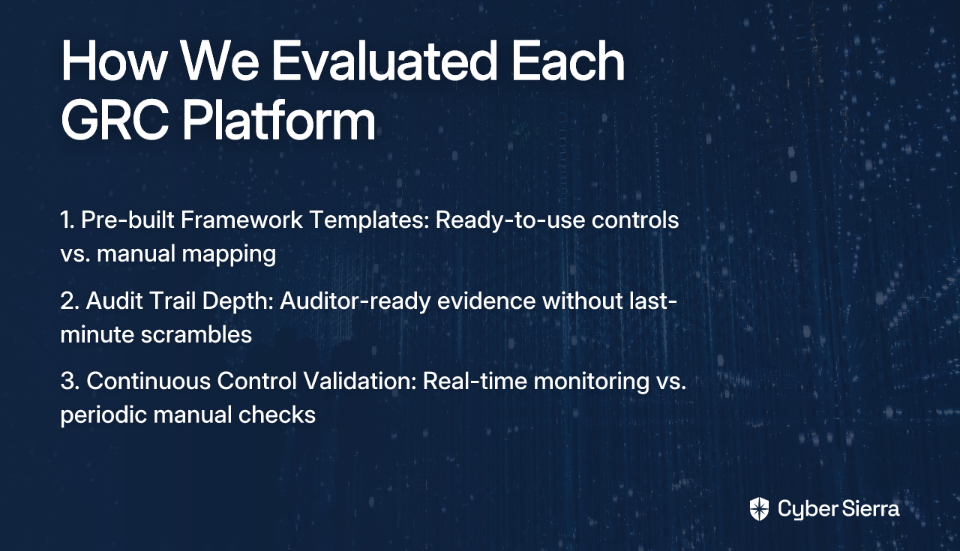
This article cuts through the noise. We've evaluated 7 governance risk and compliance software platforms that go beyond generic checklists, with a specific focus on their performance across three criteria:
- Pre-built framework templates — Does the tool come with ready-to-use controls, or do you map everything yourself?
- Audit trail depth — Can you generate auditor-ready evidence without a last-minute scramble?
- Continuous control validation — Does the platform monitor controls in real-time, or does it rely on periodic, manual checks?
Let's get into it.
GRC Software for Financial Services (BFSI)
Key frameworks: PCI DSS, GDPR
Financial institutions operate under some of the most demanding compliance requirements in the world. Between PCI DSS mandates for cardholder data security and GDPR obligations around data privacy, the margin for error is essentially zero — and the cost of a breach or failed audit is enormous.
1. Cyber Sierra
Best for: BFSI, HealthTech, and Manufacturing teams that need one platform to cover all major frameworks
Cyber Sierra is an AI-enabled cybersecurity and governance and compliance platform designed specifically for regulated industries. Rather than handing you a blank canvas, it arrives with pre-mapped controls across PCI DSS, GDPR, HIPAA, SOC 2, ISO 27001, and NIST — so your compliance team isn't starting from zero.
What makes Cyber Sierra stand out is its native integration of compliance and continuous monitoring into a single platform. The Continuous Control Monitoring (CCM) module provides near real-time visibility into how your controls are performing — detecting exceptions and anomalies as they happen, not during your next quarterly review. This directly addresses one of the most persistent complaints compliance managers have: discovering control failures only when an auditor points them out.
For financial institutions dealing with an extended vendor ecosystem, the Third-Party Risk Management (TPRM) module adds another layer of value, automating vendor assessments and providing ongoing visibility into third-party security posture — a critical capability when a single vendor failure can trigger regulatory scrutiny.
Cyber Sierra has also been recognized by Gartner® in the Hype Cycle™ for Cyber-Risk Management, 2024, underscoring its growing position as a credible player in the compliance automation space.
Evaluation Scorecard:
| Criteria | Rating |
|---|---|
| Pre-built Framework Templates | ⭐⭐⭐⭐⭐ Excellent |
| Audit Trail Depth | ⭐⭐⭐⭐⭐ Detailed & auditor-ready |
| Continuous Control Validation | ✅ Yes — native CCM module |
2. MetricStream
Best for: Large, mature financial institutions with complex, multi-jurisdictional compliance needs
MetricStream is one of the more established names in enterprise GRC. Its Connected GRC approach unifies risk, compliance, audit, and cyber risk functions in a single platform — a genuine advantage for organizations managing multiple business units or operating across several regulatory jurisdictions.
MetricStream's AI capabilities are worth noting: the platform offers automated regulatory change management, which helps compliance teams track shifting requirements under GDPR and other frameworks without manual effort. For large banks and insurers, the depth of its audit functionality is enterprise-grade and built to withstand intense regulatory scrutiny.
The trade-off is that MetricStream's breadth often comes with complexity. Initial configuration is more involved than a purpose-built compliance automation tool, and the platform is typically better suited to organizations with dedicated GRC personnel.
Evaluation Scorecard:
| Criteria | Rating |
|---|---|
| Pre-built Framework Templates | ⭐⭐⭐⭐ Good |
| Audit Trail Depth | ⭐⭐⭐⭐⭐ Extensive |
| Continuous Control Validation | ✅ Yes — AI-driven risk intelligence |
GRC Software for Healthcare (HealthTech)
Key frameworks: HIPAA, SOC 2
Healthcare organizations face a unique compliance burden. HIPAA violations carry steep financial penalties and reputational damage, while SOC 2 has become a gating requirement for HealthTech vendors selling into enterprise health systems. The challenge is managing both — often with lean compliance teams and limited tooling budgets.
3. AuditBoard
Best for: Healthcare organizations with a strong internal audit function
AuditBoard has earned a strong reputation for making the audit process less painful. Its intuitive interface and collaborative workflow tools are built around how audit teams actually work — gathering evidence, assigning tasks, tracking remediation — rather than how software architects imagine they work.
For HIPAA and SOC 2 compliance, AuditBoard's audit planning and execution capabilities are genuinely strong. It centralizes communication between compliance and operational teams, which matters when you're trying to collect evidence from clinical staff who aren't thinking about your audit timeline.
Where AuditBoard is more limited is in continuous, technical control validation. The platform excels at workflow automation and evidence management, but it isn't designed to continuously poll your infrastructure for control failures the way a dedicated CCM solution would. That's a real gap for HealthTech companies that need real-time visibility rather than periodic check-ins.
Evaluation Scorecard:
| Criteria | Rating |
|---|---|
| Pre-built Framework Templates | ⭐⭐⭐⭐ Strong |
| Audit Trail Depth | ⭐⭐⭐⭐⭐ Excellent — audit-native design |
| Continuous Control Validation | ⚠️ Partial — workflow-focused |

4. Quantivate GRC Suite
Best for: Mid-sized healthcare and financial services organizations managing fragmented compliance data
Quantivate positions itself as a scalable GRC suite that tackles one of compliance management's most persistent problems: data fragmentation. When your risk data lives in spreadsheets, your policy documents sit in SharePoint, and your audit evidence is scattered across email threads, pulling together a coherent compliance picture is nearly impossible. Quantivate's integrated modules — covering enterprise risk, compliance, and vendor management — are designed to consolidate this.
For healthcare organizations, Quantivate's compliance solution supports HIPAA and GDPR, with policy and document management capabilities that help organizations maintain traceable, auditor-ready records. Its IT risk management module adds automated risk assessments and integrates with operational resilience management — useful for providers managing complex IT environments.
The caveat: Quantivate is more configurable than prescriptive. You'll get a solid foundation, but mapping it precisely to HIPAA's specific technical safeguard requirements will still require some setup work.
Evaluation Scorecard:
| Criteria | Rating |
|---|---|
| Pre-built Framework Templates | ⭐⭐⭐ Configurable |
| Audit Trail Depth | ⭐⭐⭐⭐ Good |
| Continuous Control Validation | ⚠️ Partial — automated workflows, not real-time technical monitoring |
GRC Software for Manufacturing
Key frameworks: ISO 27001, NIST
Manufacturing is increasingly a cybersecurity target. As operational technology (OT) converges with IT, and as supply chains become more digitally connected, the attack surface expands rapidly. ISO 27001 and NIST frameworks provide essential structure, but many GRC tools weren't designed with manufacturing's OT environment or supply chain complexity in mind.
5. ServiceNow GRC
Best for: Manufacturing organizations already running the ServiceNow ecosystem
If your organization is already using ServiceNow for IT service management, ServiceNow GRC is a natural extension. Its strength lies in how deeply it integrates risk and compliance management into daily IT workflows — connecting GRC to incident management, change management, and IT operations in ways that most standalone GRC tools simply can't replicate.
For ISO 27001 and NIST compliance in manufacturing, ServiceNow GRC's no-code workflow automation allows organizations to build compliance processes that mirror their actual operations. And because it sits on the Now Platform, audit trails are rich and comprehensive — every workflow action, approval, and exception is logged automatically.
The limitation is platform dependency. For organizations not already in the ServiceNow ecosystem, onboarding is significant, and the cost reflects its enterprise positioning.
Evaluation Scorecard:
| Criteria | Rating |
|---|---|
| Pre-built Framework Templates | ⭐⭐⭐⭐ Strong |
| Audit Trail Depth | ⭐⭐⭐⭐⭐ Very strong — native platform logging |
| Continuous Control Validation | ✅ Yes — via ITOM and SecOps integration |
6. Archer
Best for: Large manufacturing enterprises with mature, formal risk management programs
Archer is one of the longest-standing names in Integrated Risk Management (IRM), and its content library is unmatched in breadth. For manufacturers navigating ISO standards, NIST frameworks, and operational risk requirements simultaneously, Archer's pre-built content packs and customizable reporting tools provide a comprehensive starting point.
Archer is particularly strong at the enterprise level — managing risk across complex organizational structures, reporting up to board level, and supporting the kind of formal risk governance that regulators expect from large manufacturers. Its customizable dashboards make it easier to translate compliance data into language that resonates with non-technical stakeholders.
The trade-off is that Archer's continuous control validation relies more on rules-based automation and data integrations than on native, agent-based monitoring — something to weigh if real-time technical control visibility is a priority.
Evaluation Scorecard:
| Criteria | Rating |
|---|---|
| Pre-built Framework Templates | ⭐⭐⭐⭐⭐ Extensive |
| Audit Trail Depth | ⭐⭐⭐⭐⭐ Enterprise-grade |
| Continuous Control Validation | ⚠️ Partial — rules-based, not native agent monitoring |
7. Delve
Best for: Modern, tech-forward manufacturers pursuing ISO 27001 or SOC 2 for the first time
Delve takes an AI-first approach to compliance automation. Its agents automate evidence collection, continuous monitoring, and compliance workflows — with the company claiming up to a 75% reduction in time spent on compliance tasks. For lean teams without a dedicated compliance department, that's a meaningful efficiency gain.
Delve's ISO 27001 offering is particularly well-suited for manufacturers entering formal certification for the first time: it strips out irrelevant controls, focuses effort where it matters, and pairs automation with 1:1 expert support via Slack. It also supports SOC 2, GDPR, and PCI DSS, making it a versatile choice for growing organizations.
Evaluation Scorecard:
| Criteria | Rating |
|---|---|
| Pre-built Framework Templates | ⭐⭐⭐⭐ Good — tailored per framework |
| Audit Trail Depth | ⭐⭐⭐⭐ Good — auto-collected evidence |
| Continuous Control Validation | ✅ Yes — AI-driven |
Framework Coverage Comparison Table
Here's a summary of how each platform stacks up against our evaluation criteria.
| Tool | Primary Industries | Key Frameworks | Pre-built Templates | Audit Trail Depth | Continuous Control Validation |
|---|---|---|---|---|---|
| Cyber Sierra | BFSI, HealthTech, Manufacturing | PCI DSS, GDPR, HIPAA, SOC 2, ISO 27001, NIST | ⭐⭐⭐⭐⭐ Excellent | ⭐⭐⭐⭐⭐ Detailed | ✅ Yes |
| MetricStream | BFSI, Enterprise | SOX, GDPR, ISO 27001 | ⭐⭐⭐⭐ Good | ⭐⭐⭐⭐⭐ Extensive | ✅ Yes |
| AuditBoard | Healthcare, Enterprise | HIPAA, SOC 2, SOX | ⭐⭐⭐⭐ Strong | ⭐⭐⭐⭐⭐ Excellent | ⚠️ Partial |
| Quantivate | BFSI, Healthcare | HIPAA, GDPR, Custom | ⭐⭐⭐ Configurable | ⭐⭐⭐⭐ Good | ⚠️ Partial |
| ServiceNow GRC | Manufacturing, IT | ISO 27001, NIST | ⭐⭐⭐⭐ Strong | ⭐⭐⭐⭐⭐ Very Strong | ✅ Yes |
| Archer | Manufacturing, Enterprise | ISO standards, NIST | ⭐⭐⭐⭐⭐ Extensive | ⭐⭐⭐⭐⭐ Extensive | ⚠️ Partial |
| Delve | Tech, Mid-Market | ISO 27001, SOC 2, GDPR, PCI DSS | ⭐⭐⭐⭐ Good | ⭐⭐⭐⭐ Good | ✅ Yes |
Shift From Annual Audits to Continuous Compliance
Choosing the right GRC platform boils down to a single principle: stop preparing for audits and start maintaining continuous compliance. Generic tools that require months of manual configuration for your specific industry are a time sink.
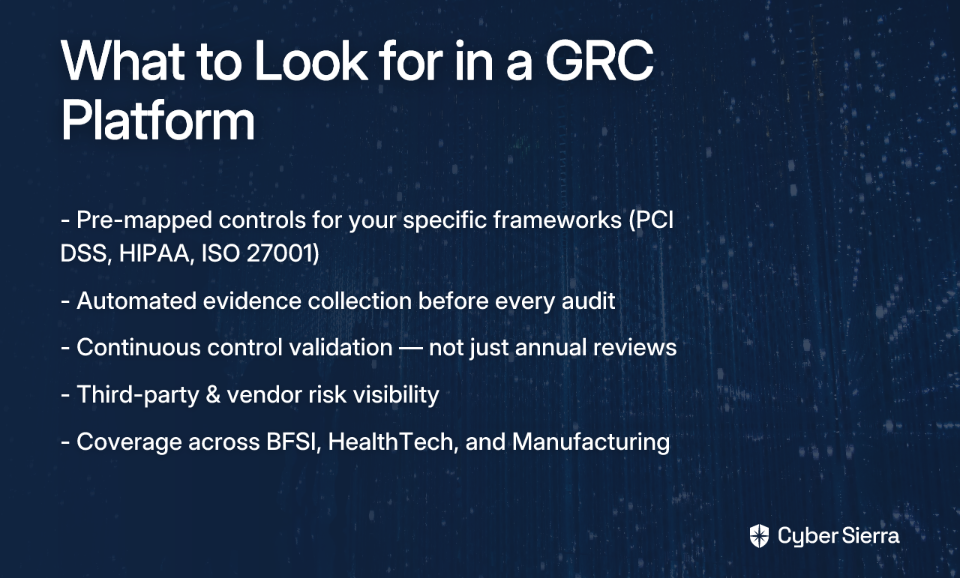
The most effective platforms for BFSI, HealthTech, and Manufacturing deliver three core advantages out of the box:
- Pre-mapped controls for frameworks like PCI DSS and HIPAA, eliminating guesswork.
- Automated evidence collection that saves your team from last-minute scrambles.
- Continuous control validation to catch compliance gaps as they happen, not when an auditor finds them.
Here’s a practical next step: calculate the hours your team spent manually gathering evidence for your last audit. That number represents the real cost of a GRC tool that isn't built for your reality.
When you’re ready to reclaim that time and move from periodic checks to a state of constant audit-readiness, book a tailored demo and see how Cyber Sierra streamlines compliance for regulated industries.
Frequently Asked Questions
What is GRC software and why is it important for regulated industries?
GRC (Governance, Risk, and Compliance) software helps organizations manage policies, assess risks, and comply with regulations. For regulated industries, it is crucial for centralizing compliance, automating evidence collection, and providing a clear audit trail to reduce manual work and penalties.
What are the most important features in GRC software for BFSI or HealthTech?
The most important features are pre-built framework templates, deep audit trail capabilities, and continuous control validation. These ensure you are always audit-ready, save months of setup on frameworks like PCI DSS or HIPAA, and spot issues in real-time rather than during annual reviews.
How does continuous control validation improve compliance?
Continuous control validation automatically monitors your security controls in real-time, unlike traditional periodic checks. This proactive approach allows you to detect and remediate compliance gaps as they happen, preventing minor issues from becoming major failures discovered during an audit.
Why are pre-built framework templates so critical?
Pre-built framework templates provide ready-to-use controls mapped to specific regulations like ISO 27001 or SOC 2. Instead of building your program from scratch, your team can start immediately with established best practices, reducing errors and accelerating your path to being audit-ready.
Can one GRC tool manage multiple frameworks like GDPR and SOC 2 simultaneously?
Yes, modern GRC platforms are designed to manage multiple compliance frameworks from a single dashboard. Tools with pre-mapped controls that overlap between frameworks allow you to "test once, comply with many," saving your team from duplicating evidence collection and management efforts.
What is the difference between GRC and Integrated Risk Management (IRM)?
GRC focuses on managing governance, risk, and compliance within specific operational silos, while Integrated Risk Management (IRM) takes a more holistic, enterprise-wide view. IRM connects risk management to broader business strategy, creating a more comprehensive risk-aware culture.
