



Tool Complexity and Poor Usability: The Hidden Cost in GRC Cybersecurity



Join thousands of professionals and get the latest insight on Compliance & Cybersecurity.
You've just spent hours navigating through your organization's Governance, Risk, and Compliance (GRC) platform, clicking through countless tabs and menus to generate a simple compliance report. Your frustration mounts as you realize that a task that should take minutes has consumed nearly a third of your workday. The cluttered interface, unintuitive navigation, and overwhelming array of features have once again hindered your ability to focus on what truly matters – analyzing and mitigating risk.
This scenario plays out daily for compliance officers and cybersecurity professionals across industries. In fact, research indicates that compliance officers currently spend a staggering 31% of their time simply navigating platform features rather than performing critical risk analysis. This operational inefficiency isn't just an annoyance – it represents a significant hidden cost in both productivity and security effectiveness.
The Growing Complexity Crisis in GRC Tools
The cybersecurity landscape has witnessed an exponential increase in tool complexity over the past decade. Organizations now juggle an average of 15-20 security tools for small entities, with large enterprises managing 130 or more different solutions. Yet, studies reveal that organizations typically utilize only 10-20% of the technology they own, creating a perfect storm of underutilization and overwhelming complexity.
"Excessive preemptive complexity without clear scoping leads to unmanageable software," notes one cybersecurity professional in a recent discussion. This sentiment echoes across the industry, where the tendency to over-engineer tools has resulted in added complexity that users find burdensome and confusing.
The consequences of this complexity extend far beyond mere frustration:

- Decreased Productivity: When professionals spend nearly a third of their time navigating tools rather than performing their core responsibilities, operational efficiency plummets.
- Increased Error Rates: Confusing interfaces and cluttered dashboards lead to higher rates of user error, potentially creating security gaps or compliance oversights.
- Extended Training Periods: Complex tools require more extensive training, increasing onboarding costs and delaying time-to-productivity for new team members.
- Reduced Adoption: When tools are difficult to use, professionals may seek workarounds or avoid using them altogether, undermining the very purpose of GRC initiatives.
The Real-World Impact on Compliance Teams
For compliance officers and GRC professionals, the frustration with poor usability extends beyond personal inconvenience. The integration challenges and fragmented interfaces directly impact their ability to effectively manage organizational risk.
"GRC professionals often face underestimation from engineers," reports one industry insider, highlighting how the perception that GRC roles are less critical leads to poor usability in tools designed for compliance and governance. This disconnect creates a vicious cycle where compliance teams struggle with inadequate tools while simultaneously facing increased expectations for security oversight.
One compliance manager shared their experience: "Cluttered and inconsistent layouts create a confusing browsing experience," making it difficult to maintain a comprehensive view of the organization's compliance posture. When interfaces lack focus on user-centered design, they become overwhelming and hard to navigate, particularly during high-pressure scenarios like security incidents or audit preparations.
The impact becomes particularly evident during critical compliance periods:
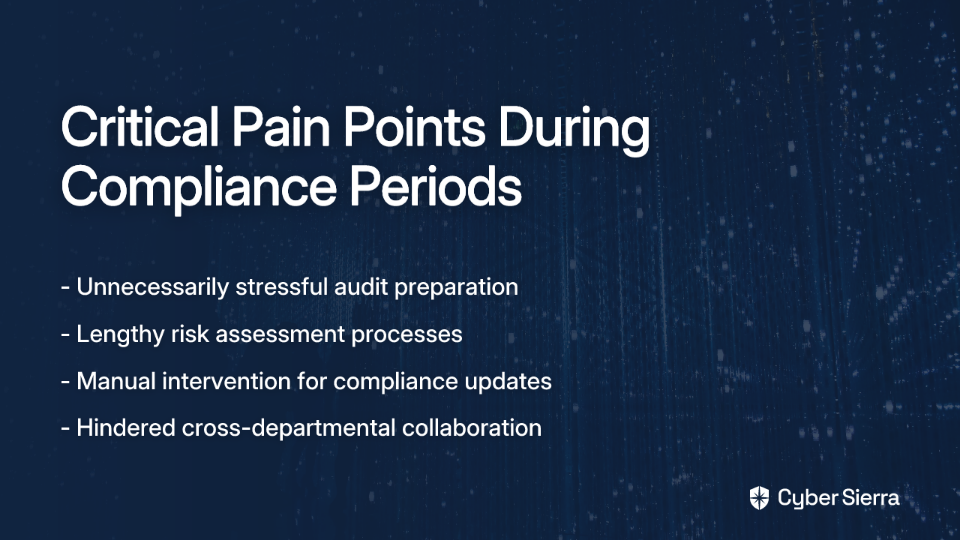
- Audit preparation becomes unnecessarily stressful as teams struggle to generate required reports
- Risk assessments take longer to complete, potentially missing emerging threats
- Compliance updates require extensive manual intervention rather than streamlined workflows
- Cross-departmental collaboration suffers when interfaces aren't intuitive for all stakeholders
How Cyber Sierra Addresses GRC Usability Challenges
Cyber Sierra has recognized these pain points and developed its GRC platform with usability at the forefront. Unlike traditional GRC tools that prioritize feature bloat over user experience, Cyber Sierra takes a fundamentally different approach by focusing on intuitive design and automation.
Streamlined, Intuitive Interface
Cyber Sierra's platform features a clean, uncluttered interface that prioritizes the most common user tasks and workflows. By applying user-centered design principles, the platform allows compliance officers to locate essential tools quickly without frustration.
The dashboard presents a clear overview of compliance status across various frameworks, with intuitive drill-down capabilities that maintain context as users navigate deeper. This thoughtful design eliminates the confusion that plagues many competing platforms.
Powerful Automation for Routine Tasks
Perhaps most importantly, Cyber Sierra leverages automation to reduce the time spent on repetitive compliance tasks. This directly addresses the 31% time-waste statistic by automating evidence collection, control mapping, and report generation.
By automatically gathering and categorizing compliance evidence from various sources, Cyber Sierra eliminates the manual effort typically required. This automation extends to mapping controls across multiple frameworks, so compliance officers don't need to duplicate efforts when dealing with overlapping requirements from NIST, ISO, SOC 2, and other standards.
Enhanced Visibility Through Integration
Cyber Sierra's platform seamlessly integrates with existing security tools and data sources, providing a unified view of the organization's cybersecurity environment. This integration is crucial for maintaining compliance across multiple frameworks and avoiding the blind spots that often occur with fragmented systems.
As one security professional noted, "Integration challenges create significant obstacles for users, complicating their tasks and increasing frustration." Cyber Sierra addresses this directly by offering pre-built connectors for common security tools, ensuring that compliance officers have comprehensive visibility without complex configuration.
Real-World Impact: A Case Study
A mid-sized financial services organization previously struggled with their legacy GRC platform, with compliance officers spending almost 40% of their time navigating the system rather than performing meaningful risk analysis. After implementing Cyber Sierra's solution, they reported:
- A reduction in time spent on navigation and data retrieval from 31% to less than 10%
- 65% faster audit preparation cycles
- Significantly improved user satisfaction scores among the compliance team
- More proactive risk management due to time freed up from administrative tasks

Best Practices for Reducing Tool Complexity in GRC
While Cyber Sierra provides a comprehensive solution to GRC usability challenges, organizations can also adopt several best practices to reduce complexity in their existing environments:
1. Prioritize User-Centered Design
As one cybersecurity expert noted, "UX researchers, behavioral experts, and UX designers are still too little engaged in cybersecurity challenges." Involving these professionals in the selection and configuration of GRC tools can dramatically improve usability. Consider:
- Conducting usability testing with actual end-users
- Mapping common workflows to minimize clicks and navigation
- Customizing dashboards for different user roles to reduce clutter
2. Apply the YAGNI Principle
"YAGNI (You Aren't Gonna Need It) principles should be applied when designing a system," suggests one developer. This approach focuses on implementing only what is currently necessary rather than attempting to anticipate every possible future requirement. For GRC tools, this means:
- Enabling only the modules and features currently in use
- Configuring dashboards to show only relevant controls and metrics
- Removing unnecessary fields and options that create visual noise
3. Implement Regular Tool Assessment
Regularly evaluate your GRC tools to identify redundancies and usability issues. Consider questions like:

- Are there multiple tools serving the same function?
- Which tools have the highest adoption rates and why?
- What features are used most frequently, and how can access to them be streamlined?
Conclusion
Tool complexity and poor usability represent significant operational pain points in GRC cybersecurity, with compliance officers wasting nearly a third of their time navigating cumbersome platforms rather than focusing on risk analysis. This inefficiency not only impacts productivity but also potentially undermines security effectiveness.
Cyber Sierra addresses these challenges through its intuitive interface, powerful automation capabilities, and seamless integration with existing security infrastructure. By prioritizing usability alongside functionality, Cyber Sierra enables compliance officers to focus on what truly matters – protecting their organizations through effective risk management and compliance oversight.
As cybersecurity threats continue to evolve and regulatory requirements multiply, the value of usable, efficient GRC tools will only increase. Organizations that prioritize usability in their GRC strategy will not only improve operational efficiency but also enhance their overall security posture in an increasingly complex threat landscape.
Frequently Asked Questions
What is the biggest challenge with current GRC tools?
The biggest challenge is excessive complexity and poor usability. Many GRC tools are over-engineered with cluttered interfaces and unintuitive navigation, making it difficult for compliance officers and cybersecurity professionals to perform critical tasks efficiently. This often consumes significant time that could be better spent on strategic risk analysis and mitigation.
How much time do professionals typically waste on GRC tool navigation?
Professionals spend approximately 31% of their time navigating GRC platform features rather than performing critical risk analysis. This significant time wastage is due to complex interfaces and inefficient workflows, leading to decreased productivity and potential security oversights as users struggle to find information or generate reports.
How does Cyber Sierra improve GRC tool usability?
Cyber Sierra improves GRC tool usability through its streamlined, intuitive interface and powerful automation capabilities. The platform is built with user-centered design principles, offering a clean dashboard and easy navigation. Key tasks like evidence collection, control mapping, and report generation are automated, drastically reducing manual effort and allowing professionals to focus on strategic GRC activities.
What are the main benefits of using a user-friendly GRC platform like Cyber Sierra?
The main benefits include increased productivity, reduced error rates, faster audit preparation, and improved risk management. By simplifying complex GRC processes, Cyber Sierra allows teams to accomplish more in less time. An intuitive interface minimizes mistakes, while automation speeds up compliance cycles, freeing up professionals to proactively address risks.
Can Cyber Sierra integrate with my existing security tools?
Yes, Cyber Sierra is designed to seamlessly integrate with existing security tools and data sources. It offers pre-built connectors for common security tools, providing a unified view of an organization's cybersecurity environment. This integration eliminates data silos and ensures comprehensive visibility for effective compliance management across multiple frameworks.
Why is automation important in a GRC platform?
Automation is important because it significantly reduces the time spent on repetitive, manual compliance tasks. Tasks such as evidence collection, mapping controls across different frameworks (like NIST, ISO, SOC 2), and report generation can be automated. This saves valuable time, reduces human error, ensures consistency, and allows compliance teams to focus on higher-value strategic work.
What steps can I take to reduce GRC tool complexity in my organization?
You can prioritize user-centered design in tool selection, apply the YAGNI (You Aren't Gonna Need It) principle to features, and conduct regular tool assessments. Involving UX experts, implementing only necessary functionalities, and regularly reviewing your toolset to eliminate redundancies and streamline access can significantly improve usability.

For more information on how Cyber Sierra can help your organization overcome GRC usability challenges, visit cybersierra.co/platform-governance-risk-compliance/
