



8 Best HIPAA Compliance Automation Software for HealthTech Teams

Join thousands of professionals and get the latest insight on Compliance & Cybersecurity.
Summary
- Effective HIPAA compliance automation can reduce manual evidence collection and monitoring work by up to 80%.
- These tools handle the mechanical work of compliance, such as evidence gathering and continuous monitoring, freeing up your team for strategic risk management.
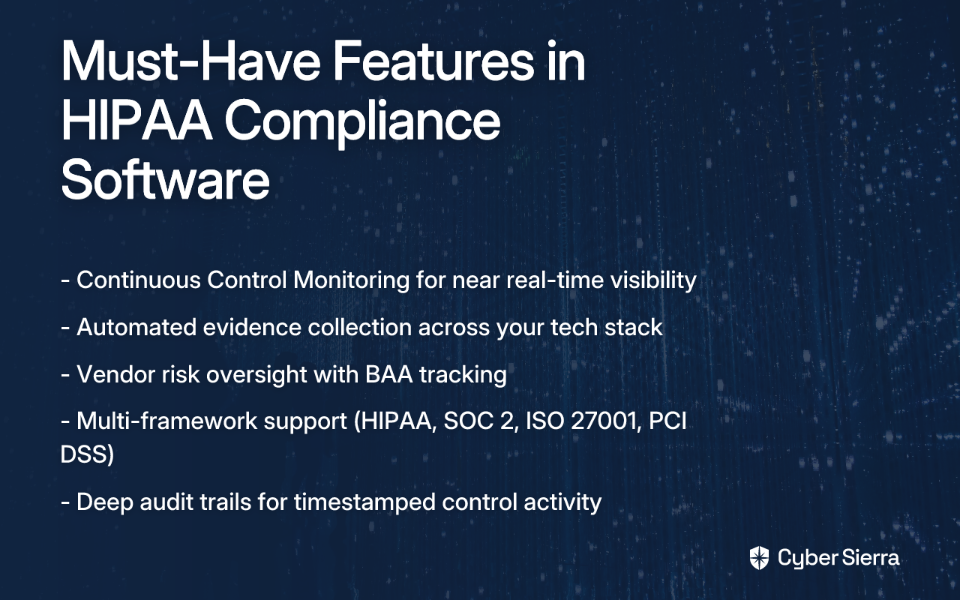
- Key features to look for include continuous control monitoring, automated evidence collection, vendor risk management, and support for multiple frameworks (e.g., SOC 2, ISO 27001).
- For HealthTech companies juggling multiple frameworks, a unified platform like Cyber Sierra streamlines compliance by integrating GRC, continuous monitoring, and third-party risk management.
Your compliance team didn't sign up to spend three weeks hunting down screenshots, chasing control owners for attestations, and manually mapping the same controls across four overlapping frameworks. Yet that's exactly where most HealthTech compliance programs are stuck. The best setups have cut manual compliance work by 70–80%—but getting there requires choosing the right tooling.
The honest truth is that full plug-and-play HIPAA automation is still a myth. Automation enforces the rules; humans still define them. What the best HIPAA compliance automation software actually does is eliminate the mechanical grunt work — evidence collection, continuous control monitoring, access log reviews, audit trail maintenance — so your team can focus on the judgment calls that genuinely require human expertise.
This article reviews eight platforms evaluated on the criteria that matter most to HealthTech compliance teams: continuous control monitoring, audit trail depth, vendor risk oversight, and multi-framework support.
What To Look For in HIPAA Compliance Automation Software
Not every platform that claims "HIPAA compliance automation" solves the same problems. The features below separate tools that genuinely reduce compliance burden from those that simply digitize manual processes.
Comparing the Top HIPAA Compliance Automation Tools
Here's how the eight platforms stack up on the criteria that matter most to HealthTech compliance teams.
| Software | Continuous Monitoring | Audit Trail Depth | Vendor Risk Oversight | Multi-Framework Support |
|---|---|---|---|---|
| Cyber Sierra | Near real-time | Deep | Automated, continuous | HIPAA, SOC 2, ISO 27001, PCI DSS, GDPR, NIST CSF |
| Drata | Yes | Robust | Limited | HIPAA, SOC 2, ISO 27001 |
| Vanta | Yes | Moderate | Yes | HIPAA, SOC 2, ISO 27001 |
| Sprinto | Yes | Moderate | Yes | HIPAA, SOC 2, ISO 27001 |
| Scrut Automation | Yes | Moderate | Yes | HIPAA, SOC 2, ISO 27001 |
| Compliancy Group | Basic | Moderate | Yes | HIPAA only |
| Hyperproof | Yes | Moderate | Yes | HIPAA, SOC 2, ISO 27001, NIST CSF |
| OneTrust | Yes | Deep | Yes | GDPR, HIPAA, and others |
The 8 Best HIPAA Compliance Automation Software Options
The platforms below represent the strongest options for HealthTech teams evaluating HIPAA compliance automation. Each has been assessed on the criteria outlined above, with notes on where each tool excels and what type of organization it suits best.
1. Cyber Sierra
Best for: HealthTech enterprises managing HIPAA alongside SOC 2, ISO 27001, or other frameworks. Supported frameworks: HIPAA, SOC 2, ISO 27001, PCI DSS, GDPR, NIST CSF. Deployment: Cloud-based SaaS.
Cyber Sierra is an AI-enabled cybersecurity platform that unifies Governance, Risk, and Compliance (GRC), Continuous Control Monitoring (CCM), and Third-Party Risk Management (TPRM) into a single platform. Its core differentiator is near real-time visibility into your security posture — moving HIPAA compliance from a periodic fire drill to a continuously monitored, automated program.
For HealthTech organizations juggling multiple frameworks, this matters enormously. Rather than maintaining separate evidence repositories for HIPAA and SOC 2, Cyber Sierra's GRC module maps overlapping controls automatically, reducing duplicated effort and accelerating audit readiness. Cyber Sierra was recognized as a Sample Vendor in the Gartner® Hype Cycle™ for Cyber-Risk Management, 2024, and holds ISO 27001 certification itself.
Key features:
- Near real-time control monitoring. The CCM module builds a centralized control repository, continuously validates control effectiveness, and detects exceptions as they occur — not during the next quarterly review.
- Automated evidence collection. Integrates across your tech stack to pull compliance evidence continuously, so audit prep stops being a weeks-long scramble.
- Third-party risk management. The TPRM module automates vendor assessments, tracks BAAs, and provides near 24/7 visibility into vendor security compliance — addressing the vendor risk blind spot that causes the most expensive HIPAA breaches.
- Multi-framework GRC automation. Manages HIPAA alongside SOC 2, ISO 27001, PCI DSS, GDPR, and NIST CSF from a single platform, with automated reporting and detailed audit trails.
2. Drata
Best for: Tech-forward healthcare organizations prioritizing deep integration coverage. Supported frameworks: HIPAA, SOC 2, ISO 27001. Deployment: Cloud-based SaaS.
Drata is a well-regarded compliance automation platform known for its extensive library of over 200 native integrations, which allows it to pull evidence continuously from across a complex tech stack. For HealthTech companies using a broad mix of cloud services and developer tooling, Drata's integration depth is a genuine strength.
Key features:
- Continuous automated evidence collection. Connects to hundreds of systems and keeps compliance documentation current without manual intervention.
- Audit Hub. Provides a dedicated, auditor-facing workspace where all evidence and reports are securely accessible, significantly reducing back-and-forth during audits.
- AI questionnaire assistance. Helps teams respond to security questionnaires faster, reducing the overhead of vendor due diligence requests.
3. Vanta
Best for: Healthcare technology startups and mid-sized organizations building compliance programs quickly. Supported frameworks: HIPAA, SOC 2, ISO 27001. Deployment: Cloud-based SaaS.
Vanta is known for its accessible interface and its ability to automate a substantial portion of the evidence collection required for security audits. It runs frequent automated checks against connected systems to detect configuration drift, making it a practical choice for organizations that need to achieve compliance fast and maintain it with a lean team.
Key features:
- Broad native integrations. Automatically pulls evidence from cloud providers, HR platforms, and developer tools to minimize manual collection.
- Frequent automated testing. Runs recurring checks against your environment to surface misconfigurations before they become compliance gaps.
- Vendor management workflows. Includes tools for assessing third-party risks and tracking vendor security posture.
4. Sprinto
Best for: SaaS-based HealthTech companies needing fast audit readiness and a customer-facing trust signal. Supported frameworks: HIPAA, SOC 2, ISO 27001. Deployment: Cloud-based SaaS.
Sprinto automates HIPAA compliance by continuously monitoring controls and flagging issues as they arise. One of its more distinctive features is a one-click Trust Center, which lets organizations share real-time compliance status with prospects and customers — useful for HealthTech companies where security posture is a sales differentiator.
Key features:
- Continuous control monitoring. Automatically detects and alerts on policy drift and control failures across the environment.
- Vendor security oversight. Tracks vendor security posture and provides alerts for third-party risk changes.
- Trust Center. Allows instant creation of a public-facing compliance page populated with live security status data.
5. Scrut Automation
Best for: Cloud-native HealthTech companies managing overlapping compliance frameworks. Supported frameworks: HIPAA, SOC 2, ISO 27001. Deployment: Cloud-based SaaS.
Scrut Automation's unified control library is its standout capability — teams can map controls across HIPAA, SOC 2, and ISO 27001 simultaneously, eliminating the redundant work that comes from treating each framework as a separate project. This makes it particularly efficient for compliance managers dealing with framework overlap confusion.
Key features:
- Unified control library. Manages controls for multiple frameworks from a single repository, reducing duplicated effort.
- Automated evidence gathering. Monitors technical safeguards in near real-time to track compliance without manual intervention.
- Vendor risk management. Streamlined workflows for overseeing Business Associate compliance and risk posture.
6. Compliancy Group
Best for: Smaller healthcare practices without a dedicated compliance team. Supported frameworks: HIPAA only. Deployment: Cloud-based SaaS.
Compliancy Group takes a guided, workflow-driven approach to HIPAA compliance. It's designed for organizations that need structure and step-by-step support rather than a flexible, enterprise-grade platform. If your primary goal is achieving HIPAA compliance without extensive technical resources, its simplicity is an advantage.
Key features:
- Guided compliance dashboard. Provides a clear view of training completion, risk assessment progress, and remediation tasks.
- BAA management. Maintains logs of third-party agreements and tracks annual review requirements.
- Incident management. Facilitates the documentation, tracking, and resolution of potential breaches and compliance incidents.
7. Hyperproof
Best for: Organizations needing flexible, multi-framework compliance operations with strong risk management integration. Supported frameworks: HIPAA, SOC 2, ISO 27001, NIST CSF. Deployment: Cloud-based SaaS.
Hyperproof positions itself as a compliance operations platform, with particular strength in helping teams manage controls across multiple frameworks without rebuilding from scratch each time. Its pre-built HIPAA program templates and control-mapping capabilities make it accessible for teams adding HIPAA to an existing compliance program.
Key features:
- Out-of-the-box HIPAA templates. Pre-built control sets and program structures accelerate initial compliance setup.
- Centralized risk and vendor management. Integrates risk tracking and third-party compliance monitoring into a single platform.
- Automated evidence collection. Connects to common systems to reduce manual evidence gathering overhead.
8. OneTrust
Best for: Organizations where HIPAA and privacy compliance — particularly GDPR — are closely intertwined. Supported frameworks: HIPAA, GDPR, and a broad range of additional frameworks. Deployment: Cloud-based SaaS.
OneTrust is a comprehensive platform for privacy, security, and governance. Its depth in data privacy makes it a strong choice for HealthTech organizations operating across jurisdictions where GDPR and HIPAA requirements overlap. It provides extensive capabilities for data mapping, consent management, and demonstrating due diligence to regulators.
Key features:
- Deep audit trail. Maintains comprehensive logs of all compliance activities, essential for demonstrating accountability under both HIPAA and privacy regulations.
- Continuous monitoring. Provides ongoing visibility into compliance controls across both privacy and security requirements.
- Integrated vendor risk oversight. Robust tools for assessing and continuously monitoring third-party privacy and security risks.
How To Choose the Right Tool for Your HealthTech Team
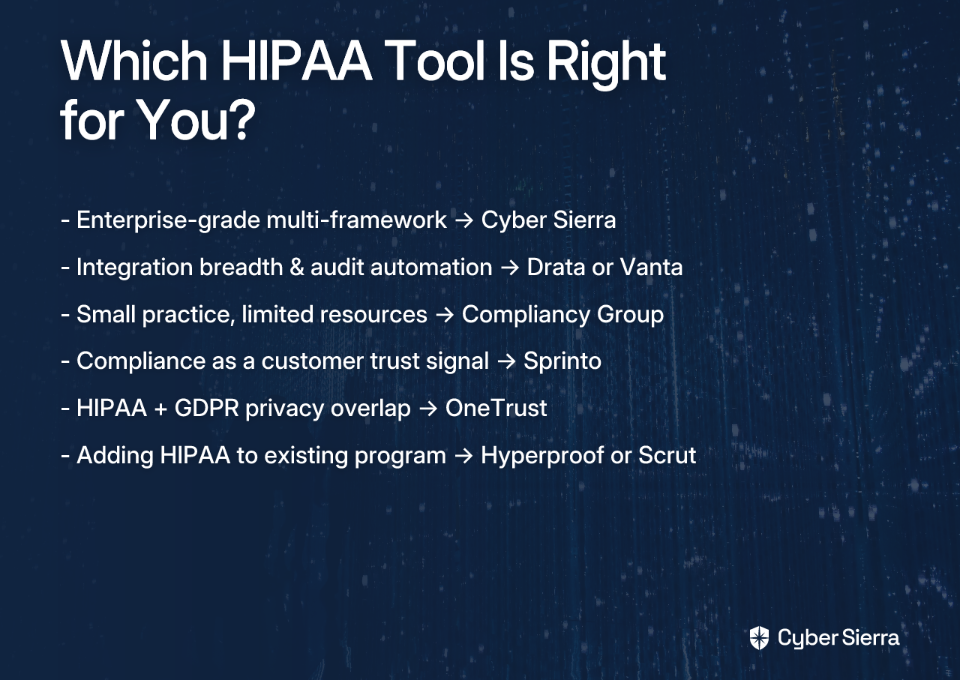
Selecting the best HIPAA compliance automation software ultimately depends on your organization's scale, existing framework obligations, and where your team's time is currently being consumed. Use this decision guide to narrow the field.
Reclaim Your Team From the Compliance Grind
Choosing the right HIPAA compliance software isn’t about replacing your team; it's about liberating them from the manual grind of audit preparation. The goal is to shift their focus from chasing screenshots to making strategic risk decisions.
To do that, remember two key takeaways from this guide:
- Automation tackles the grunt work. The best platforms handle the repetitive, mechanical tasks—continuous evidence collection, control monitoring, and audit trail maintenance—that consume up to 80% of your team's time.
- Multi-framework support is non-negotiable. For HealthTech, HIPAA rarely lives alone. A unified platform that maps controls to SOC 2, ISO 27001, and other frameworks prevents duplicated effort and audit fatigue.
Your next step is to see how automation can eliminate the most time-consuming tasks in your workflow. Cyber Sierra's unified platform is built to do just that. When you're ready to move from periodic fire drills to continuous compliance, see Cyber Sierra in action.
Frequently Asked Questions
What does HIPAA compliance automation software actually do?
HIPAA compliance software automates repetitive, manual tasks. It handles evidence collection, continuous control monitoring, and audit trail maintenance, freeing your compliance team to focus on strategic risk management and policy decisions rather than administrative grunt work.
How much manual work can HIPAA compliance software realistically save?
Effective HIPAA compliance platforms can reduce manual work by 70–80%. This is achieved by automating evidence gathering across your tech stack, continuously monitoring for misconfigurations, and streamlining audit preparation, drastically cutting down on time spent chasing screenshots and reports.
Why is multi-framework support important for HealthTech companies?
Multi-framework support eliminates redundant work. Many HealthTech companies must also comply with SOC 2 or ISO 27001. A unified platform maps overlapping controls between frameworks, so you only have to collect and manage evidence once, saving significant time and resources.
Can a tool make my company 100% HIPAA compliant?
No, a tool alone cannot make you compliant. Automation software enforces the policies and controls that you define. It provides the framework for continuous monitoring and proof of compliance, but your organization remains responsible for risk assessment, policy-making, and ultimate accountability.
What are the most important features to look for in a HIPAA compliance tool?
Look for continuous control monitoring for real-time visibility, automated evidence collection to reduce audit prep time, vendor risk management to oversee third parties, and multi-framework support to manage overlapping compliance obligations like SOC 2 or ISO 27001 efficiently.
How does automation help with vendor risk and Business Associate Agreements (BAAs)?
Automation streamlines vendor risk management by continuously monitoring third-party security posture and tracking BAAs. Instead of relying on annual questionnaires, it provides ongoing visibility, helping you detect and mitigate vendor-related risks before they become a breach.
