



5 HIPAA Compliance Platforms That Automate BAA Management and PHI Tracking

Join thousands of professionals and get the latest insight on Compliance & Cybersecurity.
Summary
- With 58% of healthcare data breaches involving third-party vendors, manual management of Business Associate Agreements (BAAs) and Protected Health Information (PHI) creates significant operational risk.
- Effective HIPAA compliance relies on automating tedious tasks like evidence collection and BAA lifecycle tracking, freeing teams to focus on improving security instead of just preparing for audits.
- When evaluating platforms, prioritize features like continuous real-time monitoring and integrated vendor risk management to build a proactive compliance posture rather than a reactive one.
- Cyber Sierra unifies GRC, vendor risk management, and continuous monitoring to connect BAA status with live PHI controls, simplifying audit readiness.
You've done the right things. You've deployed technical controls, locked down access, and started evaluating vendors. Then comes the part no one warns you about clearly enough: the relentless operational grind of Health Insurance Portability and Accountability Act (HIPAA) compliance.
Not the controls themselves — but the documentation, the risk assessments, the Business Associate Agreements (BAAs) that quietly expire, and the Protected Health Information (PHI) that keeps spreading across systems while your team scrambles to track it. As one compliance practitioner put it plainly: "The expensive part isn't the technical controls, it's the documentation, risk assessments, and ongoing audit readiness."
That's where HIPAA compliance platforms come in. But there's a catch — and it's worth naming directly. Many vendors advertise what look like turnkey solutions. The reality experienced practitioners describe is more nuanced: tools work best when they automate the tedious work so your team can focus on actually being secure, not just compliant on paper.
This article cuts through the noise. We'll look at five platforms purpose-built to automate the hardest operational parts of HIPAA — BAA lifecycle management and continuous PHI tracking — and what sets each one apart.
Why BAA Management and PHI Tracking Are So Complex
Before comparing platforms, it's worth understanding what makes these two areas particularly difficult to manage manually.
A BAA is a legally enforceable contract required whenever a healthcare organization shares PHI with a third-party service provider — think medical billing services, cloud storage vendors, or electronic health record (EHR) platforms. Managing these agreements involves more than a signed document. It requires tracking renewal dates, version histories, and ensuring each vendor still meets current HIPAA requirements. Miss a renewal, fail to update terms after a vendor relationship changes, or lose track of a signed copy, and you're exposed — operationally and legally.
The vendor dimension compounds quickly. Research from Censinet indicates that 58% of healthcare data breaches involve third-party vendors. That figure reflects a systemic problem: organizations often know who their direct vendors are but lose visibility when those vendors have their own subcontractors — what practitioners call "fourth parties." Keeping BAAs accurate and current across that extended supply chain is nearly impossible without automation.
PHI tracking carries its own complexity. Compliance with the HIPAA Security Rule requires organizations to inventory every system that touches PHI, map how data flows through those systems, enforce role-based access controls, run regular risk assessments, and maintain detailed access logs for audits. According to Censinet's PHI monitoring guidance, these steps include:
- Identifying PHI systems and data flows. Inventorying all systems handling PHI and mapping every user access point.
- Setting up access controls. Implementing role-based permissions and multi-factor authentication (MFA).
- Conducting risk assessments. Regularly evaluating vulnerabilities across technical, administrative, and physical security domains.
- Monitoring and reporting PHI access. Using continuous tracking systems to generate audit-ready logs.
Non-compliance with these requirements carries steep consequences. Fines can reach $2 million annually, and the average cost of a healthcare data breach sits at $10.93 million — figures that make investment in the right platform a straightforward business decision.
What to Look for in a HIPAA Compliance Platform
The right platform doesn't just check boxes. It integrates with your existing environment, automates the most time-intensive processes, and — critically — helps you build a real security program alongside your compliance posture.
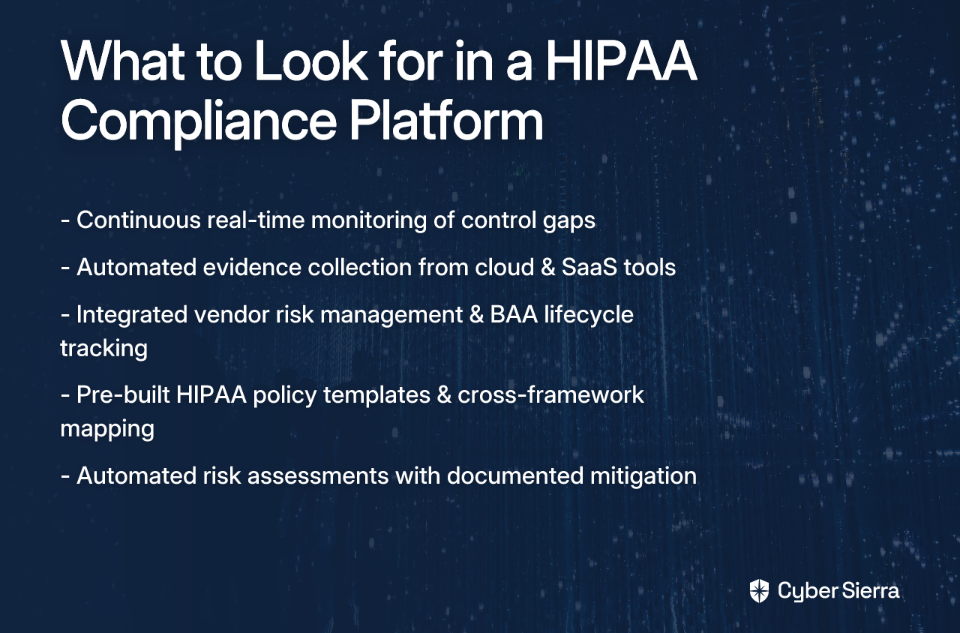
Based on how practitioners describe their needs, effective platforms share several core capabilities:
- Continuous real-time monitoring. Identifies control gaps before they surface during audits, not after.
- Automated evidence collection. Integrates with cloud providers, identity systems, and SaaS tools to pull compliance documentation automatically, reducing manual effort by up to 70%.
- Integrated vendor risk management. Goes beyond static questionnaires to continuously monitor vendor security posture and manage BAAs across the full vendor lifecycle.
- Pre-built policy libraries and controls mapping. Offers ready-to-use HIPAA policy templates and maps controls across overlapping frameworks like SOC 2 and ISO/IEC 27001:2022, eliminating redundant work.
- Comprehensive risk management. Automates risk assessments and provides a structured way to track vulnerabilities and document mitigation efforts — giving you the plan you need to show auditors.
5 Platforms That Automate BAA Management and PHI Tracking
Each platform below approaches HIPAA automation from a different angle. Some are broad compliance suites; others are more specialized. Here's what each one actually does well.
1. Cyber Sierra
Cyber Sierra is an AI-enabled cybersecurity platform that unifies Governance, Risk, and Compliance (GRC), Third-Party Risk Management (TPRM), and Continuous Control Monitoring (CCM) into a single environment. For HIPAA-regulated organizations, this unified architecture matters: it means the BAA status of a vendor, the controls protecting PHI, and the current state of your audit evidence are all connected — not siloed across separate tools.
Key HIPAA capabilities:
- GRC automation. Automates data collection, risk assessments, and policy management for HIPAA. Controls and policies are centralized in one repository, so audit preparation doesn't require last-minute evidence scrambles.
- Third-Party Risk Management. Directly addresses the BAA management challenge by automating vendor assessments, prioritizing vendors based on risk level, and providing near real-time visibility into vendor security posture — going well beyond point-in-time questionnaires.
- Continuous Control Monitoring. Tracks the health of controls protecting PHI on an ongoing basis. Automates control testing, detects exceptions in real-time, and provides a single source of truth for security posture rather than a periodic snapshot.
Cyber Sierra is recognized as a Sample Vendor in the Gartner® Hype Cycle™ for Cyber-Risk Management, 2024, and is accredited by the Cyber Security Agency of Singapore (CSA). For organizations that need HIPAA compliance to connect directly to their operational security program — not just their audit prep — the integrated approach is a practical advantage.
2. Drata
Drata is a compliance automation platform with strong native integrations across cloud infrastructure, identity providers, and developer tools. It's a widely used option for organizations working through HIPAA alongside SOC 2 or ISO 27001 compliance.
Key HIPAA capabilities:
- Automated evidence collection. Connects to services like AWS, Okta, and GitHub to pull compliance evidence continuously, reducing the manual burden of audit preparation.
- Risk management tools. Provides structured workflows for evaluating and documenting compliance risks, mapping them back to controls.
- Employee training tracking. Monitors completion of HIPAA compliance training requirements, so you can demonstrate workforce readiness during audits.
Drata is particularly well-suited for engineering-heavy teams that want deep integration with their existing development and infrastructure stack.
3. Vanta
Vanta has built one of the broadest integration ecosystems among compliance automation platforms, making it a practical choice for organizations running complex, multi-vendor environments.
Key HIPAA capabilities:
- Real-time compliance monitoring. Continuously tracks the status of HIPAA controls and surfaces automated alerts when gaps emerge — so organizations aren't discovering issues during an audit.
- Broad tool integrations. Connects across cloud providers, endpoint management, identity providers, and SaaS applications to centralize compliance visibility in one place.
Vanta works well for teams that prioritize speed to compliance and want to manage multiple frameworks (HIPAA, SOC 2, ISO 27001) through a common interface.
4. Secureframe
Secureframe focuses on accelerating audit readiness, with particular strengths in documentation management and employee compliance training.
Key HIPAA capabilities:
- Pre-built HIPAA policy templates. Provides customizable privacy and security policies that reduce the time required to produce compliant documentation — addressing the common pain point of underestimating documentation effort.
- Centralized audit documentation. Creates a single, automated repository for collecting and organizing required audit evidence, making it accessible and organized when auditors come calling.
- Compliance training tools. Includes employee training modules covering HIPAA requirements, with tracking to demonstrate workforce awareness.
Secureframe is a strong fit for organizations that feel the documentation burden most acutely and need to establish a scalable compliance program from the ground up.
5. Proofpoint
Proofpoint approaches HIPAA compliance from the data protection side rather than the GRC side. It's not a full compliance management platform, but it addresses a critical layer of the HIPAA Security Rule: protecting PHI from unauthorized access and data loss.
Key HIPAA capabilities:
- Insider threat management. Detects anomalous access to PHI and streamlines incident investigation workflows, which is directly relevant to HIPAA's audit control and integrity requirements.
- Information protection and data loss prevention. Unifies content inspection and threat intelligence to prevent PHI from being exfiltrated through email, cloud apps, or endpoint devices.
Proofpoint is best positioned as a complementary tool alongside a broader GRC or compliance automation platform — particularly for organizations where email-based PHI exposure or insider risk is a primary concern.
Automation Enables Security — It Doesn't Replace It
One point worth addressing directly, because practitioners raise it consistently: compliance automation tools are only as valuable as the security program behind them.
As one experienced security professional observed: "The hard part about SOC 2 isn't the automation of collecting evidence. The hard part is actually being secure." The same principle applies to HIPAA. Platforms can automate evidence collection, map controls, manage BAA workflows, and track PHI access — but if the underlying security controls are weak or missing, the automation is documenting a gap, not closing one.
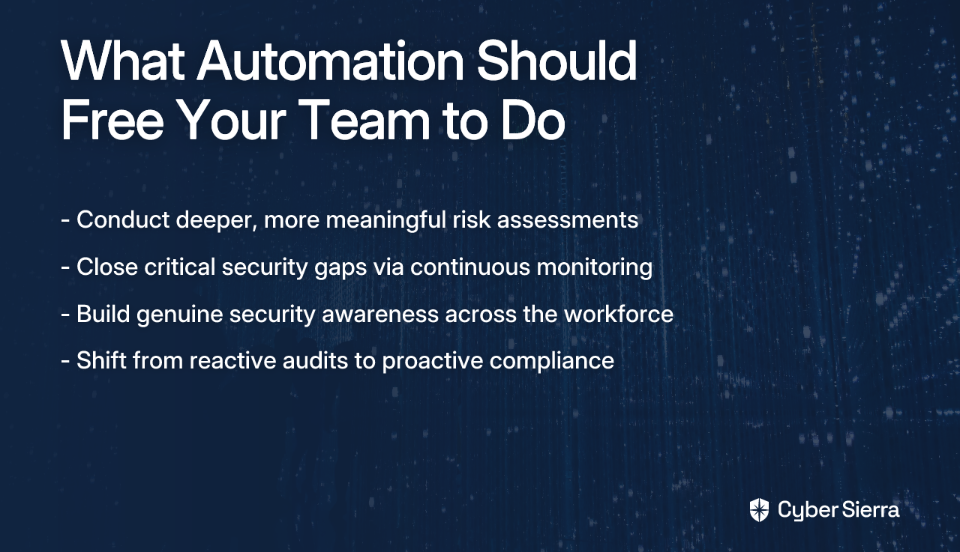
This is a real pattern. Teams sometimes go through the motions of a compliance platform without building the security foundation that makes compliance meaningful. Automation should free up skilled compliance and security professionals to focus on higher-value work:
- Conducting deeper, more meaningful risk assessments that go beyond checkbox validation.
- Closing the most critical security gaps identified through continuous monitoring.
- Building genuine security awareness across the workforce.
- Shifting from reactive audit preparation to proactive, continuous compliance.
The goal is a program where audits are a straightforward validation of a strong ongoing posture — not a chaotic sprint to collect months of evidence in two weeks.
Go Beyond Checkbox HIPAA Compliance
The operational grind of HIPAA compliance isn't just about tedious work—it's about risk. Managing Business Associate Agreements (BAAs) in spreadsheets and manually tracking Protected Health Information (PHI) across dozens of vendors leaves dangerous gaps that auditors—and attackers—can find.
The core takeaway is this: effective compliance automation isn't about passing an audit. It's about freeing your team from manual evidence collection to focus on strengthening your actual security posture. A platform should connect the dots between a vendor's BAA status and the real-time health of the controls protecting your PHI.
As a next step, take 15 minutes this week to map just one critical PHI data flow and its associated vendors. The complexity you uncover will make the case for a unified system clear.
When you’re ready to see how automation can connect vendor risk management with continuous control monitoring in a single platform, book a Cybersierra demo.
Frequently Asked Questions
What is a HIPAA compliance platform?
A HIPAA compliance platform is a software solution designed to automate the administrative and operational tasks required for HIPAA compliance. It helps manage documentation, track Business Associate Agreements (BAAs), monitor Protected Health Information (PHI), and streamline audit preparation.
Why is managing Business Associate Agreements (BAAs) so complex?
BAA management is complex because it involves more than just a signature. Organizations must track renewal dates, version histories, and the compliance status of each vendor and their subcontractors ("fourth parties"), which is nearly impossible to do accurately at scale without automation.
How do compliance platforms automate PHI tracking?
These platforms automate PHI tracking by inventorying systems that handle PHI, mapping data flows, and continuously monitoring access controls. They integrate with cloud and SaaS tools to collect evidence and generate audit-ready logs, replacing manual tracking and reducing human error.
What are the key features to look for in a HIPAA compliance platform?
Key features include continuous real-time monitoring of security controls, automated evidence collection, integrated vendor risk and BAA management, and pre-built policy templates. These tools should automate tedious work to help your team focus on improving actual security.
Can using a platform guarantee HIPAA compliance?
No, a platform cannot guarantee compliance on its own. Automation tools are designed to support and streamline your compliance program, not replace it. They handle evidence collection and monitoring, but your organization is still responsible for implementing strong underlying security controls.
