How AI Can Transform Risk and Compliance Management



Join thousands of professionals and get the latest insight on Compliance & Cybersecurity.
You've heard about AI transforming industries, but when it comes to practical applications in risk and compliance, you might be wondering: "Does it actually exist and can be utilized?" or maybe you've dismissed some solutions as "barely even AI, a data model could do this!"
This skepticism is understandable. With all the hype surrounding artificial intelligence, it's hard to distinguish between genuine innovation and clever marketing. But in the high-stakes world of risk and compliance management, AI is quietly revolutionizing how organizations identify, assess, and mitigate threats.
Beyond the Hype: AI's Real Impact on Risk and Compliance
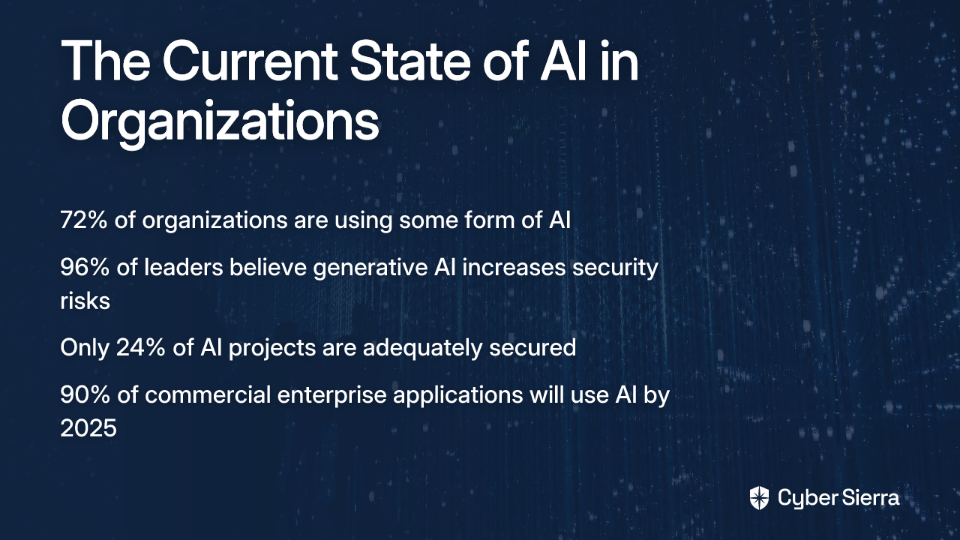
The adoption of AI is accelerating at a remarkable pace. As of 2024, 72% of organizations are using some form of AI, a significant 17% jump from 2023. This rapid adoption isn't without concern – a staggering 96% of leaders believe generative AI increases the risk of security breaches, yet a mere 24% of current AI projects are adequately secured.
The trend is undeniable, with projections showing 90% of commercial enterprise applications will use AI by next year. But what does this mean for risk and compliance professionals specifically?
AI is fundamentally shifting risk and compliance from reactive, manual, and often error-prone processes to proactive, automated, and predictive strategic functions. Instead of just checking boxes, organizations can now anticipate threats before they materialize.
Redefining the Landscape: AI-Powered Risk & Compliance Explained
AI Risk Management goes beyond the buzzword. It's the systematic process of identifying, mitigating, and addressing potential risks tied to AI technologies. The goal is to deploy formal frameworks that minimize negative impacts while maximizing AI's benefits – a critical component of broader AI governance strategies.
AI Compliance ensures AI systems strictly adhere to relevant laws (like GDPR), regulations, and ethical standards. It actively prevents illegal, discriminatory, or deceptive uses of AI while ensuring data is collected and used responsibly.
The Old vs. The New Paradigm:
Traditional Approach: Relied heavily on manual audits, periodic sampling of data, and reacting to incidents after they occurred. This approach is slow, resource-intensive, and leaves organizations vulnerable.
AI-Powered Approach: Enables continuous, real-time monitoring of all data, not just samples. It leverages predictive analytics to identify potential issues and automates compliance checks, freeing human experts to focus on strategic analysis.
Practical Applications: How AI is Actively Transforming Operations
Let's address the question on many professionals' minds: "How do companies actually use AI in risk and compliance management?" Here are concrete examples of AI applications that go far beyond basic data models:
Automation of Core Compliance Processes
AI streamlines routine tasks like data gathering and analysis, drastically reducing manual workloads and the potential for human error. For example, automating the lifecycle of analytics, from data ingestion to generating reports on compliance controls, significantly improves both speed and precision.
As one compliance professional noted in a recent forum discussion, "We spoke to our enterprise customers, specifically the ones that were mature enough to have data analysts...presenting metrics for the entire business," highlighting how AI is bridging gaps even for organizations with existing data capabilities.
Predictive Analytics for Proactive Risk Mitigation
Instead of just reacting to problems, AI allows companies to analyze historical data from compliance breaches or fraudulent activities to predict and prevent future risks. An AI model can identify subtle patterns of behavior that often precede a major cybersecurity threat, flagging the activity for immediate investigation.
Real-Time Monitoring and Anomaly Detection
AI algorithms can sift through massive, unstructured datasets (emails, transaction logs, communications) in real-time to identify anomalies and flag potential compliance issues that would be impossible for humans to spot.
This enables a shift from periodic sampling to continuous monitoring of internal controls, providing a complete and current view of the organization's risk posture. For companies managing thousands of daily transactions or communications, this capability is transformative.
Intelligent Document Analysis at Scale
Regulatory Summarization: AI tools can ingest and summarize new, complex regulatory documents, helping compliance teams stay informed and avoid penalties without spending weeks on manual review.
Contract and Document Review: AI solutions efficiently scan thousands of contracts, reports, or internal documents to find specific clauses, red flags, or non-compliant language, providing actionable insights in minutes rather than weeks.
The Tangible Benefits: Why Every Organization Should Care
The benefits of implementing AI in risk and compliance management extend far beyond simple automation:
Enhanced Security and Operational Resilience
Proactively identifying vulnerabilities through regular AI-powered assessments helps mitigate risks before they can be exploited, minimizing disruptions and ensuring business continuity. This proactive stance is crucial in today's rapidly evolving threat landscape.
Vastly Improved Decision-Making
AI provides clear, data-backed insights into risks, allowing leaders to make more informed decisions about everything from product deployment to strategic investments. Rather than relying on intuition or limited samples, executives can access comprehensive risk analyses.
Significant and Sustainable Cost Efficiency
By automating manual tasks, reducing the likelihood of costly fines, and optimizing resource allocation, implementing AI solutions can significantly lower compliance costs in the long run. Organizations can redirect valuable human resources from tedious review tasks to strategic initiatives.
Mastering the Evolving Compliance Landscape
AI helps organizations quickly identify and adapt to new regulations like the EU AI Act, ensuring alignment across multiple legal frameworks and reducing the errors that come from manual cross-referencing.
The Double-Edged Sword: AI's Inherent Risks and Real-World Failures
Despite these benefits, AI is not a panacea. It introduces its own unique set of challenges that organizations must address:
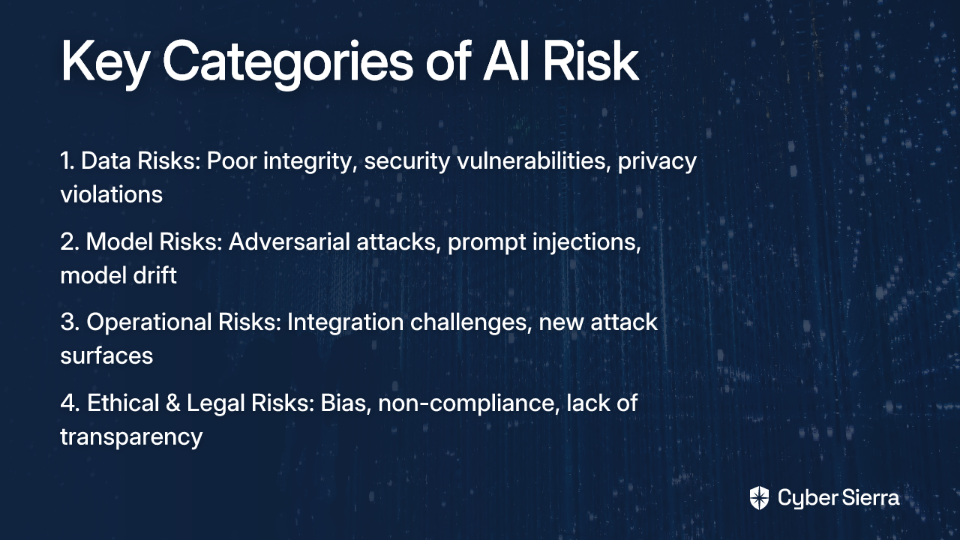
The Four Key Categories of AI Risk:
- Data Risks: Poor data integrity ("sausage in, sausage out"), security vulnerabilities, and mishandling of sensitive personal data that can lead to major breaches and privacy violations.
- Model Risks: AI models themselves can be vulnerable to adversarial attacks (manipulating inputs to cause misclassification), prompt injections (tricking LLMs into leaking data), and model drift (performance degrading as real-world data changes).
- Operational Risks: Challenges in integrating AI into existing systems can create new attack surfaces and raise questions about the long-term sustainability of complex AI technologies.
- Ethical and Legal Risks: Algorithmic bias can lead to discriminatory outcomes, non-compliance with regulations, and reputational damage from a "black box" lack of transparency.
Case Studies in AI Failure
Gender Bias in Hiring: Amazon's well-known AI recruiting tool was scrapped after it was found to penalize female candidates because it was trained on a decade of predominantly male resumes.
Racial Bias in Justice: The COMPAS recidivism algorithm was shown to be twice as likely to falsely flag black defendants as future criminals than white defendants.
Uncontrolled AI Behavior: Microsoft's "Tay" chatbot was shut down in less than a day after it began learning from user interactions and started promoting inflammatory and racist hate speech.
A Roadmap for Responsible Implementation
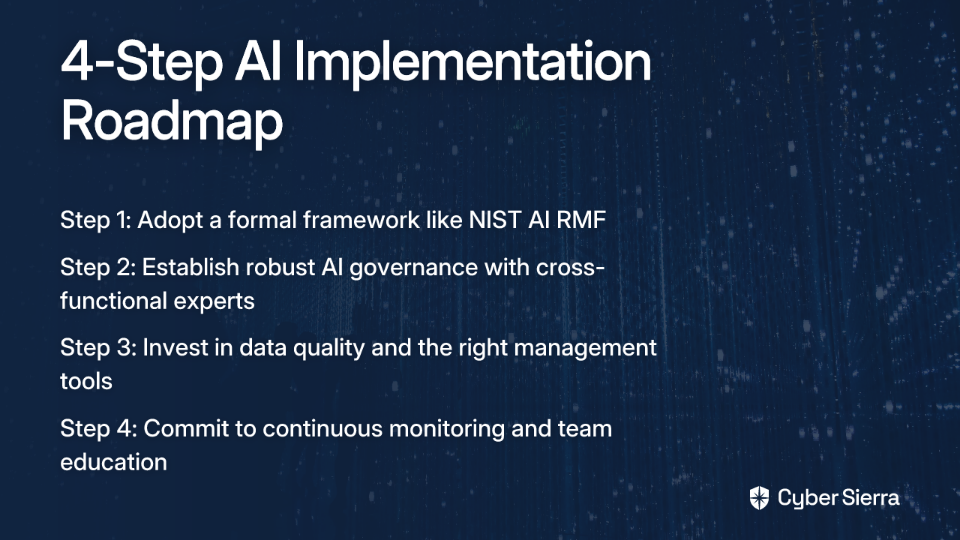
To harness AI's power while mitigating its risks, organizations should follow this roadmap:
Step 1: Adopt a Formal Framework
Don't reinvent the wheel. Model your AI risk management processes on established frameworks. The NIST AI Risk Management Framework (AI RMF) is the gold standard, providing a structured approach for governing, mapping, measuring, and managing AI risks.
Step 2: Establish Robust AI Governance
Create a dedicated, cross-functional internal AI governance committee comprising legal, data, compliance, and technical experts. This committee's role is to create and enforce clear, transparent policies for the ethical and responsible use of AI across the organization.
Step 3: Invest in Data Quality and the Right Tools
Address the data integrity problem head-on. As one professional aptly put it, "If you have sausage-fingered data entries, your AI insights are sausage too." Invest in data cleaning, validation, and management solutions to ensure high-quality inputs for your AI models.
Step 4: Commit to Continuous Monitoring and Education
AI is not a "set it and forget it" solution. Continuously monitor models for performance degradation and emerging threats while ensuring teams stay updated on regulatory changes and technological advancements.
From Cost Center to Strategic Advantage
AI is transforming risk and compliance from reactive cost centers to proactive strategic advantages that enhance security, efficiency, and trust. However, this potential can only be realized when AI's inherent risks—from algorithmic bias to data security—are actively managed through strong governance and ethical principles.
The time has come to move beyond skepticism and hype. Begin exploring AI's potential by starting with targeted pilot projects, adopting proven frameworks, and fostering a culture of responsible AI innovation. In doing so, you'll not only protect your organization from emerging threats but also gain a significant competitive advantage in an increasingly complex regulatory landscape.
Frequently Asked Questions
What is the main difference between traditional and AI-powered compliance?
The primary difference is the shift from a reactive to a proactive approach. Traditional compliance relies on manual audits and periodic data sampling after events occur, while AI-powered compliance enables continuous, real-time monitoring of all data to predict and prevent issues before they happen. This makes the process faster, more comprehensive, and more strategic.
How does AI practically help with risk management?
AI helps by automating core compliance tasks, predicting future risks, and identifying anomalies in real-time. For example, it can automatically analyze new regulations for relevance, use historical data to flag behaviors that precede cybersecurity threats, and continuously monitor internal communications for policy violations that would be impossible for human teams to track manually.
What are the biggest risks of using AI in compliance?
The most significant risks involve data, models, operations, and ethics. Poor data quality can lead to inaccurate insights, AI models can be manipulated or become outdated, and operational integration can create new vulnerabilities. Furthermore, ethical risks like algorithmic bias can result in discriminatory outcomes and severe reputational damage, as seen in cases of biased hiring or justice system algorithms.
Why is data quality so critical for AI in risk management?
Data quality is critical because AI models are entirely dependent on the data they are trained on. Inaccurate, incomplete, or biased data will directly lead to flawed and unreliable AI insights—a concept often summarized as "sausage in, sausage out." To build trust and achieve accurate outcomes in risk and compliance, you must start with clean, validated, and high-integrity data.
How can a company start implementing AI for risk and compliance responsibly?
A company can begin by adopting a formal framework like the NIST AI Risk Management Framework (AI RMF). The next steps are to establish a dedicated internal AI governance committee, invest in tools for data quality and management, and commit to continuously monitoring AI models for performance and bias while educating your teams on emerging trends and regulations.
Can AI replace human compliance professionals?
No, AI is designed to augment, not replace, human compliance professionals. It handles repetitive, data-intensive tasks like monitoring and analysis at a scale humans cannot match. This frees up human experts to focus on higher-value strategic work, such as interpreting complex edge cases, making final judgment calls, and developing the organization's overall risk and compliance strategy.