



How to Evaluate Enterprise Risk Management Software: A Complete Guide



Join thousands of professionals and get the latest insight on Compliance & Cybersecurity.
In today's rapidly evolving threat landscape, Chief Information Security Officers (CISOs) and senior leadership teams face mounting pressure to implement robust Enterprise Risk Management (ERM) solutions. With cyber threats becoming increasingly sophisticated and regulatory requirements growing more stringent, selecting the right ERM software has become a critical decision that can significantly impact an organization's security posture and compliance status.
This comprehensive guide will walk you through the essential considerations when evaluating and selecting ERM software, ensuring your organization makes an informed decision that aligns with both business objectives and security requirements.
Understanding Enterprise Risk Management in the Cybersecurity Context
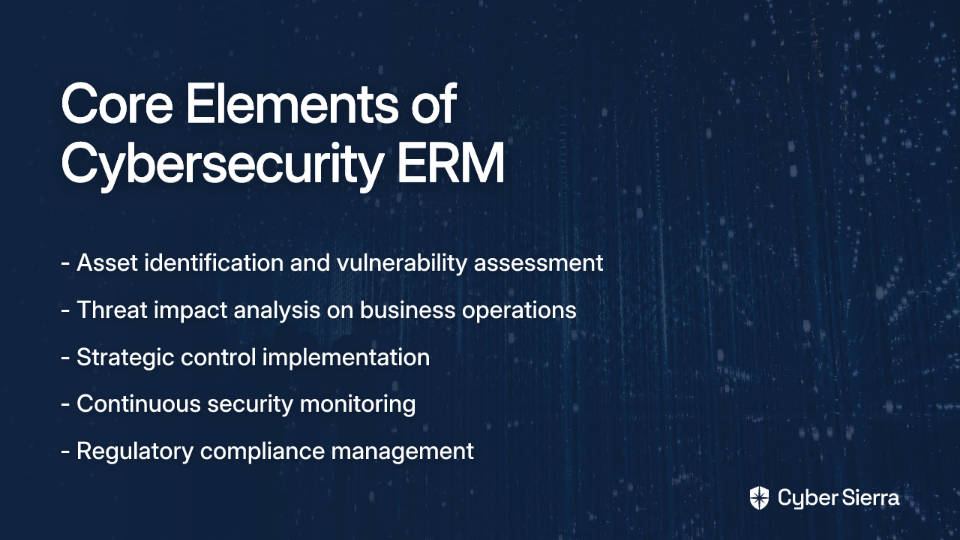
Enterprise Risk Management encompasses the strategies, processes, and tools organizations use to identify, assess, and mitigate risks across all operations. In the cybersecurity domain, ERM focuses specifically on:
- Identifying and prioritizing digital assets and their vulnerabilities
- Assessing potential threats and their impact on business operations
- Implementing controls to mitigate identified risks
- Continuously monitoring the effectiveness of security measures
- Ensuring compliance with relevant regulatory frameworks
As one CISO noted in a recent forum discussion: "The management decided that it was time to acquire a new ERM software to facilitate the collection, analysis, reporting, and modeling of all risk-related information, with a focus on operational risk and incident management." This sentiment reflects the growing recognition that manual processes are no longer sufficient for managing the complex risk landscape organizations face today.
The Evolving Landscape of Enterprise Risk Management
Traditional approaches to risk management often involved siloed processes, manual data collection, and periodic assessments that quickly became outdated. Modern ERM solutions are transforming this landscape by:
- Centralizing risk data across departments and functions
- Automating assessment processes to improve efficiency
- Providing real-time visibility into the organization's risk posture
- Facilitating collaboration between security, compliance, and business teams
- Enabling data-driven decision-making through advanced analytics
This evolution is particularly important as organizations face "pressure to meet stringent compliance requirements from cyber-insurance" providers and regulatory bodies, requiring more sophisticated approaches to risk management.
Key Challenges in ERM Software Selection
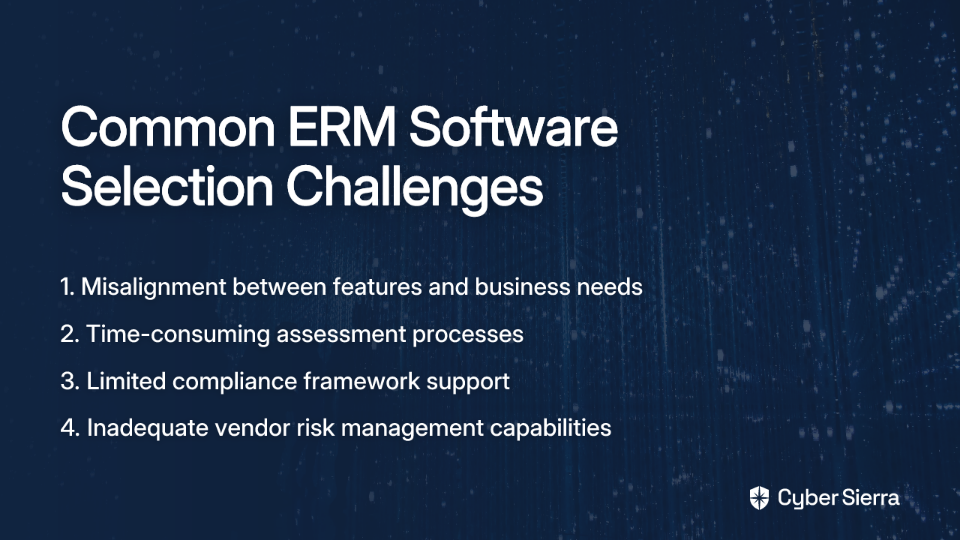
Before diving into evaluation criteria, it's important to understand the common challenges organizations face when selecting ERM software:
1. Poor Feature Alignment
Many organizations report disappointment with their ERM solutions due to misalignment between software capabilities and actual business requirements. As one IT manager shared in a Reddit discussion: "We had a bad experience with the previous vendor, their solution was extremely poor in features (even those specified in the scope statements), buggy but above all cost a huge amount of money to fix/maintain by the vendor."
2. Efficiency and Speed
Modern security teams need tools that enable rapid risk assessment without sacrificing thoroughness. One security professional expressed this need clearly: "I need an adhoc assessment that takes minutes-hours rather than days-weeks like some of my assessments." Solutions that streamline and accelerate risk processes are increasingly essential in fast-paced business environments.
3. Compliance Framework Integration
Organizations often struggle with tools that don't adequately support multiple compliance frameworks. With statements like "because of stricter legislation they have the wish to become ISO 27001 certified within the next two years," it's clear that framework adaptability is a crucial consideration.
4. Vendor Risk Management Capabilities
As third-party risks increase, organizations need robust capabilities to assess vendor security. Questions such as "Is relying solely on the SOC 2 report sufficient for due diligence in this scenario?" highlight the importance of comprehensive vendor risk assessment features.
Essential Evaluation Criteria for ERM Software
When evaluating ERM software, consider these critical factors to ensure the solution meets your organization's specific needs:
1. Usability and Interface Design
The most powerful features are worthless if users find the system difficult to navigate. Look for:
- Intuitive dashboards with customizable views
- Clear visualization of risk data
- Simplified workflows for common tasks
- Accessibility for both technical and non-technical users
2. Integration Capabilities
Your ERM solution should seamlessly connect with your existing technology stack:
- API availability for custom integrations
- Pre-built connectors for common security and IT management tools
- Ability to import data from various sources (SIEM, vulnerability scanners, etc.)
- Support for Single Sign-On (SSO) and identity management systems
3. Compliance Framework Support
The solution should support multiple compliance frameworks and adaptability to new requirements:
- Built-in templates for common frameworks (ISO 27001, NIST, PCI DSS, GDPR, etc.)
- Cross-mapping capabilities between different frameworks
- Customizable controls and requirements
- Automated evidence collection and validation
4. Reporting and Analytics
Look for robust reporting capabilities that provide actionable insights:
- Customizable reports for different stakeholders
- Executive dashboards with key risk indicators (KRIs)
- Trend analysis and historical comparison
- Risk scoring and prioritization mechanisms
5. Automation Capabilities
Efficiency gains often come through automation:
- Automated control testing and validation
- Scheduled assessments and reminders
- Workflow automation for approvals and notifications
- Automated data collection from integrated systems
6. Vendor Risk Management
Comprehensive vendor risk management features should include:
- Vendor inventory management and risk classification
- Automated assessment questionnaires
- Continuous monitoring of vendor security posture
- Integration with third-party risk intelligence
7. Scalability and Performance
The solution should grow with your organization:
- Support for multiple business units and geographies
- Ability to handle increasing volumes of risk data
- Performance under load during peak assessment periods
- Flexible licensing models
Top ERM Solutions Comparison
While many ERM solutions exist in the market, we've evaluated several leading options based on the criteria above:
Cyber Sierra: The Comprehensive Solution
Cyber Sierra stands out as our top recommendation for organizations seeking a comprehensive, AI-enabled cybersecurity risk management platform. Key strengths include:
- Continuous Control Monitoring (CCM): Cyber Sierra's CCM module provides ongoing visibility into security controls, centralizes control repositories, and delivers actionable risk intelligence. This addresses the common pain point of manual evidence gathering and lack of real-time posture visibility.
- Third-Party Risk Management (TPRM): The TPRM module simplifies vendor risk assessment, onboarding, and continuous monitoring, helping enterprises evaluate and mitigate risks associated with their supply chain. This is particularly valuable given the concerns about relying solely on SOC 2 reports for vendor due diligence.
- Governance, Risk & Compliance (GRC): Cyber Sierra's GRC module automates data collection, risk assessments, control monitoring, and reporting for various frameworks, streamlining audits and reducing compliance fatigue.
What sets Cyber Sierra apart is its integrated approach, combining these capabilities with threat intelligence, employee security training, and cyber insurance guidance in a unified platform. This integration eliminates the silos that often plague risk management processes and provides a comprehensive view of an organization's security posture.
Alternative Solutions
While Cyber Sierra offers the most comprehensive approach, other solutions worth considering include:
- MetricStream: Strong in regulatory compliance management but may require significant customization.
- LogicGate Risk Cloud: User-friendly interface with good workflow capabilities but less robust in continuous monitoring.
- OneTrust: Excellent for privacy compliance but may have limitations for broader ERM needs.
- Archer: Highly customizable but can be complex to implement and maintain.
Implementation Best Practices for ERM Software
Selecting the right software is only the first step. To ensure successful implementation and adoption:
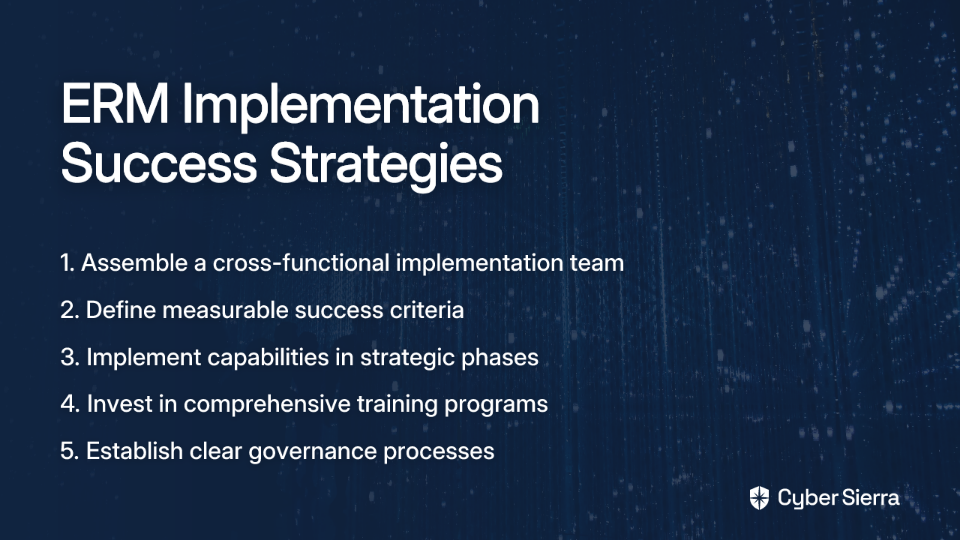
1. Form a Cross-Functional Team
"Before acquiring an ERM software, engage a project team from user business units and IT to assess use cases and ensure the tool's features align with organizational requirements," recommends an experienced CISO. This cross-functional approach ensures the solution meets the needs of all stakeholders.
2. Define Clear Success Criteria
Establish measurable objectives for your ERM implementation:
- Reduction in time spent on compliance activities
- Improved visibility into risk posture
- Enhanced third-party risk management
- Streamlined audit processes
3. Implement in Phases
Rather than attempting to implement all features simultaneously, consider a phased approach:
- Phase 1: Core risk assessment and management capabilities
- Phase 2: Compliance framework mapping and reporting
- Phase 3: Vendor risk management
- Phase 4: Advanced analytics and automation
4. Invest in Training and Change Management
"Make sure the tool fits their needs," notes one IT professional. Even the best tool will fail if users don't understand how to use it effectively. Develop a comprehensive training program and provide ongoing support to ensure adoption.
5. Establish Governance Processes
Define clear processes for:
- Risk assessment methodologies and cadence
- Review and approval workflows
- Escalation procedures for high-risk findings
- Regular system reviews and updates
Future Trends in ERM Software
As you evaluate solutions, consider these emerging trends that will shape the future of ERM:
1. AI and Machine Learning Integration
Advanced analytics will increasingly power risk prediction and prioritization, helping organizations identify emerging risks before they materialize.
2. Continuous Risk Assessment
The traditional quarterly or annual risk assessment cycle is giving way to continuous, real-time risk monitoring. As one security professional noted, "I don't think these frameworks are adapting to risks fast enough!" Modern solutions must provide near real-time visibility.
3. Integrated Security and Risk Platforms
The lines between security operations, risk management, and compliance are blurring. Future solutions will offer more integrated approaches that connect these functions.
4. Regulatory Technology (RegTech) Advancements
As regulatory requirements continue to evolve, ERM solutions will incorporate more sophisticated regulatory intelligence and automation capabilities.
Conclusion: Making the Right Choice for Your Organization
Selecting the right ERM software requires a thoughtful evaluation of your organization's specific needs, challenges, and objectives. While Cyber Sierra emerges as our top recommendation due to its comprehensive approach and robust capabilities, the most important factor is alignment with your unique requirements.
As you embark on your selection process:
- Start with clear requirements based on input from all stakeholders
- Prioritize usability and integration to ensure adoption and efficiency
- Consider both immediate needs and future scalability
- Evaluate vendors not just on features, but on support and partnership
Remember that ERM is not just about technology—it's about establishing a risk-aware culture supported by the right processes and tools. The right software solution should enable your organization to move from reactive to proactive risk management, providing the visibility and insights needed to make informed decisions in an increasingly complex threat landscape.
By following the evaluation framework outlined in this guide, you'll be well-positioned to select an ERM solution that not only meets your current needs but also supports your organization's evolving risk management journey.
Frequently Asked Questions (FAQ)
What is Enterprise Risk Management (ERM) in cybersecurity?
Enterprise Risk Management (ERM) in cybersecurity refers to the strategies, processes, and tools organizations use to identify, assess, and mitigate digital risks. This includes protecting digital assets, understanding vulnerabilities, evaluating potential threats' impact on business operations, implementing security controls, continuously monitoring their effectiveness, and ensuring compliance with relevant regulations.
Why is modern ERM software crucial for organizations today?
Modern ERM software is crucial because it helps organizations effectively manage the increasingly complex and sophisticated cyber threat landscape and meet stringent regulatory requirements. Unlike traditional methods, modern solutions centralize risk data, automate assessments, provide real-time visibility into risk posture, facilitate collaboration, and enable data-driven decision-making, moving beyond outdated manual processes.
What are common challenges faced when selecting ERM software?
Common challenges include poor feature alignment with business needs, inefficient or slow assessment processes, limited support for multiple compliance frameworks, and inadequate vendor risk management capabilities. Organizations often struggle with solutions that are buggy, expensive to maintain, or don't integrate well with existing systems.
How can an organization choose the right ERM software?
To choose the right ERM software, an organization should evaluate solutions based on usability and interface design, integration capabilities with existing tech stacks, comprehensive compliance framework support, robust reporting and analytics, automation capabilities, thorough vendor risk management features, and scalability. Starting with clear requirements and prioritizing these factors is key.
What makes Cyber Sierra a recommended ERM solution in this guide?
Cyber Sierra is recommended due to its comprehensive, AI-enabled platform that integrates Continuous Control Monitoring (CCM), Third-Party Risk Management (TPRM), and Governance, Risk & Compliance (GRC) functionalities. This unified approach eliminates silos, provides real-time visibility, automates data collection and assessments, and offers a holistic view of an organization's security posture, addressing many common ERM challenges.
What are the key future trends in ERM software development?
Key future trends in ERM software include greater integration of AI and machine learning for predictive risk analytics, a shift towards continuous real-time risk assessment rather than periodic reviews, the development of more integrated security and risk platforms, and advancements in Regulatory Technology (RegTech) to cope with evolving compliance landscapes.
For more information on Cyber Sierra's comprehensive ERM capabilities, visit cybersierra.co or request a personalized demo to see how their platform can transform your organization's approach to enterprise risk management.
