



10 Critical Infosec Risks Every CISO Must Monitor in Real-Time


Join thousands of professionals and get the latest insight on Compliance & Cybersecurity.
Summary
- Traditional security assessments like annual penetration tests are no longer sufficient, creating dangerous blind spots in a rapidly evolving threat landscape.
- To effectively manage modern threats like cloud misconfigurations and supply chain vulnerabilities, security programs must shift from periodic audits to continuous, real-time monitoring.
- Organizations need real-time visibility into critical risks—including IAM sprawl, unpatched software, and human-centric threats—to prevent them from escalating into breaches.
- A Continuous Control Monitoring (CCM) platform automates control testing, providing the visibility needed to manage these infosec risks proactively.
In today's rapidly evolving threat landscape, information security risks can materialize and escalate within minutes, not months. Many security leaders struggle with a fundamental question: what exactly constitutes an infosec risk? Is a hardware failure causing a Confluence outage an "engineering risk" or an "infosec risk"? This ambiguity leaves dangerous gaps in security governance.
According to NIST, information security risk is "the risk to organizational operations (including mission, functions, image, reputation), organizational assets, individuals, other organizations... due to the potential for unauthorized access, use, disclosure, disruption, modification, or destruction of information and/or information systems." This definition encompasses the full CIA Triad (Confidentiality, Integrity, and Availability), clarifying that the loss of access to information, regardless of cause, is indeed an infosec risk.
Traditional approaches to monitoring these risks—annual penetration tests, quarterly vulnerability scans, point-in-time assessments—create dangerous blind spots. The modern CISO must shift from periodic auditing to continuous vigilance through real-time monitoring systems.
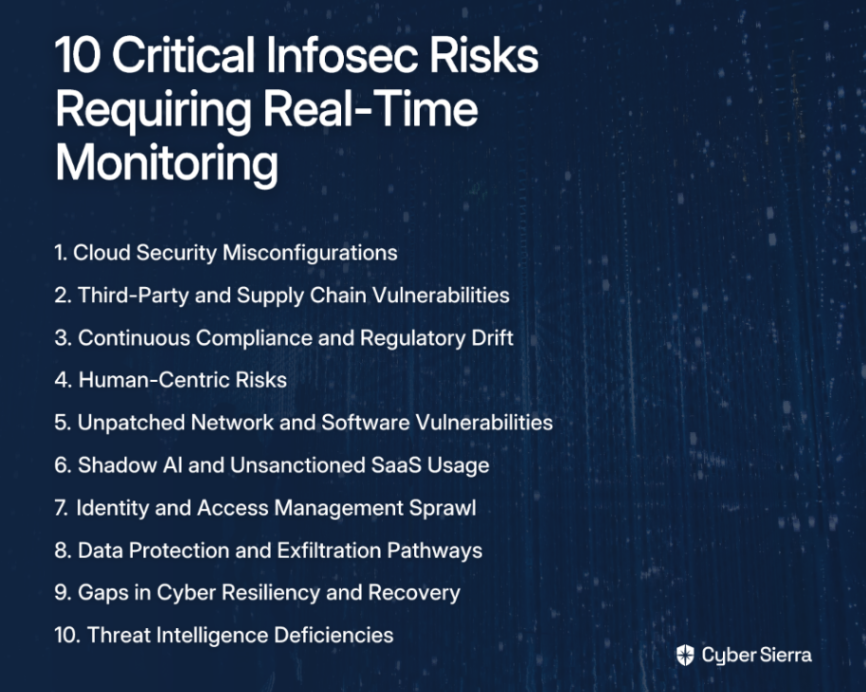
Let's explore the 10 critical infosec risks that demand real-time visibility and how Continuous Control Monitoring (CCM) transforms risk management from reactive to proactive.
1. Cloud Security Misconfigurations
How It Manifests: Publicly exposed storage buckets, insecure APIs, overly permissive IAM roles, and unpatched cloud services represent some of the most common yet dangerous cloud misconfigurations. A single developer change can instantly create a vulnerability.
Business Impact: These misconfigurations can lead to catastrophic data exposure, loss of intellectual property, regulatory violations, and significant operational disruptions.
Why Periodic Assessments Fail: Cloud environments are ephemeral and constantly changing. A configuration that was secure during a quarterly audit can be rendered vulnerable by a single developer change minutes later.
The Continuous Monitoring Solution: Cyber Sierra's Threat Intelligence platform provides continuous, "outside-in" visibility of your attack surface. It performs cloud infrastructure scanning for misconfigurations, allowing you to identify and remediate issues like public S3 buckets or insecure network groups in near real-time, long before your next scheduled audit.
2. Third-Party and Supply Chain Vulnerabilities
How It Manifests: A breach in a vendor's system—from your CRM provider to a small marketing analytics tool—can grant attackers a backdoor into your network and data. The SolarWinds incident demonstrated how devastating these attacks can be.
Business Impact: Data breaches originating from the supply chain can lead to reputational damage by association, potential regulatory penalties, and loss of customer trust.
Why Periodic Assessments Fail: Static, point-in-time vendor questionnaires become outdated the moment they are completed. They don't reflect a vendor's ongoing security hygiene or capture emerging threats.
The Continuous Monitoring Solution: Cyber Sierra's Third-Party Risk Management (TPRM) module transforms vendor oversight from a static checklist to a dynamic process. It provides near real-time, 24/7 visibility into vendor security compliance and automates the entire risk management lifecycle, from onboarding to continuous monitoring, ensuring your partners' security posture doesn't become your biggest liability.
3. Continuous Compliance and Regulatory Drift
How It Manifests: Security controls for frameworks like ISO 27001, SOC 2, PCI DSS, or HIPAA can fall out of alignment between audits due to system changes, new software deployments, or human error.
Business Impact: This drift can result in failed audits, hefty regulatory fines, loss of critical certifications, and significant business disruption.
Why Periodic Assessments Fail: Manual evidence gathering is a frantic, resource-intensive process that only proves compliance for a single moment in time. It offers no assurance of ongoing adherence.
The Continuous Monitoring Solution: Cyber Sierra's Governance, Risk & Compliance (GRC) platform, powered by Continuous Control Monitoring (CCM), automates the entire compliance lifecycle. It automates data collection and risk assessments, ensures ongoing compliance through continuous control monitoring, and manages multiple frameworks from a single dashboard, keeping your organization perpetually audit-ready.
4. Human-Centric Risks: Phishing, Social Engineering, and Insider Threats
How It Manifests: An employee clicking a sophisticated phishing link, a finance team member being manipulated by a deepfake voice call, or a disgruntled employee exfiltrating sensitive data are all examples of human-centric risks.
Business Impact: These risks can lead to credential theft, ransomware deployment, financial fraud, and intellectual property loss.
Why Periodic Assessments Fail: Annual security training sessions are quickly forgotten and fail to prepare employees for rapidly evolving, AI-powered phishing and deepfake attacks. Traditional security tools miss subtle changes in user behavior that could indicate an insider threat.
The Continuous Monitoring Solution: Cyber Sierra's Employee Security Training module builds a resilient "human firewall." It provides continuous learning and updates on evolving threats and runs simulated counter-phishing campaigns to keep skills sharp. This is complemented by the CCM platform, which can detect exceptions and anomalies in real time, flagging unusual access patterns that could signal a compromised account or a malicious insider.
5. Unpatched Network and Software Vulnerabilities
How It Manifests: Known vulnerabilities (CVEs) in operating systems, applications, and network devices that remain unpatched provide clear entry points for attackers.
Business Impact: Unpatched vulnerabilities can lead to system compromise, ransomware attacks, data breaches, and severe operational disruptions.
Why Periodic Assessments Fail: Quarterly or even monthly vulnerability scans create a window of opportunity for attackers to exploit newly disclosed vulnerabilities before they are detected.
The Continuous Monitoring Solution: Cyber Sierra's Threat Intelligence module offers continuous network vulnerability scanning. It provides a comprehensive security scorecard for posture insights, helping you manage and prioritize vulnerability remediation based on real-world risk, closing gaps before they can be exploited.
6. Shadow AI and Unsanctioned SaaS Usage
How It Manifests: Employees using unapproved AI tools (like public LLMs) or SaaS applications to handle sensitive corporate data create a massive, unmonitored attack surface.
Business Impact: Unsanctioned tools can lead to uncontrolled data leakage, intellectual property loss, and severe compliance violations (e.g., GDPR, CCPA).
Why Periodic Assessments Fail: Annual policy reviews or infrequent network scans are completely blind to the daily adoption of new, unauthorized cloud tools by employees.
The Continuous Monitoring Solution: A two-pronged approach is needed. Cyber Sierra's Employee Security Training educates staff on the inherent risks of using unsanctioned tools. Simultaneously, the CCM platform can be configured to monitor network logs and identify traffic to unauthorized services, providing the real-time visibility needed to enforce policy.
7. Identity and Access Management (IAM) Sprawl
How It Manifests: A growing web of over-privileged user accounts, orphaned accounts from former employees, and inconsistent enforcement of multi-factor authentication (MFA) creates significant security gaps.
Business Impact: IAM issues represent a primary vector for unauthorized access, lateral movement by attackers, and catastrophic data breaches.
Why Periodic Assessments Fail: Manual user access reviews are tedious, error-prone, and cannot keep pace with the constant changes in roles and permissions in a dynamic organization.
The Continuous Monitoring Solution: Cyber Sierra's CCM provides a central controls repository with near real-time updates on access controls. It continuously monitors for IAM policy violations, such as a user being granted excessive permissions or an admin account without MFA, providing actionable risk intelligence to remediate these critical gaps instantly.
8. Data Protection and Exfiltration Pathways
How It Manifests: Weak controls around sensitive data allow it to be easily copied to removable media, uploaded to personal cloud storage, or sent via unencrypted channels.
Business Impact: Data leakage can lead to severe regulatory penalties, loss of competitive advantage, and erosion of customer trust.
Why Periodic Assessments Fail: Data Loss Prevention (DLP) policies are often "set and forget." Periodic checks don't test the effectiveness of these controls against new or unforeseen exfiltration methods.
The Continuous Monitoring Solution: Cyber Sierra's CCM automates the testing of data protection controls. It continuously verifies that encryption is enabled on critical databases, that DLP rules are active, and that access controls on sensitive data repositories are correctly configured, ensuring your most valuable asset remains secure.
9. Gaps in Cyber Resiliency and Recovery
How It Manifests: A well-designed disaster recovery plan can fail during a real incident because production environment changes have rendered it obsolete. Backups might be discovered to be corrupted or incomplete only after a ransomware attack.
Business Impact: These gaps can result in prolonged downtime, catastrophic revenue loss, and an inability to recover from a major cyber incident.
Why Periodic Assessments Fail: BCDR plan testing is often an annual, tabletop exercise. It doesn't continuously validate the technical controls and configurations required for a successful recovery.
The Continuous Monitoring Solution: While not a BCDR tool itself, Cyber Sierra's CCM continuously validates the security controls that underpin resiliency (e.g., ensuring backup servers are properly segmented and patched). Furthermore, the Cyber Sierra Cyber Insurance module helps organizations demonstrate this robust cyber hygiene, which is increasingly required by insurers as a prerequisite for coverage—a critical component of financial resiliency.
10. Threat Intelligence Deficiencies
How It Manifests: Security teams are inundated with thousands of low-context alerts, leading to alert fatigue. They lack the ability to prioritize which vulnerabilities and threats pose the most immediate and significant risk to their specific business operations.
Business Impact: Critical threats are missed while the team chases low-impact issues. This leads to slow mitigation of real dangers and a higher likelihood of a successful attack.
Why Periodic Assessments Fail: They provide a static list of findings without the dynamic, real-world context of the current threat landscape or the business criticality of the affected assets.
The Continuous Monitoring Solution: Cyber Sierra's Threat Intelligence and CCM platforms are designed to solve this. They deliver actionable risk intelligence for data-driven remediation. By correlating vulnerability data with asset criticality and real-time threat feeds, the platform helps CISOs move from a noisy alert queue to a prioritized, risk-based remediation plan.
Implementing Your Continuous Monitoring Program
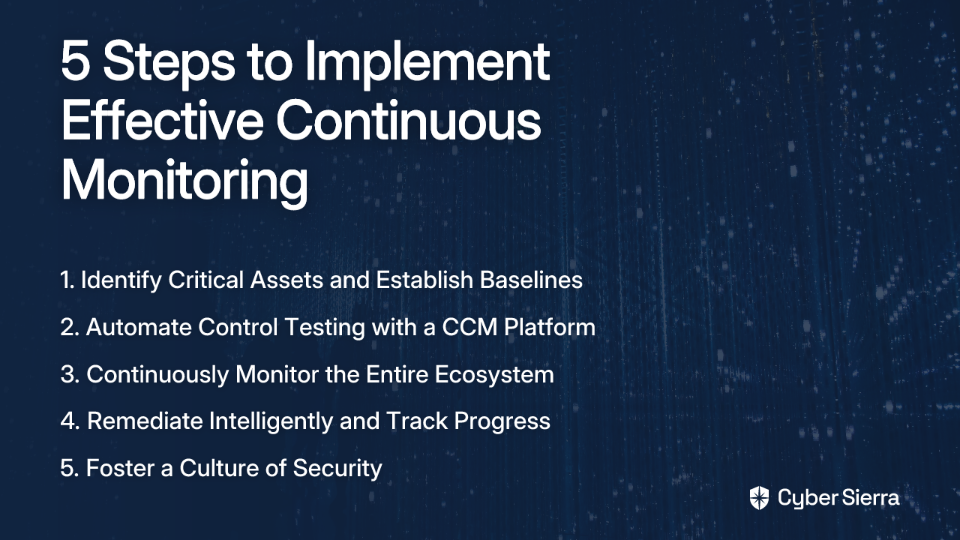
Moving from theory to practice, here's how to implement an effective continuous monitoring program:
Shifting from Reactive Defense to Proactive Resilience
The era of the annual audit and the quarterly scan is over. In a world where infosec risks evolve by the minute, real-time visibility is not a luxury—it is the foundation of a modern, resilient cybersecurity program.
By shifting from a reactive, incident-driven approach to a proactive strategy powered by Continuous Control Monitoring, you can identify and mitigate risks before they escalate into breaches.
Stop chasing infosec risks after the fact.
See how Cyber Sierra's integrated cybersecurity platform can provide the real-time visibility and automation you need to stay ahead by scheduling a personalized demo today.
Frequently Asked Questions
What is an information security risk?
An information security risk is any potential threat to your organization's data and systems that could impact confidentiality, integrity, or availability. According to NIST, this includes anything that could lead to unauthorized access, use, disclosure, disruption, modification, or destruction of information. This broad definition clarifies that events like system outages are indeed infosec risks because they affect information availability.
Why are traditional security assessments no longer effective?
Traditional security assessments, such as annual penetration tests or quarterly vulnerability scans, are no longer effective because they only provide a point-in-time snapshot of your security posture. In today's dynamic cloud environments, a system can become vulnerable minutes after an audit is completed. These periodic checks create dangerous blind spots, leaving organizations exposed to threats that emerge between assessments.
What is Continuous Control Monitoring (CCM)?
Continuous Control Monitoring (CCM) is a technology-driven process that automates the testing and monitoring of security controls in near real-time. Instead of waiting for a manual audit, a CCM platform continuously verifies that controls are in place and working as intended. This proactive approach allows organizations to identify and remediate security gaps, compliance drifts, and misconfigurations as they happen, shifting from a reactive to a resilient security posture.
How does continuous monitoring help manage third-party and supply chain risks?
Continuous monitoring transforms third-party risk management from a static, checklist-based process into a dynamic one. Instead of relying on outdated vendor questionnaires, a continuous monitoring solution provides 24/7 visibility into your vendors' security posture. It can track their compliance status, scan for vulnerabilities, and alert you to emerging threats, ensuring a partner's security weakness doesn't become your breach.
What are the first steps to implementing a continuous monitoring program?
The first steps to implementing a continuous monitoring program involve identifying your most critical assets and establishing security baselines for them. Following that, you should automate control testing with a CCM platform, expand monitoring across your entire ecosystem (cloud, vendors, on-prem), develop an intelligent remediation plan based on risk priority, and foster a security-conscious culture through ongoing training.
