Building an Integrated Risk Program That Scales Across Frameworks

Join thousands of professionals and get the latest insight on Compliance & Cybersecurity.
Summary
- Over 70% of organizations manage multiple compliance frameworks, often leading to redundant work and audit fatigue.
- An Integrated Risk Management (IRM) approach unifies compliance efforts, treating risk holistically across the organization instead of as a series of disconnected checklists.
- Key actions include unifying security controls through control mapping and adopting a risk-first mentality to prioritize efforts based on business impact.
- Leverage a unified platform like Cybersierra's GRC solution to automate control mapping and continuous monitoring, streamlining compliance across multiple frameworks.
You've meticulously implemented SOC 2 controls, only to learn your organization now needs to comply with ISO 27001. Or perhaps you're managing NIST requirements while simultaneously preparing for a HIPAA audit. The spreadsheets multiply, the documentation becomes unwieldy, and your team is drowning in what security professionals aptly call "audit fatigue."
If this sounds familiar, you're not alone. Research shows that 70% of service organizations must comply with multiple frameworks, leading to redundant work and inefficient processes. Meanwhile, security and compliance teams frequently find themselves caught in a reactive cycle—scrambling to gather evidence, addressing the same controls multiple times for different frameworks, and struggling to maintain a coherent view of their overall risk posture.
"A poorly defined process can make any GRC tool ineffective," noted one security professional in a recent Reddit discussion about GRC platforms. This insight captures a fundamental truth about risk management: technology alone isn't the answer.
The "Why": Understanding Integrated Risk Management (IRM)
Traditional Governance, Risk, and Compliance (GRC) approaches often treat security as a series of disconnected checklists. You complete SOC 2 requirements, then move to PCI DSS, then tackle GDPR—with minimal connection between these efforts. This siloed approach creates inefficiencies, blind spots, and ultimately, security vulnerabilities.
Integrated Risk Management (IRM) offers a more strategic solution. Rather than treating compliance as a series of separate exercises, IRM provides a unified approach to identifying, evaluating, and mitigating risks across an organization. It aligns strategic planning with daily operations and connects risk efforts across departments (IT, operations, finance), creating a comprehensive view of organizational risk.
The core benefits of adopting an integrated approach include:
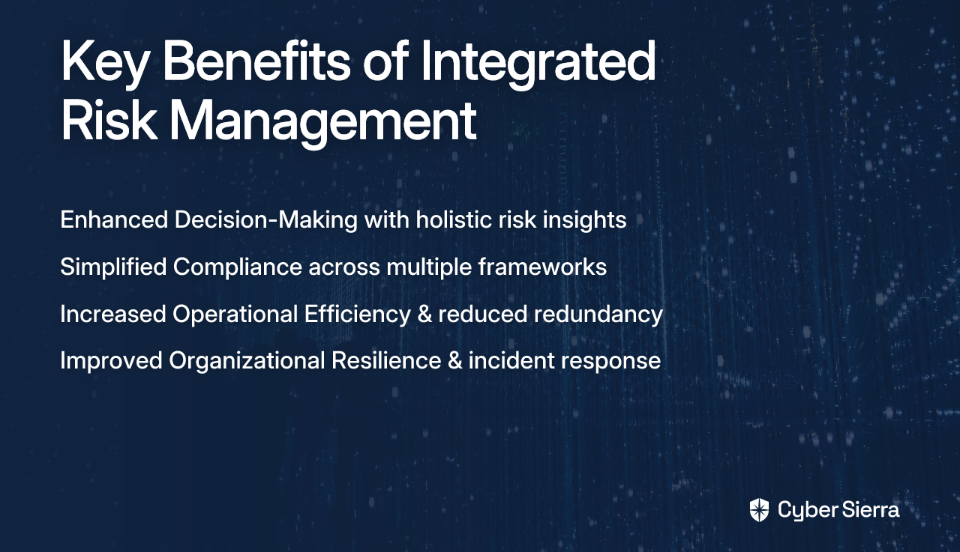
- Enhanced Decision-Making: Leadership gains access to holistic, up-to-date risk insights, enabling more informed strategic decisions.
- Simplified Regulatory Compliance: By mapping controls across frameworks, you can satisfy multiple compliance requirements with a single set of evidence.
- Increased Operational Efficiency: Teams spend less time on redundant documentation and more time on strategic risk reduction.
- Improved Organizational Resilience: A comprehensive understanding of risks enables faster recovery from disruptions and more effective incident response.
The Foundation: Core Components of a Scalable Program
Before implementing technology solutions, it's crucial to build a solid foundation for your integrated risk program. Many organizations make the mistake of purchasing a GRC platform before establishing the processes it's meant to support, leading to frustration and poor outcomes.
Assemble a Diverse Team of Experts
A successful risk program requires insights and buy-in from across the organization. Form a cross-functional team that includes:
- Senior leadership to provide strategic direction and resource allocation
- IT security professionals to manage technical controls
- Business unit managers who understand operational risks
- Legal/compliance experts who can interpret regulatory requirements
This diversity ensures your risk program considers all perspectives and addresses the full spectrum of organizational risks.
Establish Clearly Defined Goals and Criteria
Set specific short- and long-term goals for your risk program that align with broader business objectives. These might include:
- Reducing the time spent on compliance activities by 50% within one year
- Achieving a mature risk posture that satisfies requirements across all relevant frameworks
- Implementing continuous monitoring for critical controls by Q3
Your goals should be adaptable as the business evolves, focusing on business outcomes rather than just compliance checkboxes.
Develop Robust Policies and Procedures
Create detailed internal policies for risk reporting, decision-making, and defining acceptable risk levels. Effective policies should be:
- Role-based: Clearly defining responsibilities for each team member
- Consistent: Using standardized terminology and approaches across the organization
- Adaptable: Flexible enough to accommodate new regulations or business changes
- Documented: Accessible to all stakeholders in a centralized repository
These foundational elements significantly improve process maturity—a critical factor in the success of your risk program regardless of what technology you eventually implement.
The Blueprint: A Step-by-Step Guide to Implementation

With your foundation in place, you're ready to implement an integrated risk program that can scale across frameworks.
Step 1: Unify Controls with Control Mapping
Instead of managing each framework separately, create a master set of controls that can be mapped to multiple frameworks. This approach, known as control mapping, dramatically reduces redundant work.
For example, a single, robust access control policy can satisfy requirements across ISO 27001, SOC 2, and NIST CSF. By implementing and testing this control once, you can provide evidence for multiple compliance frameworks, saving significant time and effort.
The process involves:
- Identifying common control objectives across frameworks
- Creating a unified control set that addresses these objectives
- Mapping each control to specific requirements in each framework
- Documenting these relationships in a centralized system
Step 2: Adopt a Risk-First Mentality
Link every control directly to an identified business risk. This ensures your compliance efforts are focused on the highest-priority areas and provides context for why each control matters.
The process includes:
- Cataloging IT assets and identifying their associated risks using a comprehensive risk register
- Conducting risk assessments to evaluate potential threats and their impacts on your business
- Using a risk analysis matrix to determine likelihood and impact ratings for each risk
- Prioritizing control implementation based on risk severity rather than compliance deadlines
This risk-first approach ensures your program addresses genuine security concerns rather than merely checking compliance boxes.
Step 3: Implement Continuous Control Monitoring (CCM)
Traditional compliance programs rely on periodic assessments—annual audits or quarterly reviews. This approach leaves significant gaps during which control failures can go undetected.
Continuous Control Monitoring (CCM) represents a paradigm shift. It's an automated process that constantly evaluates controls to minimize business losses and increase operational effectiveness. CCM:
- Reduces remediation costs by catching issues early
- Increases confidence in risk management
- Provides immediate access to evidence for audits
- Enables proactive rather than reactive security management
Platforms like Cyber Sierra's CCM solution facilitate this by creating a central controls repository with near real-time updates. This provides a single source of truth for all controls and helps automate control testing and validation across multiple frameworks like NIST, ISO 27001, and PCI DSS.
Step 4: Centralize and Automate Evidence Generation
One of the most time-consuming aspects of compliance is evidence collection. Organizations often struggle with "inadequate evidence protection" and "ineffective search functionalities" when preparing for audits.
Address these challenges by:
- Implementing a centralized system for all compliance documentation
- Automating evidence collection where possible (e.g., automated screenshots of configuration settings)
- Establishing a consistent naming convention and folder structure
- Implementing proper access controls to maintain data integrity
Companies using automation for evidence collection report a 70% reduction in time spent on routine compliance tasks, freeing resources for more strategic risk management activities.
Scaling and Maturing Your Program
A truly effective risk program isn't static—it evolves with your organization. As your business grows and the threat landscape changes, your integrated risk management approach must scale accordingly.
Embrace an Iterative Process
Risk management is not a "set it and forget it" activity. Establish a regular cadence for:
- Reviewing and updating your risk register
- Reassessing control effectiveness
- Refining policies and procedures based on lessons learned
- Adapting to new regulatory requirements or business changes
This iterative approach ensures your program remains relevant and effective despite changing circumstances.
Leverage a Unified GRC Platform
As organizations grow, manual processes and spreadsheets become unsustainable. Many security professionals report "juggling multiple GRC platforms, leading to confusion and inefficiency." A unified platform solves this problem by providing a single source of truth for all risk and compliance activities.
A good GRC platform should:
- Automate data collection and risk assessments
- Support control mapping across multiple frameworks
- Provide comprehensive reporting capabilities
- Offer flexibility and customization as your needs evolve
A unified GRC platform, such as Cyber Sierra's Governance, Risk & Compliance solution, helps organizations manage control mapping, continuous monitoring, and policy management in one place. This not only streamlines compliance but also provides the flexibility and customization needed to scale as the business evolves, a key concern for teams that outgrow simpler automation tools.
Integrate Third-Party Risk Management (TPRM)
A scalable risk program must account for supply chain risks. Modern organizations rely on numerous third-party vendors, each introducing potential vulnerabilities to your security posture.
Integrate automated and continuous monitoring of vendor security into your IRM framework by:
- Implementing a standardized vendor risk assessment process
- Prioritizing vendors based on data access and criticality
- Continuously monitoring vendor security postures
- Establishing clear protocols for addressing vendor-related incidents
This integrated approach ensures vendor risks are managed with the same rigor as internal risks, providing a more comprehensive view of your organization's overall risk landscape.
Foster a Proactive Security Culture
A mature risk program extends beyond tools and processes to people. Technology alone cannot ensure security—your employees play a crucial role in risk management.
Implement ongoing security awareness training and phishing simulations to strengthen the "human firewall." Ensure that security and compliance are integrated into everyday business operations rather than treated as separate activities.
The Path Forward: From Compliance Chaos to Integrated Risk Management
Building an integrated risk program that scales across frameworks requires a strategic shift—from isolated, periodic compliance activities to a continuous, risk-first methodology. By establishing a solid foundation, unifying controls, implementing continuous monitoring, and leveraging the right technology, you can transform compliance from a burden into a business enabler.
Organizations that make this shift report significant benefits:
- Reduced time spent on compliance activities
- Improved visibility into their security posture
- Enhanced ability to respond to new regulatory requirements
- More effective allocation of security resources
As risk management continues to evolve, we're seeing trends toward greater integration of AI for proactive threat detection and the incorporation of ESG (Environmental, Social, Governance) factors as critical business risks. Organizations with mature, integrated risk programs will be better positioned to adapt to these emerging challenges.
Take time to evaluate your own program's maturity and consider how an integrated approach could reduce friction and improve your overall risk posture. The journey from siloed compliance to integrated risk management isn't always easy, but the operational efficiencies and security improvements make it well worth the effort.
Frequently Asked Questions
What is the difference between traditional GRC and Integrated Risk Management (IRM)?
The primary difference is that Integrated Risk Management (IRM) provides a unified, strategic approach to risk, while traditional GRC often treats compliance frameworks in isolated silos. IRM connects risk management efforts across the entire organization (IT, finance, operations) to provide a holistic view of risk. This contrasts with traditional GRC, which can lead to redundant work and a fragmented understanding of an organization's overall security posture as teams manage each framework like a separate checklist.
Why is control mapping essential for compliance with multiple frameworks?
Control mapping is essential because it allows you to satisfy multiple compliance requirements with a single control, dramatically reducing redundant work. Instead of implementing and testing separate controls for frameworks like ISO 27001, SOC 2, and NIST, you can create a unified set of controls. By mapping this single control to the relevant requirements in each framework, you test it once and use the evidence for multiple audits, saving significant time and resources.
How can a smaller organization begin building an integrated risk program?
A smaller organization can begin by focusing on foundational, low-cost steps before investing in complex tools. Start by assembling a cross-functional team with members from IT, operations, and leadership to get diverse input. Then, unify your controls by identifying overlaps in the frameworks you manage. Finally, adopt a risk-first approach by cataloging your key IT assets and focusing your initial efforts on securing the highest-priority risks to the business.
What is Continuous Control Monitoring (CCM) and why is it important?
Continuous Control Monitoring (CCM) is an automated process that constantly evaluates the effectiveness of your security controls in near real-time, rather than waiting for periodic audits. It is important because it provides immediate visibility into control failures, allowing for proactive remediation before a security incident occurs. This shift from periodic, manual checks to automated, ongoing validation reduces risk, lowers remediation costs, and ensures you have up-to-date evidence ready for any audit.
When is the right time to adopt a unified GRC platform?
The right time to adopt a unified GRC platform is after you have established clear processes for risk management and your manual methods, like spreadsheets, become unsustainable. Many organizations fail by buying a tool before defining their risk program's goals, policies, and procedures. Once your foundational processes are in place and your organization begins to scale, a GRC platform can automate control mapping, continuous monitoring, and evidence collection, solving the inefficiencies of manual management.