



ISO 27001 Compliance Software vs Hiring a Consultant: Cost Comparison

Join thousands of professionals and get the latest insight on Compliance & Cybersecurity.
Summary
- ISO 27001 certification costs range from $40,000 to $80,000, including hidden costs like penetration testing, gap analysis, and annual surveillance audits.
- The traditional consultant-led approach costs $30,000-$50,000 upfront but creates dependency, while compliance automation software can reduce overall costs by 25-50% and cut certification time in half.
- The most effective strategy is a hybrid model, using an automation platform for continuous evidence collection and a consultant for high-value, strategic guidance.
- An AI-enabled GRC automation platform automates up to 70% of compliance tasks, turning certification from a one-time project into a continuous program.
You've been tasked with getting ISO 27001 certified, and your first job is building a budget. Simple enough — until you start making calls and realize nobody will give you a straight number. Consultant quotes range wildly. Certification body fees vary by geography. And every conversation surfaces another "hidden" cost you hadn't accounted for: risk assessments, policy documentation, employee security training, penetration testing.
Then comes the harder question: do you invest in an ISO 27001 consultant to guide you through the entire process, or deploy a compliance automation platform to do the heavy lifting in-house?
This guide breaks down both paths with real numbers — so you can make a defensible case to your CFO and pick the right approach for your organization.
The Anatomy of ISO 27001 Costs: A Realistic Budget
Before comparing consultants and software, it helps to understand what you're actually paying for. The final audit fee is only one line item. According to Secureframe's certification cost breakdown, total ISO 27001 costs typically fall across four phases:
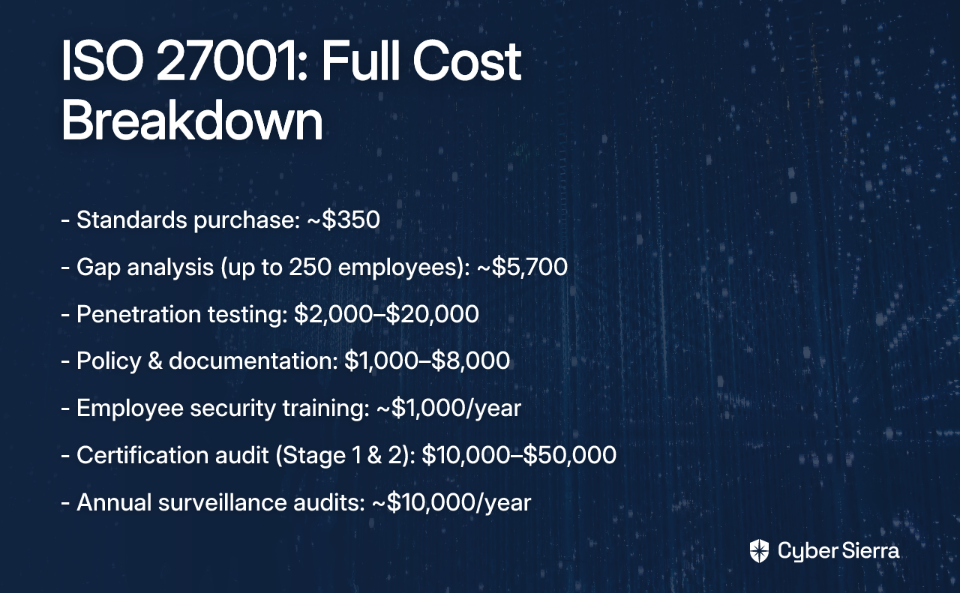
- Preparation and scoping. Purchasing the ISO/IEC 27001:2022 and ISO/IEC 27002 standards runs approximately $350. A gap analysis — which maps your current Information Security Management System (ISMS) against what the standard requires — can cost around $5,700 for organizations with up to 250 employees.
- Implementation. This is where most of the effort and money goes. Penetration testing alone can range from $2,000 to $20,000 depending on scope, per Secureframe's pen testing guide. Policy and documentation development adds another $1,000 to $8,000 if done manually or with limited support, as noted by Rhymetec's 2025 cost breakdown. Budget roughly $1,000 annually for employee security awareness training.
- Certification audit. The Stage 1 and Stage 2 certification audit conducted by an accredited certification body typically runs $10,000 to $50,000, depending on organizational size and complexity.
- Ongoing maintenance. ISO 27001 certification is valid for three years — but annual surveillance audits in years one and two cost around $10,000 each. A full recertification audit is due at the three-year mark.
One critical note from practitioners: always verify that your certification body is accredited by a recognized authority, such as UKAS in the UK or ANAB in North America. As one experienced auditor put it bluntly in an industry forum, unaccredited bodies "sell easy audits and rubber stamp certifications" that "aren't worth the ink used to print" them. A certificate from an unaccredited body will be rejected by enterprise customers and procurement teams — making the entire investment worthless.
Path 1: The Traditional Route with an ISO 27001 Consultant
The consultant-led approach is the classic model. You bring in a certified expert — typically an ISO 27001 Lead Auditor or Lead Implementer — who project-manages your path to certification from gap analysis through audit day.
What It Costs
According to ISMS.online's consultant cost guide, end-to-end ISO 27001 consulting engagements typically range from $30,000 to $50,000. Hourly rates for individual consultants generally run $100 to $300 per hour. A typical engagement breaks down roughly as follows:
- Phase I (Discovery and Scoping): ~$20,000, covering ISMS scoping, initial risk assessment, and Statement of Applicability (SoA) development.
- Phase II (Remediation and Implementation): ~$18,000, covering gap remediation, control implementation guidance, and ISMS build-out.
Costs are also geography-dependent. Engagements in North America and Western Europe command a significant premium over equivalently scoped projects in Southeast Asia or Eastern Europe.
Pros and Cons
Pros:
- Dedicated expertise. You get direct access to someone who has guided organizations through ISO 27001 dozens of times and knows where auditors focus their scrutiny.
- Reduced internal workload. The consultant drives the project, freeing your internal team from significant administrative overhead during the implementation phase.
- Tailored guidance. Advice is adapted to your specific industry, risk environment, and organizational structure rather than being generic framework guidance.
Cons:
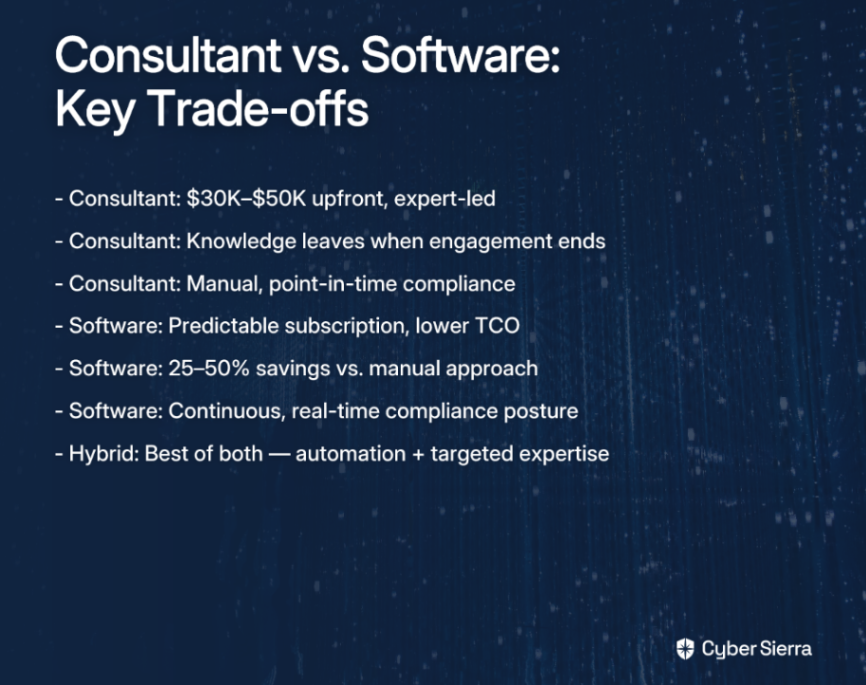
- High upfront investment. A $30,000–$50,000 cash outlay before a single audit fee is paid is a significant budget commitment, particularly for mid-sized organizations.
- Knowledge drain. When the engagement ends, the expertise walks out the door. Your team may not fully own the ISMS — making ongoing management, surveillance audits, and control updates much harder.
- Manual and slow. Evidence collection still relies on spreadsheets, email chains, and manually assembled document packages. It doesn't scale.
- Point-in-time compliance. The consultant's focus is on passing the audit — not building a continuously monitored, always-audit-ready security program.

Path 2: The Modern Approach with ISO 27001 Compliance Software
Compliance automation platforms take a fundamentally different approach. Instead of a human expert guiding a manual process, the software integrates with your existing technology stack, automates evidence collection, and provides a continuously updated view of your compliance posture — turning ISO 27001 from a project into a program.
What It Costs
Compliance software is typically priced as an annual subscription, converting a large capital expense into a predictable operational one. The financial case for automation is strong: organizations using compliance automation report saving 25–50% on overall compliance costs compared to manual approaches. Vanta's product page notes that automation can cut certification timelines by up to 50%, with many organizations achieving compliance in 12–24 weeks rather than 12+ months.
That's not just a speed improvement — it's a direct reduction in internal labor costs, consultant hours, and the opportunity cost of having your security team buried in evidence-gathering instead of doing actual security work.
Core Features That Drive the Savings
The cost efficiency comes from specific capabilities that eliminate the most time-consuming manual tasks:
- Automated evidence collection. The platform integrates with your cloud infrastructure, identity providers, and development tools to automatically gather control evidence. This eliminates the hundreds of hours security teams typically spend manually collecting screenshots and logs before an audit.
- Continuous control monitoring. Instead of a periodic snapshot, the platform delivers a real-time dashboard of your compliance posture. Gaps and misconfigurations are flagged the moment they appear — not when an auditor finds them. Platforms like Scrut Automation automate up to 70% of compliance tasks and run daily cloud compliance checks against 230+ CIS benchmarks.
- Framework cross-mapping. Controls and evidence mapped to ISO 27001 can be automatically cross-referenced against SOC 2, HIPAA, GDPR, and PCI DSS. Organizations pursuing multiple frameworks no longer need to rebuild their evidence library from scratch for each audit.
- Integrated risk management. Built-in risk assessment workflows aligned with ISO 27005 allow teams to document, track, and treat risks within the same platform — keeping your risk register current rather than letting it age between audits.
- Auditor collaboration portal. A dedicated, secure workspace where auditors can review policies, controls, and evidence directly removes the back-and-forth of assembling and transmitting audit packages.
Pros and Cons
Pros:
- Lower total cost of ownership. Predictable subscription fees combined with dramatic reductions in manual labor produce significant long-term savings over the consultant model.
- Speed to certification. Automation compresses timelines considerably — particularly the evidence-gathering and control-validation phases that consume the most calendar time in manual processes.
- Scalability. Annual surveillance audits and new framework additions are handled within the same platform, without engaging additional consultants or rebuilding processes from scratch.
- Sustainable compliance program. The platform becomes a permanent system of record for your ISMS — policies, risk assessments, control evidence, and audit history all in one place, continuously maintained.
Cons:
- Requires internal ownership. The platform augments your team — it doesn't replace the need for a responsible person to drive the compliance program. Someone still needs to own it.
- Potential learning curve. Teams need to invest time in onboarding and learning to use the platform effectively before they realize its full value.
- Integration quality matters. The ROI depends heavily on how well the platform integrates with your specific technology stack. Evaluate integration coverage carefully before committing.
The Case for a Hybrid Strategy
The consultant-vs-software framing is a false choice. The most cost-effective and durable path to certification combines both — strategically.
The model works like this: a compliance automation platform becomes the operational backbone of your ISMS. It handles the 80% of work that is repetitive, data-driven, and time-intensive — automated evidence collection, continuous control monitoring, policy management, and real-time posture reporting. A GRC platform built for ISO 27001 gives your team a single source of truth and keeps you perpetually audit-ready.
A consultant is then engaged for a narrower, high-value scope where human expertise genuinely earns its premium:
- Finalizing a complex ISMS scope that requires deep industry-specific knowledge
- Advising on non-obvious control interpretations or edge cases in your environment
- Conducting the formal internal audit, where independence from implementation is a real requirement
The result: your consultant bills fewer hours at a fraction of the full-engagement cost, your team builds permanent capability they retain after the engagement ends, and your compliance posture doesn't collapse the day after certification.
Your Smartest Path to ISO 27001
Building a defensible ISO 27001 budget isn't about choosing between a consultant and software—it's about making a strategic investment in your security posture. To make the right call, focus on two key takeaways from this guide.
First, understand the total cost of ownership. A realistic budget must account for hidden costs like penetration testing, gap analysis, and annual surveillance audits—not just the final certification fee. Second, embrace a hybrid strategy. Use an automation platform for the heavy lifting of continuous evidence collection and hire a consultant for high-value, targeted advice. This approach cuts costs, accelerates timelines, and keeps critical security knowledge in-house.
Your next step today? Sketch out the key systems and data flows that will define your ISMS scope. This simple exercise will clarify the scale of your project and make your cost estimates far more accurate.
When you’re ready to see how a platform can automate this work and provide a single source of truth for your compliance program, check out Cyber Sierra's pricing. See how our GRC platform turns compliance from a painful project into a powerful business advantage.
Frequently Asked Questions
What is the total cost of ISO 27001 certification?
Total costs typically range from $40,000 to $80,000 for initial certification. This includes standards, gap analysis, pen testing, training, the audit, and fees for consultants or software, varying by company size and complexity.
How long does it take to get ISO 27001 certified?
The timeline for ISO 27001 certification is typically 3 to 12 months. While manual processes can take over a year, compliance automation software can accelerate this to just 12-24 weeks by streamlining evidence collection and control monitoring.
What is the difference between using a consultant and compliance software for ISO 27001?
A consultant provides expert project management, while software automates the process. Consultants offer tailored guidance at a high upfront cost. Software provides a lower total cost of ownership, continuous monitoring, and builds a sustainable, in-house compliance program.
How can automation software reduce ISO 27001 costs?
Automation software reduces costs by minimizing manual labor and consultant hours. It automates time-consuming tasks like evidence collection, which can cut overall compliance costs by 25-50% and significantly compress audit timelines, saving on staff and audit fees.
What are ongoing costs after initial ISO 27001 certification?
Ongoing costs primarily consist of annual surveillance audits, which average around $10,000 each. Your certification requires these audits in years one and two, a full recertification in year three, plus any software subscription or internal staff costs.
Why is using an accredited certification body so important?
Using an accredited certification body ensures your certificate is globally recognized and accepted. Certificates from unaccredited bodies are often rejected by enterprise customers and procurement teams, rendering your entire investment worthless.
