



ISO 27001 Certification Roadmap for Financial Services

Join thousands of professionals and get the latest insight on Compliance & Cybersecurity.
You've been tasked with securing ISO 27001 certification for your financial institution, and the pressure is mounting. Tight deadlines loom, mountains of documentation await, and you're already feeling overwhelmed by where to even begin. The scope seems impossible to define clearly, and you wonder if your organization has the expertise to navigate this complex process.
Sound familiar? You're not alone. Financial services professionals frequently report feeling "overwhelmed by the extensive documentation" and experience "confusion regarding how to properly define the scope" when tackling ISO 27001 certification.
But here's the truth: while ISO 27001 certification is indeed rigorous, it's entirely achievable with the right roadmap. This article provides exactly that—a clear, step-by-step path specifically designed for financial services organizations.
Why ISO 27001 is Non-Negotiable for Financial Services
The financial services sector is a cornerstone of the global economy, contributing £173.6 billion to the UK economy alone in 2021 (8.3% of total output). With this economic importance comes enormous responsibility for managing sensitive information.
ISO/IEC 27001 is the leading international standard for an Information Security Management System (ISMS). Its purpose is to help organizations protect their information systematically and cost-effectively through implementing controls based on three core principles:
- Confidentiality: Ensuring only authorized individuals can access sensitive client financial data
- Integrity: Safeguarding the accuracy of transaction records and preventing unauthorized alterations
- Availability: Maintaining critical system uptime for services like online banking platforms
Beyond protecting information, ISO 27001 delivers several critical benefits specifically valuable to financial institutions:
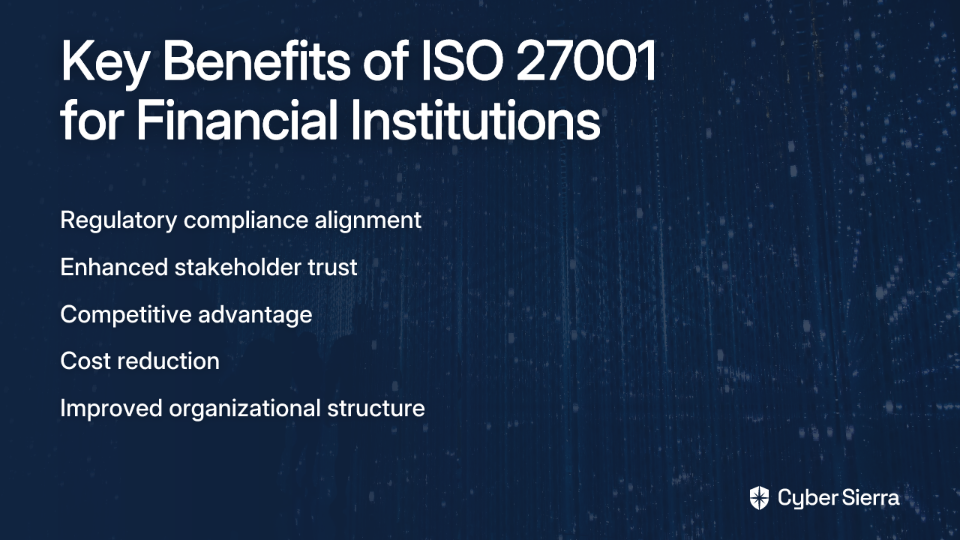
Regulatory Compliance Alignment
ISO 27001 provides a framework that helps satisfy requirements from multiple regulations:
- General Data Protection Regulation (GDPR): The risk assessment framework helps manage requirements for data confidentiality, integrity, and resilience
- Gramm-Leach-Bliley Act (GLBA): The standard helps fulfill requirements to document data protection measures
Tangible Business Benefits
- Enhanced Stakeholder Trust: In an industry built on trust, certification provides verifiable evidence of your commitment to information security
- Competitive Advantage: Certification distinguishes your firm from non-certified competitors—a significant advantage when securing new business
- Cost Reduction: Prevents security incidents, saving money on breach remediation, regulatory fines, and reputational damage
- Improved Organization: Clarifies roles, responsibilities, and processes across the organization
The Comprehensive ISO 27001 Implementation Roadmap
Let's break down the certification journey into manageable phases:
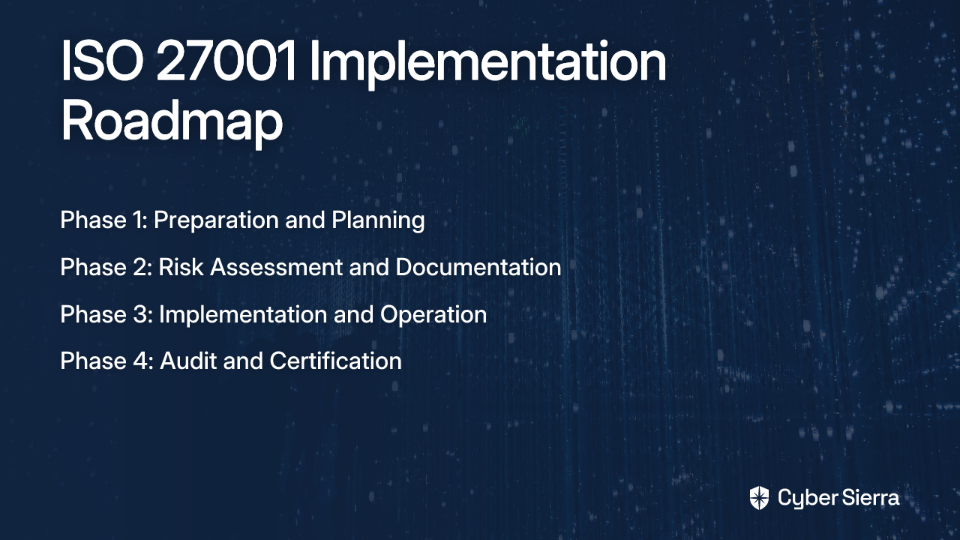
Phase 1: Preparation and Planning (The Foundation)
- Obtain Management Support This is your critical first step. Without executive commitment for resources and time, certification projects often fail. Present ISO 27001 not as a compliance burden but as a strategic business advantage.
- Form an Internal ISO 27001 Team Many professionals report "feeling unsupported and pressured due to lack of team guidance during implementation." Address this by establishing a cross-functional team with clear roles and responsibilities across IT, Engineering, Legal, and other departments.
- Define the ISMS Scope This addresses the commonly reported "confusion regarding scope." Your scope should clearly identify which parts of the organization will be covered by the ISMS. Tip: Define your scope by considering:
- IT systems that fall under compliance
- Users and external users affected
- Physical locations involved
- Existing company policies that fall under compliance
Phase 2: Risk Assessment and Documentation (Demystifying the Paperwork)
- Conduct a Gap Analysis Evaluate your current security posture against ISO 27001 requirements to identify weak spots and guide resource planning.
- Create an Inventory of Assets Document all information assets that need protection, including hardware, software, data, and people.
- Define Risk Assessment Methodology & Perform the Assessment Establish formal rules for identifying and analyzing information security risks. Then execute the assessment to identify threats to your assets.
- Write the Risk Treatment Plan Based on the assessment, create a plan detailing how you will address unacceptable risks.
- Prepare Mandatory Documentation Many feel "overwhelmed by the extensive documentation," so let's clarify exactly what's required:
- Scope of the ISMS
- Information security policy and objectives
- Risk assessment and risk treatment plans
- Statement of Applicability (SoA) - a central document listing all 93 controls from Annex A of the standard
- Evidence of competence (e.g., training records)
- Records from internal audits and management reviews
Phase 3: Implementation and Operation (Putting the Plan into Action)
- Implement Security Controls and Policies Put the plans and controls from your Risk Treatment Plan and SoA into practice.
- Conduct Employee Awareness & Training Educate all stakeholders on security policies and their roles. This is essential for embedding security into the company culture.
- Operate and Monitor the ISMS Establish metrics to measure the effectiveness of your controls. Regularly monitor performance and maintain records to prove the ISMS is functioning as intended.
Phase 4: Audit and Certification (The Final Hurdles)
- Conduct an Internal Audit Before external auditors arrive, perform a full internal audit to check if your ISMS meets all requirements. This is your dress rehearsal.
- Hold a Management Review Top management must formally review the ISMS's performance, audit results, and outstanding issues to ensure it remains effective.
- Implement Corrective Actions Address any non-conformities found during monitoring or the internal audit.
- Undergo the External Certification Audit
- Stage 1 Audit: The certification body reviews your documentation to confirm readiness
- Stage 2 Audit: Auditors conduct a detailed, evidential audit to verify your controls are operating effectively
Life After Certification: Maintenance and Continual Improvement
Certification is a cycle, not a finish line. After certification:
- Periodic Surveillance Audits: The certification body will conduct annual surveillance audits to ensure your ISMS is being maintained
- Recertification: Certification is typically valid for three years, requiring a full recertification audit afterward
- Continual Improvement: Regularly review and update the ISMS to adapt to new threats and business changes
Navigating the Journey: Timelines, Costs, and Strategic Options
Realistic Timelines
Implementation can take anywhere from 3 months for a small, agile organization to over a year for a large, complex financial institution. Compliance automation tools can accelerate this timeline, sometimes to just 2-3 months.
Understanding the Costs
Costs depend on company size, complexity, and existing security maturity. Key cost factors include:
- Training and literature for staff
- External assistance (consultants or tools)
- Employee time dedicated to the project
- Technology adjustments or purchases
- The certification audit itself
Strategic Implementation Options
- Do It Yourself (DIY): Best for organizations with in-house expertise
- With Tools: Use software platforms (like Conformio, Hicomply, DataGuard, or Sprinto) to streamline documentation and control monitoring
- Consultant-Led: For companies lacking internal expertise, "It would be best to bring in a consultant to do a gap analysis and advise on a roadmap" as recommended by industry professionals
Conclusion
ISO 27001 certification in financial services isn't just about compliance—it's a strategic framework for building resilience, earning customer trust, and gaining a competitive edge in a highly regulated market.
By following this roadmap, what initially appears to be an overwhelming transformation becomes a manageable journey with clear milestones. The time to begin is now: secure management buy-in, define your scope, and take that first step toward certification.
Remember, many financial institutions have successfully navigated this path before you. With the right approach, your organization will join them in demonstrating its commitment to information security excellence through ISO 27001 certification.
Frequently Asked Questions
What is ISO 27001 and why is it crucial for financial services?
ISO 27001 is the leading international standard for an Information Security Management System (ISMS), providing a framework to protect sensitive information. It is crucial for financial services to maintain regulatory compliance, build customer trust, and protect critical financial data based on the principles of confidentiality, integrity, and availability.
How long does it take to get ISO 27001 certified?
The timeline for ISO 27001 certification can range from 3 months to over a year. The exact duration depends on an organization's size, complexity, and current security maturity. While a small, agile company might achieve certification in a few months, a large, complex financial institution will likely require a longer timeframe.
What are the main phases of the ISO 27001 implementation process?
The ISO 27001 implementation process is typically broken down into four main phases: Preparation and Planning, Risk Assessment and Documentation, Implementation and Operation, and finally, Audit and Certification. This structured approach takes you from gaining management support and defining your scope all the way to undergoing the final external audit.
What is an ISMS scope and why is it important to define?
The ISMS scope is a formal statement that defines the boundaries of your Information Security Management System (ISMS). It is critically important because it clarifies exactly which parts of your organization—including systems, locations, and processes—must comply with the ISO 27001 standard. A well-defined scope prevents confusion, ensures all critical assets are covered, and makes the audit process smoother.
Is ISO 27001 certification a one-time project?
No, ISO 27001 certification is not a one-time project; it is an ongoing commitment to continual improvement. After achieving certification, your organization must maintain the ISMS. This involves periodic surveillance audits conducted by the certification body (typically annually) and a full recertification audit every three years to retain your certified status.
What are the options for implementing ISO 27001?
There are three primary strategic options for implementing ISO 27001: doing it yourself (DIY) if you have in-house expertise, using compliance automation tools to streamline the process, or hiring an external consultant for expert guidance. The best choice depends on your organization's internal resources, budget, and desired timeline.
