



When Do I Need ISO 27001 to Close Sales?


Join thousands of professionals and get the latest insight on Compliance & Cybersecurity.
You've spent months perfecting your product, fine-tuning your sales pitch, and building a robust pipeline of prospects. But now, as you're getting closer to closing those enterprise deals, you're repeatedly hit with the same question: "Does your organization have ISO 27001 certification?"
This question stops your sales momentum dead in its tracks. Your prospects – especially those large enterprises and government agencies – won't move forward until they're satisfied with your answer. Suddenly, you're wondering if your lack of ISO 27001 certification is costing you valuable deals and revenue.
The Growing Demand for ISO 27001 in Sales Conversations
In today's hyper-connected business environment, data breaches and security incidents have become alarmingly common. High-profile attacks like the Colonial Pipeline ransomware incident have put cybersecurity front and center in business discussions.
As a result, organizations are increasingly cautious about who they trust with their data. Many have implemented strict vendor security assessment processes, with ISO 27001 certification often serving as a key qualification criterion.
"Some of our clients work with much larger businesses or government which require a SOC Type II or equivalent attestation," notes one IT professional in a recent online discussion. This reality is becoming more common across industries, where certification isn't just nice to have – it's becoming a requirement to even get past the initial vendor screening phase.
What Exactly is ISO 27001?
Before diving deeper, let's clarify what ISO 27001 actually is. ISO 27001 is an internationally recognized standard for information security management. It provides a framework for establishing, implementing, maintaining, and continually improving an Information Security Management System (ISMS).
The standard focuses on three core principles:

- Confidentiality: Ensuring information is accessible only to authorized individuals
- Integrity: Safeguarding the accuracy and completeness of information
- Availability: Making information accessible to authorized users when needed
Unlike other security frameworks that might focus on specific technical controls, ISO 27001 takes a comprehensive, risk-based approach to information security that encompasses people, processes, and technology.
When ISO 27001 Can Make or Break Your Sales Process
Enterprise and Government Contracts
If your target market includes large enterprises, financial institutions, healthcare organizations, or government agencies, ISO 27001 certification may be non-negotiable. These organizations often have strict vendor security requirements, and ISO 27001 has become a standard checkbox item in their procurement processes.
"If your main goal is to improve sales, then ISO 27001 has different focuses," explains one cybersecurity professional. Many companies find that having this certification dramatically accelerates the sales cycle with enterprise clients, as it eliminates lengthy security assessments and questionnaires that can delay deals for months.
Competitive Differentiation
In crowded markets where products and services are similar, ISO 27001 certification can be a powerful differentiator. When prospects are comparing multiple vendors with similar offerings, security certifications often become a deciding factor – especially in industries where data protection is paramount.
International Business Expansion
For companies looking to expand globally, ISO 27001 certification provides instant credibility. Since it's an internationally recognized standard, it helps bridge trust gaps when entering new markets where your brand may not be well-known.
When You Might Not Need ISO 27001 Yet
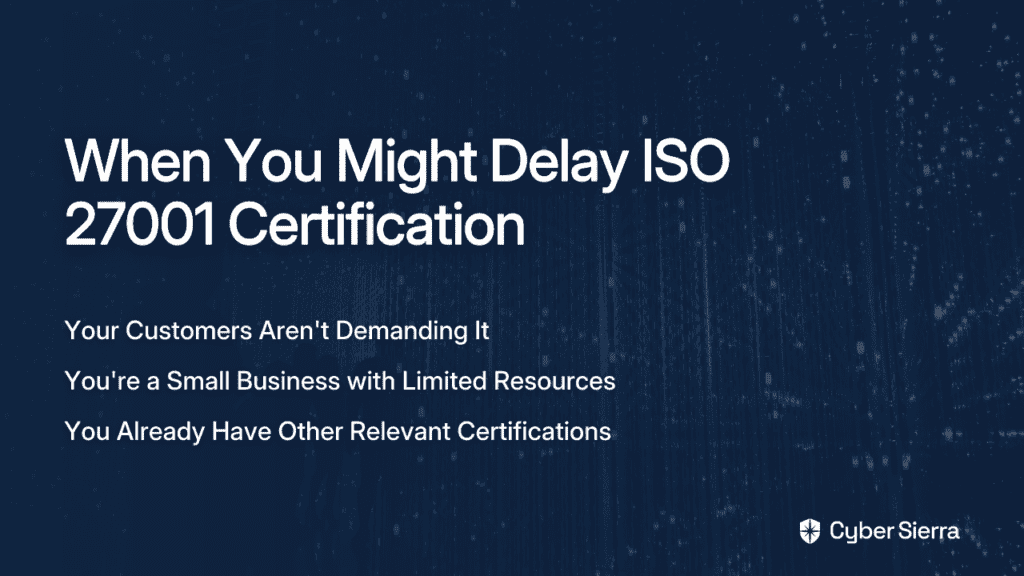
Despite its benefits, ISO 27001 certification isn't always necessary for every business. Here are scenarios where you might reasonably delay pursuing certification:
Your Customers Aren't Demanding It
As one expert puts it, "You shouldn't pursue any attestation report unless you have current clients expecting it or you need it for the RFP process." If your typical customers don't ask about ISO 27001 during sales conversations, the investment might not yield immediate returns.
You're a Small Business with Limited Resources
For smaller organizations, the cost and effort required for ISO 27001 certification can be significant. If you're not losing deals due to a lack of certification, it might make more sense to implement security best practices internally without pursuing formal certification right away.
You Already Have Other Relevant Certifications
If you already maintain other security certifications like SOC 2 Type II that satisfy your customers' requirements, ISO 27001 might be redundant in the short term. "If your customers are not asking for it, SOC 2 is enough for many," notes one IT security professional.
The Common Challenges of ISO 27001 Implementation
Lack of Internal Expertise
Many organizations struggle with limited internal expertise to navigate the ISO 27001 certification process. As one professional confessed, "I'm from the company's business side, and I have a tech background but no prior ISM experience. They don't consider hiring a consultant at this point."
This knowledge gap can make the certification process seem daunting, but it's not insurmountable. Solutions like Cyber Sierra's Governance, Risk & Compliance (GRC) module can help bridge this gap by providing guided frameworks and automation tools specifically designed for ISO 27001 implementation.
Administrative Burden
Another common concern is the perceived administrative burden. "We're already dealing with control fatigue after SOC 2," mentions one team considering ISO 27001. "The team's tossing around the idea of going for ISO 27001, and honestly, we're not sure if it's a smart move or just more paperwork."
This is a legitimate concern. ISO 27001 does require documentation, regular reviews, and ongoing monitoring. However, modern GRC platforms can significantly reduce this burden through automation and continuous control monitoring.
Time and Resource Constraints
ISO 27001 certification typically takes 6-12 months, depending on your organization's size and current security posture. As one professional notes, "It appears to be a time-consuming process to obtain the certificate. I'm not even sure if a company without internal expertise can obtain certification this way."
Practical Steps to Determine If You Need ISO 27001
1. Analyze Your Sales Pipeline
Review your recent lost deals and RFP rejections. Are you consistently losing opportunities due to security concerns or certification requirements? If so, ISO 27001 might directly impact your bottom line.
2. Conduct a Gap Assessment
Before committing to full certification, consider conducting a gap assessment using the ISO 27001 framework. This helps you understand your current compliance level and the effort required to achieve certification.
As one expert recommends, "Consider a gap assessment first. You could use the ISO 27001 framework to guide your ISMS without actually doing the audit/getting a cert if your customers are not asking for it."
3. Talk to Your Prospects
Directly ask your prospects if ISO 27001 certification would influence their purchasing decision. This straightforward approach can provide clarity on whether the investment will yield tangible sales benefits.
4. Secure Management Buy-in
ISO 27001 implementation requires organizational commitment. As multiple experts emphasize, "Get management on your side. If this is not sponsored by the board, run." Without executive support, the certification process will likely stall.
Making ISO 27001 Certification More Manageable
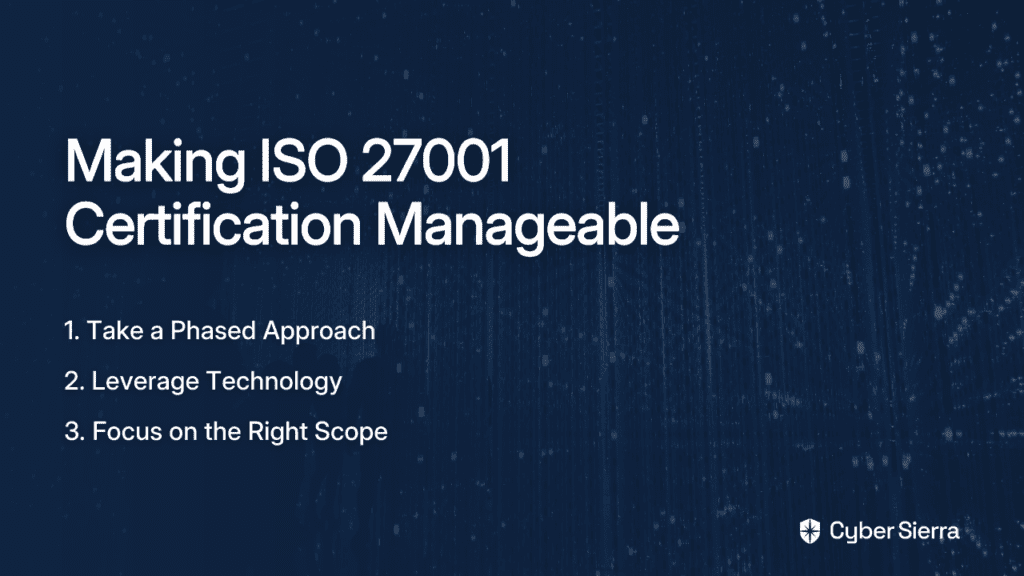
If you determine that ISO 27001 is necessary for your sales success, here are strategies to make the process more manageable:
1. Take a Phased Approach
You don't need to tackle everything at once. Break down the implementation into manageable phases, addressing the most critical areas first.
2. Leverage Technology
Modern security and compliance platforms can significantly streamline the certification process. Cyber Sierra's Continuous Control Monitoring (CCM) system, for instance, automates evidence collection and monitoring across multiple frameworks including ISO 27001, reducing the manual effort that often leads to "control fatigue."
3. Focus on the Right Scope
ISO 27001 allows you to define the scope of your certification. Start with the most critical systems and processes relevant to your customers, rather than attempting to certify your entire organization at once.
Conclusion
ISO 27001 certification can be a powerful sales enabler in the right circumstances. For organizations selling to enterprises, government agencies, or regulated industries, it often becomes a necessary credential to close deals.
However, the decision should be driven by tangible business needs rather than simply following industry trends. By carefully assessing your specific customer requirements and sales challenges, you can make an informed decision about whether ISO 27001 certification will deliver meaningful ROI through accelerated sales cycles and expanded market opportunities.
If you determine that ISO 27001 is indeed necessary for your sales success, platforms like Cyber Sierra can help simplify the journey by automating compliance processes, providing continuous control monitoring, and offering the expertise needed to navigate the certification process efficiently.
Remember that ISO 27001 is not just a sales tool but a framework for building a more secure organization. The true value comes not just from the certificate itself, but from the improved security posture and operational discipline it helps establish.
