



ISO 37301 Compliance Management System vs. Other Frameworks: A Comparison Guide


Join thousands of professionals and get the latest insight on Compliance & Cybersecurity.
Summary
- Managing multiple compliance frameworks like SOC 2, ISO 27001, and NIST in silos creates redundant work and audit fatigue.
- ISO 37301 is a certifiable standard that provides a foundational 'umbrella' framework to govern all of your compliance obligations, from ISO 27001 to SOC 2.
- Implement a 'map once, comply many' strategy by creating a central controls repository to avoid collecting the same evidence for different audits.
- A GRC platform with Continuous Control Monitoring automates this process; Cyber Sierra's platform maps controls across frameworks to keep your organization perpetually audit-ready.
If you've ever found yourself chasing down random spreadsheets and hundreds of screenshots from five different teams just to satisfy one audit requirement — only to turn around and do it all over again for a different framework — you already know the pain of modern compliance.
This is the reality for most compliance managers today. Organizations simultaneously navigate SOC 2, ISO 27001, NIST CSF, GDPR, HIPAA, and a growing list of sector-specific regulations. Each framework brings its own requirements, controls, and evidence collection rituals.
Managed in silos, they create what compliance professionals have started calling compliance fatigue — a draining cycle of duplicated effort, audit anxiety, and ever-present risk of missing something critical.
The growing complexity of compliance isn't slowing down. And simply adding another framework to your stack isn't the answer.
That's where ISO 37301 comes in — not as yet another framework to pile onto your workload, but as a foundational Compliance Management System (CMS) designed to bring structure and coherence to all of your compliance obligations at once. Think of it as the system that manages your systems.
This guide breaks down how the ISO 37301 compliance management system compares to ISO 27001, SOC 2, and the NIST Cybersecurity Framework, maps out overlaps and gaps, and shows how a unified approach — powered by the right technology — can transform compliance from a periodic scramble into a continuous, organized program.
What is ISO 37301? The Foundation for a Strong Compliance Culture
ISO 37301:2021 is the international standard that provides requirements and guidelines for establishing, developing, implementing, evaluating, maintaining, and improving an effective Compliance Management System. It replaced its predecessor, ISO 19600, with a crucial upgrade: it is now a Type A certifiable standard, meaning organizations can obtain third-party certification against it — a significant signal of compliance maturity to regulators, partners, and customers alike.
At its core, ISO 37301 promotes a proactive, risk-based approach to compliance. Rather than scrambling reactively when regulations change or audits loom, organizations embed compliance into their core processes and culture. It follows the Plan-Do-Check-Act (PDCA) cycle for continual improvement, ensuring the CMS evolves alongside the organization and its regulatory environment.
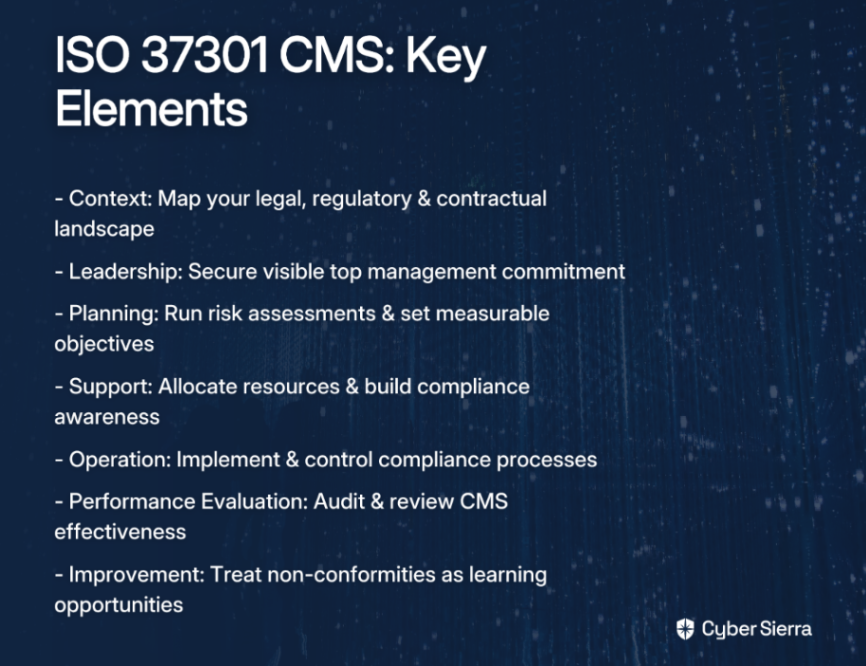
Key ISO 37301 elements include:
- Context of the Organization. Understanding internal and external factors — legal, regulatory, contractual — that shape your compliance obligations.
- Leadership and Commitment. Mandating visible, active support from top management. Compliance can't live only in the legal or IT department.
- Planning. Conducting compliance risk assessments, setting measurable objectives, and mapping out action plans.
- Support. Allocating resources, ensuring staff competency, and fostering organization-wide awareness.
- Operation. Implementing and controlling the processes that fulfill compliance obligations.
- Performance Evaluation. Monitoring, measuring, and auditing CMS effectiveness through internal audits and management reviews.
- Improvement. Treating non-conformities as learning opportunities and continually enhancing the system.
The benefits of implementing an ISO 37301 CMS are tangible:
- Mitigate legal and regulatory risk through a systematic, documented approach to obligations.
- Build stakeholder trust — certification provides third-party validation of your compliance posture.
- Gain a competitive advantage by demonstrating verifiable commitment to ethical governance.
- Improve decision-making through structured risk analysis and clear accountability.
ISO 37301 vs. The Field: A Head-to-Head Comparison
Understanding how ISO 37301 sits alongside — not against — other major frameworks is the key to unlocking a smarter compliance strategy.
ISO 37301 vs. ISO 27001 (Information Security Management)
ISO 27001 is the gold standard for establishing an Information Security Management System (ISMS). It focuses specifically on protecting the confidentiality, integrity, and availability of information assets.
ISO 37301 is broader. While ISO 27001 narrows its lens to information security, ISO 37301 covers all of an organization's compliance obligations — legal, regulatory, contractual, environmental, HR, and beyond.
Overlap: Both are management system standards built on the same High-Level Structure (HLS), which means they share common structural elements: risk-based thinking, leadership commitment, documented objectives, and continual improvement. This alignment makes it relatively straightforward to integrate both systems.
Gap: ISO 37301 acts as the "umbrella" compliance governance framework, while ISO 27001 is a domain-specific "spoke" beneath it. An organization can use its ISO 37301 CMS to formally manage its ISO 27001 obligations as one component of a larger compliance universe.
ISO 37301 vs. SOC 2 (Service Organization Controls)
SOC 2 is an attestation standard developed by the AICPA, focused on controls at service organizations relevant to five Trust Services Criteria: Security, Availability, Processing Integrity, Confidentiality, and Privacy.
Overlap: Both ISO 37301 and SOC 2 involve continuous monitoring and assessment of controls to maintain ongoing compliance rather than treating it as a one-time event.
Gap: SOC 2 is an audit report — an external attestation of your controls at a point in time — not a management system you get certified for. ISO 37301, by contrast, provides the governance framework to manage the compliance obligations that a SOC 2 report attests to. It offers a more comprehensive risk management lens that extends well beyond the five Trust Services Criteria. Put simply: ISO 37301 helps you build and govern the program; SOC 2 helps you prove it to customers.
ISO 37301 vs. NIST Cybersecurity Framework (CSF)
The NIST CSF provides voluntary guidance for organizations to manage and reduce cybersecurity risk through five core functions: Identify, Protect, Detect, Respond, and Recover.
Overlap: Both ISO 37301 and NIST CSF emphasize risk analysis as a foundation for decision-making. NIST's operational functions can align with the controls and processes managed within an ISO 37301 system.
Gap: NIST is laser-focused on cybersecurity. It's also a set of best-practice guidelines — not a certifiable standard. ISO 37301 is industry-agnostic, covering all compliance domains, and provides a structured governance layer with formal certification potential that NIST does not offer.

Framework Comparison at a Glance
Here is a simple breakdown of how these frameworks differ in focus, scope, and type.
| Attribute | ISO 37301 (CMS) | ISO 27001 (ISMS) | SOC 2 | NIST CSF |
|---|---|---|---|---|
| Primary Focus | Enterprise-wide Compliance Governance | Information Security | Service Org. Data Controls | Cybersecurity Risk |
| Scope | All legal, regulatory & voluntary obligations | Information assets | Customer data (Trust Services Criteria) | IT systems & critical infrastructure |
| Type | Certifiable Management System | Certifiable Management System | Attestation Report | Guideline / Best Practices |
| Approach | Risk-based, continual improvement | Risk-based, continual improvement | Control-based attestation | Risk-based functions |
| Certification | Yes | Yes | No (attestation only) | No |
The "Map Once, Comply Many" Strategy: Unifying Your Compliance Efforts
Here's the inefficiency hiding in plain sight: many of the controls required by ISO 27001, SOC 2, and NIST CSF are fundamentally the same. Access control policies, incident response procedures, risk assessments, vendor management practices — they all appear across multiple frameworks with slightly different labels.
Without a unified approach, your team ends up collecting the same evidence, re-documenting the same controls, and re-explaining the same processes — for every single audit. As one compliance professional noted on Reddit, "If you're dealing with multiple frameworks, the mapping features save a ton of time."
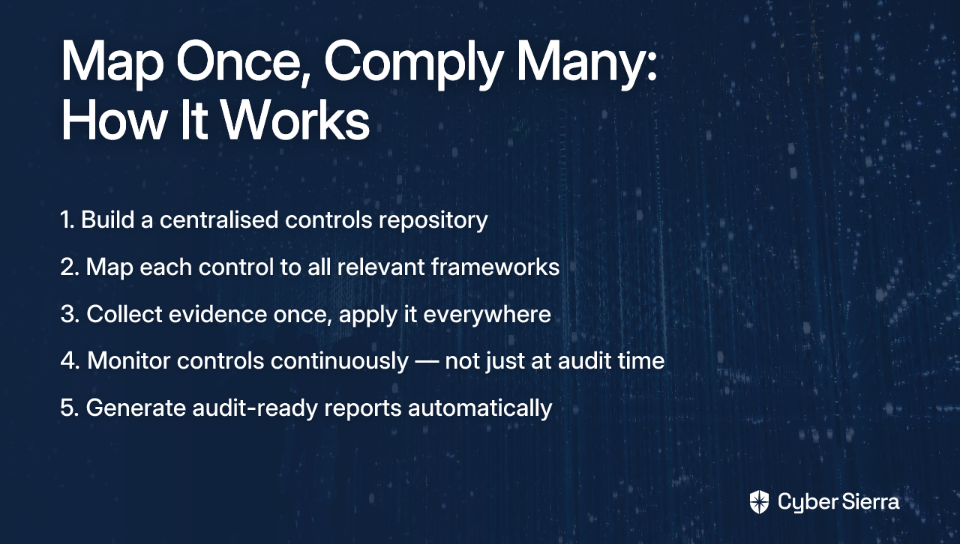
The solution is a centralized controls repository and a "map once, comply many" approach. By mapping a single control — say, your Access Control Policy — to its corresponding requirements across ISO 27001 (Annex A.9.1.1), SOC 2 (CC6.1), and NIST CSF (PR.AC), you collect evidence once and apply it across all relevant frameworks simultaneously. Instead of treating each audit as a separate project, you build a living compliance program where evidence accumulates continuously.
This approach directly addresses the most painful part of audit prep: the "manual, back-and-forth process of gathering documents" that, as described on Reddit, burns hours and introduces errors. Automation transforms processes, giving compliance teams the bandwidth to focus on gaps and governance rather than evidence hunting.
How to Unify ISO 37301 and Other Frameworks with a GRC Platform
Knowing the strategy is one thing. Executing it without the right tooling is another. Here's where a modern GRC platform becomes essential.
Using Cyber Sierra to Unify Compliance
Best for: CISOs and compliance managers who need a single source of truth across GRC, multi-framework compliance, and third-party risk.
Cyber Sierra's GRC platform acts as the operational hub for your ISO 37301 compliance management system — and every other framework you need to satisfy. It supports SOC 2, ISO 27001, HIPAA, GDPR, NIST CSF, PCI DSS, and custom control sets, allowing you to manage all your compliance obligations from a single interface.
Continuous Control Monitoring (CCM)
Rather than scrambling to collect evidence before an audit, Cyber Sierra's CCM module provides near real-time visibility into your control environment — continuously. It automates control testing and validation, replacing manual uploads and spreadsheet-chasing with timestamped, automated evidence. Auditors get a single, organized location for everything they need, from policy acknowledgments to system configurations to control testing results.
Centralized Controls Repository
Map controls across multiple frameworks and let every compliance requirement pull from the same body of evidence. This is the "map once, comply many" strategy in practice — and it directly reduces the manual hours spent on audit prep while eliminating the risk of inconsistent documentation.
Automated Reporting and Audit Trails
The platform generates comprehensive compliance reports and maintains detailed, timestamped audit trails showing who did what and when. This level of transparency is exactly what external auditors require — and what many manual processes fail to deliver reliably.
If your team is still chasing down spreadsheets and screenshots from five different departments before every audit cycle, a platform like Cyber Sierra is what the shift to continuous, unified compliance looks like in practice.
Beyond the Platform: Why Process Discipline is Non-Negotiable
A word of caution before you assume that the right software automatically solves your compliance challenges.
The honest truth, echoed by compliance professionals on Reddit, is that "these platforms are only as effective as the underlying process discipline. If teams aren't consistently maintaining controls or documentation standards, you end up digitizing existing inefficiencies rather than solving them."
This is precisely why ISO 37301 matters so much as a starting point — not an afterthought. The standard forces organizations to establish the governance structure, leadership accountability, and operational discipline before or in parallel with technology adoption. It ensures that when you automate evidence collection or control monitoring, you're automating something that actually works.
ISO 37301's emphasis on Leadership and Commitment means compliance isn't something the IT team handles alone in a corner — it requires visible buy-in from top management, clear ownership of obligations, and a genuine culture of compliance that permeates the organization.
The winning combination is straightforward: use ISO 37301 to establish the "why" and "how" of your compliance program, and use a platform like Cyber Sierra to deliver the "what" and "when" through continuous, automated monitoring. The framework provides the governance backbone; the technology eliminates the manual burden.
Turn Compliance from a Scramble into a System
Juggling multiple compliance frameworks doesn't have to mean drowning in redundant work. The path to a saner audit cycle boils down to two key shifts. First, use a foundational system like ISO 37301 to govern all your compliance obligations, not just manage them in silos. Second, adopt a "map once, comply many" strategy by centralizing your controls to stop collecting the same evidence for different audits.
You can start today. Pick one core process—like your access control or incident response plan—and map its requirements across two different frameworks you manage. This simple exercise will immediately reveal where your team is losing time to duplicated effort.
When you're ready to stop mapping manually and automate the entire process, a GRC platform provides the single source of truth you need. See how Cyber Sierra eliminates duplicate work and keeps you perpetually audit-ready. Book your personalized demo and transform your compliance program.
Frequently Asked Questions
What is the main benefit of ISO 37301?
The main benefit of ISO 37301 is that it provides a universal framework to manage all of an organization's compliance obligations systematically. Instead of juggling multiple frameworks in silos, it creates a unified Compliance Management System (CMS) that reduces duplicate work and mitigates risk.
How does ISO 37301 work with other standards like ISO 27001?
ISO 37301 acts as an "umbrella" framework under which specific standards like ISO 27001 can be managed. While ISO 27001 focuses only on information security, the broader ISO 37301 CMS governs all compliance areas, ensuring specific programs are effectively implemented and monitored.
Can ISO 37301 replace SOC 2?
No, ISO 37301 does not replace SOC 2, as they serve different purposes. ISO 37301 is a certifiable management system to govern compliance processes, while SOC 2 is an attestation report that validates your controls for customers. An ISO 37301 system helps manage the controls SOC 2 covers.
What does a "map once, comply many" strategy mean?
It is an efficiency strategy where you map a single control to its requirements across multiple compliance frameworks. For example, an access control policy can satisfy rules in ISO 27001, SOC 2, and NIST. You collect evidence once and apply it everywhere, eliminating redundant work.
Why is a GRC platform helpful for managing multiple frameworks?
A GRC platform automates the "map once, comply many" strategy and provides continuous visibility into your compliance posture. It centralizes controls, automates evidence collection, and monitors your environment, replacing manual work and ensuring you are always ready for an audit.
Is ISO 37301 certification mandatory?
No, ISO 37301 certification is not mandatory for most organizations. However, obtaining certification provides independent, third-party validation of your compliance program. This builds significant trust with regulators, partners, and customers, offering a strong competitive advantage.
