



What's The Total Cost of a ISO 9000 Certification?


Join thousands of professionals and get the latest insight on Compliance & Cybersecurity.
You've been tasked with implementing ISO 9000 in your organization, and the first question on your mind is likely about costs. You've heard stories of companies spending thousands—even tens of thousands—of dollars on certification, and you're wondering if your budget can handle it. The uncertainty around total costs can be paralyzing, especially when you're working with limited resources.
Executives want precise figures, but you keep finding vague cost ranges online without the specific details you need to make an informed decision. This lack of clarity makes planning nearly impossible.
The True Cost of ISO 9000 Certification: Beyond the Surface Numbers
ISO 9000 certification isn't just about paying a certification body and getting a certificate to hang on your wall. The total investment encompasses both obvious direct costs and numerous hidden expenses that can catch unprepared organizations by surprise.
The reality is that ISO certification and "limited budget" are often mutually exclusive concepts. As one business owner candidly shared on Reddit, "there is a LOT of work to get into compliance," and costs can range dramatically from a few thousand dollars to tens of thousands depending on your organization's size, complexity, and current quality management practices.
What makes budgeting even more challenging is that different organizations face vastly different certification journeys. A company with established quality procedures will spend significantly less than one starting from scratch.
Understanding the Complete Cost Structure
Before diving into specific numbers, it's essential to understand what ISO 9000 actually encompasses. The ISO 9000 family focuses on quality management systems (QMS), with ISO 9001 being the principal standard that organizations typically seek certification for. Supporting standards include ISO 9000 (fundamentals and vocabulary) and ISO 9004 (guidance for sustained success).
Now, let's break down the costs you can expect when pursuing ISO 9000 certification:

1. Direct Certification Costs
Registration and Certification Body Fees: These are the most visible costs and typically range from $5,000 to $10,000 for small businesses. The certification body charges include:
- Application fees: $500-$2,000
- Initial assessment costs: Approximately $1,300 per day for auditor fees
- Certification issuance fees: $500-$1,500
These fees vary based on your organization's:
- Size (employee count)
- Number of locations
- Complexity of operations
- Industry sector
For example, a manufacturing company with complex processes will require more audit days than a simple service provider with the same number of employees.
2. Implementation Costs: The Largest Expense Category
Consultant Fees: This is where costs can escalate quickly. External consultants typically charge between $300 and $1,000 per hour, potentially adding $5,000 to $50,000 to your total investment depending on your organization's size and current quality management maturity. As one business owner noted, "the price point is going to be at least $20k (cheap consultants)."
Internal Resource Allocation: Often overlooked but significant:
- Employee time dedicated to implementation (typically 1-3 employees spending 15-40% of their time over 6-12 months)
- Management review meetings
- Documentation development and maintenance
- Process mapping and improvement activities
Documentation and System Development: Creating a compliant quality management system requires:
- Quality manual development
- Procedure documentation
- Work instruction creation
- Forms and record templates
- Document control systems (potentially including QMS software that can cost $5,000-$15,000 annually)
Training Expenses:
- Internal auditor training: $1,000-$2,500 per person
- Employee awareness training: $100-$500 per employee
- Quality management representative training: $2,000-$3,500
3. Hidden and Ongoing Costs
Surveillance and Recertification Audits: ISO certification isn't a one-time expense. After initial certification, you'll need:
- Annual surveillance audits: $2,000-$4,000 per year
- Recertification audit (every three years): $4,000-$8,000
Failed Audit Recovery: If you fail an audit, the costs can escalate dramatically. Assessment costs for failed audits can reach up to 60% of the original assessment costs. One quality manager shared, "We had to redo our entire documentation system after failing our first audit - it cost us an additional $15,000 and three months of work."
Staff Turnover Management: When trained employees leave, you incur:
- New employee training costs
- Knowledge transfer expenses
- Potential compliance gaps during transitions
Continuous Improvement Initiatives: ISO 9001 requires ongoing system improvement, which means:
- Regular internal audits (staff time and resources)
- Corrective action processes
- Management reviews
- System updates as standards evolve
Integrity Costs: Perhaps the most concerning hidden costs come from systemic issues in the certification process itself. As one engineer candidly shared on Reddit, some companies engage in questionable practices during audits, including:
- Documents backdated during audits
- Employees sent home or instructed not to speak to auditors
- Incomplete or misleading records
Cost Breakdown Examples: Small vs. Large Organizations
Let's look at realistic cost breakdowns based on organization size:
Small Business (1-25 employees)
DIY Approach (minimal consultant help):
- Certification body fees: $5,000-$7,000
- Documentation system: $2,000-$3,000
- Internal resources: $7,000-$10,000 (calculated based on employee time)
- Basic consultant guidance: $3,000-$5,000
- Training: $2,000-$3,000 Total Approximate Cost: $19,000-$28,000
Consultant-Led Approach:
- Certification body fees: $5,000-$7,000
- Documentation system: $3,000-$5,000
- Internal resources: $5,000-$7,000
- Comprehensive consulting: $15,000-$25,000
- Training: $2,000-$3,000 Total Approximate Cost: $30,000-$47,000
Medium Business (26-100 employees)
- Certification body fees: $8,000-$12,000
- Documentation system: $5,000-$10,000
- Internal resources: $15,000-$30,000
- Consulting: $20,000-$40,000
- Training: $5,000-$10,000 Total Approximate Cost: $53,000-$102,000
Annual Maintenance Costs (all sizes)
- Surveillance audits: $2,000-$4,000
- Internal audits: $2,000-$5,000
- System maintenance: $3,000-$10,000
- Continuous improvement: $2,000-$5,000 Total Annual Maintenance: $9,000-$24,000
Strategies to Control Certification Costs
While ISO 9000 certification requires significant investment, several strategies can help minimize costs:
1. Preparation is Key
Before engaging with certification bodies:
- Conduct a thorough gap analysis to identify your current compliance level
- Develop basic documentation and processes independently
- Train internal staff as ISO internal auditors ($1,000-$2,500 per person) to reduce consultant dependency
2. Choose the Right Implementation Approach
- DIY with Training: For organizations with quality experience, purchasing implementation kits ($997-$1,500) and training can be cost-effective
- Guided Implementation: Hybrid approach using consultants for specific technical areas only
- Full Consultation: Often most efficient for organizations with no quality management experience
3. Optimize Certification Scope
- Clearly define your certification scope to include only necessary processes
- Consider phased implementation for large organizations
- Explore multi-site sampling options if you have multiple similar locations
4. Leverage Technology
- Use cloud-based QMS software to streamline documentation and reduce administrative burden
- Implement automated audit management tools
- Consider integrated management systems if pursuing multiple ISO standards
Is ISO 9000 Certification Worth the Investment?
The cost of ISO 9000 certification is substantial, but many organizations find the return on investment compelling:
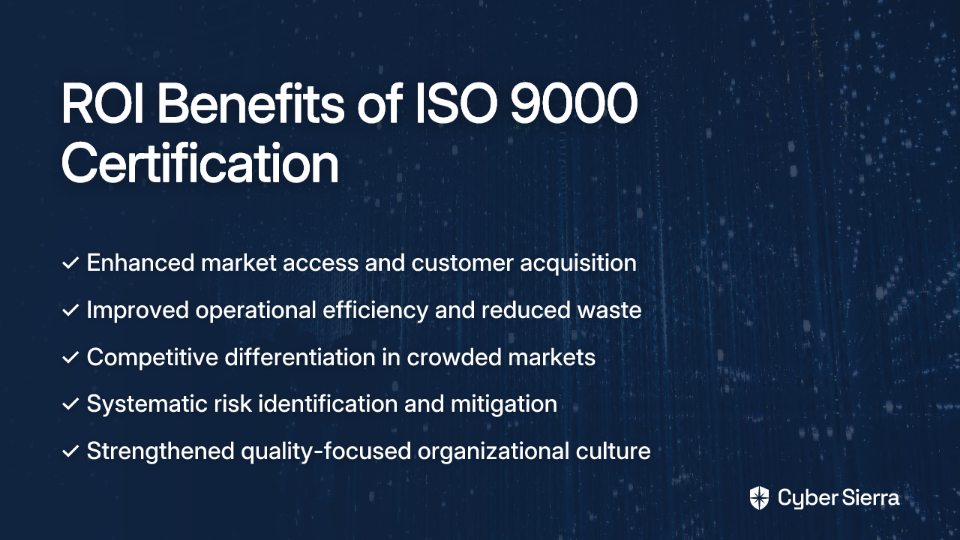
- Market access: Many customers require ISO certification from suppliers
- Operational efficiency: Documented processes typically reduce errors and waste
- Competitive advantage: Certification differentiates your organization in competitive markets
- Risk reduction: Systematic approaches help identify and mitigate business risks
- Cultural improvement: Quality focus often enhances organizational culture
As one certified organization reported: "While our ISO 9001 certification cost approximately $40,000 initially, we recovered that investment within 18 months through reduced waste, fewer customer complaints, and winning two major contracts that required certification."
Conclusion
The total cost of ISO 9000 certification extends far beyond the certification body fees. When budgeting for certification, consider all direct, hidden, and ongoing costs to avoid financial surprises.
For organizations with limited budgets, careful planning and a phased approach can make certification more accessible. Remember that the goal isn't just certification itself but building a quality management system that adds value to your organization.
Before beginning your ISO journey, thoroughly research costs specific to your industry and organization size, and consider consulting with multiple certification bodies and consultants to find the best value. While certification requires significant investment, the systematic approach to quality management can deliver substantial returns when implemented effectively.
Frequently Asked Questions (FAQ) about ISO 9000 Costs
What is the typical total cost of ISO 9000 certification for a small business?
For a small business (1-25 employees), the typical total cost of ISO 9000 certification can range from $19,000 to $47,000. This range depends heavily on whether you opt for a DIY approach with minimal consultant help (around $19,000-$28,000) or a consultant-led implementation (around $30,000-$47,000), and includes certification body fees, documentation, internal resource allocation, and training.
How long does it take to get ISO 9000 certified?
The time it takes to get ISO 9000 certified typically ranges from 6 to 12 months, though this can vary. The duration depends on factors like your organization's size, the complexity of your processes, your current level of quality management maturity, and the resources dedicated to the implementation project.
Why are consultant fees a significant part of ISO 9000 implementation costs?
Consultant fees are a significant part of ISO 9000 costs because they bring specialized expertise and experience, often accelerating the certification process and ensuring compliance, especially for organizations new to quality management systems. Consultants typically charge between $300 and $1,000 per hour, and their involvement can range from providing basic guidance to leading the entire implementation, which can add $5,000 to $50,000 or more to the total investment.
Can my organization implement ISO 9000 without external consultants?
Yes, it is possible for an organization to implement ISO 9000 without external consultants, especially if you have existing quality management experience and dedicated internal resources. This DIY approach can save significant costs but requires thorough preparation, staff training (like internal auditor training), and potentially the use of implementation kits. However, organizations with no prior experience might find the process more challenging and time-consuming without expert guidance.
What happens if my organization fails an ISO 9000 audit?
If your organization fails an ISO 9000 audit, you will need to address the identified non-conformities and undergo a follow-up assessment, which incurs additional costs and delays certification. These re-assessment costs can be substantial, potentially up to 60% of the original assessment fees, and may require significant rework of your documentation or processes, adding further to the overall expense and effort.
Is ISO 9000 certification a one-time cost?
No, ISO 9000 certification is not a one-time cost; there are ongoing expenses required to maintain certification. After initial certification, you must undergo annual surveillance audits (costing $2,000-$4,000 each) and a full recertification audit every three years (costing $4,000-$8,000), in addition to internal costs for system maintenance and continuous improvement.
What are the main benefits of ISO 9000 certification despite the costs?
Despite the significant investment, the main benefits of ISO 9000 certification include improved market access, enhanced operational efficiency, a stronger competitive advantage, reduced business risks, and a better organizational culture. Many organizations find that these benefits lead to a tangible return on investment through reduced waste, fewer customer complaints, and access to new business opportunities that require certification.
For more detailed information on ISO 9000 certification steps, visit 9001simplified.com, which provides a comprehensive guide to navigating the certification process.
