



ISO 9001 vs ISO 27001 - A Comprehensive Comparison


Join thousands of professionals and get the latest insight on Compliance & Cybersecurity.
You've been tasked with implementing ISO standards in your organization, but now you're staring at a mountain of documentation requirements while managing 10+ other projects. The overwhelming amount of information online is giving you a headache, and you can't help but wonder: "Is writing all these documents really necessary, especially when processes keep changing?"
If this sounds familiar, you're not alone. Many professionals feel trapped in a maze of ISO requirements, struggling to find a clear starting point amid consultants who seem more interested in selling services than providing genuine guidance.
This comprehensive comparison of ISO 9001 and ISO 27001 will cut through the confusion, helping you understand how these two critical standards differ, where they overlap, and how they can work together to strengthen your organization.
What is ISO 9001? The Foundation of Quality Management
ISO 9001 is the world's most recognized standard for Quality Management Systems (QMS), with over one million organizations certified globally. This framework helps businesses consistently deliver products and services that meet customer expectations and regulatory requirements.
At its core, ISO 9001 is about ensuring quality in what you deliver to customers. The 2015 version (currently in effect with 2024 amendments addressing climate change considerations) emphasizes:
- A process-based approach to managing operations
- Risk-based thinking to prevent issues before they occur
- The Plan-Do-Check-Act (PDCA) cycle for continuous improvement
- Strong leadership commitment to quality objectives

Organizations implement ISO 9001 to demonstrate their dedication to customer satisfaction, process efficiency, and product/service quality. The standard doesn't prescribe specific controls but instead provides a framework for organizations to establish their own quality processes based on their unique context.
According to the American Society for Quality (ASQ), ISO 9001 certification typically leads to enhanced operational efficiency, improved customer satisfaction, and reduced waste—all contributing to a stronger bottom line.
What is ISO 27001? The Guardian of Information Security
While ISO 9001 focuses on quality, ISO 27001 is the leading international standard for Information Security Management Systems (ISMS). With over 70,000 certifications across 150 countries, it provides a systematic approach to managing sensitive information and protecting its confidentiality, integrity, and availability.
ISO 27001 is fundamentally about securing how you handle information assets. The standard:
- Requires organizations to identify and systematically assess information security risks
- Includes 11 mandatory clauses outlining ISMS requirements
- Features Annex A, which in its latest version (ISO 27001:2022) contains 93 control objectives organized into four domains:
- Organizational Controls (37)
- People Controls (8)
- Physical Controls (14)
- Technological Controls (34)

One common point of confusion is the relationship between ISO 27001 and ISO 27002. Let's clarify:
- ISO 27001 is the certification standard that defines what you need to do
- ISO 27002 is a supporting code of practice that provides implementation guidance on how to implement the controls
Organizations seeking ISO 27001 certification don't need to implement all 93 controls. Instead, they conduct risk assessments to determine which controls are necessary for their specific risk profile, documenting their decisions in a Statement of Applicability (SoA).
Key Differences Between ISO 9001 and ISO 27001
While both standards share the same High-Level Structure (HLS), they have distinct focuses and requirements. Understanding these differences is crucial for effective implementation.
1. Primary Focus and Objectives
ISO 9001:
- Focuses on quality of products and services
- Aims to enhance customer satisfaction
- Addresses the entire operational lifecycle
ISO 27001:
- Focuses on protecting information assets
- Aims to safeguard confidentiality, integrity, and availability of information
- Addresses information security risks specifically
2. Scope Definition
ISO 9001:
- Allows flexibility with certain exclusions if they don't affect quality
- Can be applied to specific departments or the entire organization
- Focuses on processes that impact customer requirements
ISO 27001:
- Requires a rigidly defined scope
- Must include all information systems, products, and dependencies
- No exclusions allowed within the defined scope
3. Mandatory Controls
ISO 9001:
- No preset controls mandated
- Organizations define their own controls based on their context
- Focus on process effectiveness and customer satisfaction
ISO 27001:
- Requires implementation of controls from Annex A based on risk assessment
- Must document justification for any controls not implemented
- Controls are specific and security-focused
As one Reddit user lamented, "ISO 27001 can be quite daunting" compared to other standards. This is partly because of its technical specificity and comprehensive security requirements.
4. Resource Allocation
ISO 9001:
- Requires dedicated resources for product conformity
- Resources cannot be assigned other tasks that might compromise quality
ISO 27001:
- Allows for shared resources across compliance areas
- Resources can serve multiple functions if security objectives are met
5. Documentation Requirements
ISO 9001:
- Requires documented information on quality processes
- Must maintain records of conformity and performance
ISO 27001:
- Requires extensive documentation of the ISMS
- Must maintain records of risk assessments, SoA, and security incidents
This difference in documentation explains why many professionals feel that "writing all of these documents is a pain in the ass..not to mention if something changes after you've already wrote them."
Surprising Similarities: Where ISO 9001 and ISO 27001 Align
Despite their different focuses, ISO 9001 and ISO 27001 share several common requirements, making them complementary rather than contradictory. These similarities provide a foundation for an integrated management system:
- Common Structure: Both follow the same 10-clause High-Level Structure (HLS)
- Organizational Context: Both require understanding internal and external issues affecting the organization
- Leadership Commitment: Both demand top management involvement and accountability
- Risk-Based Thinking: Both emphasize identifying and addressing risks proactively
- Documented Information: Both require maintaining appropriate documentation
- Internal Audits: Both mandate regular internal audits to verify compliance
- Corrective Actions: Both require processes for addressing non-conformities
- Continuous Improvement: Both embrace the concept of ongoing enhancement

The Strategic Benefits of Integrating ISO 9001 and ISO 27001
Given the compatible nature of these standards, many organizations choose to implement them together. This integration offers substantial benefits that address many of the pain points expressed by professionals working with these frameworks.
1. Reduced Documentation Burden
If you've ever thought, "QA documentation is filled with shitloads of things that I do not think are necessary," an integrated approach is your solution. By combining systems, you can:
- Create unified policies that address both quality and security requirements
- Maintain a single management system manual
- Reduce documentation redundancy by up to 30%
2. Cost and Time Efficiency
When you're "managing like 10+ other projects other than this," efficiency becomes crucial. Integration helps by:
- Conducting combined internal audits instead of separate ones
- Streamlining certification audits (potentially saving thousands in auditing fees)
- Reducing the resources needed for maintenance and updates
3. Holistic Risk Management
An integrated approach allows for comprehensive risk assessment that covers both quality and security concerns, ensuring that:
- Quality improvements don't compromise security
- Security measures don't impede quality processes
- Risks are addressed systematically across the organization
4. Enhanced Competitive Advantage
Dual certification demonstrates to stakeholders that your organization takes both quality and information security seriously. This builds trust with:
- Customers seeking reliable providers
- Partners evaluating collaboration opportunities
- Regulatory bodies assessing compliance
Practical Steps for Integrating ISO 9001 and ISO 27001
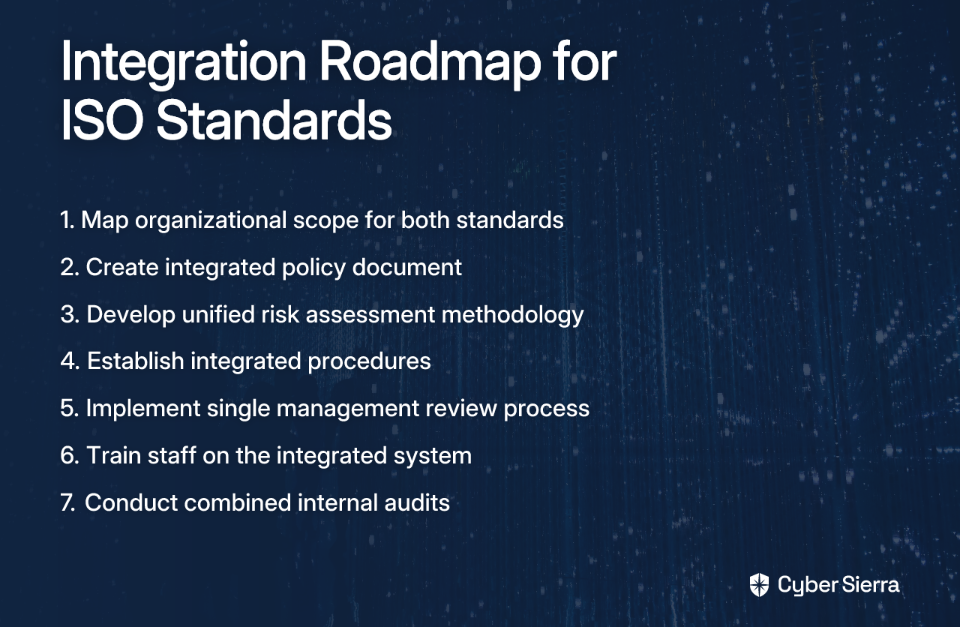
If you're feeling "extremely overwhelmed by the amount of info out there," here's a clear, step-by-step approach to integrating these standards:
- Map your organization's scope for both standards, identifying overlaps and unique requirements
- Create an integrated policy that addresses both quality and information security objectives
- Develop a unified risk assessment methodology that considers both quality and security risks
- Establish integrated procedures for common requirements like document control and internal audits
- Implement a single management review process that addresses both standards
- Train staff on the integrated system to ensure understanding across the organization
- Conduct combined internal audits to verify compliance with both standards
Conclusion: Quality and Security - Two Sides of the Same Coin
ISO 9001 and ISO 27001 serve different but complementary purposes in strengthening your organization. While ISO 9001 ensures you deliver quality products and services, ISO 27001 protects the information assets that make that delivery possible.
The key distinction is simple: ISO 9001 focuses on the quality of what you deliver, while ISO 27001 protects how you deliver it. Together, they create a robust framework for operational excellence and risk management.
By understanding the differences and similarities between these standards and taking an integrated approach to implementation, you can transform what seems like an overwhelming documentation burden into a strategic advantage for your organization.
Frequently Asked Questions
What is the main difference between ISO 9001 and ISO 27001?
The main difference is their primary focus. ISO 9001 concentrates on the quality of products and services to ensure customer satisfaction, while ISO 27001 concentrates on protecting the confidentiality, integrity, and availability of information. In simple terms, ISO 9001 ensures what you deliver is high quality, whereas ISO 27001 secures how you handle the information related to your operations.
Why should our organization integrate ISO 9001 and ISO 27001?
You should integrate ISO 9001 and ISO 27001 to reduce documentation, save time and costs, and create a more holistic risk management framework. An integrated system eliminates redundant policies, allows for combined audits, and streamlines maintenance, turning a compliance burden into a strategic advantage that addresses both quality and security efficiently.
How do ISO 9001 and ISO 27001 work together?
ISO 9001 and ISO 27001 work together through their shared 10-clause High-Level Structure (HLS). This common framework provides a natural foundation for integration, aligning processes like leadership commitment, internal audits, and corrective actions. For example, the risk-based thinking from ISO 9001 can be expanded to include the specific information security risks detailed in ISO 27001, creating a comprehensive management system.
Do we have to implement all 93 controls in ISO 27001 Annex A?
No, you are not required to implement all 93 controls from Annex A. Your implementation must be based on the findings of your information security risk assessment. You will then document your justification for including or excluding each control in a Statement of Applicability (SoA), ensuring your security measures are tailored specifically to your organization's risk profile.
Which certification should my company get first: ISO 9001 or ISO 27001?
The right certification to pursue first depends on your primary business goals. If your main objective is to enhance product quality and customer trust, start with ISO 9001. If protecting sensitive data is your top priority or a client requirement, begin with ISO 27001. Many organizations start with ISO 9001 to build a foundational quality process, but prioritizing based on your most urgent business or contractual needs is the best approach.
Are ISO 9001 and ISO 27001 suitable for small businesses?
Yes, both standards are highly suitable for small businesses because they are designed to be scalable. A small business can implement the standards in a way that fits its size, complexity, and resources, avoiding the bureaucracy that might be necessary for a larger corporation. For a small business, certification is a powerful way to build credibility, gain a competitive edge, and establish trust with larger clients.
