



How to Secure Manufacturing OT Environments with IT-OT Convergence Controls


Join thousands of professionals and get the latest insight on Compliance & Cybersecurity.
Summary
- Manufacturing is now the most targeted sector for cyberattacks, accounting for 25% of global incidents, as the convergence of IT and Operational Technology (OT) expands the attack surface.
- The primary challenge lies in bridging the cultural and operational gap between IT teams, who prioritize data security, and OT teams, who prioritize physical safety and continuous production.
- A successful security strategy must start with unified governance and cross-departmental collaboration before implementing technical controls like network segmentation and Zero Trust.
- Gain real-time visibility and move beyond periodic audits by using an automated platform for Continuous Control Monitoring (CCM) across both IT and OT environments.
You've deployed a new smart manufacturing system to optimize production, but your IT department wasn't consulted until after implementation. Now they're raising serious security concerns about connecting these operational technologies to your corporate network, causing project delays and budget overruns. Meanwhile, your OT engineers insist the systems need to remain accessible to ensure production continuity, creating a standoff between departments that's putting your business at risk.
This scenario plays out daily across manufacturing facilities worldwide, where the inevitable collision of Information Technology (IT) and Operational Technology (OT) creates significant security challenges that can no longer be ignored.
The Inevitable Collision of IT and OT in Manufacturing
The manufacturing sector is undergoing a digital transformation, with 56% of firms already piloting smart manufacturing initiatives that rely on the integration of traditionally separate systems. This IT-OT convergence brings together two fundamentally different worlds:
- Information Technology (IT): Data-centric computing systems used for business operations, prioritizing confidentiality and data integrity.
- Operational Technology (OT): Systems that monitor and control physical devices and industrial processes (PLCs, SCADA systems, DCS), prioritizing safety and continuous availability.
While this integration drives efficiency, predictive maintenance, and data-driven insights, it also creates unprecedented security risks. Manufacturing has become the most targeted sector, accounting for 25% of global cyber incidents in 2024, with ransomware attacks targeting industrial environments nearly doubling in 2022.
The stakes couldn't be higher. As one IT professional lamented in a recent discussion, "Nobody ever involves IT for critical portions of the project... once we have a chance to look at the scope... the project is back on hold because they end up being over budget." This disconnect is no longer just an operational headache—it's a critical security vulnerability.
The New Threat Landscape: Why Convergence Creates the Perfect Storm
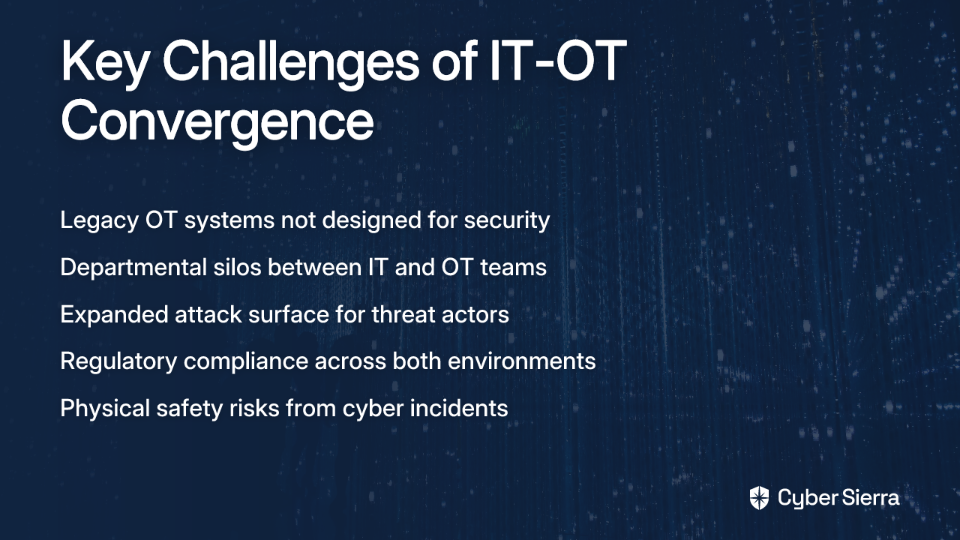
The convergence of IT and OT environments creates unique security challenges that go beyond traditional cybersecurity concerns:
Expanded Attack Surface
Previously isolated ("air-gapped") OT networks are now connected to IT systems, allowing attackers to pivot from a compromised email account to the factory floor. This dramatically expands the attack surface and creates new entry points for threat actors.
Disruption of Physical Control Systems
Unlike IT attacks that might compromise data, OT attacks can halt production, damage expensive machinery, or create unsafe conditions. The Global Cybersecurity Alliance warns of "unauthorized modifications to critical system configurations, potentially endangering lives."
Exploitation of Legacy Systems
Many OT devices are decades old and were not designed with security in mind. They often lack modern security features and cannot be easily patched without significant downtime. IT professionals describe these as "network connected horror-shows" that they lack the bandwidth to secure properly.
Targeted Industrial Malware
Sophisticated malware strains like Ekans and TRITON are specifically designed to target Industrial Control Systems (ICS). These threats can manipulate industrial processes or cause equipment failures with potentially catastrophic consequences.
Increased Regulatory Scrutiny
The regulatory landscape is evolving rapidly. The SEC's rules on public company cybersecurity disclosures and the Cyber Incident Reporting for Critical Infrastructure Act of 2022 (CIRCIA) mandate stricter reporting and governance, raising the financial and reputational stakes of an incident.
Bridging the Divide: A Framework for People and Process
Before implementing technical controls, organizations must address the human element of IT-OT convergence. As one professional noted, "A lot of OT folks assume that IT folks are reckless cowboys and just break things all the time."
Establish Unified Governance and "Radical Ownership"
Develop a Unified Security Strategy: Create a single security framework that addresses both IT and OT vulnerabilities. As one industry expert emphasized, "Leadership needs to drive radical ownership" to avoid the "shift the blame" culture that often emerges in siloed organizations.
Define Clear Roles & Responsibilities: Avoid role misalignment by clearly delineating responsibilities. "IT needs to handle what they know, infrastructure. OT needs to handle what they know, PLCs, the OT server software." This clarity prevents both gaps and overlaps in security coverage.
Empower Project Management: Appoint dedicated project managers who can facilitate communication between IT and OT teams. "Good project managers need to be at the center of communicating the project, not as an additional duty but as a job," notes one practitioner. Ensuring IT involvement from day one prevents costly retrofitting of security controls.
Foster Cross-Departmental Collaboration and Training
Close the IT and OT Collaboration Gap: According to PwC research, providing OT teams with cybersecurity training and encouraging collaboration with IT for an integrated risk framework significantly reduces security incidents.
Reimagine Staffing: Cross-train IT and OT cybersecurity teams to enhance skills and foster mutual understanding. Focus on hiring qualified professionals who can bridge both worlds, serving as translators between the teams.
Expand Risk Visibility to Leadership
Regularly update executive leadership on OT security posture and risks, making them tangible through tabletop exercises that simulate cyberattacks on the OT environment. This approach helps secure necessary investment and executive buy-in for comprehensive security measures.
A Technical Blueprint for Securing Converged Environments
With the organizational foundation in place, manufacturers can implement a structured technical approach to securing their converged environments.
Step 1: Adopt a Suitable OT Security Framework
Don't start from scratch. Select and implement a common framework like the NIST Cybersecurity Framework (CSF) for overall program organization, supplemented by OT-specific standards like IEC 62443 or NIST SP 800-82 (Guide to Industrial Control Systems Security).
These frameworks provide structured approaches to identifying, protecting, detecting, responding to, and recovering from security incidents in industrial environments.
Step 2: Implement Network Segmentation and Zero Trust
Isolate Critical Systems: Use network segmentation to create barriers between IT and OT. A common model is the Purdue Model, which separates networks into logical zones based on their function and required security level.
Create a Demilitarized Zone (DMZ): Establish a secure buffer zone between the corporate IT network and the industrial control system (ICS) network. This DMZ should include firewalls, data diodes, or other security controls that limit direct traffic between zones while allowing necessary communication.
Apply Zero Trust Principles: Implement strict identity verification and least-privilege access for every user and device trying to access resources on the OT network. This approach mitigates the risk of lateral movement by attackers if perimeter defenses are breached.
Step 3: Gain Visibility with Continuous Control Monitoring (CCM)
Start with an Asset Inventory: You cannot protect what you cannot see. An updated inventory of all OT assets, their connectivity, and their potential vulnerabilities is crucial for effective security planning.
Move Beyond Periodic Audits: Manual, point-in-time audits are insufficient for dynamic converged environments. Implement Continuous Monitoring for real-time anomaly detection and immediate response to potential threats.
This is where a platform like Cybersierra becomes invaluable. Its Continuous Control Monitoring (CCM) module automates the validation of security controls in near real-time, building a central repository that provides a single source of truth for both IT and OT controls. By automating control testing and detecting exceptions immediately, Cybersierra enables proactive risk management instead of reactive incident response, while streamlining compliance across frameworks like NIST and ISO 27001.

Step 4: Implement a Structured Risk Management Process
Adopt a framework like ISO 31000 for a structured approach to risk management, following these steps:
- Establish Context: Define the scope, goals, and risk criteria for your OT environment.
- Risk Identification: Identify vulnerabilities, threats, and potential attack vectors.
- Risk Analysis: Assess the likelihood and potential impact of each identified risk.
- Risk Evaluation: Compare risk levels against your organization's risk tolerance.
- Risk Treatment: Implement appropriate controls (technical, process, or people-focused) or transfer risk through mechanisms like cyber insurance.
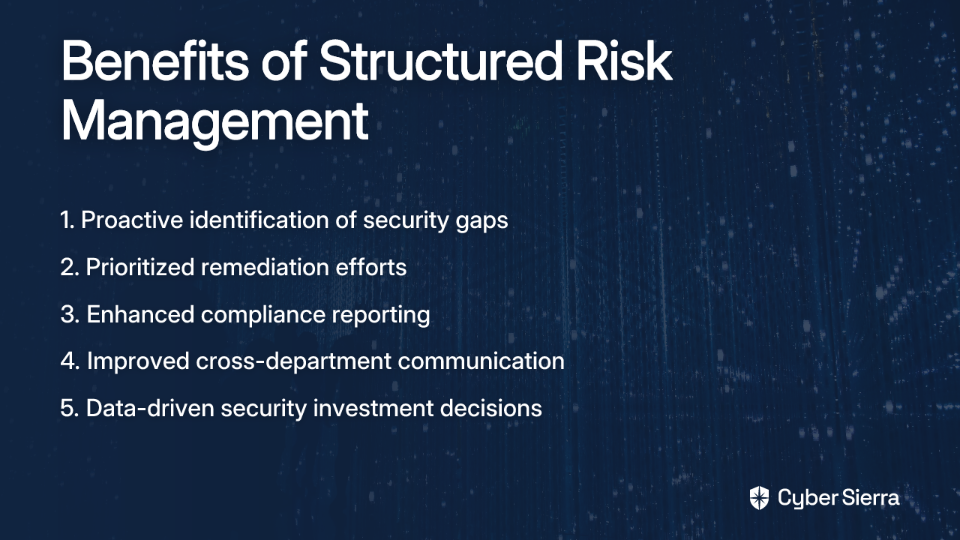
Cybersierra's GRC platform can automate this entire process, from data collection to reporting, while helping organizations demonstrate the cyber hygiene required by insurers to obtain comprehensive coverage.
Building a Resilient and Future-Ready Manufacturing Operation
Effective OT security is not achieved through a single product but through a continuous program that integrates people (a collaborative culture), process (unified governance and risk management), and technology (segmentation, monitoring, and controls).
The goal is to move from a reactive, siloed security model to a proactive, integrated one that enables innovation while managing risk. Platforms like Cybersierra are designed to be the connective tissue for this modern approach, providing the visibility and control needed to secure converged environments, innovate safely, and stay resilient in the face of evolving threats.
By addressing both the technical and human aspects of IT-OT convergence, manufacturers can transform what has traditionally been a source of friction into a strategic advantage, ensuring that digital transformation enhances rather than compromises operational security and business continuity.
Frequently Asked Questions
What is IT-OT convergence and why is it a security concern?
IT-OT convergence is the integration of Information Technology (IT) systems used for data-centric computing with Operational Technology (OT) systems that control physical industrial processes. This convergence is a major security concern because it connects previously isolated OT networks to IT networks, expanding the attack surface and allowing threats to move from corporate systems to the factory floor, potentially disrupting physical operations and creating safety risks.
What are the primary differences between IT and OT security?
The primary difference lies in their core priorities: IT security prioritizes data confidentiality and integrity, while OT security prioritizes system availability and the physical safety of operations. IT systems can often be patched or taken offline for maintenance, but disrupting OT systems can halt production or create hazardous conditions, requiring a fundamentally different security approach.
How can manufacturing companies start securing their converged IT-OT environment?
The best starting point is to address the human and process elements by establishing a unified governance structure that bridges the gap between IT and OT teams. Before implementing technology, create a single security strategy with clear roles and responsibilities, foster cross-departmental collaboration, and secure executive buy-in. This organizational alignment is critical for the successful implementation of technical security controls.
What role does network segmentation play in OT security?
Network segmentation is a critical security control that isolates OT networks from corporate IT networks to prevent attackers from moving laterally between them. By creating barriers, such as a Demilitarized Zone (DMZ), segmentation contains potential breaches and protects critical industrial control systems. This is a foundational practice for implementing a Zero Trust architecture in a manufacturing environment.
Why are traditional IT security tools often insufficient for OT environments?
Traditional IT security tools are often insufficient because they are not designed for the legacy systems, proprietary protocols, and high-availability requirements of OT environments. Active scanning from standard IT vulnerability scanners can disrupt or damage sensitive OT devices. Therefore, OT security requires specialized tools that can passively monitor industrial networks without interfering with real-time processes.
What is Continuous Control Monitoring (CCM) and why is it important for OT?
Continuous Control Monitoring (CCM) is the automated, real-time validation of security controls to ensure they are working as intended. It is crucial for OT because it shifts security from periodic, manual audits to a proactive, 24/7 posture. CCM provides immediate visibility into control failures or anomalies, allowing for rapid response to potential threats before they can impact production or safety.
As manufacturing continues to evolve, those who master the secure integration of IT and OT will gain a significant competitive edge—producing more efficiently while maintaining the robust security posture necessary in today's threat landscape.
