



Key Changes in NIST CSF 2.0: A Comprehensive Guide


Join thousands of professionals and get the latest insight on Compliance & Cybersecurity.
You've set up your cybersecurity program following the NIST Cybersecurity Framework. But just when you thought you had everything under control, NIST releases version 2.0 with significant changes. Now you're faced with potentially updating numerous policies and procedures, all while preparing for upcoming audits that may use these new standards. The National Institute of Standards and Technology (NIST) released the finalized Cybersecurity Framework 2.0 in February 2024, marking the first major update since the framework's initial publication in 2014. This revision introduces substantial changes aimed at expanding its applicability and addressing evolving cybersecurity challenges. For security professionals and compliance managers, understanding these changes is crucial to maintaining effective security programs and ensuring regulatory compliance. This article breaks down the key changes in NIST CSF 2.0 and what they mean for your organization.
Introduction to NIST CSF 2.0
The NIST Cybersecurity Framework has become a cornerstone for organizations seeking to build robust cybersecurity programs. As a voluntary framework, it provides a set of guidelines and best practices to help organizations manage and reduce cybersecurity risk. CSF 2.0 builds upon the previous version's foundation while introducing significant enhancements to address feedback from users and the evolving threat landscape. The main objective remains helping organizations understand and manage cybersecurity risks effectively, but with greater emphasis on governance and enhanced adaptability for various organizational structures and sizes. Many users have expressed confusion about understanding NIST controls and concerns about inaccuracies in compliance documentation. As one security professional noted on Reddit, "I find myself frequently questioning whether or not I actually comprehended what I just read and what the control is asking for." This underscores the need for clarity in guidance—something NIST has attempted to address with version 2.0.
Key Change #1: Introduction of the Govern Function
Perhaps the most significant addition to CSF 2.0 is the introduction of the Govern function. This new core function elevates cybersecurity as a significant enterprise risk alongside financial and reputational concerns, emphasizing governance outcomes for managing cybersecurity risks. The Govern function includes three main categories:
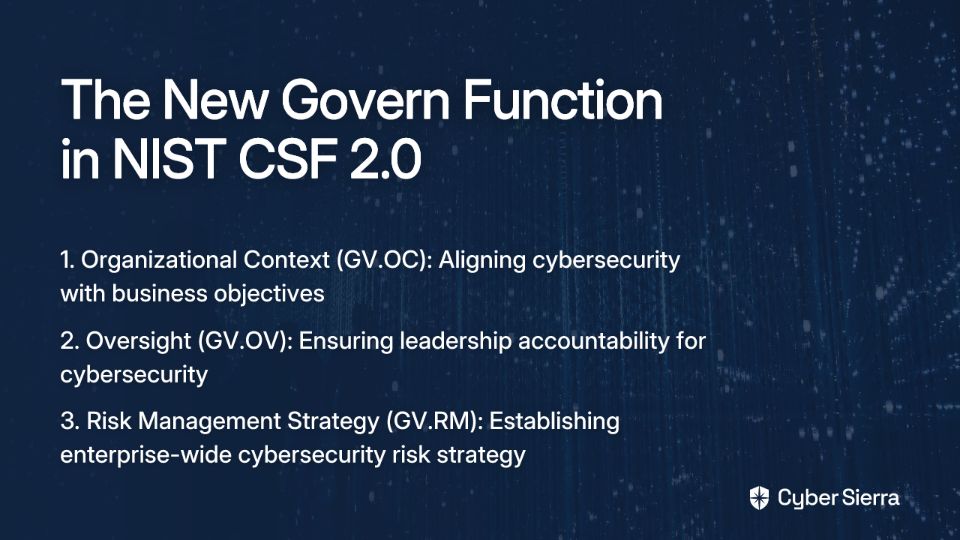
- Organizational Context (GV.OC): Understanding how cybersecurity fits into your organization's overall mission and objectives
- Oversight (GV.OV): Ensuring leadership visibility and accountability for cybersecurity
- Risk Management Strategy (GV.RM): Establishing and maintaining your organization's strategy for managing cybersecurity risk
This addition is particularly valuable as it bridges the communication gap between technical teams and executive leadership. As one cybersecurity professional commented, "The governance aspect really rounds out this framework. Love it to bits. To me the govern functions will help highlight each of the other phases to business units who aren't directly involved with cyber functions, specifically those in executive-level roles that will be able to flow up information to C-suites and board." By integrating governance directly into the framework, NIST CSF 2.0 helps organizations establish clearer lines of responsibility and accountability for cybersecurity across all levels of the organization. This addresses a common pain point where cybersecurity was often treated as exclusively an IT issue rather than an enterprise-wide concern requiring executive oversight.
Key Change #2: Expanded Scope and Applicability
While the original CSF was primarily targeted at critical infrastructure, version 2.0 has been designed to be applicable to organizations of all sizes and across all sectors. This expanded scope makes the framework more accessible and relevant to a broader range of organizations, including:
- Small and medium-sized businesses with limited cybersecurity resources
- Non-profit organizations
- Educational institutions
- Government agencies at all levels
- Healthcare providers
- Financial services companies
The updated framework provides more flexible implementation guidance, acknowledging that organizations have different resources, capabilities, and risk tolerances. This addresses feedback that the previous version was too rigid or prescriptive for some organizations. CSF 2.0 also introduces refined implementation tiers to help organizations assess their cybersecurity program maturity:

- Tier 1: Partial - Cybersecurity risk management practices are not formalized, and risk is managed in an ad hoc manner
- Tier 2: Risk-Informed - Risk management practices are approved but may not be established as organizational-wide policy
- Tier 3: Repeatable - The organization's risk management practices are formally approved and expressed as policy
- Tier 4: Adaptive - The organization adapts its cybersecurity practices based on lessons learned and predictive indicators
These tiers aren't meant to be maturity levels that organizations should necessarily strive to climb. Instead, they help organizations determine the appropriate level of rigor for their cybersecurity programs based on their specific needs and risk appetite.
Key Change #3: Enhanced Supply Chain Security Focus
CSF 2.0 places significantly more emphasis on supply chain risk management than its predecessor. This reflects the growing recognition that many cybersecurity breaches occur through third-party vendors and suppliers. The updated framework includes expanded guidance on:
- Identifying and assessing supply chain risks
- Establishing security requirements for suppliers
- Verifying that suppliers meet security requirements
- Responding to supply chain security incidents
This enhanced focus aligns with other NIST publications, such as NIST SP 800-161 (Cybersecurity Supply Chain Risk Management Practices for Systems and Organizations), creating a more cohesive approach to supply chain security across NIST's guidance. Organizations that have already invested in third-party risk management programs will find these additions helpful in validating and potentially enhancing their existing approaches. For those just beginning to address supply chain risks, CSF 2.0 provides valuable guidance on where to start.
Key Change #4: Enhanced Tools and Resources
NIST has significantly expanded the tools and resources available to help organizations implement CSF 2.0. One of the most valuable additions is the searchable reference tool, which allows organizations to customize their cybersecurity profiles and map to over 50 other cybersecurity documents.
This tool, available at the NIST CSF website, addresses a common pain point expressed by security professionals: the challenge of mapping between different frameworks and standards. As one Reddit user noted, "I like using 800-53 and would like to have a true mapping from 2.0 to 800-53 version whatever to make it easier to verify with less time invested." Other new resources include:
- Community profile templates: Pre-configured profiles that organizations can use as starting points
- Quick start guides: Simplified guidance for organizations just beginning their CSF implementation journey
- Implementation examples: Real-world examples of how organizations have implemented the CSF
- Mapping resources: Tools to help organizations map the CSF to other frameworks and standards they may be using
These resources are particularly valuable for organizations with limited cybersecurity expertise or resources, as they provide practical guidance and templates that can be adapted to specific organizational needs.
Key Change #5: Enhanced Incident Response Focus
CSF 2.0 includes enhanced guidance on cybersecurity incident response, reflecting the reality that despite best efforts, security incidents will occur. The framework emphasizes integrating cybersecurity incident response into overall risk management practices. The updated framework includes expanded guidance in the Respond and Recover functions, including:

- Response Planning: Improved processes to ensure response actions are executed during or after an incident
- Communications: Enhanced guidance on coordinating response activities with internal and external stakeholders
- Analysis: More detailed approaches for effectively understanding the impact of incidents
- Mitigation: Expanded strategies for containing incidents and preventing expansion
- Improvements: More robust processes for incorporating lessons learned into future response activities
This enhanced focus on incident response aligns with NIST's other publications, such as the updated Special Publication 800-61r3 (Computer Security Incident Handling Guide), creating a more cohesive approach to incident management across NIST's guidance.
Key Change #6: Alignment with International Standards
CSF 2.0 strengthens its alignment with international cybersecurity standards, making it easier for global organizations to achieve compliance across multiple frameworks. This includes better alignment with:
- ISO/IEC 27001 (Information Security Management Systems)
- COBIT (Control Objectives for Information Technologies)
- The European Union's NIS2 Directive
- Various sector-specific frameworks and regulations
This enhanced alignment reduces the compliance burden for organizations operating in multiple jurisdictions or required to comply with multiple frameworks. It allows organizations to leverage their CSF implementation to support compliance with other frameworks, rather than starting from scratch with each new requirement.
Implementation Challenges and Recommendations
While CSF 2.0 brings significant improvements, organizations may face challenges when transitioning from the previous version or implementing the framework for the first time.
Challenge: Mapping Between Versions
One significant challenge is the lack of a direct, one-to-one mapping between CSF 1.1 and CSF 2.0. As one security professional noted, "There are enough changes that 2.0 does not even come close to mapping 1:1 with CSF ver 1.1. There are too many multiple mappings from ver 1.1 to vers 2.0 so it's not a great mapping."
Recommendation: Rather than trying to force a direct mapping, organizations should take this opportunity to reassess their cybersecurity program holistically against CSF 2.0. Start by understanding the new Govern function and how it impacts your overall approach, then work through the remaining functions methodically.
Challenge: Understanding Control Requirements
Many users still find it challenging to interpret exactly what specific controls are asking for. As one Reddit user expressed, "Last thing I want to do is write up a bunch of controls just to find out that what I wrote was completely inaccurate/off point."
Recommendation: Leverage the expanded implementation examples and guidance provided with CSF 2.0. Additionally, consider:
- Mapping CSF controls to your existing internal policies, as one practitioner suggested: "Pull up your internal policies and standards and have a crack at mapping to those... Stick in a reference to the relevant policy/standard paragraph against each element of the CSF."
- Consulting NIST's supplementary publications that provide more detailed guidance on specific topics
- Participating in industry forums and communities of practice to learn from others' experiences
Challenge: Resource Constraints
Smaller organizations may still find it challenging to implement the framework due to limited resources and expertise.
Recommendation: Take advantage of the new quick start guides and community profiles, which provide streamlined guidance for organizations with limited resources. Focus initially on the highest-priority areas based on your risk assessment, then gradually expand your implementation as resources allow.
How Cyber Sierra Simplifies CSF 2.0 Implementation
For organizations seeking to streamline their implementation of NIST CSF 2.0, platforms like Cyber Sierra can significantly reduce the complexity and resource requirements.

Cyber Sierra's Continuous Control Monitoring (CCM) module is particularly relevant for organizations implementing CSF 2.0, as it:
- Builds a central controls repository that maps directly to CSF 2.0 and other frameworks
- Provides near real-time visibility into your security posture through continuous monitoring
- Delivers actionable risk intelligence to help prioritize remediation efforts
- Manages controls across multiple compliance frameworks simultaneously
- Automates control testing and validation, reducing manual effort
The platform's Governance, Risk & Compliance (GRC) module directly addresses the new Govern function in CSF 2.0 by:
- Automating data collection for governance-related controls
- Supporting policy management aligned with governance requirements
- Generating comprehensive reports for executive oversight
- Maintaining detailed audit trails for compliance documentation
By leveraging a platform like Cyber Sierra, organizations can more efficiently implement CSF 2.0 while also supporting compliance with other frameworks and standards.
Conclusion: Embracing the Evolution
The transition from CSF 1.1 to CSF 2.0 represents a significant evolution in NIST's approach to cybersecurity guidance. The introduction of the Govern function, expanded scope, enhanced supply chain focus, and improved tools and resources all contribute to a more comprehensive and adaptable framework. While the transition may present challenges, particularly for organizations that have heavily invested in the previous version, the benefits of CSF 2.0's enhanced approach to cybersecurity risk management make it worth the effort. Organizations should approach the transition as an opportunity to reassess and strengthen their cybersecurity programs, rather than simply mapping from one version to another. By embracing the changes and leveraging the expanded resources and tools available, organizations can build more resilient cybersecurity programs that better protect their assets and support their missions.
For ongoing updates and community engagement, visit the NIST Cybersecurity Framework official site.

Frequently Asked Questions (FAQ) about NIST CSF 2.0
What is NIST CSF 2.0?
NIST CSF 2.0 is the latest version of the National Institute of Standards and Technology's Cybersecurity Framework, officially released in February 2024. It provides a voluntary set of guidelines, standards, and best practices to help organizations of all types and sizes manage and reduce cybersecurity risk. This version marks the first major update since 2014, building upon the original foundation with significant enhancements to address the evolving threat landscape and user feedback.
Why was the NIST Cybersecurity Framework updated to version 2.0?
The NIST Cybersecurity Framework was updated to version 2.0 primarily to address the evolving cybersecurity landscape, incorporate extensive feedback from users across various sectors, and expand its applicability beyond its original focus on critical infrastructure. Key motivations included the need for stronger integration of cybersecurity governance, enhanced focus on supply chain risk management, and providing more adaptable guidance for a broader range of organizations, including small and medium-sized businesses.
What is the most significant change in NIST CSF 2.0?
The most significant change in NIST CSF 2.0 is the introduction of the new "Govern" function. This addition elevates cybersecurity risk management to a strategic enterprise-level concern, emphasizing leadership oversight, organizational context, and the establishment of a clear cybersecurity risk management strategy. The Govern function aims to bridge the gap between technical cybersecurity operations and executive decision-making.
Who can benefit from using NIST CSF 2.0?
NIST CSF 2.0 is designed for organizations of all sizes, sectors, and levels of cybersecurity maturity, representing a significant expansion from its predecessor's focus on critical infrastructure. This includes small and medium-sized businesses (SMBs), non-profit organizations, educational institutions, and government agencies at all levels. The framework's updated guidance and resources, such as quick start guides, make it more accessible and adaptable to diverse organizational needs and capabilities.
How does NIST CSF 2.0 address supply chain security?
NIST CSF 2.0 significantly enhances the focus on supply chain risk management (SCRM) compared to version 1.1. It provides more detailed guidance on identifying, assessing, and managing cybersecurity risks associated with third-party vendors and suppliers. This includes establishing security requirements for suppliers, verifying their compliance, and planning for and responding to supply chain security incidents, aligning with other NIST guidance like SP 800-161.
What are common challenges when implementing or transitioning to NIST CSF 2.0?
Common challenges when implementing or transitioning to NIST CSF 2.0 include the lack of a direct one-to-one mapping from version 1.1, making it necessary to reassess programs holistically. Organizations may also find it challenging to fully interpret specific control requirements and may face resource constraints, particularly smaller entities. It's recommended to leverage NIST's new tools, focus on a risk-based approach, and consider the new Govern function's impact early in the process.
How can organizations simplify the implementation of NIST CSF 2.0?
Organizations can simplify NIST CSF 2.0 implementation by utilizing the new resources provided by NIST, such as quick start guides, community profiles, and the searchable online reference tool. Starting with a thorough understanding of the Govern function and its implications for overall strategy is crucial. Additionally, platforms like Cyber Sierra can streamline the process by automating control mapping, providing continuous monitoring, and assisting with GRC (Governance, Risk & Compliance) activities, reducing manual effort and complexity.
