



GRC Tool vs Spreadsheets: Why Manual Compliance Fails at Scale


Join thousands of professionals and get the latest insight on Compliance & Cybersecurity.
Summary
- Manual compliance workarounds, like using spreadsheets for risk registers, are highly error-prone, with studies showing a vast majority contain errors that create compliance blind spots.
- Relying on annual vendor questionnaires and static evidence collection creates a false sense of security, failing to capture real-time risks and control failures between audits.
- The hidden costs of manual GRC include hundreds of wasted hours, common audit findings, and poor risk visibility that can lead to breaches.
- Automating compliance with a tool like Cyber Sierra's GRC platform transforms the process from a reactive scramble into a continuous discipline, ensuring you are always audit-ready.
It's two weeks before your SOC 2 audit. Meet Sarah, a compliance manager at a fast-growing SaaS company. Her desktop is a graveyard of good intentions: Risk_Register_v4_FINAL_updated.xlsx with 14 color-coded tabs, an inbox drowning in "RE: FWD: RE: Policy Sign-off Required" chains, and a shared drive folder of vendor security questionnaires in PDF format — some dating back 14 months.
She knows something is wrong. But she's not sure if the problem is her, or the process.
It's the process.
Here's the truth: spreadsheets and manual processes aren't just inefficient — they're a compounding liability. They introduce hidden risks, eat hours your team doesn't have, and create the kind of audit findings that could have easily been avoided. Below, we break down the five most common manual compliance workarounds, the real cost of each, and the structural fix that purpose-built GRC tools provide.
This tension is perfectly captured by a candid admission from one user on Reddit's GRC community: "the spreadsheet route totally works but ngl it can get messy real quick if you don't have someone who knows what they're doing. Like you'll spend forever just trying to figure out what evidence you actually need to collect and how to organize it all."
When someone floated the idea of a GRC tool, the predictable counterargument surfaced: "Getting a tool at this stage is overkill."
The 5 Most Costly Manual GRC Workarounds
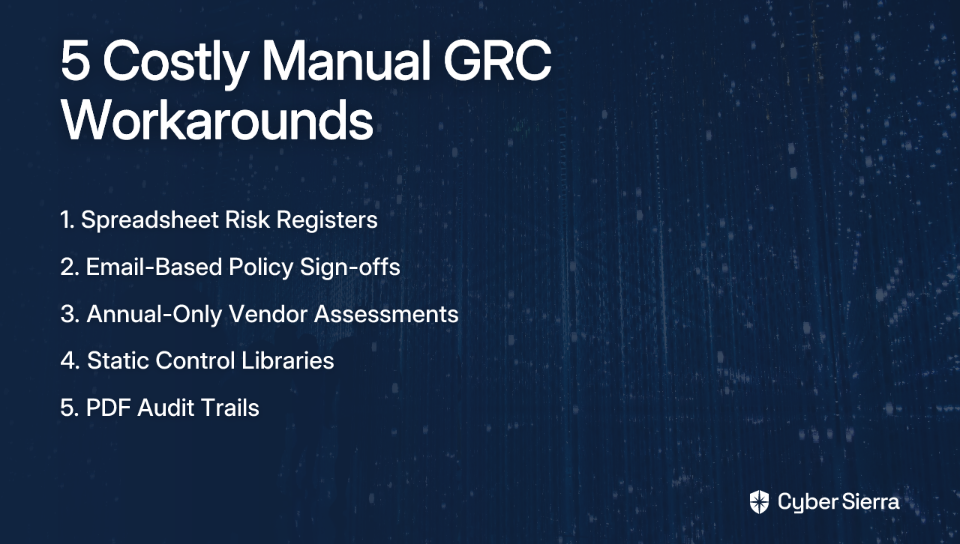
1. The Spreadsheet Risk Register: A Fragile Foundation
The Workaround
A complex Excel or Google Sheet tracking risks, owners, mitigation plans, and impact scores across multiple tabs.
Why It Breaks at Scale
Spreadsheets are not databases. They have no referential integrity — meaning there's no reliable way to link a specific risk to the control that mitigates it, or tie that control to the framework clause it satisfies. According to Continuum GRC, nearly 90% of business spreadsheets contain errors, and those errors directly translate into miscategorized risks and compliance blind spots.
Worse, managing multiple spreadsheets means manually updating data across every file whenever something changes. The result? Logistical nightmares, contradictory versions, and collaboration bottlenecks — only one person can effectively own the master sheet at a time.
The Quantifiable Cost
Teams lose dozens of hours quarterly just correcting data entry errors and manually reconciling risk data. Poor or stale risk data leads to poor resource allocation — money and effort spent on low-priority risks while high-severity gaps go unaddressed.
The Structural Fix
Cyber Sierra's GRC platform replaces static spreadsheets with a dynamic, centralized risk register. Risks are automatically linked to controls, assets, and policies. Multi-framework support (SOC 2, ISO 27001, HIPAA, GDPR, PCI DSS) means your risk data is always contextualized within the right regulatory lens — and real-time reporting eliminates the need to manually compile data for leadership or auditors.
2. Email-Based Policy Sign-offs: The Black Hole of Attestation
The Workaround
Sending policy documents over email and tracking acknowledgments in a spreadsheet, hoping employees actually open and read them.
Why It Breaks at Scale
Emails get buried. Documents get ignored. And when an auditor asks for proof that your entire engineering team acknowledged the Acceptable Use Policy before accessing production systems, you're suddenly trawling through three months of inbox threads looking for a reply that may not exist.
As Mosey notes, "important documents may get lost in inboxes… tracking is inefficient and error-prone." There's no reliable version control, no timestamp that would hold up to scrutiny, and no centralized view of who has — or hasn't — attested to anything.
The Quantifiable Cost
Missing or unprovable policy sign-offs are one of the most common and entirely avoidable audit findings. Beyond the findings, compliance and HR teams waste hours every cycle chasing employees for acknowledgments and searching through email threads to reconstruct an attestation trail.
The Structural Fix
Cyber Sierra's GRC platform includes centralized policy management that automates this entire workflow. Policies live in a single library, assigned to specific employee groups. Distribution, reminders, and digital sign-offs are automated — and every attestation is time-stamped, reportable, and immediately accessible when an auditor comes knocking.
3. Annual-Only Vendor Assessments: A Point-in-Time Illusion
The Workaround
Sending a security questionnaire PDF to vendors at onboarding or renewal, filing the response, and revisiting it next year.
Why It Breaks at Scale
Your vendor's security posture is not a static fact — it's a living condition that changes constantly. A vendor that passed your annual questionnaire in January could have suffered a breach in March, onboarded a high-risk sub-processor in June, and misconfigured their cloud environment in September. You won't know any of this until next January, if you're lucky — or until it becomes your breach.
Managing even a modest vendor portfolio through manual questionnaires, follow-up emails, and remediation tracking spreadsheets simply doesn't scale. The operational overhead becomes a full-time job that still produces an incomplete picture.
The Quantifiable Cost
Cyber insurance underwriters are increasingly demanding evidence of continuous third-party due diligence — not an annual PDF from a vendor. Companies that can't demonstrate ongoing vendor oversight face higher premiums, coverage exclusions, or outright rejection. And that's before you account for the reputational and financial cost of a supply chain breach that could have been caught earlier.
The Structural Fix
Cyber Sierra's TPRM module shifts vendor risk management from a periodic checkbox to a continuous, automated discipline. It provides 24/7 visibility into vendor security compliance with alerts for any compliance drift, automates the assessment workflow from sending to analysis, and uses risk-based prioritization to help you focus attention on your most critical third parties — not just the loudest ones.

4. Static Control Libraries: Fighting Today's Threats with Yesterday's Rules
The Workaround
Documenting SOC 2 or ISO 27001 controls in a Word document, then scrambling to collect point-in-time screenshots before each audit as evidence.
Why It Breaks at Scale
Controls are only useful if they're actually working right now — not as of the last time someone took a screenshot of an AWS configuration screen. Static documentation tells you what your controls looked like at a moment in the past. It tells you nothing about whether they're effective today.
The pre-audit evidence scramble is a near-universal compliance experience. That scramble is a symptom of a process problem, not a knowledge problem. Presenting outdated or insufficient evidence is a direct path to an audit finding — or worse, an audit failure.
The Quantifiable Cost
Beyond audit findings, teams routinely spend hundreds of hours manually gathering evidence — screenshots of cloud configurations, access control lists, incident logs — that automated integrations could collect continuously. That's hundreds of hours spent on low-value manual toil instead of actual security improvement.
The Structural Fix
Cyber Sierra's CCM platform makes your control library a living, breathing system. It builds a centralized controls repository with near real-time updates, integrates with your existing tech stack (AWS, Azure, Okta, and more) to automate control testing and evidence collection 24/7, and detects exceptions and anomalies in real time so your team can remediate issues before an auditor finds them. The result: you walk into every audit already prepared.
5. PDF Audit Trails: Disorganized and Unreliable
The Workaround
Compiling audit evidence into PDFs and Word documents, organized in shared drive folders with names like /Audit_Evidence_2024/SOC2/Access_Control/Final/.
Why It Breaks at Scale
This is compliance by archaeology. When an auditor requests evidence for a specific control, your team doesn't retrieve it — they excavate it. Missing documents, inconsistent formats, and version conflicts mean teams "waste time searching for information rather than focusing on compliance," as Mosey describes. Auditors who have to manually sift through disorganized evidence folders take longer — and charge accordingly.
There's also a subtler problem: PDFs are a dead end. They can't be cross-referenced, linked to controls, queried, or updated in place. They're snapshots of a moment in a process that should be continuous.
The Quantifiable Cost
Every extra hour an auditor spends making sense of your disorganized evidence package costs you money. Beyond direct costs, the chaos of manual audit prep creates serious compliance fatigue — burning out the exact team members you need most during high-stakes audit periods.
The Structural Fix
Because Cyber Sierra's GRC platform continuously collects evidence via CCM and centralizes all policies, risks, and vendor data in one place, generating a comprehensive audit report becomes a single action — not a week-long project. Auditors can be given read-only access to self-serve the exact evidence they need, linked directly to the control it supports. Clean, organized, defensible — every time.
A GRC Tool Isn't a Luxury — It's a Structural Requirement
The common objection to adopting a GRC tool is that it's "overkill" — that the overhead of maintaining a platform outweighs the time saved. That calculation might be true at five employees with one framework and one annual audit. It stops being true the moment you add a second framework, double your vendor count, grow your team, or face a customer security review.
Manual compliance processes, don't just slow teams down — they introduce compounding risk at every layer: missed regulatory updates, undetected control failures, unmonitored vendor drift, and incomplete audit trails that leave you exposed precisely when you're under the most scrutiny. The question isn't whether you can afford a GRC tool. It's whether you can afford what happens when the manual approach fails publicly.
✅ Signs You've Outgrown Manual GRC
Run through this checklist honestly. If you check more than two boxes, you've already crossed the threshold.
- Your risk register filename includes 'FINAL' and a number greater than three.
- An audit request triggers a week-long scramble for screenshots.
- You can't confirm a control is effective without scheduling a meeting.
- Onboarding a new hire to compliance processes takes a two-hour call.
- Your team spends more time chasing policy sign-offs than improving security.
- You are pursuing SOC 2, ISO 27001, HIPAA, or entering new markets.
- You learned about a critical vendor's data breach from the news.
From Manual Chaos to Continuous Compliance
If your compliance program lives in a spreadsheet named Risk_Register_v5_FINAL.xlsx, you're not just being inefficient—you're managing risk on a fragile foundation. Manual workarounds don't just waste hundreds of hours; they create the exact compliance blind spots and audit findings you're working so hard to prevent.
The only structural fix is to shift from periodic, point-in-time scrambles to a state of continuous compliance. Here are the two key takeaways:
- Controls are only effective if they’re working now. Static evidence and annual vendor checks create a false sense of security. Real-time monitoring is the only way to see your actual risk posture.
- A defensible audit trail is built automatically, not excavated. Auditors need clear, organized proof. An automated system provides it on demand, while manual folders hide it for hours.
Here's your next step: Pick one critical control and find the current evidence for it. If it takes you longer than 60 seconds, your process is creating unnecessary risk.
When you're ready to trade spreadsheet chaos for automated clarity, schedule your custom demo and see how an integrated GRC platform can put you back in control.
Frequently Asked Questions
What is a GRC tool and what does it replace?
A GRC (Governance, Risk, and Compliance) tool is a platform that centralizes and automates compliance tasks. It replaces manual workarounds like spreadsheet risk registers, email-based policy sign-offs, and disorganized evidence folders, providing a single source of truth for your program.
When should a company switch from spreadsheets to a GRC tool?
A company should switch to a GRC tool when manual processes become a bottleneck. Signs include managing multiple frameworks (SOC 2, ISO 27001), audit prep taking weeks, or spending more time chasing paperwork than improving security. If you're outgrowing manual methods, it's time to upgrade.
How does a GRC platform streamline audit preparation?
A GRC platform streamlines audits by automating evidence collection 24/7. It links evidence directly to controls, policies, and risks, creating a clean, organized, and defensible audit trail. This transforms audit prep from a week-long scramble into a simple, on-demand report generation.
What are the main risks of managing compliance with spreadsheets?
The main risks of using spreadsheets are data errors, lack of version control, and compliance blind spots. Nearly 90% of spreadsheets contain errors, leading to mismanaged risks, failed audits, and an inability to link risks to the controls that mitigate them in a reliable way.
Why is continuous monitoring better than annual vendor assessments?
Continuous monitoring is superior because a vendor's security posture can change daily. Annual assessments provide only a point-in-time snapshot, leaving you blind to new risks like breaches or misconfigurations that occur between checks. Continuous monitoring offers real-time visibility.
How does a GRC tool help with policy management?
A GRC tool automates the entire policy lifecycle. It centralizes all documents, manages distribution to specific employee groups, sends automated reminders, and tracks digital sign-offs with timestamps. This creates a provable attestation trail that eliminates email chaos and audit findings.
