



MAS Technology Risk Management: A Complete Compliance Guide for Singapore FSIs


Join thousands of professionals and get the latest insight on Compliance & Cybersecurity.
Summary
- The 2021 MAS TRM Guidelines are binding regulations for all Singapore financial institutions, significantly expanding requirements for board accountability, third-party risk, and cyber resilience.
- Key compliance obligations include strong governance, extensive vendor due diligence (TPRM), continuous cyber monitoring, and tested incident response plans.
- Common compliance gaps arise from manual TPRM processes and point-in-time security checks, which fail to meet MAS's expectation for continuous, evidence-based compliance.
- Automating compliance with a specialized GRC platform helps financial institutions manage vendor risk, continuously monitor controls, and stay audit-ready for MAS reviews.
The Monetary Authority of Singapore's (MAS) Technology Risk Management (MAS TRM) Guidelines are not a voluntary code of conduct. They are a binding regulatory obligation, enforced through supervisory review. Non-compliance can result in regulatory directives, licence conditions, or civil penalties.
The 2021 revision, issued on 18 January 2021, significantly expanded the scope of obligations, placing new demands on board accountability, third-party risk, and cyber resilience.
For CISOs, Heads of Technology Risk, and Compliance Officers at Singapore financial institutions (FSIs), the 2021 update changed the operating environment in concrete ways. Every major security decision, from authentication choices to vendor contracts, now sits within a framework that regulators will scrutinise.
This guide breaks down what MAS TRM requires, where FSIs typically fall short, and how purpose-built technology can support continuous, demonstrable compliance.
What Are the MAS TRM Guidelines?
The MAS TRM Guidelines (2021) set out the regulatory expectations for technology risk governance, cyber resilience, and IT controls across Singapore's financial sector.
MAS issues these guidelines under its mandate to promote a sound and reputable financial system, and FSIs are expected to demonstrate ongoing compliance, not just point-in-time adherence.
One data point illustrates the shift in 2021: the word "cyber" appears 74 times in the updated guidelines, compared to just 4 times in the 2013 version, according to Kroll's regulatory analysis. This reflects a deliberate regulatory response to the growing sophistication of threats targeting Singapore's financial infrastructure.
Who Must Comply
The guidelines apply broadly across MAS-regulated entities, including:
- Banks: Full banks, wholesale banks, and merchant banks
- Insurers: Life insurers, general insurers, reinsurers, and brokers
- Capital markets firms: Licensed entities, exchanges, approved market operators, and clearing houses
- Payment service providers and digital banks licensed under MAS
If your institution holds a MAS licence, MAS technology risk management obligations apply to your operations. There is no minimum size threshold.
MAS TRM Obligations: A CISO's Compliance Checklist
The 2021 guidelines are structured around several interconnected domains. Below is a breakdown of the primary obligations every Singapore FSI must address.
Technology Risk Governance and Board Oversight
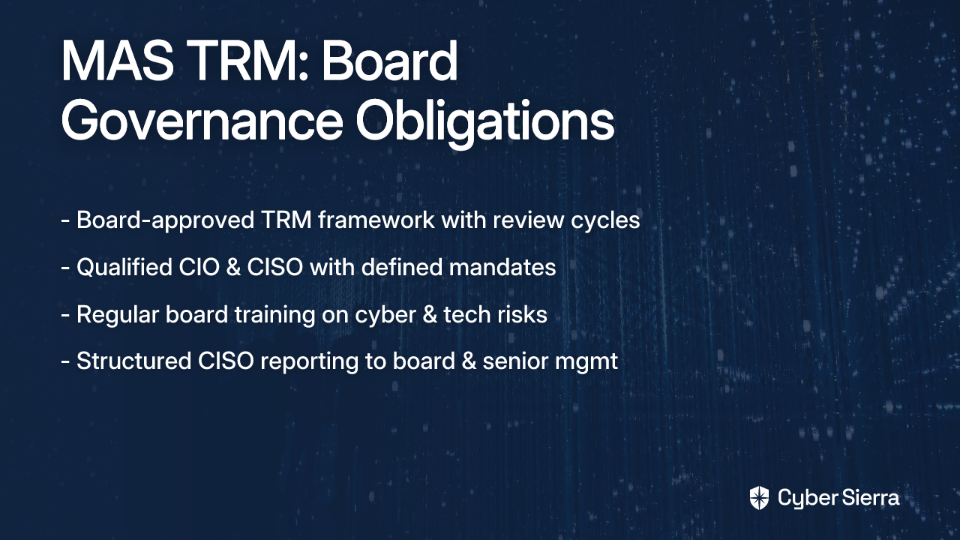
Section 3 of the MAS TRM Guidelines places direct accountability on the Board and Senior Management (BSM). BSM must formally approve the technology risk management framework, allocate adequate resources for its implementation, and maintain active oversight of technology and cyber risks. This is not a delegation item.
The guidelines also require FSIs to appoint a qualified Chief Information Officer (CIO) and Chief Information Security Officer (CISO). Both roles must have the seniority and authority to influence risk decisions. Boards must receive regular, structured briefings on technology risk so they can discharge their oversight duties.
Key governance obligations at a glance:
Third-Party Risk Management (TPRM) Obligations
The 2021 revision significantly expanded what MAS considers a "third party" for TPRM purposes.
Unlike earlier guidance that focused primarily on outsourcing arrangements, the updated MAS TRM Guidelines extend due diligence requirements to any vendor or service provider that accesses, processes, or transmits material data or is involved in critical systems.
MAS also maintains a dedicated third-party risk management regulatory page consolidating notices and expectations for FSIs, including MAS Notice FSM-N06 on the management of outsourced relevant services.
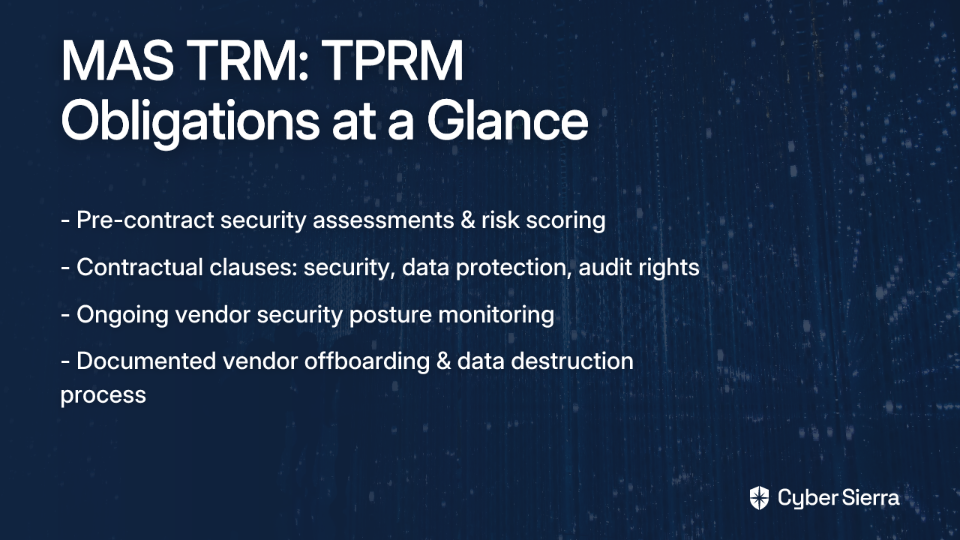
Together, these establish a clear standard: due diligence must occur before engagement, and monitoring must continue for the duration of the relationship.
TPRM obligations under MAS TRM include:
Cyber Resilience Requirements
The MAS technology risk guidelines require FSIs to build and maintain operational capabilities for detecting, responding to, and recovering from cyber incidents. This goes beyond policy documentation. MAS expects evidence of functioning controls.
Core cyber resilience obligations include:
- Security operations capability: Collection and analysis of cyber event data, threat intelligence, and vulnerability information. Many FSIs meet this through a Security Operations Centre (SOC).
- Incident response (IR): A documented, tested IR plan with defined escalation paths and communication protocols.
- Vulnerability management and penetration testing: Regular independent penetration tests to validate controls, with remediation timelines tracked and evidenced.
- Adversarial attack simulations: The 2021 guidelines encourage red team exercises to test defences against sophisticated, multi-vector attacks, according to Kroll's review of the 2021 update.
- Secure software development: Controls covering secure coding standards, source code reviews, and third-party or open-source software risk.
System Availability and Recovery
FSIs must define and document Recovery Time Objectives (RTOs) and Recovery Point Objectives (RPOs) for all critical systems. Business Continuity Plans (BCPs) must be comprehensive, kept current, and tested at intervals sufficient to demonstrate recoverability within stated RTOs.
MAS expects FSIs to identify single points of failure, test failover capabilities, and maintain a register of critical systems with corresponding recovery expectations.
IT Audit and Control Testing
Independent IT audits must be conducted regularly to validate the effectiveness of TRM controls. The audit function must have sufficient access to systems, documentation, and personnel to form a credible view. Evidence gathered during control testing must be retained and available for MAS review.
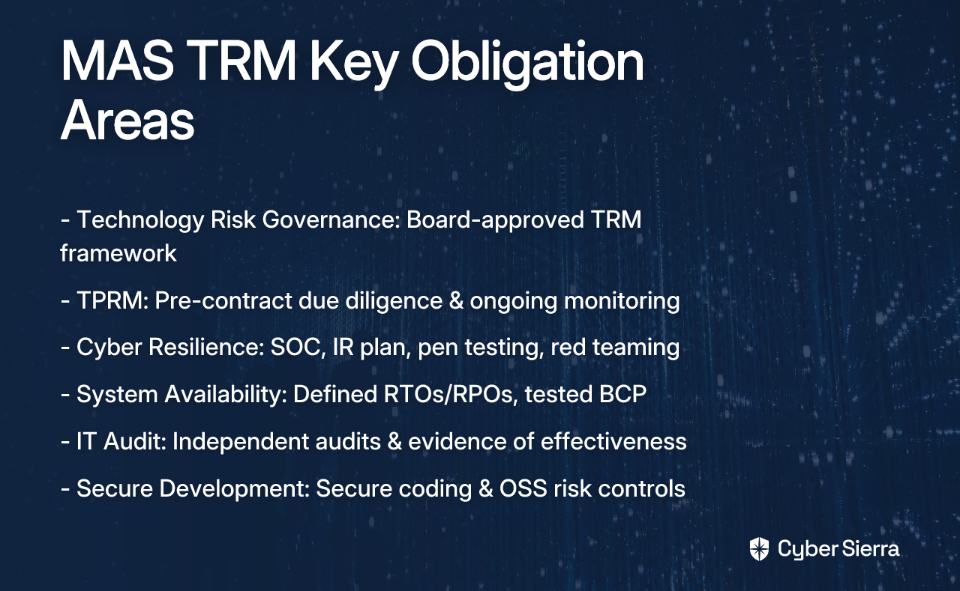
MAS TRM Compliance Requirements Summary
This table summarises the core obligations for financial institutions under the MAS TRM guidelines.
| Obligation Area | Key Requirement | MAS TRM Reference |
|---|---|---|
| Technology Risk Governance | Board-approved TRM framework; qualified CIO and CISO | Section 3 |
| TPRM | Pre-contract due diligence; ongoing vendor monitoring | Section 9 |
| Cyber Resilience | SOC capability; IR plan; penetration testing; red teaming | Section 11–12 |
| System Availability | Defined RTOs/RPOs; tested BCP for critical systems | Section 6 |
| IT Audit | Independent audits; evidence of control effectiveness | Section 5 |
| Secure Development | Secure coding; source code reviews; OSS risk controls | Section 10 |
Common Compliance Gaps Singapore FSIs Face
Even well-resourced FSIs consistently fall short in predictable areas. Understanding where gaps emerge is the first step to closing them before a MAS audit.
TPRM at scale: The 2021 expansion of TPRM scope means FSIs now need to manage due diligence for a far larger vendor population than before. Many teams rely on manual processes, spreadsheets, and annual questionnaires.
These cannot keep pace with the volume of vendors or the frequency of required reassessments. Automation platforms can reduce vendor assessment cycles significantly, directly addressing this bottleneck.
Documentation and evidence gaps: MAS audits are evidence-driven. Compliance officers frequently find themselves scrambling to pull penetration test reports, policy approval records, vendor risk scores, and board meeting minutes from disparate systems. Without centralised evidence management, audit preparation becomes a project in itself, rather than a routine process.
Point-in-time vs. continuous compliance: Many FSIs perform annual penetration tests and periodic control reviews, then operate on the assumption that they remain compliant until the next cycle. MAS expectations are for continuous compliance. A control that lapses between reviews is a compliance gap, regardless of when the last test was conducted.
Keeping pace with regulatory updates: The MAS TRM framework is revised, supplemented by circulars, and cross-referenced with adjacent requirements from frameworks like the Cybersecurity Act administered by CSA Singapore and the PDPC's data protection obligations.
FSIs that treat MAS TRM as a static checklist miss regulatory developments that may affect their controls.
Continuously monitoring for regulatory change is a common challenge for compliance teams in the Singapore FSI sector.

How AI Automation Supports MAS TRM Compliance
Manual compliance management does not scale to meet the demands of MAS technology risk guidelines. AI-driven automation addresses each of the core obligation areas with precision and continuity.
TPRM Automation for MAS-Mandated Vendor Due Diligence
Automated TPRM platforms can standardise the vendor onboarding workflow, deploy risk assessment questionnaires aligned to MAS TRM standards, and score vendors against a consistent risk rubric.
More importantly, they enable continuous monitoring, flagging changes in vendor posture between formal review cycles. This directly addresses the MAS expectation for ongoing oversight rather than one-time assessments.
Continuous Controls Monitoring for Cyber Resilience
Continuous controls monitoring (CCM) integrates with your existing security stack to validate controls against MAS TRM requirements in real time.
Instead of discovering a control failure during an annual audit, CCM surfaces it when it occurs. This gives compliance teams the evidence they need to demonstrate proactive governance, not reactive remediation.
Automated Evidence Collection for Audit Readiness
Rather than assembling evidence manually before each MAS review, a centralised GRC platform can automatically collect, tag, and map evidence to specific MAS TRM control requirements.
Penetration test reports, vulnerability scan outputs, board meeting minutes, and vendor risk assessments all feed into a single repository, structured for audit consumption.
Gap Assessment AI for MAS TRM Framework Mapping
AI-driven gap assessment tools can map your current security controls against the MAS TRM control framework, identifying which requirements are met, which are partially addressed, and which have no corresponding control.
The output is a prioritised remediation plan, not a generic risk register. This is particularly useful when transitioning from an existing framework such as ISO 27001 or NIST CSF to full MAS TRM alignment.
How Cyber Sierra Maps to MAS TRM Requirements
Cyber Sierra is an AI-native GRC platform built to meet the specific compliance demands of MAS-regulated financial institutions. Unlike generic GRC tools adapted for Singapore, Cyber Sierra was designed with MAS TRM obligations as a core requirement from the outset.
The platform uses AI to automate evidence collection, surface findings, and flag control gaps continuously, helping compliance teams focus on high-value risk decisions instead of manual work.
Here is how each Cyber Sierra module maps to MAS TRM obligations:
Technology Risk Governance: The platform's Cyber GRC module provides board-level dashboards that map directly to MAS reporting expectations. Compliance officers can generate structured reports aligned to MAS TRM section requirements, reducing the manual effort involved in board and CRO-level reporting.
TPRM Compliance: The TPRM module automates the full vendor lifecycle, from pre-contract due diligence using MAS-aligned assessment templates to ongoing risk monitoring and contract management. It directly addresses the expanded TPRM scope introduced in the 2021 revision.
Cyber Resilience and CCM: The continuous controls monitoring module integrates with your security stack to provide real-time validation of cyber resilience controls, including vulnerability management workflows, IR plan status tracking, and penetration test remediation timelines.
Audit Readiness: Cyber Sierra's automated evidence collection engine maintains a structured, always-current repository of compliance evidence mapped to MAS TRM control references. When a MAS review is initiated, relevant evidence is accessible immediately, with control mappings already documented.
Gap Assessment AI: The AI-driven gap assessment function maps your current control state against the MAS TRM framework and generates a prioritised action plan. This is useful both for initial compliance baseline assessments and for ongoing reviews as MAS guidance evolves.

Singapore-Specific: GCC Deployment and Regulatory Alignment
For Singapore FSIs, the data residency and sovereignty requirements that accompany MAS technology risk management obligations are non-trivial. Where a platform is hosted matters.
Cyber Sierra is deployed on the Singapore Government Commercial Cloud (GCC), meeting the data residency requirements that Singapore government agencies and regulated financial institutions operate under.
The company was selected for Singapore’s IMDA Spark Programme and is accredited by the Cyber Security Agency of Singapore (CSA) as a trusted service provider.
These recognitions are meaningful signals for procurement and risk teams conducting vendor due diligence under their own MAS TPRM obligations.
The platform is currently deployed in Singapore government agencies and leading financial institutions, providing a live reference base for FSI compliance teams evaluating fit.
Looking ahead, Cyber Sierra is built with awareness of adjacent regulatory obligations that Singapore FSIs face, including the Infocomm Media Development Authority's (IMDA) IM8 policy framework and the Cybersecurity Code of Practice (CCOP) administered by the Cyber Security Agency of Singapore (CSA).
MAS guidance on AI governance is also tracked within the platform's development roadmap.
Shift From Reactive Audits to Real-Time Resilience
Meeting MAS TRM requirements isn't just about passing an audit; it's about building a resilient financial operation. The 2021 guidelines moved the goalposts from periodic checks to continuous, evidence-backed governance.
The two biggest friction points for most FSIs are managing third-party risk at scale and collecting audit-ready evidence on demand. Manual spreadsheets and last-minute data calls no longer meet regulatory expectations.
Your next step today? Map your top three critical vendors against the MAS TPRM due diligence checklist. This simple exercise will quickly reveal any gaps in your current process before your next review.
When you're ready to automate that process and gain continuous visibility across all your MAS TRM controls, a purpose-built GRC platform is essential. See how Cyber Sierra’s AI-native platform provides a real-time, audit-ready view of your compliance posture. Book a platform demo to see it in action.
Frequently Asked Questions
What are the MAS Technology Risk Management (TRM) Guidelines?
The MAS TRM Guidelines are mandatory regulations for Singapore's financial institutions, setting expectations for technology risk governance, cyber resilience, and IT controls. They are designed to protect the security and stability of the financial system against evolving cyber threats.
Who is required to comply with the MAS TRM Guidelines?
All MAS-regulated entities must comply, regardless of size. This includes banks, insurers, capital markets firms, payment service providers, and digital banks. Compliance is a binding regulatory obligation for any institution holding a MAS licence.
What were the key changes in the 2021 MAS TRM revision?
The 2021 revision significantly increased the focus on cyber resilience, expanded third-party risk management (TPRM) to a wider range of vendors, and placed direct accountability on the Board and Senior Management for technology risk governance and oversight.
What are common compliance gaps for financial institutions?
Common gaps include managing third-party risk at scale, maintaining continuous evidence for audits, and shifting from point-in-time checks to continuous compliance monitoring. Many firms struggle with manual processes that cannot keep pace with regulatory expectations.
How can automation help achieve MAS TRM compliance?
Automation helps by enabling continuous controls monitoring, streamlining vendor due diligence, and automatically collecting evidence for audits. This shifts compliance from a periodic, manual effort to a continuous, proactive process, directly addressing MAS expectations.
Why is board-level oversight critical for MAS TRM?
Board-level oversight is critical because MAS places direct accountability on the Board and Senior Management. They must approve the TRM framework, allocate adequate resources, and actively oversee technology and cyber risks to discharge their governance duties effectively.
