



Are Your MCPs a Ticking Time Bomb?


Join thousands of professionals and get the latest insight on Compliance & Cybersecurity.
You've integrated AI across your enterprise, leveraging the new Model Context Protocol (MCP) to connect your LLMs to critical business data. Your team is celebrating enhanced productivity, seamless system integration, and impressive ROI. But beneath this success lurks an unseen danger that sent an electric shiver down the spine of one security researcher: "the concept of pulling a remote repo that can script your OS."
MCPs—the universal connectors enabling AI systems to access your files, databases, and APIs—represent a massive, largely unaddressed attack surface in your security posture. While your organization races to deploy GenAI solutions, you're unknowingly adopting infrastructure that, by default, can "run commands as root" and access your local filesystem.
The most alarming part? These vulnerabilities aren't theoretical. Recent research has uncovered critical flaws affecting hundreds of thousands of MCP implementations worldwide. Yet most organizations will only address these risks "once we see a panic caused by a couple very public and very devastating examples."
This article aims to prevent your organization from becoming one of those examples.
What is MCP, and Why is it Everywhere?
The Model Context Protocol (MCP) functions as the "USB-C for AI applications"—a universal adapter simplifying how AI systems integrate with everything from local files to complex databases and APIs. This standardized protocol connects Large Language Models with external tools and data sources through a straightforward architecture:
- MCP Host: The AI model or application (e.g., Claude Desktop-MCP, Azure OpenAI)
- MCP Manager: The protocol implementation handling connections
- MCP Server: The backend service exposing data or tools
- Data Sources: Your critical business information
MCPs have proliferated rapidly because they solve a fundamental business challenge: enabling AI systems to securely access the context they need to deliver value. They promise enhanced efficiency, interoperability, and the ability to build more powerful, context-aware AI applications.
But this rapid adoption has come at a cost: security.
The Ticking Time Bomb: Unpacking MCP's Critical Vulnerabilities
Industry research has documented a 327% increase in sophisticated attack vectors targeting machine communication protocols since 2023. This isn't surprising when you examine the current state of MCP security.
Remote Code Execution & Malicious Servers
The most alarming example is CVE-2025-6514, a critical RCE vulnerability in the mcp-remote project with a CVSS score of 9.6. Attackers can execute arbitrary OS commands on any machine running affected versions (0.0.5 to 0.1.15) simply by connecting to a malicious MCP server. With over 437,000 downloads of this npm package, the exposure is massive.
Compounding this risk is the lack of an official, vetted MCP server registry. Anyone can upload a malicious server, creating a situation reminiscent of the problems with unofficial package repositories that have plagued PyPI and npm.
Protocol-Level Design Flaws
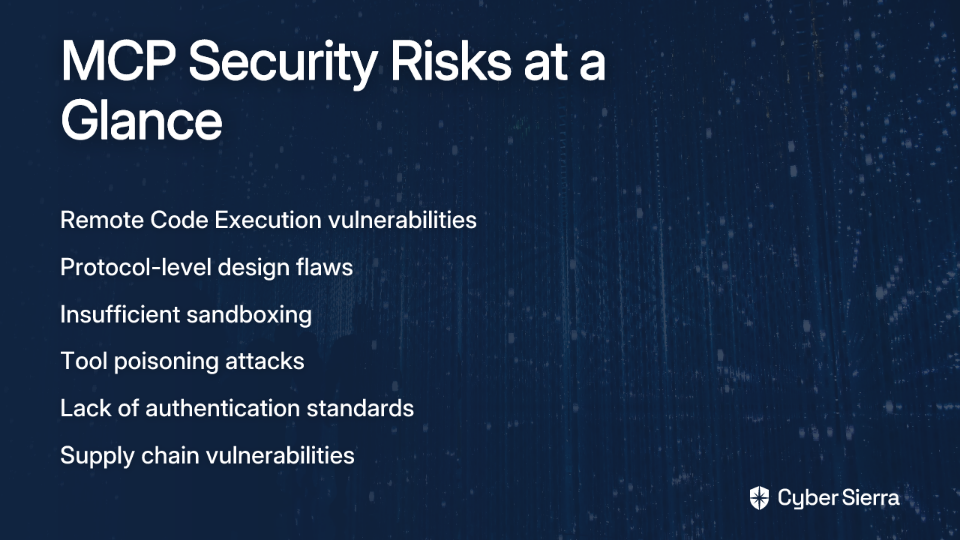
Independent security researchers have identified serious structural weaknesses in MCP implementations:
- Lack of Authentication Standards: Leading to weak or non-existent security controls
- Exposed Plaintext Credentials: Configuration files often store sensitive data in plaintext
- Session IDs in URLs: Exposing sessions to hijacking
- Missing Integrity Controls: Allowing messages to be tampered with in transit
These aren't minor oversights—they're fundamental security gaps that create multiple attack vectors.
The Amplified Attack Surface
Several factors further exacerbate MCP security risks:
Insufficient Sandboxing: Many current MCP implementations lack native sandboxing. As one security expert noted, "Docker by itself is not a secure environment" for running MCPs.
Indirect Prompt Injection (Tool Poisoning): Malicious instructions hidden in an MCP tool's description can manipulate the LLM into performing unintended, harmful actions. This attack vector bypasses traditional security controls by exploiting the AI's trust in connected tools.
Consent Fatigue: Similar to MFA fatigue attacks, users can be bombarded with consent requests from a malicious server until they approve a harmful action—a particularly effective social engineering technique.
The statistics are sobering. Independent research from security firm Syncado found that of tested MCP implementations:
- 43% had Command Injection Vulnerabilities
- 22% allowed Path Traversal/Arbitrary File Read
- 30% had SSRF Vulnerabilities
- Worryingly, 45% of vendors dismissed these as "theoretical" or "acceptable risks"
When security professionals ask, "How is any enterprise able to use this?" they're acknowledging a disturbing reality: MCPs have been deployed widely with minimal security scrutiny, and the consequences could be devastating.
The CISO's Playbook: A Strategic Framework for MCP Security
Many organizations are asking whether existing security solutions like SIEM/SOAR are sufficient for MCP protection. The answer is no—not without a comprehensive strategy that addresses the unique challenges of this new protocol.
Here's a strategic framework for securing your MCP infrastructure before it becomes the source of your next data breach:

Phase 1: Assess and Identify
Conduct Immediate Audits: Perform thorough security audits of all current and planned MCP deployments, focusing on access controls, authentication methods, and data flows.
Use Scanning Tools: Leverage tools like the Backslash open tool to identify security gaps in your MCP implementations. This provides an initial overview of vulnerabilities that require immediate attention.
Update Vulnerable Components: Prioritize patching critical vulnerabilities. For example, immediately update mcp-remote to version 0.1.16 or later to fix CVE-2025-6514.
Phase 2: Harden and Isolate
Implement Zero Trust Network Access (ZTNA): This architecture is non-negotiable for MCP security:
- Isolate components to prevent lateral movement in case of a breach
- Enforce least privilege by defining strict permissions for what MCP servers can access
- Never let MCPs run as root
Mandate Strong Authentication: Make authentication mandatory for all MCP connections. Use secure methods like OAuth for server authentication, and ensure all communication occurs over HTTPS.
Embrace Sandboxing: Address the need for secure execution environments by using technologies like WebAssembly (wasm) to run MCP servers in a contained environment, preventing system-level exploits. As one security engineer recommended, "use wasm & mcp.run — free, secure MCP infra with no risk of system exploits or data exfiltration."
Phase 3: Monitor and Respond
Continuous Security Monitoring: Log all MCP activities and feed them into your Security Information and Event Management (SIEM) and Security Orchestration, Automation and Response (SOAR) systems for anomaly detection. Deploy AI-powered monitoring for real-time threat detection.
Implement Canary Tokens: As one security professional advised, "throw a canary in there." Deploy decoy assets or tokens within your data sources accessed by MCPs. If a canary is tripped, it's an immediate alert of a potential breach.
Secure the Supply Chain: Implement AI prompt shields to mitigate tool poisoning attacks. Follow robust supply chain security practices for any third-party MCP servers, including thorough vetting and continuous vulnerability monitoring.
Phase 4: Govern and Train
Establish Clear Policies: Define explicit policies and paths for MCP operations, limiting file access to specified, safe directories. Implement centralized control over which MCPs can be deployed and how they interact with your systems.
Focus on User Training: Remember that "people will always be the #1 weak-link." Implement advanced user training on the risks of connecting to untrusted servers and recognizing signs of prompt injection or consent fatigue.
Defuse the Bomb Before It Detonates
MCP is not just another protocol—it's a fundamental shift in how AI interacts with your enterprise data. Leaving it unsecured is an invitation for a breach that could compromise your most sensitive information.
The time to act is now. The vulnerabilities are real, documented, and actively exploitable. Waiting for a "devastating example" is not a strategy—it's a gamble with your organization's data integrity and reputation.
CISOs must lead the charge to transform MCP from a security nightmare into a secure, powerful enabler of business innovation. By adopting a proactive, multi-layered security framework encompassing Zero Trust, robust authentication, continuous monitoring, and strict governance, you can defuse this ticking time bomb and harness the power of GenAI safely.
The statistics are clear: 98% of breaches could be avoided with good security hygiene. Your MCP infrastructure doesn't have to be the exception.
Will your organization wait for the bomb to detonate, or will you take action to secure your MCPs today?
Frequently Asked Questions (FAQ)
What is the Model Context Protocol (MCP)?
The Model Context Protocol (MCP) is a universal standard that allows AI models and applications to connect with external data sources, files, and APIs. Think of it as a "USB-C for AI," enabling seamless integration between Large Language Models (LLMs) and the critical business context they need to function effectively, including local files, databases, and third-party services.
Why is MCP considered a major security risk?
MCP is a major security risk because many implementations have severe vulnerabilities, lack fundamental security controls like authentication and sandboxing, and create a new, expansive attack surface for enterprises. The protocol itself has design flaws, popular packages contain critical Remote Code Execution (RCE) vulnerabilities, and the lack of secure defaults means MCPs can often access sensitive system files or execute commands with high privileges.
What is the most critical vulnerability found in MCPs?
One of the most critical vulnerabilities is CVE-2025-6514, a Remote Code Execution (RCE) flaw in the popular mcp-remote npm package with a 9.6 CVSS score. This vulnerability allows an attacker to execute any operating system command on a machine that connects to a malicious MCP server. Given the package has over 437,000 downloads, this single vulnerability represents a massive and severe risk.
How can an organization secure its MCP implementations?
Organizations can secure their MCP implementations by adopting a multi-layered security framework based on Zero Trust principles. This strategy involves several key actions: auditing all MCP deployments, patching known vulnerabilities, isolating components to prevent lateral movement, mandating strong authentication for all connections, running MCPs in sandboxed environments like WebAssembly (wasm), and continuously monitoring all MCP activity for anomalies.
Can traditional security tools like SIEM/SOAR protect against MCP threats?
No, traditional security tools like SIEM and SOAR are not sufficient on their own to protect against MCP-specific threats. While these tools are essential for monitoring and response, they must be integrated into a broader strategy tailored to MCP's unique challenges. You must first harden the MCP infrastructure itself with proper access controls and sandboxing before feeding its activity logs into your SIEM/SOAR systems for effective threat detection.
What is indirect prompt injection (tool poisoning) in MCP?
Indirect prompt injection, or tool poisoning, is an attack where malicious instructions are hidden within the description or data of a trusted MCP tool. When an LLM accesses this compromised tool, it unwittingly executes the hidden instructions, which could lead to data leaks or unauthorized actions. This attack bypasses many security measures by exploiting the AI's inherent trust in its connected tools.
This article is part of our ongoing series on emerging security threats. For personalized guidance on MCP security for your organization, contact our security-focused apps team at [email protected].
