10 Point Cybersecurity Maturity Assessment Checklist for Enterprise CISOs


Join thousands of professionals and get the latest insight on Compliance & Cybersecurity.
Summary
- Traditional cybersecurity maturity assessments are often subjective and infrequent, creating dangerous security gaps between evaluations.
- This article provides a 10-point checklist to objectively measure your security program's maturity across critical domains like risk management, vendor security, and incident response.
- The ultimate goal is to shift from periodic, point-in-time assessments to a proactive security posture built on continuous visibility and assurance.
- An integrated GRC platform like Cyber Sierra automates this process, transforming manual checks into continuous, real-time risk management.
For many security leaders, a cybersecurity maturity assessment can feel "a bit abstract." There's a persistent worry that the "final score depends on the person performing the assessment," making the entire process subjective and prone to errors. If you've ever thought, "it's difficult to figure it out by myself," you're not alone.
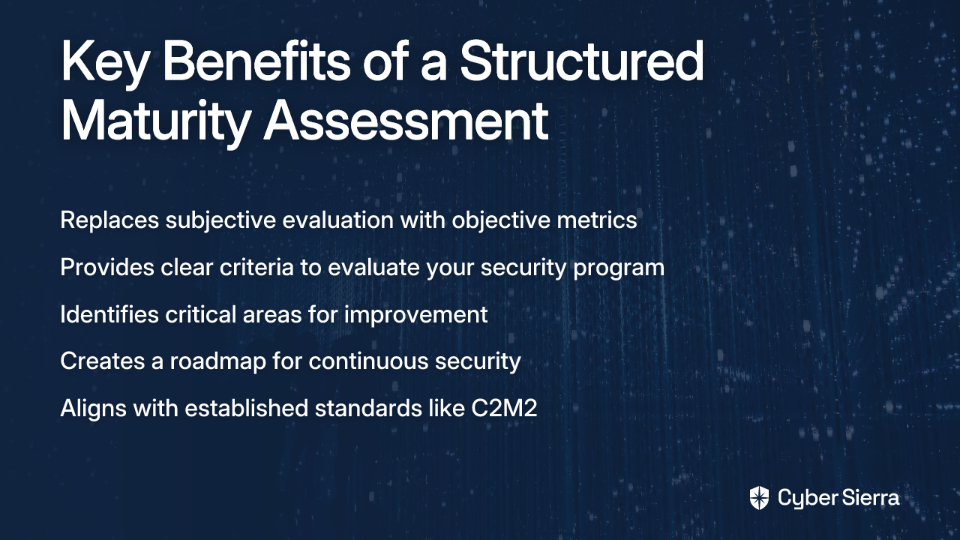
This article provides a concrete, actionable 10-point cybersecurity maturity assessment checklist that replaces abstract concepts with measurable actions and subjective feelings with objective scoring. Rather than struggling with ambiguity, you'll have clear criteria to evaluate your security program's maturity and identify the most critical areas for improvement.
Maturity assessments aren't about arbitrary scores but about systematically evaluating capabilities against established standards like the Cybersecurity Capability Maturity Model (C2M2). With this checklist, you'll have a roadmap to transform periodic, reactive security measures into a proactive, continuous security program that provides real-time visibility into your organization's security posture.
The 10-Point Cybersecurity Maturity Assessment Checklist
1. Continuous Control Monitoring (CCM)
What to Measure:
- Existence and effectiveness of a centralized control repository
- Automatic testing and validation of security controls across multiple compliance frameworks
- Speed of detection and reporting for control failures and anomalies
- Visibility into security posture across all digital assets
How to Score It:
- 0 (Not Implemented): Control testing is manual, ad-hoc, and performed only for audits. Evidence collection is a scramble.
- 1 (Partially Implemented): Some controls are monitored with scripts or basic tools, but there's no central view. Monitoring is periodic (e.g., weekly scans), not continuous.
- 2 (Fully Implemented): A dedicated CCM platform is used to automate control testing, evidence collection, and validation 24/7. A central dashboard provides real-time visibility into control effectiveness and compliance posture.
Common Gaps:
- Over-reliance on periodic, manual evidence gathering for audits
- Lack of a unified, real-time view of security posture, creating blind spots
- Failure to adapt controls quickly in response to evolving threats
Manual, point-in-time checks are no longer sufficient in today's dynamic threat landscape. This is where Continuous Control Monitoring (CCM) becomes foundational to any modern security program. Platforms like Cyber Sierra's CCM solution address this gap directly by automating control testing and providing ongoing visibility into your security posture, transforming security from periodic checks to a continuous, proactive process.
2. Risk Management Framework
What to Measure:
- Formal establishment of a cyber risk management strategy and program
- Process for identifying, analyzing, and categorizing risks to critical assets
- Effectiveness of risk mitigation strategies and controls
- Regularity and thoroughness of risk assessments
How to Score It:
- 0 (Not Implemented): No formal risk management program exists. Risks are addressed reactively.
- 1 (Partially Implemented): Risk assessments are performed annually or for specific projects but are not integrated into daily operations. Risk register is maintained but often outdated.
- 2 (Fully Implemented): A formal, documented risk management program is in place, integrated with business objectives. Risks are continuously identified, assessed, and treated, with clear ownership and an up-to-date risk register.
Common Gaps:
- Over-reliance on past incidents without considering emerging threats
- Failure to align the risk management strategy with overall business objectives and risk appetite
- Lack of a quantitative approach to prioritizing risks
3. Third-Party Risk Management (TPRM)
What to Measure:
- Comprehensive inventory of all third-party vendors, prioritized by level of access to sensitive data
- Process for vendor due diligence during onboarding, including security assessments
- Capability for continuous monitoring of vendor security posture
- Formal processes for vendor offboarding
How to Score It:
- 0 (Not Implemented): No formal process for assessing vendor risk. Vendors are onboarded without security review.
- 1 (Partially Implemented): Vendors are assessed at onboarding using questionnaires, but there is no ongoing monitoring. Risk assessments are inconsistent.
- 2 (Fully Implemented): A dedicated TPRM program is in place, using automation to assess, manage, and continuously monitor the entire vendor lifecycle. High-risk vendors are subject to more stringent, ongoing scrutiny.
Common Gaps:
- Insufficient due diligence during vendor selection
- Lack of ongoing monitoring, leaving the organization exposed to supply chain risks
- Poorly defined contractual security requirements
Cyber Sierra's TPRM platform can help automate vendor assessments and provide continuous monitoring capabilities that move beyond point-in-time questionnaires.
4. Incident Response (IR) & Readiness
What to Measure:
- Existence of a documented, comprehensive Incident Response plan
- Clarity of roles, responsibilities, and communication channels during an incident
- Effectiveness of IR procedures for identification, containment, eradication, and recovery
- Frequency and outcomes of IR plan testing (e.g., tabletop exercises, simulations)
- Key metrics like Mean Time to Detection (MTTD) and Mean Time to Respond (MTTR)
How to Score It:
- 0 (Not Implemented): No formal IR plan exists. Response is chaotic and ad-hoc.
- 1 (Partially Implemented): An IR plan is documented but rarely tested or updated. Roles are unclear, leading to delayed responses.
- 2 (Fully Implemented): The IR plan is regularly tested, updated, and integrated with security tools. The IR team conducts drills and simulations, and lessons learned are used to improve the plan and security controls.
Common Gaps:
- Insufficient training or resources for the designated incident response team
- Lack of clarity in roles, leading to confusion and delays during a real incident
- Failure to incorporate threat intelligence into response planning
5. Threat and Vulnerability Management
What to Measure:
- Comprehensive coverage of vulnerability scanning across all assets
- Process for prioritizing vulnerabilities based on severity, exploitability, and asset criticality
- Effectiveness and timeliness of patch management program
- Integration of threat intelligence for context and proactive defense
How to Score It:
- 0 (Not Implemented): No regular vulnerability scanning or patch management process.
- 1 (Partially Implemented): Scans are run periodically, but remediation is inconsistent. Prioritization is based solely on CVSS scores without business context.
- 2 (Fully Implemented): A continuous vulnerability management program is in place, using a risk-based approach to prioritize remediation. Patching is automated where possible, and SLAs for remediation are enforced and tracked.
Common Gaps:
- Delayed patching, especially for high-risk vulnerabilities
- Incomplete asset inventory, leading to unscanned and unprotected systems
- Lack of integration between threat intelligence feeds and vulnerability management
Cyber Sierra's Threat Intelligence platform provides proactive insights into your attack surface and helps prioritize remediation efforts based on risk.
6. Identity and Access Management (IAM)
What to Measure:
- Implementation of the principle of least privilege for all user accounts
- Effectiveness of access controls and authentication mechanisms, including MFA
- Processes for user access reviews, onboarding, and timely offboarding
- Management and monitoring of privileged access (PAM)
How to Score It:
- 0 (Not Implemented): Shared accounts are common, access is not based on role, and MFA is not used.
- 1 (Partially Implemented): IAM policies exist, but enforcement is inconsistent. MFA is deployed on some external systems but not internally. Access reviews are infrequent.
- 2 (Fully Implemented): A robust IAM/PAM solution is in place. Access is role-based and regularly reviewed. MFA is enforced across the enterprise. User lifecycle management is automated.
Common Gaps:
- Over-provisioned user access rights ("privilege creep")
- Failure to promptly deprovision access for terminated employees
- Inconsistent application of MFA, leaving critical systems vulnerable
7. Data Governance and Protection
What to Measure:
- Existence of a formal data classification policy and its application
- Effectiveness of data protection measures like encryption, masking, and DLP
- Processes for ensuring data confidentiality, integrity, and availability
- Alignment with data privacy regulations (e.g., GDPR, CCPA)
How to Score It:
- 0 (Not Implemented): No data classification policy. Sensitive data is not identified or specially protected.
- 1 (Partially Implemented): A data classification policy exists but is not widely understood or enforced. Encryption is used inconsistently.
- 2 (Fully Implemented): Data is classified at creation, and protection controls are automatically applied based on classification. Regular audits verify compliance.
Common Gaps:
- Inconsistent data access controls and lack of clear data ownership
- Failure to classify data, resulting in both sensitive and non-sensitive data being treated the same
- Lack of robust data protection for data stored in cloud environments
8. Asset and Exposure Management
What to Measure:
- Comprehensive and continuously updated inventory of all hardware, software, cloud, and data assets
- Ability to map the organization's attack surface and identify potential exposure points
- Processes for managing the entire lifecycle of assets, from procurement to decommissioning
- Structure and design of the cybersecurity architecture to protect these assets
How to Score It:
- 0 (Not Implemented): No central asset inventory. "Shadow IT" is prevalent.
- 1 (Partially Implemented): An asset inventory exists but is maintained manually and frequently out of date.
- 2 (Fully Implemented): An automated asset discovery and management system provides a real-time, comprehensive view of all IT and OT assets and their security status.
Common Gaps:
- Incomplete or outdated asset inventories, which are the root cause of many security failures
- Failure to include cloud services and third-party dependencies in the asset scope
- Lack of a process to identify and manage the external attack surface
9. Employee Security Training & Awareness
What to Measure:
- Existence and engagement rates of a continuous security awareness training program
- Employee performance in simulated phishing campaigns
- Employee understanding of key security policies
- Presence of a security-conscious culture
How to Score It:
- 0 (Not Implemented): No formal security training is provided.
- 1 (Partially Implemented): Annual, compliance-driven training is conducted, but it's not engaging or continuous. Phishing tests are rare.
- 2 (Fully Implemented): A continuous training program is in place with interactive modules, regular phishing simulations, and performance tracking. Security is championed as a shared responsibility.
Common Gaps:
- "One-and-done" annual training that fails to build lasting security habits
- Lack of ongoing training campaigns to address new and evolving threats
- Training content is generic and not tailored to specific roles or risks
Cyber Sierra's Employee Security Training platform offers interactive modules and simulated phishing campaigns to strengthen your human firewall.
10. Governance, Risk, and Compliance (GRC) Integration
What to Measure:
- Level of automation in GRC processes, including data collection and reporting
- Ability to manage multiple compliance frameworks efficiently
- Quality and accessibility of audit trails and documentation
- Overall management of the cybersecurity program and alignment with business strategy
How to Score It:
- 0 (Not Implemented): GRC processes are entirely manual. Audit preparation is a massive, disruptive effort.
- 1 (Partially Implemented): Some GRC functions are managed with disparate tools, creating silos and inefficiencies.
- 2 (Fully Implemented): An integrated GRC platform automates data collection, control monitoring, and reporting. A "collect once, use many" approach makes the organization "audit-ready" at all times.
Common Gaps:
- Manual, siloed processes leading to inefficiencies, errors, and audit fatigue
- Lack of integration across different compliance frameworks, causing redundant work
- Difficulty generating comprehensive reports for leadership and auditors
Cyber Sierra's GRC platform streamlines compliance processes and reduces manual effort across multiple frameworks.
From Checklist to Continuous Assurance: Transforming Security Maturity
While this checklist provides a vital snapshot of your security program's maturity, relying solely on periodic assessments leaves you vulnerable between evaluations. The modern approach to cybersecurity maturity isn't about point-in-time assessments—it's about continuous visibility and assurance.
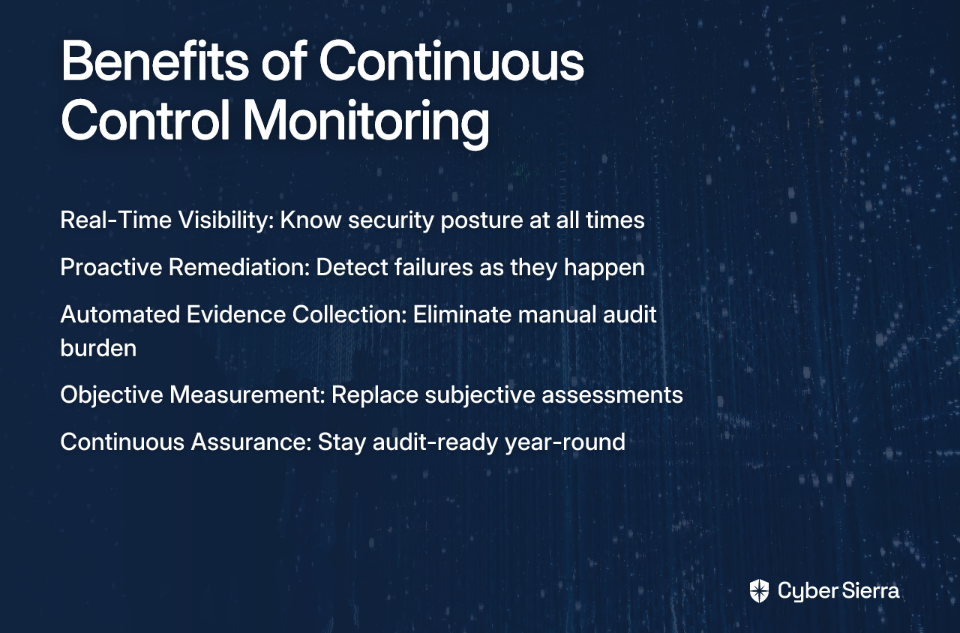
This is where Continuous Control Monitoring (CCM) transforms your security program from reactive to proactive. Instead of waiting for your annual assessment to discover gaps, CCM provides:
- Real-Time Visibility: Know your security posture at all times, not just during audits
- Proactive Remediation: Detect control failures as they happen, not months later
- Automated Evidence Collection: Eliminate the manual burden of gathering audit evidence
- Objective Measurement: Replace subjective assessments with data-driven insights
Elevate Your Security Maturity with Continuous Monitoring
A static checklist is a map, but a CCM platform is the GPS that guides you in real-time. Cyber Sierra's platform directly addresses the challenges outlined in this checklist:
- The CCM module automates control validation across multiple frameworks
- The TPRM module provides continuous vendor oversight beyond questionnaires
- The GRC module streamlines compliance and keeps you audit-ready
- The Threat Intelligence platform helps identify and prioritize vulnerabilities
- The Security Training platform strengthens your human defenses
This integrated approach solves the fundamental problems of traditional maturity assessments:
- It replaces abstract concepts with concrete metrics and dashboards
- It eliminates subjectivity through automated evidence gathering
- It transforms your security program from periodic assessments to continuous assurance
Stop chasing compliance and start building resilience. Discover how Cyber Sierra's AI-enabled cybersecurity platform can help you automate your security program, gain continuous visibility, and elevate your organization's security maturity. Explore the Cyber Sierra platform today.
Frequently Asked Questions
What is a cybersecurity maturity assessment?
A cybersecurity maturity assessment is a systematic evaluation of an organization's security program to measure its effectiveness, capabilities, and resilience against established standards. It goes beyond simple compliance checks to assess how well processes are defined, implemented, and optimized. This helps identify strengths and weaknesses, allowing for strategic improvements and better allocation of resources to build a more proactive and resilient security posture.
How often should a cybersecurity maturity assessment be conducted?
While traditional cybersecurity maturity assessments are often conducted annually, the modern best practice is to move towards a continuous assessment model using automated tools. A formal, comprehensive assessment is valuable once a year or after significant organizational changes. However, relying solely on these point-in-time snapshots creates visibility gaps. Implementing a Continuous Control Monitoring (CCM) platform allows for real-time evaluation of your security posture, ensuring you are always aware of your maturity level and can address issues as they arise, rather than waiting for an annual review.
What is the main benefit of using a checklist for a maturity assessment?
The main benefit of using a checklist is that it replaces abstract security concepts with concrete, measurable actions, making the assessment process objective and repeatable. A structured checklist provides clear criteria for evaluation across different domains like risk management, incident response, and data governance. This removes subjectivity, ensures consistency regardless of who performs the assessment, and helps pinpoint specific areas for improvement, creating a clear roadmap for enhancing your security program.
How does a maturity assessment differ from a compliance audit?
A compliance audit verifies if an organization meets a specific set of rules or standards (e.g., PCI DSS, HIPAA), while a maturity assessment evaluates the effectiveness and sophistication of the security program itself. In short, compliance asks, "Are you doing the required things?" while maturity asks, "How well are you doing them, and are they effective?" An organization can be compliant but still have an immature security program. A maturity assessment provides a more strategic, forward-looking view of an organization's ability to manage cyber risk proactively.
My assessment score is low. Where should I start improving?
If your assessment score is low, start by focusing on foundational areas that have the greatest impact on reducing risk, such as Asset and Exposure Management and Threat and Vulnerability Management. You cannot protect what you don't know you have. Begin by creating a comprehensive asset inventory. Concurrently, establish a robust vulnerability management program to identify and remediate the most critical weaknesses. These two areas provide the visibility and control needed to build a more mature security program. From there, you can prioritize other domains based on your organization's specific risk profile.
What is Continuous Control Monitoring (CCM) and why is it important for security maturity?
Continuous Control Monitoring (CCM) is an automated process that continuously tests and validates the effectiveness of your security controls in real-time. It is crucial for security maturity because it shifts security from a periodic, reactive exercise to a proactive, continuous process. Instead of discovering control failures during an annual audit, CCM provides immediate alerts, allowing for swift remediation. This provides constant assurance that your security posture is strong and that you remain compliant and audit-ready at all times.