



6 Best MetricStream Alternatives for Enterprise Compliance in 2026


Join thousands of professionals and get the latest insight on Compliance & Cybersecurity.
Summary
- Legacy GRC platforms like MetricStream come with a high total cost of ownership ($75K–$1M+ annually), lengthy implementation, and require significant manual effort.
- The GRC market is shifting from documentation tools to AI-native "execution engines" that automate tasks like evidence collection and control monitoring.
- When evaluating alternatives, consider whether your team needs an assistive tool or an autonomous platform that can execute compliance work with less human intervention.
- To move from manual compliance documentation to an automated execution engine, consider a modern GRC platform like Cyber Sierra.
MetricStream has earned its place in the enterprise GRC market, where over 1 million users rely on its broad framework coverage, risk quantification capabilities, and deep regulatory support for financial services including frameworks like DORA.
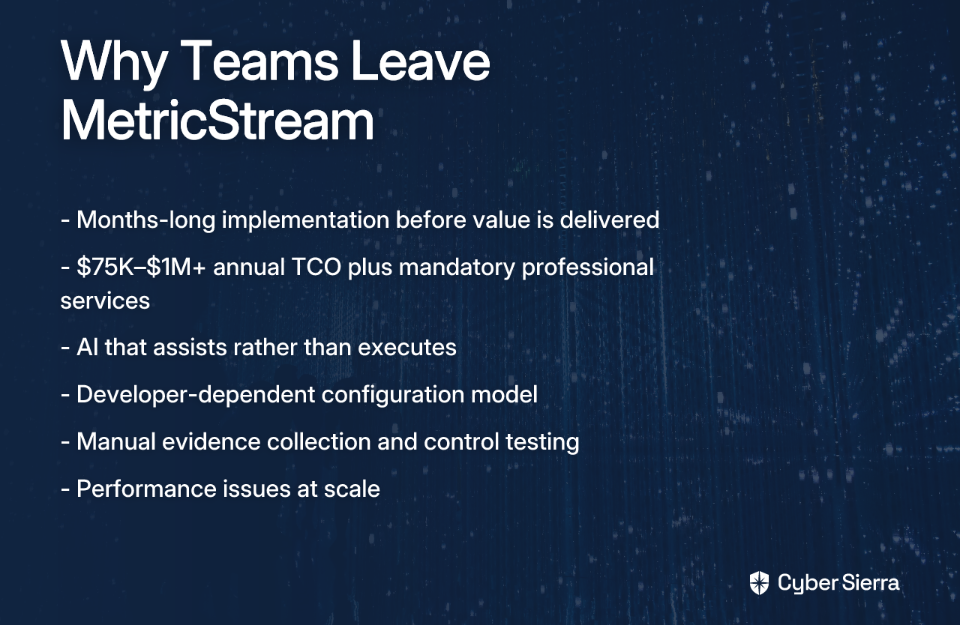
But it is a system of record, not an execution engine. It requires months of implementation, significant professional services investment, and its AI capabilities remain assistive rather than autonomous.
If you manage a GRC program at scale, you have likely felt the weight of MetricStream's total cost of ownership before the platform delivers measurable value.
Gartner Peer Insights reviewers consistently flag its steep learning curve, performance issues at volume, and a configuration model that one reviewer described as "Lego pieces requiring developer help."
For teams that need their compliance program to execute, not just document, that gap matters.
This guide breaks down the six strongest MetricStream alternatives for enterprise GRC leaders.
Why Enterprise Teams Look for a MetricStream Alternative
MetricStream's ideal customer is a large, regulated enterprise, such as a global bank, an energy major, or a financial market infrastructure operator with complex governance structures and the budget to absorb a high-cost implementation. Clients like Shell and LSEG are representative of that profile.
The problem is that MetricStream's pricing reflects that positioning. According to some industry analyses, licensing starts at roughly $75K per year for smaller enterprise deployments, scales to $250K for mid-size implementations, and runs $750K to over $1M annually for large enterprise configurations.
That is before professional services, which are not optional. When the board starts scrutinizing GRC program ROI, a platform that takes years to configure and requires continuous developer involvement becomes difficult to defend.
The AI automation gap is equally significant. MetricStream's platform offers predictive analytics, risk quantification, and semantic search, which are useful capabilities. But its AI augments human work rather than replacing it.
Evidence collection, control testing, and third-party risk assessments still require substantial manual effort. For GRC teams under pressure to reduce operational overhead, that ceiling is a real constraint.
A 2023 Gartner survey found that 45% of organizations experienced third-party disruptions over a two-year period, an environment where manual TPRM processes cannot keep pace.
MetricStream vs. Alternatives: At a Glance
This table provides a high-level comparison of MetricStream and modern GRC alternatives.
| Feature | MetricStream | Modern Alternatives |
|---|---|---|
| Primary Function | GRC management and reporting | Automated GRC execution |
| AI Capability | Assistive: analytics and semantic search | AI-driven automation |
| Annual TCO | $75K to $1M+ | Designed for lower TCO |
| Implementation Time | Months to years | Weeks |
| Customization | Complex configuration, developer-dependent | Flexible; no-code or managed options |
| TPRM Depth | Limited automation | Continuous, automated monitoring |
| Deployment | Vendor-hosted SaaS or on-premise | Customer cloud options available |
6 Best MetricStream Alternatives for Enterprise GRC
Here are the six platforms worth evaluating if you are actively looking for a MetricStream alternative or reassessing your current GRC stack.
1. Cyber Sierra
Cyber Sierra is a strong MetricStream alternative for enterprises that want compliance automation rather than just compliance documentation. The AI-enabled platform helps automate repetitive GRC work, such as evidence collection, control monitoring, and risk assessments, giving teams more time for strategic security decisions.
APAC regulatory depth is a standout for organisations operating across that region. For a CISO managing a significant security budget, Cyber Sierra represents a shift from GRC as a cost center to GRC as a strategic asset.
Best for: Enterprises prioritizing AI-driven compliance automation, APAC regulatory coverage, and faster time-to-value.
Key capabilities: AI-enabled GRC automation, third-party risk management, and continuous control monitoring.
Consideration: APAC regulatory depth is its primary geographic strength; coverage for other specific regional frameworks may require validation.
2. ServiceNow IRM
ServiceNow IRM is a natural fit for enterprises that have already standardised on ServiceNow for IT service management. GRC workflows integrate directly with existing ITSM processes, change management, and incident response, which reduces the integration overhead that standalone platforms carry.
For organisations that want a single platform vendor across IT and risk functions, the consolidation case is real. The tradeoff is rigidity outside the ServiceNow paradigm: customisation beyond native modules can be cumbersome, and users have flagged complex navigation as a recurring friction point.
It is a workflow platform that includes GRC, not a GRC specialist. If your team is not already embedded in the ServiceNow ecosystem, the licensing cost to get there may not be justified.
Best for: Large enterprises already running ServiceNow who want to consolidate GRC onto their existing platform.
Key capabilities: Native ITSM integration, unified IT and risk workflows, and change and incident management connection.
Consideration: Not a standalone GRC specialist. Customisation outside core modules requires significant ServiceNow expertise.
3. Archer GRC
Archer GRC offers comparable enterprise depth to MetricStream and has been a peer in the legacy GRC space for years. Its flexibility is a genuine strength, as the platform can be configured to support complex, unique risk management programs in ways that more opinionated tools cannot.
For organisations that want a direct like-for-like MetricStream replacement and have the in-house expertise to manage implementation, Archer is a credible option.
However, it carries the same structural limitations as the platform it would be replacing. Implementation is complex, the user interface reflects its age, and it is not an AI-native solution. Replacing MetricStream with Archer solves the vendor relationship problem without solving the AI automation problem.
Best for: Large enterprises seeking deep GRC configurability as a direct MetricStream replacement.
Key capabilities: High configurability for unique risk programs, enterprise-grade GRC depth, and flexible deployment options.
Consideration: Legacy complexity mirrors MetricStream. Not built for AI-driven compliance automation.
4. IBM OpenPages
IBM OpenPages is the natural alternative to MetricStream for organisations already running strategic IBM infrastructure.
It integrates with IBM's broader technology stack and applies Watson AI for analytics, risk quantification, and explainable AI capabilities that matter in regulated industries where decision transparency is auditable. Financial services buyers in particular will find familiar depth in its regulatory coverage.
The main risks are ecosystem dependency and cost structure, as OpenPages pricing reflects enterprise IBM contract economics, and deep integration can create lock-in. For existing IBM clients, the consolidation value may outweigh those concerns.
For organisations without prior IBM investment, the onboarding curve is significant.
Best for: Large regulated enterprises, particularly in financial services, with existing IBM infrastructure.
Key capabilities: IBM Watson AI for analytics, deep integration with IBM's technology stack, and strong regulatory support for financial services.
Consideration: Risk of ecosystem lock-in. Cost structure is consistent with enterprise IBM licensing.
5. AuditBoard
AuditBoard takes a different approach. Instead of trying to replicate the breadth of a legacy GRC platform, it focuses on making internal audit, SOX compliance, and risk management usable for the teams executing them. The interface is cleaner than legacy alternatives, onboarding is faster, and the operational lift is lower.
For GRC organisations where internal audit is the primary use case and the broader risk management program is less complex, AuditBoard delivers value without the overhead of a monolithic platform.
It is not a comprehensive MetricStream replacement for an enterprise running complex, multi-domain GRC programs. But for teams whose frustration with MetricStream stems from its complexity, AuditBoard is worth serious evaluation.
Best for: GRC teams focused on internal audit, SOX compliance, and risk management who need a lighter, more usable platform.
Key capabilities: User-friendly interface, strong focus on internal audit and SOX, and faster implementation.
Consideration: Does not replicate full enterprise GRC breadth. Better suited as a best-of-breed audit tool than an all-in-one replacement.
6. Onspring
Onspring occupies a distinct position in the GRC market. It is a no-code platform that allows GRC teams to build, configure, and modify their own workflows without developer involvement.
For organisations whose frustration with MetricStream centres on its rigidity and dependence on professional services for every configuration change, Onspring offers a fundamentally different operating model. Teams can adapt their GRC processes as regulations change or business requirements shift, without opening a services ticket.
The tradeoff is that the platform's out-of-the-box framework content is thinner than legacy alternatives. The responsibility of building and maintaining compliant workflows sits with the customer.
Best for: Agile GRC teams with unique process requirements who want full ownership of their workflow configuration.
Key capabilities: No-code workflow builder, process automation, and high adaptability for changing requirements.
Consideration: Shallower out-of-the-box framework content. Internal GRC capability is required to build and maintain effective workflows.
When Staying with MetricStream Still Makes Sense
There is a specific scenario where replacing MetricStream is the wrong decision: large financial institutions or globally regulated enterprises where MetricStream has been deeply embedded across multiple business units over several years.
In those environments, MetricStream is not just a tool. It is woven into core risk and audit processes, regulatory reporting cycles, and internal governance structures.
The cost, time, and operational disruption required to migrate away from a heavily customised, deeply integrated implementation can exceed the cost of maintaining the current platform, at least in the near term.
If your MetricStream instance is a central dependency, the business case for replacement needs to be built carefully and over a realistic timeline.
Three Signals It Is Time to Switch
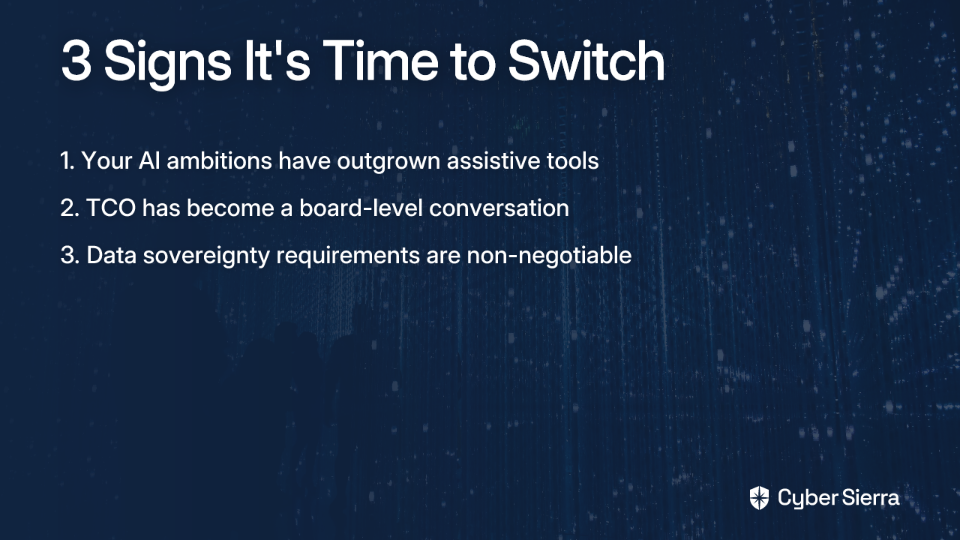
Your AI ambitions have outgrown assistive tools. If your team is still manually collecting evidence, chasing vendors for questionnaire responses, and running point-in-time control assessments, your GRC platform is not keeping up.
AI-driven compliance automation is now available. The technology gap between MetricStream's assistive AI and what modern, AI-enabled platforms offer has widened enough to be strategically significant.
TCO has become a board-level conversation. When the annual cost of maintaining a GRC platform rivals the cost of building a new security function, leadership attention follows.
If your MetricStream contract, combined with professional services and internal configuration effort, is consuming a disproportionate share of your security budget without corresponding ROI, that is a business case for evaluating alternatives.
Data sovereignty or deployment flexibility is non-negotiable. Cloud-first mandates, data residency requirements, and regulatory obligations around where compliance data sits are increasingly pushing enterprise GRC buyers toward platforms that can deploy within their own cloud environments.
Traditional vendor-hosted SaaS models do not address those requirements. If your organisation has hard constraints on where compliance data can reside, that requirement alone may disqualify a significant portion of the legacy GRC market.
Shift Your GRC From Record-Keeper to Execution Engine
The GRC market has shifted. The decision is no longer about which platform has the most features, but which one executes compliance work instead of just documenting it. The goal is to reduce your team's operational burden and get a faster return on investment, not just to create a system of record.
Modern, AI-enabled alternatives to legacy platforms focus on automating tasks like evidence collection and control monitoring. To understand the impact, consider how many hours your team spent on manual evidence collection last month. An automated platform can reclaim those hours for higher-value work.
See how an AI-enabled platform can turn GRC from a cost center into a strategic advantage. Book a demo of Cyber Sierra to see how automation fits your current process.
Frequently Asked Questions
Why do companies look for MetricStream alternatives?
Companies seek alternatives due to MetricStream's high total cost of ownership, lengthy implementation times, and reliance on manual processes. Its AI capabilities assist rather than automate, creating a significant operational burden for GRC teams needing to execute, not just document.
What is the best MetricStream alternative for AI-driven GRC?
Cyber Sierra is a strong alternative for AI-driven GRC. Its platform uses AI-enabled automation to help execute tasks like evidence collection and control monitoring, with a focus on compliance automation over mere documentation.
How does an automated GRC platform differ from a traditional one?
An automated GRC platform actively executes compliance tasks using AI, reducing manual work. Traditional platforms like MetricStream act as a system of record, requiring significant human effort for data collection, control testing, and reporting. The key difference is the level of automation.
What is the typical cost of a MetricStream alternative?
Modern MetricStream alternatives offer a significantly lower total cost of ownership. While MetricStream can cost $75K to over $1M annually plus services, platforms like Cyber Sierra start at around $45K per year, providing a clear ROI by reducing both licensing fees and manual effort.
How do I choose the right GRC platform for my enterprise?
To choose the right platform, evaluate your primary needs. If you need deep customization and have the budget, legacy tools may fit. If your goal is automation, lower TCO, and faster value, prioritize AI-native platforms that can function as an execution engine for your GRC program.
When does it make sense to stay with MetricStream?
It makes sense to stay with MetricStream if it is deeply embedded across your organization's core processes over many years. For large, regulated enterprises in this situation, the cost and disruption of migration may outweigh the benefits of switching in the short term.
