



Best Governance Risk Compliance Platforms for Mid-Market Companies

Join thousands of professionals and get the latest insight on Compliance & Cybersecurity.
Summary
- Many mid-market companies struggle with GRC, caught between chaotic spreadsheets and overly complex, expensive enterprise software.
- The right GRC platform for a mid-market team should automate evidence collection, support multiple frameworks (like SOC 2 and ISO 27001), and provide a unified view of risk.
- Before choosing a tool, define your specific compliance goals, as the platform should support your strategy, not define it.
- A unified platform like Cyber Sierra's GRC module can help automate compliance and achieve a state of continuous audit-readiness.
If you've ever had to Teams-message a colleague asking them to close a shared spreadsheet so you can update it — again — you already know the problem. Managing Governance, Risk, and Compliance (GRC) on a patchwork of Excel files, SharePoint folders, and email threads with "APPROVED" in the subject line isn't a strategy. It's organized chaos.
The frustrating part? Many mid-market teams that have tried purpose-built GRC software have walked away disappointed. Tools that didn't deliver on their promises. Pricing models that felt "offensively expensive." Platforms so complex they needed a dedicated team just to keep running. It's no wonder some security professionals have concluded that GRC software is "an entire racket."
But there's a middle ground between spreadsheet chaos and enterprise-grade complexity — and that's exactly what this guide covers. Below, you'll find a practical breakdown of governance risk compliance platforms built (or well-suited) for mid-market organizations, what to look for before you buy, and how to avoid the pitfalls that burn most teams.
What Mid-Market Companies Should Look for in a GRC Platform
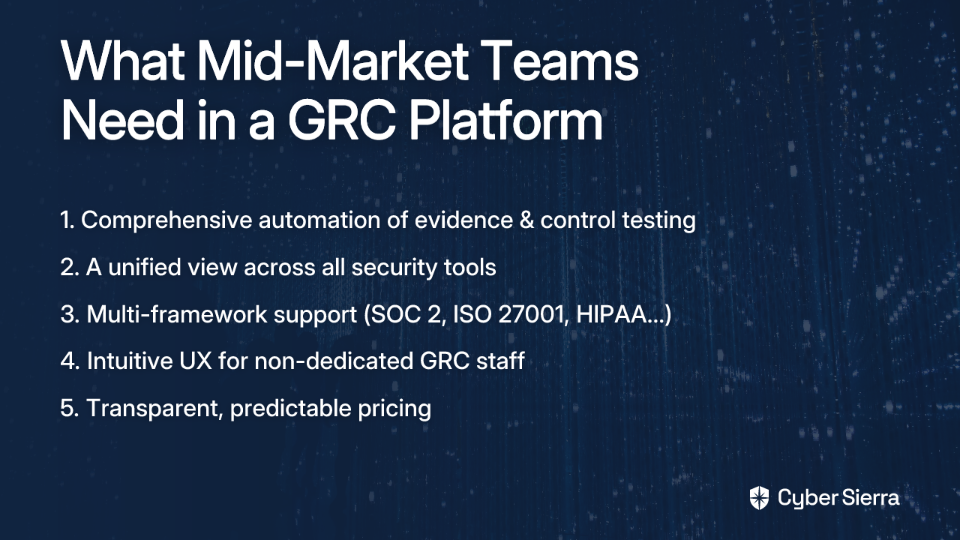
Before evaluating any specific tool, get clear on what you actually need it to do. As one practitioner put it bluntly: "What problem are you trying to solve? Knowing what your org's goals, strategy, and culture are will drive what tool you need." That's the right framing.
With that in mind, here are the criteria that matter most for mid-market teams:
Top GRC Platforms for Mid-Market Companies
With those criteria in mind, here's a curated look at governance risk compliance platforms worth evaluating. Each has distinct strengths depending on your team's size, maturity, and compliance priorities.
1. Cyber Sierra
Best for: Mid-market Chief Information Security Officers (CISOs) and compliance managers seeking a unified platform that integrates GRC with continuous monitoring, vendor risk management, and threat intelligence. Supported frameworks: SOC 2, ISO 27001, HIPAA, PCI DSS, GDPR, NIST CSF, and custom controls. Deployment: Cloud-based SaaS.
Cyber Sierra is an AI-enabled cybersecurity platform designed to move security programs from reactive audit scrambles to proactive, continuous compliance. Rather than functioning as a standalone GRC checklist tool, it integrates multiple functions — governance, risk, control monitoring, vendor risk, and threat intelligence — into a single platform. It was recognized as a Sample Vendor in the Gartner® Hype Cycle™ for Cyber-Risk Management, 2024, and holds ISO 27001 certification itself.
Where Cyber Sierra stands out for mid-market organizations is in its Continuous Control Monitoring (CCM) module, which provides near real-time visibility into control effectiveness. Instead of collecting evidence in a frantic pre-audit sprint, teams can identify and remediate gaps before they become audit findings.
Key features:
- Automated GRC. The GRC module automates data collection, risk assessments, and reporting to keep teams audit-ready across multiple frameworks without duplicated effort.
- Integrated Third-Party Risk Management (TPRM). The TPRM module automates vendor assessments and provides continuous monitoring beyond point-in-time questionnaires.
- Threat intelligence. Provides an outside-in view of your attack surface through network and cloud vulnerability scanning to help prioritize remediation.
- Cyber insurance readiness. Helps organizations meet insurer requirements and streamline the coverage process by automating the documentation insurers need.
2. Drata
Best for: Technology and SaaS companies that need deep automation to accelerate compliance and unblock sales cycles. Supported frameworks: SOC 2, ISO 27001, HIPAA, PCI DSS, GDPR. Deployment: Cloud-based SaaS.
Drata is a well-established name in compliance automation, built around the idea that continuous evidence collection should replace the pre-audit scramble. Its platform integrates with over 100 cloud and SaaS applications, pulling evidence automatically and flagging control gaps in real time. For companies under pressure to achieve SOC 2 Type II quickly — often because a prospect is asking for it — Drata is frequently recommended.
The trade-off is that Drata's depth of developer tooling and automation can be underutilized by teams without dedicated engineering resources. And as some users have noted, certain environments (such as GCC High government cloud configurations) may not be fully supported — something worth validating before signing a contract.
Key features:
- Continuous monitoring. Automates evidence collection across cloud infrastructure and SaaS applications.
- Risk management. Built-in tools to identify, assess, and track risks throughout the compliance lifecycle.
- AI questionnaire assistance. Helps teams respond faster to security questionnaires from customers and prospects.
- Trust Center. A public-facing portal to share your compliance posture with customers and auditors.
3. Hyperproof
Best for: Organizations that want to operationalize compliance as a year-round program rather than a periodic fire drill. Supported frameworks: SOC 2, ISO 27001, NIST CSF, CCPA/CPRA, PCI DSS. Deployment: Cloud-based SaaS.
Hyperproof is built around the concept of continuous compliance — treating audit readiness as a permanent state rather than a project you kick off six weeks before an auditor arrives. It emphasizes task assignment, cross-team coordination, and workflow automation to keep compliance activities moving throughout the year.
This makes it a practical choice for compliance managers who spend too much time chasing control owners for evidence and attestations. The platform's control mapping capabilities also help teams avoid the duplicate work that comes with managing multiple overlapping frameworks.
Key features:
- Control mapping. Link controls once and map them across multiple compliance frameworks to eliminate redundant work.
- Automated evidence collection. Pulls evidence from cloud systems to reduce manual collection effort.
- Task automation engine. Built-in workflows to assign responsibilities, set deadlines, and track completion.
- Dashboards and reporting. Provides ongoing visibility into compliance program status across frameworks.
4. LogicGate Risk Cloud
Best for: Mid-market organizations that need highly customizable workflows to manage complex or non-standard GRC processes. Supported frameworks: Configurable across a wide range of regulatory and industry frameworks. Deployment: Cloud-based SaaS.
LogicGate's Risk Cloud differentiates itself through flexibility. Its no-code workflow builder lets teams design and automate GRC processes that match their specific organizational structure — rather than forcing their workflow into a rigid template. As highlighted by MetricStream's GRC overview, this makes it particularly strong for "agile risk and compliance management."
The configurability comes with a learning curve, and organizations without a clear internal GRC framework may find themselves spending significant time on setup. But for teams with well-defined processes who need the platform to match them — not the other way around — it's a compelling option.
Key features:
- Risk Cloud applications. Pre-built and customizable applications for policy management, Third-Party Risk Management (TPRM), incident management, and more.
- Visual workflow builder. Drag-and-drop interface for designing automated GRC processes without code.
- Centralized evidence repository. A single location for storing and managing compliance evidence.
- Risk quantification. Tools to express risk in financial terms, supporting board-level reporting.
5. Archer
Best for: Larger or more mature mid-market organizations with dedicated GRC teams and complex enterprise risk management requirements. Supported frameworks: Highly configurable for a wide range of industry and regulatory frameworks. Deployment: On-premise or SaaS.
Archer is the benchmark that most other GRC tools are compared against — often called "the SAP of GRC tools" by practitioners. It offers immense depth and configurability for managing enterprise-wide risk across audit, IT risk, Third-Party Risk Management (TPRM), and compliance.
That power comes at a cost, and not just in licensing fees. As one practitioner put it: "I love Archer, but it's a beast of a tool that is only realistic for a more mature GRC org with dedicated staff to work on it." For mid-market teams without a dedicated GRC function, Archer can quickly become shelfware. It's included here as a benchmark — if you're evaluating other tools, understanding what Archer does helps clarify what you're trading off.
Key features:
- Modular architecture. Separate solutions for audit management, IT risk, compliance, and third-party governance that can be deployed independently.
- Deep customization. Highly configurable to match complex organizational risk taxonomies and processes.
- Centralized risk data. Unified repository for policies, controls, risks, assessments, and incidents.
- Advanced reporting. Configurable dashboards for executive and board-level risk visibility.
GRC Is More Than a Tool — It's a Strategy
A platform doesn't fix a broken compliance program. It amplifies what's already there — for better or worse.
Before shortlisting vendors, define what you're actually trying to solve. Are you working toward a SOC 2 Type II certification? Reducing exposure from third-party vendors? Getting board-ready risk reporting in place? The answer shapes everything: which modules matter, how much automation you need, and which platform will realistically get used versus collecting dust.
As AWS's GRC overview frames it, a GRC framework should align IT operations with business goals while managing risk and meeting regulatory requirements. The tool is the vehicle — the strategy is the destination.
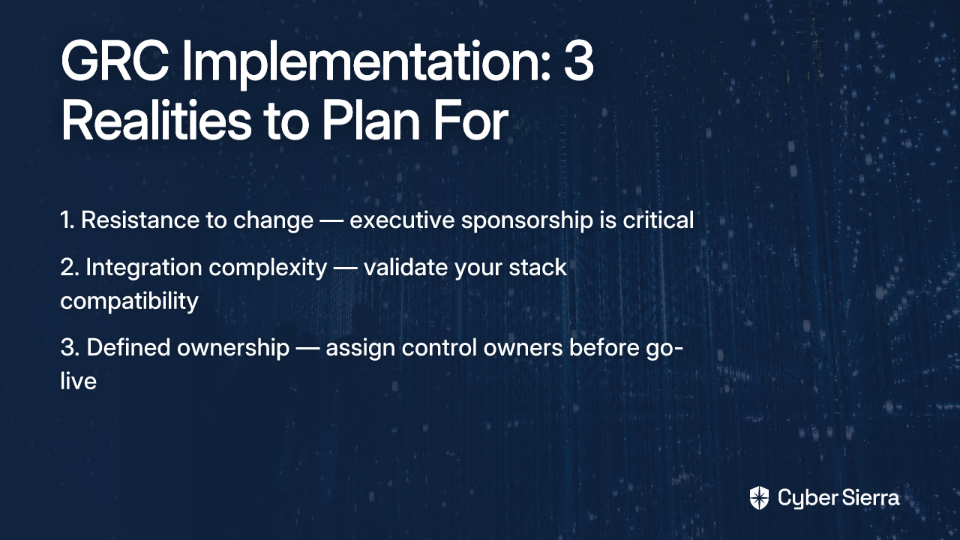
A few implementation realities worth planning for:
Your Next Step Toward Smarter GRC
Moving away from spreadsheet-driven compliance isn't about buying the most complex platform; it's about finding the right one for your mid-market team. The best GRC tools don't just add features—they remove friction.
Remember these key takeaways:
- Focus on automation: Automating evidence collection and control testing frees your team from the manual grind of audit preparation.
- Unify your frameworks: A good platform maps controls across standards like SOC 2 and ISO 27001, so you can "test once, apply everywhere."
- Let strategy lead: Define your compliance goals first. The right tool will support your strategy, not dictate it.
Your next step today isn't to book a demo. It's to identify your single biggest compliance bottleneck. Is it chasing evidence from control owners? Managing third-party vendor risk? Reporting to the board?
Once you have that clarity, you can find the right tool to solve it. If your goal is to replace audit fire drills with a state of continuous compliance, see how Cyber Sierra helps.
Frequently Asked Questions
What is a GRC platform and why do mid-market companies need one?
A GRC platform centralizes governance, risk, and compliance activities to replace manual spreadsheets. It automates evidence collection, risk assessments, and reporting, helping teams stay continuously audit-ready and move beyond inefficient, error-prone manual processes.
What are the most important features in a GRC platform for a mid-market team?
Key features include automated evidence collection, support for multiple frameworks (like SOC 2, ISO 27001), a unified risk view, and an intuitive user interface. These capabilities reduce manual work, prevent duplicated effort across audits, and ensure the tool is usable by non-specialist staff.
How does a GRC platform help with multiple compliance frameworks?
GRC platforms use control mapping to link a single piece of evidence to multiple framework requirements. This "test once, apply many" approach eliminates redundant work, allowing you to manage SOC 2, ISO 27001, and HIPAA from one dashboard and saving significant time and effort.
What is the difference between traditional GRC and continuous compliance?
Traditional GRC often involves periodic "fire drills" before an audit, while continuous compliance is an always-on approach. By using automation and continuous monitoring, GRC platforms provide real-time visibility into your security posture, allowing you to fix gaps as they arise.
How can I ensure a successful GRC platform implementation?
Successful implementation requires clear goals, executive sponsorship, and defined ownership of controls. Start by defining the specific problem you're solving (e.g., SOC 2 readiness), secure buy-in from leadership to drive adoption, and assign responsibilities before you go live.
