



Top 5 Competitors to Archer for Modern Cyber Risk Management

Join thousands of professionals and get the latest insight on Compliance & Cybersecurity.
Summary
- Legacy GRC platforms like Archer are often too complex and resource-intensive, requiring dedicated staff and extensive customization for effective use.
- Modern alternatives prioritize automation, continuous monitoring, and user-friendliness to provide actionable risk intelligence rather than just static compliance dashboards.
- When choosing a new platform, it's crucial to define your internal processes first, prioritize usability, and calculate the total cost of ownership beyond the initial price.
- Cyber Sierra offers a unified, automated platform that simplifies compliance and risk management without the complexity of traditional tools.
In today's rapidly evolving threat landscape, cybersecurity teams are increasingly frustrated with legacy GRC (Governance, Risk, and Compliance) platforms that feel more like beasts than allies. If you're using Archer—or considering it—you've likely experienced the pain of a tool that, while powerful, can be overwhelmingly complex and resource-intensive.
As one cybersecurity professional put it on Reddit, "I love Archer, but it's a beast of a tool that is only realistic for a more mature GRC org with dedicated staff to work on it." Another lamented that "Most GRC tools are obsessed with compliance and audit automation (and/or painting pretty dashboards for the management presentations)" rather than providing actionable intelligence.
The good news? The market has evolved. Modern cyber risk management platforms now offer more agile, integrated approaches that emphasize automation, continuous monitoring, and user-friendliness—without sacrificing depth. Whether you're looking to move beyond spreadsheets or replace a complex legacy system, these five alternatives to Archer deserve your attention.
The Top 5 Archer Competitors for Modern Cyber Risk Management

1. Cyber Sierra
Overview: Cyber Sierra offers a comprehensive, AI-enabled cybersecurity platform designed to simplify and automate security compliance and risk management. It transforms security from periodic, manual checks into a continuous, proactive program through an integrated suite of tools.
Key Features:
- Continuous Control Monitoring (CCM): Provides ongoing, near real-time visibility into security controls and automates evidence collection across frameworks like NIST, ISO 27001, and PCI DSS—directly addressing the pain of manual evidence gathering.
- Third-Party Risk Management (TPRM): Simplifies and automates the entire vendor risk lifecycle from onboarding and assessment to continuous monitoring, moving beyond static questionnaires.
- Governance, Risk & Compliance (GRC): Automates data collection, risk assessments, and reporting for frameworks like SOC2 and HIPAA, making enterprises audit-ready faster.
- Threat Intelligence: Offers vulnerability scanning (network and cloud) and attack surface insights to enable proactive defense.
- Employee Security Training and Cyber Insurance: Unique differentiators that build the "human firewall" and streamline the insurance application process.
Best For: CISOs, Compliance Managers, and IT leaders in industries like financial services, healthcare technology, and retail who want to move beyond manual processes and spreadsheets without the complexity of Archer.
Considerations: As a comprehensive platform, organizations should plan to leverage its integrated nature to get the most value, rather than using it for a single, siloed function.
2. ServiceNow GRC
Overview: ServiceNow is a powerful IT Service Management (ITSM) platform that extends into Governance, Risk, and Compliance. Its key strength lies in integrating risk management directly into an organization's existing IT and business workflows.
Key Features:
- AI-powered platform that connects processes and data across the enterprise
- Automates risk assessment and compliance workflows
- Extensive reporting and dashboarding for risk visibility
- Deep integration with IT service management and business operations
Best For: Large enterprises that are already heavily invested in the ServiceNow ecosystem and want to consolidate GRC into their existing platform.
Considerations: ServiceNow GRC "requires extensive configuration and setup," according to industry analyses. This can make it feel like another "beast" for organizations without dedicated ServiceNow expertise.
3. LogicGate Risk Cloud
Overview: LogicGate provides a highly flexible, no-code GRC platform known as Risk Cloud. It allows organizations to build custom applications and workflows to manage their risk and compliance processes without needing developers.
Key Features:
- No-code, drag-and-drop workflow builder
- Highly customizable applications for risk, compliance, and audit
- User-friendly interface with strong visualization capabilities
- Flexible risk assessment methodologies
Best For: Mid-market to enterprise companies with unique or evolving risk processes who need a flexible, adaptable solution.
Considerations: While flexible, it puts the onus on the user to define and build their processes. This can be challenging for low-maturity teams who are still trying to "build baby's first risk register," as one Reddit user described their situation.
4. OneTrust
Overview: OneTrust has built a strong reputation as a leader in privacy, security, and data governance. Its platform helps organizations simplify compliance with regulations like GDPR and CCPA while managing broader security risks.
Key Features:
- Deep capabilities for privacy management and data governance
- Modules for IT & Security Risk, Third-Party Risk, and Ethics & Compliance
- Automates data discovery and compliance workflows
- Strong regulatory intelligence and updates
Best For: Organizations where data privacy is a primary business driver and a central part of their risk posture.
Considerations: Its deep focus on privacy means it "may not fully address broader ERM needs," particularly in operational or strategic risk management functionalities outside of the tech and data spheres.
5. MetricStream
Overview: MetricStream is an established player in the GRC space, offering what it calls "Connected GRC." The platform is known for its advanced analytical capabilities and ability to handle complex regulatory environments.
Key Features:
- Advanced analytics and AI for risk intelligence
- Strong support for regulatory compliance management in highly regulated industries
- Comprehensive modules for risk, audit, compliance, and vendor management
- Mature reporting capabilities for executives and boards
Best For: Large, highly regulated enterprises that require deep and specialized compliance functionality and have the resources to manage a complex implementation.
Considerations: The platform's power comes with complexity. It can "require significant customization to fit specific needs," potentially leading to high implementation and maintenance costs.
Feature Comparison Table
| Platform | Core Focus | Ideal Customer | Key Differentiator |
|---|---|---|---|
| Cyber Sierra | Unified, Automated Cyber Risk & Compliance | SMBs to Enterprises seeking simplicity and automation | All-in-one platform with Continuous Control Monitoring (CCM) and integrated modules |
| ServiceNow GRC | Integrated IT & Risk Management | Large enterprises already on the ServiceNow platform | Deep integration with ITSM and business workflows |
| LogicGate | Flexible, No-Code GRC | Organizations with unique processes needing customization | Highly configurable, user-built workflows |
| OneTrust | Privacy, Security & Data Governance | Companies with a primary focus on data privacy compliance | Market-leading privacy management capabilities |
| MetricStream | Advanced, Connected GRC | Highly regulated large enterprises | Strong analytics and deep regulatory compliance features |
How to Choose the Right Archer Alternative for Your Organization
Given the variety of options, how do you select the right platform for your organization? Here are four key considerations:
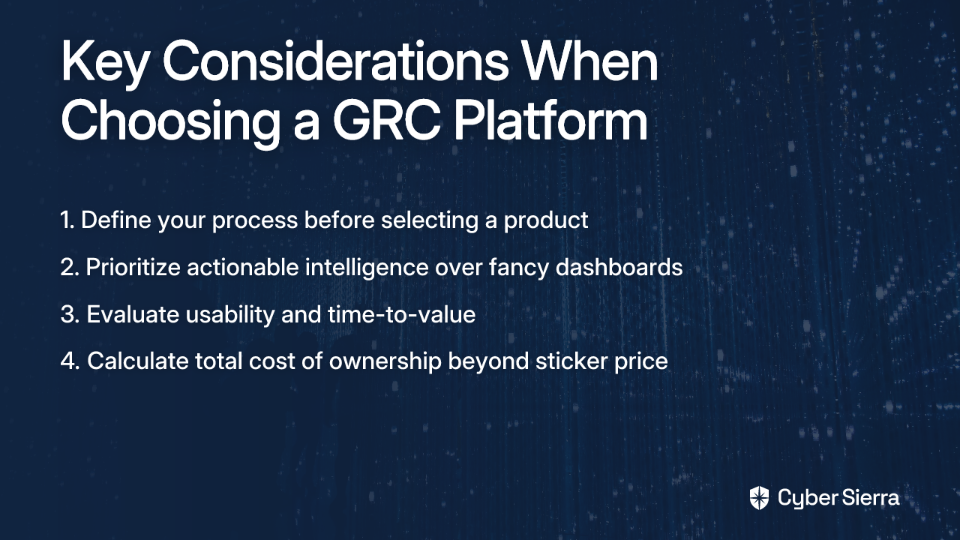
1. Define Your Process Before the Product
As one risk management professional aptly noted, "If you don't know what your process looks like...what types of reporting are needed, how can you tell which tool best fits your process?"
Before evaluating any platform, map out your risk management, compliance, and vendor assessment workflows. Understand your current maturity level and where you want to be. A tool should support your process, not dictate it.
2. Look for Actionable Intelligence, Not Just Dashboards
Move beyond "pretty dashboards for management presentations." A modern tool should provide actionable risk intelligence that drives decision-making. Ask vendors: Does this platform offer continuous monitoring to detect control failures in real-time? Does it help prioritize vulnerabilities based on business impact?
3. Prioritize Usability and Fast Time-to-Value
A complex tool that nobody uses is worse than a simple spreadsheet. Look for platforms with intuitive interfaces that don't require a dedicated team to manage. This is critical for adoption and ROI, especially for organizations without mature GRC programs.
4. Scrutinize the Total Cost of Ownership (TCO)
Many organizations have been burned by "offensively expensive" tools. Calculate the TCO beyond the sticker price, including implementation fees, customization costs, required training, and ongoing maintenance.
Conclusion: The Future is Integrated and Automated
The era of clunky, siloed, and manually-intensive GRC is ending. The market has shifted towards integrated platforms that automate manual work and provide a holistic view of cyber risk.
While Archer remains a powerful tool for specific use cases, modern alternatives like Cyber Sierra offer a more agile, comprehensive, and user-friendly path to cyber resilience. By integrating Continuous Control Monitoring, TPRM, GRC, and more into one platform, organizations can finally move from being reactive to proactive in their cyber risk management.
Ready to leave behind compliance fatigue and spreadsheet chaos? See how Cyber Sierra's AI-enabled platform can unify and automate your cyber risk management program.
Frequently Asked Questions
Why do companies look for alternatives to Archer?
Companies often seek Archer alternatives due to its complexity, high resource requirements, and steep learning curve. While powerful, Archer is often described as a "beast" that requires a dedicated team to manage and customize, making it less suitable for organizations seeking agility, faster time-to-value, or those with less mature GRC programs.
What is the main difference between legacy GRC tools and modern platforms?
The main difference lies in automation and integration. Modern platforms emphasize continuous monitoring, real-time data collection, and user-friendliness to provide actionable intelligence. In contrast, legacy GRC tools are often built around manual, periodic compliance tasks and audits, which can be resource-intensive and provide only a point-in-time view of risk.
How should I choose the right GRC platform for my business?
To choose the right GRC platform, you should first define your internal risk and compliance processes. Then, prioritize platforms that offer actionable intelligence over simple dashboards, evaluate usability for quick adoption by your team, and calculate the total cost of ownership (TCO), including implementation, training, and maintenance costs.
What makes Cyber Sierra a strong Archer alternative?
Cyber Sierra is a strong Archer alternative because it offers a unified, AI-enabled platform that simplifies risk and compliance management without the complexity of legacy systems. It integrates key functions like Continuous Control Monitoring (CCM), Third-Party Risk Management (TPRM), and employee training into a single, user-friendly interface, designed for quick implementation and continuous, automated security.
What is Continuous Control Monitoring (CCM) and why is it important for GRC?
Continuous Control Monitoring (CCM) is an automated process that provides near real-time visibility into the effectiveness of your security controls. It is important because it replaces manual, point-in-time audits with ongoing, automated evidence collection. This allows organizations to proactively identify and remediate control failures, maintain an audit-ready posture, and make more informed risk decisions.
