



Are You Still Managing Compliance with Spreadsheets in 2025?


Join thousands of professionals and get the latest insight on Compliance & Cybersecurity.
Another Tuesday morning, another gallon of coffee, and another VLOOKUP formula that's breaking down as you try to track compliance evidence across multiple frameworks. If this sounds like your compliance management routine, you're not alone.
"At least the coffee gets me through the days messing with Excel," confessed one CISO in a recent Reddit thread, capturing the caffeine-fueled reality many security leaders face when managing GRC (Governance, Risk, and Compliance) programs.
While spreadsheets seem like a free, flexible solution, the reality is far more expensive. The GRC automation market was valued at $48.7 billion in 2023 and is projected to hit $179.5 billion by 2032 — a clear indicator that organizations are recognizing the limitations of manual approaches and embracing automation.
This article will dissect the true cost of managing compliance with spreadsheets, provide a pragmatic roadmap for moving to automated GRC platforms, and help you avoid common pitfalls along the way.
The Hidden Price Tag of "Free": Exposing the True Cost of Manual Compliance
That Excel workbook might not require a license fee, but the hidden costs make it one of the most expensive tools in your security arsenal.
Time Sink & Productivity Loss
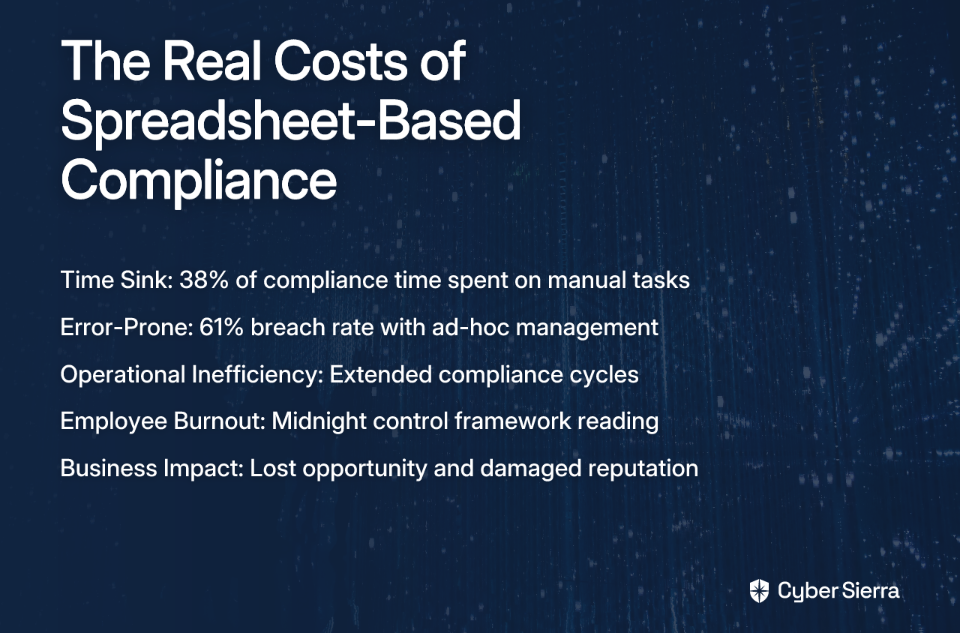
Compliance professionals spend an average of 38% of their time on manual tasks. For an 8-person team, this equates to approximately $379,392 annually in salary costs alone. One DevOps engineer reported spending "400+ hours manually documenting infrastructure configurations, taking screenshots of AWS console settings, and writing policies" — valuable time that could have been directed toward infrastructure improvements.
The breaking point? "Implementing both SOC 2 and ISO 27001 simultaneously. That's roughly 160 controls across both frameworks... Three months of engineering time that could have been spent on infrastructure improvements or reliability work."
Error-Proneness & Increased Risk
Manual compliance is inherently "error-prone, and doesn't scale," according to practitioners in the field. Organizations with ad-hoc, spreadsheet-based risk management suffer a 61% breach rate, compared to 30% for those using integrated, automated tools.
When errors lead to non-compliance, the costs become catastrophic. Consider Equifax's $575 million settlement for data breaches stemming from inadequate security controls. Your spreadsheet suddenly doesn't seem so "free" anymore.
Operational Inefficiencies & Alert Fatigue
Manual reviews and siloed tools stretch compliance cycles from minutes to days. When dealing with frameworks like FedRAMP (Federal Risk and Authorization Management Program) or CMMC (Cybersecurity Maturity Model Certification), these inefficiencies compound.
False positives consume tremendous resources. One global bank reported analysts spent an average of 4 hours investigating each alert, most of which were false hits. Multiply this across your SSP (System Security Plan) and POA&M (Plan of Action and Milestones) reports, and you're looking at significant wasted effort.
Human Cost: Audit Stress & Burnout
"You're reading control frameworks at midnight trying to understand what 'logical access controls' actually means in practice," shared one DevOps engineer who was unexpectedly assigned compliance tasks.
The demand is increasing: Financial institutions increased employee hours dedicated to compliance by 61% between 2016 and 2023. This leads to employee burnout and high turnover, creating a cycle of hiring and training costs that drains your budget and team morale.
Opportunity & Reputational Cost
Poor compliance processes directly impact business. Up to 70% of customers abandon applications if onboarding takes longer than 20 minutes. Public compliance failures damage reputation, as seen when TD Bank received a negative outlook from Fitch due to AML issues.
The Automation Advantage: What a Modern GRC Platform Actually Delivers
Moving beyond the problems, let's explore how modern GRC platforms transform compliance from a burden into a strategic asset.
Centralized Control & a Single Source of Truth
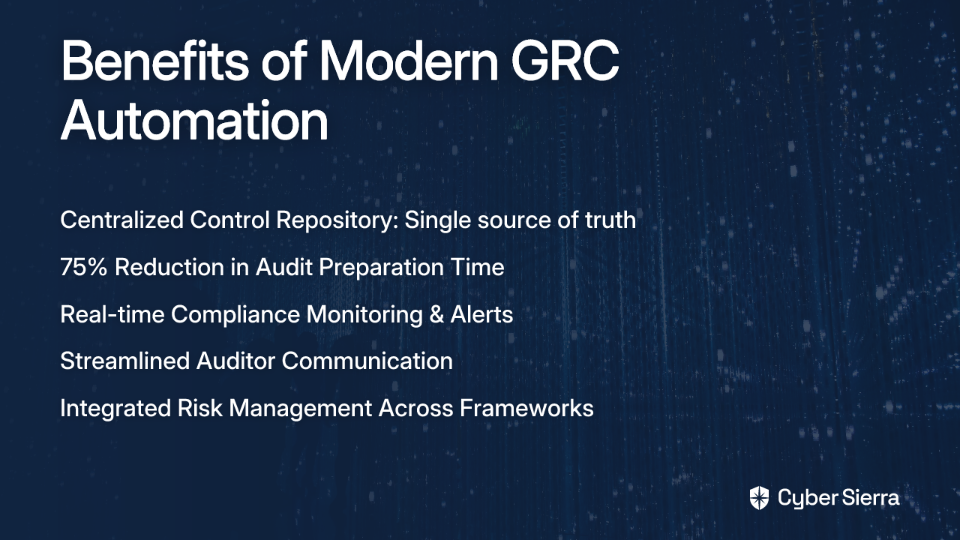
Modern GRC platforms create a centralized controls library, linking controls to frameworks like NIST CSF 2.0, ISO 27001, SOC 2, and GDPR. Instead of juggling multiple spreadsheets, you maintain a single source of truth that connects your internal controls to compliance requirements.
This centralization is particularly valuable for complex frameworks like RMF (Risk Management Framework), where tracking control implementation across systems becomes unmanageable in spreadsheets.
Reduced Manual Work & Audit Fatigue
Automation of key areas like evidence collection, risk assessment, and policy management dramatically cuts down on manual labor. The results can be transformative:
- Outreach achieved a 75% reduction in audit preparation time and a 50% reduction in time spent on evidence collection using Hyperproof.
- Highspot automated responses for 150 vendor questionnaires and managed 300 controls with a continuous compliance program.
For organizations dealing with FedRAMP or CMMC requirements, this automation is not just convenient—it's essential for maintaining sanity and accuracy.
Real-time Visibility & Proactive Monitoring
GRC tools provide continuous monitoring of compliance status and regulatory changes, sending real-time alerts for control failures. This shifts your posture from reactive to proactive.
Automated dashboards give executives real-time insights for informed decision-making, allowing for TPRM (Third Party Risk Management) and vulnerability intelligence to be integrated with compliance data.
Streamlined Audits & Reporting
One CISO noted that "Making the SSP and POA&M reports for FedRAMP works great in Paramify. We've been able to map our controls, associate evidence and manage a lot of the manual parts of RMF which is nice. I would've hated doing our FR High audit without it."
Modern platforms centralize evidence collection and auditor communication, directly addressing the common pain point of "ineffective communication with auditors" during evaluations.
Your Migration Plan: From Spreadsheet Chaos to GRC Clarity
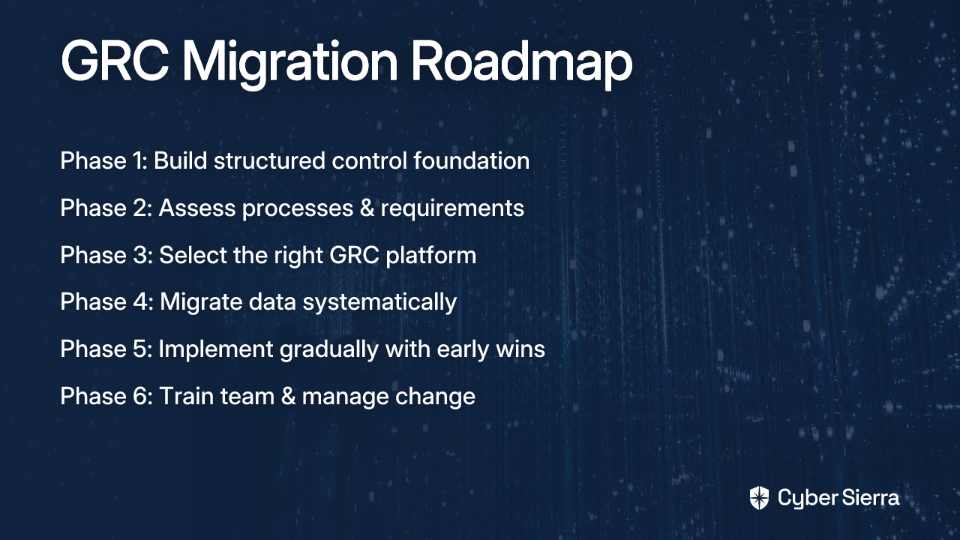
Ready to make the move? Here's your roadmap to migration success:
Phase 1: Build Your Foundation (In a Spreadsheet!)
Surprisingly, a well-structured spreadsheet is a strategic first step, not a weakness. It forms the basis for a smooth migration.
- Define Your Objective: Prepare for a specific audit (SOC 2) or implement a framework (NIST CSF 2.0).
- Gather Source Materials: Collect existing policies, procedures, and framework documentation.
- Structure Your Spreadsheet: Create essential columns:
Control ID,Control Description,Framework Mapping, andEvidence Link. - Populate Your Library: Start with baseline controls and map them to relevant frameworks.
Phase 2: The Move to an Automated GRC Platform
- Assess Current Processes & Requirements: Identify the most resource-intensive manual tasks and list all applicable regulations (e.g., PCI DSS, HIPAA, GDPR).
- Choose the Right GRC Tool:
- Evaluate vendors (IBM, Check Point, Hyperproof, AuditBoard) on features, scalability, and integrations.
- Avoid the complexity and cost of legacy tools like Archer if they don't fit your needs.
- Pro Tip: Ask potential vendors about their relationships with auditing partners to ensure streamlined communication.
- Migrate Your Data: Use the structured controls library from Phase 1 as your blueprint to safely transfer data into the new system.
- Implement Gradually: Start automation in a high-impact area like evidence collection to score an early win. Integrate with your CI/CD (Continuous Integration/Continuous Deployment) pipelines for real-time security scanning and compliance verification.
- Train Your Team & Manage Change: Provide comprehensive training to ensure everyone understands the new processes and tools for successful adoption.
- Establish Monitoring & Optimization: Set up automated alerts for attack surface findings and continuously review your processes, leveraging external risk monitoring and SaaS (Software as a Service) audit services for comprehensive coverage.
Common Pitfalls to Avoid on Your GRC Journey
- Over-automating Without a Strategy: Don't automate for the sake of it. Focus on processes that add clear value and solve real problems.
- Ignoring Change Management: Automation is not a "set it and forget it" solution. Human oversight is crucial to avoid misconfigurations.
- Working in Silos: Don't create theoretical controls or implement a tool without input from IT, DevOps, legal, and other relevant departments.
- Falling for "RegTech Bloat": Many institutions suffer from using too many disconnected tools. Audit your tech stack to eliminate redundancies and consolidate vendors.
Ditch the VLOOKUPs, Embrace the Future
In 2025, managing compliance with spreadsheets is no longer a viable option; it's a significant business risk. The spreadsheet approach turns compliance into a reactive, administrative burden rather than the proactive, strategic business function it should be.
The migration from rows and columns to a modern GRC platform isn't just about efficiency—it's about transforming how your organization approaches risk and compliance. When you can automate routine tasks, your team can focus on strategic initiatives that drive business value.
It's time to close the spreadsheet for good. Stop managing risk in rows and columns, and start building a resilient, automated compliance program built for the future. Your team (and your coffee budget) will thank you.
Frequently Asked Questions
What is the true cost of using spreadsheets for compliance management?
The true cost of using spreadsheets for compliance extends far beyond license fees, encompassing significant hidden expenses in lost productivity, increased risk of errors, operational inefficiencies, and employee burnout. While seemingly free, spreadsheets lead to immense time sinks, with compliance teams spending nearly 40% of their time on manual tasks. This manual approach is also error-prone, increasing the risk of costly data breaches and non-compliance penalties.
Why should a company switch from spreadsheets to a GRC platform?
A company should switch to a GRC platform to centralize control management, automate repetitive tasks, gain real-time visibility into its compliance posture, and streamline the entire audit process. A modern GRC platform acts as a single source of truth, mapping controls to multiple frameworks like SOC 2 or ISO 27001. It automates evidence collection, which can reduce audit preparation time by as much as 75%, allowing your team to focus on strategic security initiatives.
How do you start migrating from spreadsheets to a GRC tool?
The best way to start migrating is by first building a well-structured spreadsheet that defines your objectives, gathers source materials, and maps your existing controls to relevant frameworks. This foundational spreadsheet becomes your blueprint for a smooth transition. Once your data is organized, you can assess your specific needs, choose a GRC tool that fits your requirements, and then migrate your structured data.
What are the key features to look for in a modern GRC platform?
Key features to look for in a GRC platform include a centralized controls library, automated evidence collection, continuous monitoring with real-time alerts, and integrated reporting and audit management capabilities. Look for a platform that can map a single control to multiple frameworks to avoid duplicate work. Strong integration capabilities with your existing tech stack (like cloud providers and CI/CD pipelines) are also crucial for effective automation.
Is GRC automation suitable for small businesses?
Yes, GRC automation is highly suitable and increasingly necessary for small to medium-sized businesses (SMBs), not just large enterprises. SMBs often have smaller security teams that are stretched thin. Automation helps these teams scale their efforts effectively, allowing them to achieve and maintain compliance with frameworks like SOC 2 or HIPAA, which are often required to win enterprise customers. Many modern GRC tools offer scalable pricing models, making them accessible and cost-effective.
