



How to Negotiate a Six-Figure GRC Salary (Without Getting Stuck in Excel Hell)


Join thousands of professionals and get the latest insight on Compliance & Cybersecurity.
You've invested in your Governance, Risk, and Compliance (GRC) career. You've earned certifications, gained valuable experience, and built expertise that organizations desperately need. Yet, when you check your bank account after each payday, you can't help but wonder: "Is this really what I'm worth? Will I ever break into six-figure territory, or am I destined to spend my career buried in spreadsheets and unproductive meetings?"
You're not alone. Many GRC professionals feel underpaid and underappreciated, especially after earning major certifications like the CISSP. As one professional shared on Reddit: "I feel like I am getting a bit screwed by my employer. I passed the CISSP 2 weeks ago... I feel like I am pretty underpaid as it is."
Some even worry if GRC is lucrative enough to avoid needing a second job, as another professional questioned: "Is it lucrative or will it leave me working a second job at night?"
The good news? GRC absolutely can be a six-figure career path—if you position yourself correctly and negotiate strategically. This guide provides your playbook to not only negotiate a six-figure salary but to fundamentally reposition your GRC career from a tactical, compliance-checking function to a strategic, high-impact role that commands top dollar.
Why GRC is a Six-Figure Career (If You Position Yourself Correctly)
GRC as a Strategic Imperative
GRC isn't just about checking boxes or maintaining spreadsheets. It's an integrated strategy that helps organizations achieve objectives, address uncertainty, and act with integrity. According to TechTarget, GRC roles are crucial in complex business environments where regulatory requirements, risk landscapes, and business processes intersect.
What makes GRC particularly valuable—and increasingly future-proof—is that it requires a blend of technical knowledge, legal understanding, and business acumen that can't be easily automated. As regulations like the NIS2 Directive and GDPR continue to evolve, organizations need professionals who can translate technical and legal language for business leaders and coordinate across functions—skills that command premium compensation.
Decoding the GRC Salary Landscape
For many professionals, the prospect of a six-figure salary feels unattainable. As one Reddit user confessed: "It blows my mind that I should be making minimum 6 figures...that much money just doesn't seem 'real' to me."
Let's ground this conversation in data to combat that imposter syndrome:
Typical Salary Ranges based on CyberArrow.io's guide:
- Entry-level: $60,000 - $80,000 annually
- Mid-level: $80,000 - $100,000 annually
- Senior-level & Specialized Roles: $120,000+
Several key factors affect your market value:
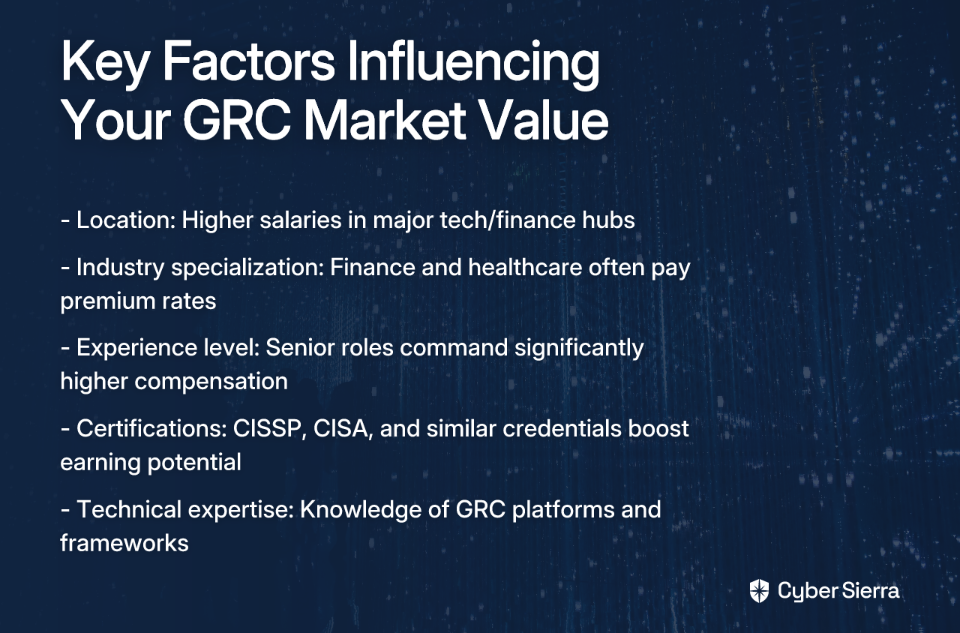
- Location: Higher salaries in major tech/finance hubs
- Industry: Finance and healthcare often pay more due to stringent compliance needs (e.g., HIPAA, PCI DSS)
- Experience & Certifications: Seniority and specialized credentials significantly boost earning potential
Step 1 – Build Your Six-Figure Value Proposition
The difference between a $75,000 GRC analyst and a $120,000+ GRC strategist often comes down to how you position your value. Here's how to escape "Excel Hell" and build a case that justifies a top-tier salary.
Articulate Your Value Beyond the Checklist
Frame your responsibilities in terms of business impact, not just tasks. Instead of simply listing your duties, transform them into value statements:
- Instead of "Conduct risk assessments," say "I identify and mitigate operational and financial risks that could impact revenue by X%."
- Instead of "Monitor compliance programs," say "I ensure continuous adherence to standards like ISO 27001, preventing costly fines and reputational damage."
- Instead of "Implement internal controls," say "I design and deploy security controls that protect critical data and prevent breaches."
Quantify Your Accomplishments
As advised by APN Consulting, prepare a list of notable accomplishments with metrics that demonstrate your impact:
- "Reduced time spent on audit evidence collection by 30% by implementing a GRC software solution."
- "Achieved a 15% reduction in critical vulnerabilities by revamping the risk assessment process."
- "Authored 5 new security policies that closed key compliance gaps identified in our last audit."
Leverage Your Skills and Certifications
Many professionals feel frustrated when certifications don't immediately translate to higher pay. One CISSP holder shared: "I feel that I'm kind of getting screwed with my salary and based on work experience, clearance, and certifications especially upon attaining the CISSP."
Frame certifications as proof of your increased market value, which you can now leverage with a current or new employer. Emphasize in-demand skills that set you apart:
- Technical Knowledge: Familiarity with risk management frameworks (NIST, ISO 27001), data security principles, and GRC platforms (Archer, ServiceNow).
- Regulatory Expertise: Deep understanding of relevant standards like PCI DSS, HIPAA, SOX, GDPR.
- Soft Skills: Communication, critical thinking, and the ability to influence without authority—these are crucial for strategic GRC roles according to Cybersecurity District.
Step 2 – The Six-Figure Negotiation Playbook
Now that you've built your value proposition, it's time to put it to work in a strategic negotiation. Here's your step-by-step playbook:
Phase 1: Preparation is Power
Do Your Homework:
- Use sites like Glassdoor, Payscale, and LinkedIn Salary to research the market rate for your specific role, experience level, and location.
- Investigate the company's financial health and salary bands if possible.
Practice Your Pitch:
- Rehearse your key points to build confidence.
- Keep it concise. As one negotiation-savvy Redditor advised: "Honestly, say less. You don't need to give a long explanation about why you want more money and what it would mean for you." State your desired range and back it up with market data and your quantified accomplishments.
Phase 2: Executing the Negotiation
Timing is Everything:
- Do not discuss salary until you have a formal written offer. This gives you maximum leverage.
- If asked for your expectations early, provide a broad, well-researched range and state that it's flexible based on the full scope of the role and compensation package.
Making the First Move (Your Counter-Offer):
- Start High: Begin with a number higher than your target to create negotiating room.
- Express Gratitude, Then Pivot: "Thank you so much for the offer. I'm very excited about this opportunity. Based on my research into the market rate for a candidate with my [X years of experience, CISSP certification, and expertise in ISO 27001 implementation], I was looking for a base salary in the range of $125,000 to $135,000."
Consider the Total Compensation Package:
- If the company can't meet your base salary, explore other areas as recommended by APN Consulting.
- Negotiable items include:
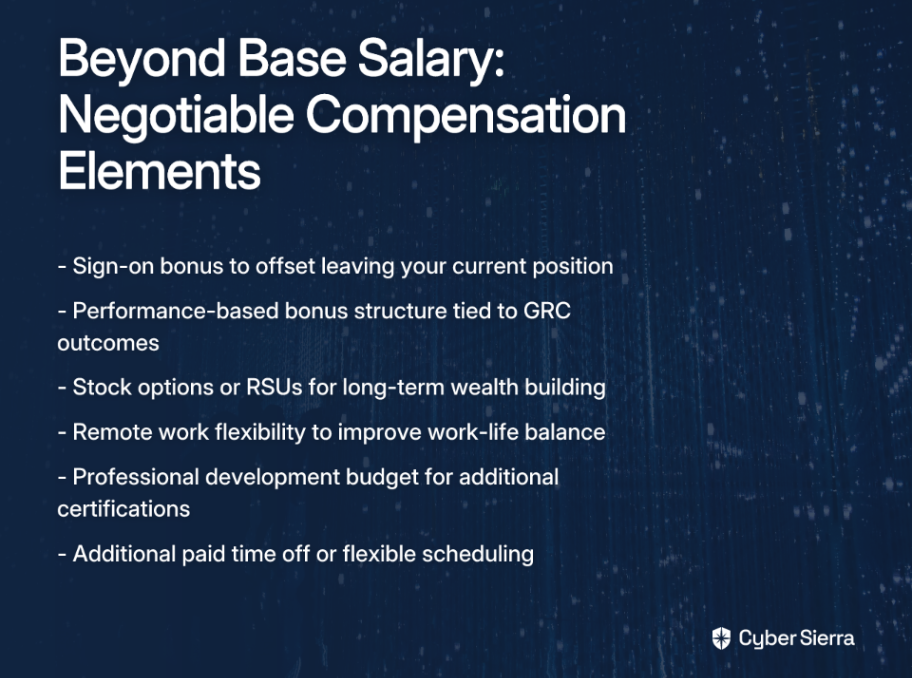
- sign-on bonus, performance bonus structure, stock options/RSUs, remote work flexibility, professional development budget, or additional vacation days.
Phase 3: Closing the Deal
Know When to Walk Away:
- One of the most powerful insights from negotiation experts is captured in this Reddit comment: "If you don't have the power to walk away, you have zero negotiation power."
- Your ability to walk away from an offer that doesn't meet your value is your greatest negotiation tool. Having other interviews or offers in the pipeline builds this power.
Get Everything in Writing:
- Once you reach a verbal agreement, request a revised formal offer letter that documents every detail: base salary, bonus structure, stock options, and any other agreed-upon perks.
- Do not resign from your current role until you have this signed document.

The "Job Hopping" Dilemma: Loyalty vs. A Six-Figure Leap
Many GRC professionals face an uncomfortable truth captured by this Reddit comment: "You'll always make more money somewhere else. I have seen people refused raises and promotions until they left for another company."
The Strategic Job Hop
Changing jobs is often the fastest way to achieve a significant salary increase, especially for those feeling underpaid and unappreciated. However, there's an art to this approach:
- Timing Matters: As suggested by users, staying at a job for 6 months to 2 years allows you to gain substantial experience and demonstrate stability before moving on.
- Build Valuable Skills First: One Redditor advises: "You just have to tailor your skills toward a specific field, get experience, and get higher paying jobs."
- Frame It as Career Progression: This isn't about disloyalty—it's about finding a role that appropriately values your new skills and market rate.
For those who've recently earned a certification like the CISSP, this can be particularly relevant. If your current employer won't recognize the value of your new credentials, the market likely will.
Own Your Value, Own Your Salary
The path to a six-figure GRC salary isn't about luck; it's about strategically demonstrating your value, backing it up with market data, and confidently negotiating for what you're worth.
You escape "Excel Hell" by becoming a strategic business partner who translates complex regulations and risks into business value. You secure a six-figure salary by proving it. Combat imposter syndrome by remembering that this salary isn't just a number—it's the market rate for the high-impact, future-proof work you do.
Remember: In today's complex regulatory environment, organizations need GRC professionals who can think strategically, communicate effectively, and drive value beyond basic compliance. Position yourself as that professional, negotiate with confidence, and that six-figure salary will be within your reach—without a single Excel hell meeting in sight.
Frequently Asked Questions
How can I justify a six-figure GRC salary?
To justify a six-figure salary, you must frame your GRC contributions in terms of business impact and quantifiable results. Instead of listing tasks, demonstrate how your work protects revenue, prevents costly fines, and mitigates financial and operational risks. For example, quantify your achievements by showing how you reduced audit preparation time by 30% or decreased critical vulnerabilities by 15%. This shifts the conversation from your duties to the tangible value you deliver to the organization.
What are the most important skills for a high-paying GRC role?
The most critical skills for a high-paying GRC role combine technical knowledge, regulatory expertise, and strong soft skills. Top earners possess a deep understanding of frameworks like NIST and ISO 27001, expertise in regulations such as GDPR or HIPAA, and the ability to communicate complex risks to business leaders. These strategic skills are difficult to automate and position you as a high-impact advisor, not just a compliance checker.
Is it necessary to change jobs to get a six-figure salary in GRC?
While not always necessary, changing jobs is often the fastest way to achieve a significant salary increase in GRC. Internal raises are typically incremental, whereas switching companies allows you to reset your market value based on your current skills and certifications. If your current employer is unwilling to recognize your increased market worth after you've gained new experience or credentials, an external move may be the most effective strategy.
What should I do if my company can't meet my base salary request?
If a company cannot meet your base salary request, consider negotiating the total compensation package. You can often gain significant value by asking for a sign-on bonus, a higher performance bonus, stock options/RSUs, a professional development budget, or increased remote work flexibility. A strong total package can often be more valuable than a slightly higher base salary alone.
Why didn't my new certification automatically lead to a raise?
A new certification like the CISSP increases your market value, but it doesn't automatically trigger an internal pay raise. It's your responsibility to leverage that new credential. You must articulate to your current employer how the certification enhances your ability to perform your role and protect the company, using it as a key data point in a formal salary negotiation. If they don't recognize this new value, the external market likely will.

Have you successfully negotiated a significant salary increase in a GRC role? Share your experiences and tips in the comments below!
