



What's New in NIST RMF Rev. 5? Controls & Baselines



Join thousands of professionals and get the latest insight on Compliance & Cybersecurity.
You've meticulously implemented NIST 800-53 Rev. 4 controls across your systems. Then suddenly, you hear there's a Rev. 5 that changes everything. Your team is already stretched thin with compliance activities, and now you're faced with migrating to a new framework that seems to have moved everything around. Will your organization fall out of compliance? How much work will this transition require?
If you're feeling overwhelmed by this change, you're not alone. The transition from Rev. 4 to Rev. 5 represents the most significant evolution of the NIST Risk Management Framework (RMF) in years, and many security professionals are struggling to understand what's actually changed and how it impacts their compliance programs.
This article cuts through the confusion to explain the most critical changes in NIST SP 800-53 Rev. 5 and the new SP 800-53B baselines document, providing a clear path forward for your transition.
The Strategic Shifts in Rev. 5: Beyond Incremental Changes
NIST SP 800-53 Rev. 5 isn't just another version update—it represents a fundamental philosophical shift in how we approach security and privacy risk management. Understanding these high-level changes provides crucial context for the specific control modifications.
From Compliance to Outcomes
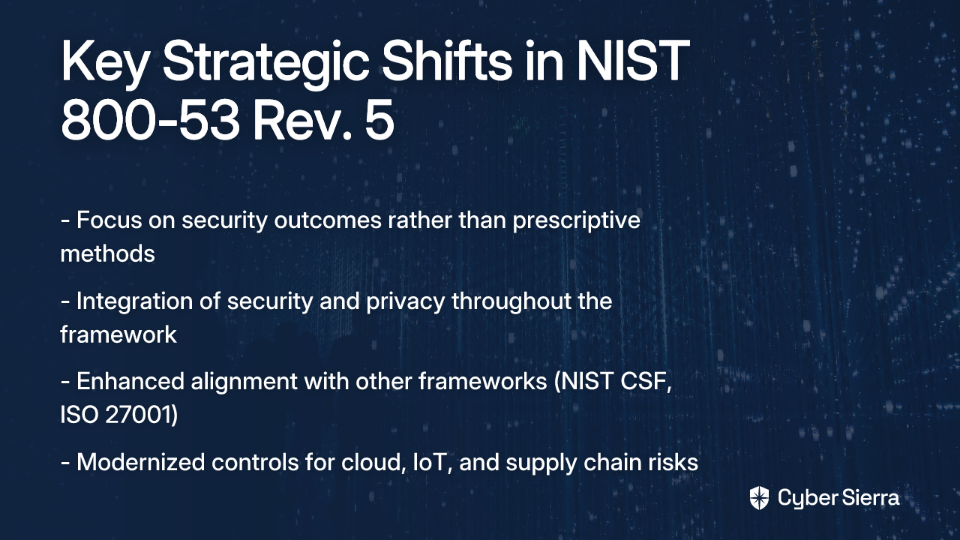
Many security professionals have struggled with "relating the high-level language of controls to specific actions" their organizations need to take. Rev. 5 addresses this by shifting toward outcome-based controls, focusing more on what security and privacy protections should achieve rather than prescribing exactly how to implement them.
This provides greater flexibility for organizations to implement controls in ways that make sense for their specific environments while still achieving the required security outcomes.
Integration of Security and Privacy
One of the most significant changes is the complete integration of security and privacy controls. Previously, privacy controls existed primarily in a separate appendix (Appendix J) with the dedicated "PT" family. This separation often created confusion about the relationship between security and privacy requirements.
In Rev. 5, privacy is no longer treated as a separate consideration but is woven throughout the entire control catalog. This integration acknowledges that effective risk management requires addressing security and privacy together, not as separate domains.
Framework Alignment and Modernization
Rev. 5 enhances alignment with other critical frameworks, including the NIST Cybersecurity Framework (CSF) and ISO/IEC 27001. This alignment reduces the effort required when working with multiple frameworks and provides clearer guidance for organizations navigating complex compliance landscapes.
Additionally, controls have been updated to address modern technologies and threats, including cloud computing, IoT devices, and sophisticated supply chain risks that weren't adequately covered in Rev. 4.
Deep Dive: The New Integrated Control Catalog
The control catalog in NIST SP 800-53 Rev. 5 includes substantial changes that security professionals need to understand to ensure proper implementation and compliance.
Integrated Privacy Controls
The elimination of the separate privacy control appendix (Appendix J) represents one of the most significant structural changes. Privacy controls are now fully integrated throughout the main catalog, ensuring privacy considerations are embedded in all relevant security domains.
For teams transitioning from Rev. 4, NIST provides a mapping of Rev. 4 Appendix J controls to Rev. 5 controls to facilitate this transition. This integration addresses a common pain point expressed by practitioners who were "confused about the distinction between security controls and privacy controls."
New Controls and Updates
Rev. 5 introduces numerous new controls and enhancements to address emerging threats and technologies. The latest update (patched November 7, 2023) added one new control and three supporting enhancements focused on modern authentication challenges:
- Identity providers and authorization servers
- Protection of cryptographic keys
- Verification of identity assertions and access tokens
- Token management
These additions reflect the growing importance of identity management, Multi-Factor Authentication (MFA), and secure token handling in modern security architectures.
Control Identifier Changes
A seemingly minor but important change involves the addition of leading zeros to control identifiers (e.g., AC-1 from Rev. 4 is now AC-01 in Rev. 5). While this may appear trivial, it has significant implications for documentation, spreadsheets, and compliance tools like eMASS that rely on these identifiers. It also affects Control Correlation Identifiers (CCIs) that map NIST controls to implementation requirements.

Understanding the New Baselines in SP 800-53B
Perhaps the most structural change in Rev. 5 is that control baselines no longer reside within SP 800-53 itself. They've been moved to a separate publication, NIST SP 800-53B, "Control Baselines for Information Systems and Organizations".
Why a Separate Baselines Document?
This separation allows the control catalog (Rev. 5) and the baselines (53B) to be updated independently, providing greater flexibility as threats and technologies evolve. It also gives greater prominence to the critical role that baselines play in the risk management process.
Updated Security Baselines
SP 800-53B provides updated high, medium, and low baselines based on the FIPS 199 impact categorization of systems. These baselines serve as starting points for control selection and must be used for Rev. 5 compliance. The changes include:
- Addition of new Rev. 5 controls to existing baselines
- Removal of certain controls that are no longer considered essential at specific impact levels
- Shifting of some controls between impact levels based on updated risk assessments
The New Privacy Baseline
One of the most significant additions in SP 800-53B is the introduction of a dedicated privacy baseline. This addresses the growing importance of privacy in information systems and provides clearer guidance for protecting personally identifiable information (PII).
A crucial clarification about the privacy baseline is that it's not a separate set of controls but rather a selection of controls from the main catalog that are foundational for protecting PII, regardless of a system's security impact level. For example, the privacy baseline highlights controls like AC-01 "Policy and Procedures" and AC-02 "Account Management" as critical for any system processing PII, as noted by Hyperproof's analysis.
Chapter 3 of NIST SP 800-53B provides detailed information on the relationship between the security and privacy baselines, which is essential reading for anyone implementing Rev. 5.
Your Action Plan: Transitioning to Rev. 5
To help make your transition to Rev. 5 as efficient as possible, here's a practical roadmap that addresses the pain point that "RMF processes can be very tedious and time-consuming."
Step 1: Gather Essential Resources
Begin by downloading the key documents you'll need:
- NIST SP 800-53 Rev. 5 (Full Document)
- NIST SP 800-53B (Baselines)
- The Rev. 4 to Rev. 5 Comparison Workbook - This spreadsheet is your most valuable tool for conducting a gap analysis.
Step 2: Perform a Gap Analysis

Using the comparison workbook, map your organization's currently implemented Rev. 4 controls to their Rev. 5 equivalents. This process will help you identify:
- Controls that remain largely unchanged and require minimal updates
- Controls that have been significantly modified and need reassessment
- Entirely new controls that need to be implemented
- Rev. 4 controls that have been deprecated or consolidated
This mapping exercise creates your transition "to-do" list, helping you prioritize efforts where they're most needed.
Step 3: Select New Baselines
Based on your system's impact level (Low, Moderate, High), select the appropriate new baseline from SP 800-53B. Additionally, determine if your system processes PII. If so, apply the new privacy baseline and tailor it according to your specific privacy risks.
Step 4: Implement, Assess, and Document
Implement the new and modified controls identified in your gap analysis. This may involve updating your Security Information and Event Management (SIEM) systems, Endpoint Detection and Response (EDR) solutions, and identity management systems to address new requirements like enhanced MFA.
Update your System Security Plan (SSP) and other RMF artifacts to reflect the new Rev. 5 controls, baselines, and tailoring decisions. This documentation provides evidence-based proof of compliance for assessors and addresses the common issue of "insufficient documentation" often cited during security assessments.
Finally, follow the remaining steps of the RMF process: assess the effectiveness of the new controls, obtain authorization, and establish continuous monitoring procedures.
Conclusion: Embracing a More Resilient Framework
The transition to NIST SP 800-53 Rev. 5 and SP 800-53B represents a significant evolution in how organizations approach security and privacy risk management. While the changes may initially seem overwhelming, they ultimately provide a more flexible, integrated, and effective approach to protecting your organization's critical assets and information.
By understanding the philosophical shifts, control changes, and baseline updates in Rev. 5, you can approach your transition strategically, focusing your efforts where they matter most and ensuring your organization maintains compliance while strengthening its security and privacy posture.
Remember that frameworks like the NIST RMF are not just compliance checkboxes—they're comprehensive methodologies for managing risk. By embracing the improvements in Rev. 5, your organization will be better equipped to address the complex and evolving threat landscape of today's digital environment.

Frequently Asked Questions
What are the main differences between NIST 800-53 Rev. 4 and Rev. 5?
The main differences are a shift to outcome-based controls, the full integration of privacy controls into the main catalog, and the separation of control baselines into a new document, NIST SP 800-53B. Rev. 5 is a significant update designed to be more flexible and address modern threats like supply chain risks, cloud computing, and IoT.
How does Rev. 5 integrate security and privacy controls?
Rev. 5 fully integrates privacy controls throughout the entire control catalog, eliminating the separate privacy appendix (Appendix J) found in Rev. 4. This change ensures that privacy is treated as a fundamental component of security risk management, rather than an afterthought. It requires organizations to consider privacy implications across all relevant security domains.
Why were the control baselines moved to NIST SP 800-53B?
The control baselines were moved to a separate document, NIST SP 800-53B, to allow the control catalog (Rev. 5) and the baselines to be updated independently. This provides greater agility, enabling NIST to update baselines in response to new threats and technologies without having to revise the entire control catalog, and vice versa.
What is the new privacy baseline in SP 800-53B?
The new privacy baseline is a selection of controls from the main catalog that are considered foundational for protecting personally identifiable information (PII). It is not a separate set of controls but rather a starting point for any system that processes PII, regardless of its security impact level (Low, Moderate, or High). Organizations must apply this baseline and tailor it based on their specific privacy risks.
What are the first steps to transition from Rev. 4 to Rev. 5?
The first step is to perform a gap analysis by downloading the key NIST documents, especially the Rev. 4 to Rev. 5 comparison workbook. Use this workbook to map your existing controls to the new framework, which will help you identify changed, new, and deprecated controls. This analysis will form the basis of your transition plan.
Are there completely new controls in NIST 800-53 Rev. 5?
Yes, Rev. 5 introduces several new controls and control enhancements to address modern security challenges. These cover areas like supply chain risk management, cloud services, and IoT devices. Recent updates have also added new controls focused on identity management, such as protecting cryptographic keys and managing authentication tokens, reflecting the evolving threat landscape.
