



NIST RMF Rev. 4 to Rev. 5: An Actionable Guide


Join thousands of professionals and get the latest insight on Compliance & Cybersecurity.
You've just heard the news: your organization needs to transition from NIST Risk Management Framework (RMF) Revision 4 to Revision 5. Your immediate thought? "Here we go again with another tedious, time-consuming compliance exercise."
I get it. RMF processes are notoriously complex and can drain resources faster than a memory leak in production code. But what if this transition could be streamlined into a methodical, efficient process that doesn't require nights and weekends?
This guide provides the actionable steps technical engineers need to make the transition from Rev. 4 to Rev. 5 as painless as possible. We'll cover how to map controls effectively, utilize the new baselines from SP 800-53B, and—perhaps most importantly—identify which of your existing tools already satisfy new requirements.
Why Rev. 5 Matters: Understanding the Key Differences
Before diving into action steps, let's understand what actually changed. Released in September 2020, NIST SP 800-53 Revision 5 marks a significant evolution in the framework—not a minor update.
Philosophical Shift: From Impact-Based to Outcome-Based
The most fundamental change in Rev. 5 is the shift to an outcome-based approach. Rather than focusing primarily on system impact levels, Rev. 5 emphasizes the desired security and privacy outcomes, making the controls more adaptable across different types of organizations.
According to the NIST Risk Management project page, this shift allows for greater flexibility while maintaining the necessary rigor required for federal systems.
Expanded Control Families: From 18 to 20
Rev. 5 introduces two new control families, expanding the total from 18 to 20:
- Supply Chain Risk Management (SR): This family addresses the growing threat landscape around vendor and supply chain compromises.
- Personally Identifiable Information Processing and Transparency (PT): Previously relegated to an appendix, privacy controls are now integrated directly into the main framework.
By the Numbers
The scale of change is substantial:
- 66 new base controls
- 149 new control enhancements
- Numerous renamed and restructured controls
As one Reddit user in the GRC community wisely cautioned, "A lot of Rev. 4 stuff carries over, but there are renamed, split, and new controls in Rev. 5, especially around privacy. You don't want to assume it's a direct map." This perspective highlights exactly why a structured approach is essential.
Your 6-Step Actionable Transition Plan
Step 1: Foundational Review and Preparation
Before touching a single control, ensure you have the right foundation:
- Review the core RMF documents:
- NIST SP 800-37 Rev. 2: The RMF process guidance
- NIST SP 800-53 Rev. 5: The control catalog
- NIST SP 800-53B: The baseline control selections
- Assemble your team: Include representatives from security engineering, operations, privacy, and compliance teams.
- Create a transition project plan: Establish clear milestones, responsibilities, and timelines.

Step 2: Conduct a Gap Analysis
One of the most practical first actions is running an assessment to "figure out where you stand on Rev. 5," as recommended in Reddit discussions.
Here's how to conduct an effective gap analysis:
- Create a comprehensive control spreadsheet: List all Rev. 5 controls alongside your current Rev. 4 controls implementation status.
- Perform a systematic comparison:
- Controls that directly carry over
- Controls that have been renamed or restructured
- Entirely new controls
- Controls that have been deprecated
- Prioritize gaps: Rank the identified gaps based on:
- Security impact
- Implementation complexity
- Resource requirements
The output of this step is a clear visualization of your gaps and a prioritized roadmap for addressing them.

Step 3: Master and Select New Baselines from SP 800-53B
Selecting the appropriate baseline is critical. As one practitioner emphasized, "If your team hasn't picked a baseline yet, make sure they're using the new ones from SP 800-53B."
The SP 800-53B document provides:
- Low-impact baseline: Minimum security requirements
- Moderate-impact baseline: Standard security requirements for most systems
- High-impact baseline: Enhanced security for critical systems
- Privacy baseline: New integrated privacy controls
Pro Tip: Download the Control Baselines Spreadsheet from NIST. This tool allows you to filter, select, and document your baseline controls with precision.
Step 4: Map Controls with Precision
This is where the real work happens. Remember, "You don't want to assume it's a direct map" between revisions.
Useful Tools:
- The Baker Tilly Comparison Tool provides side-by-side text changes and a control summary comparison.
- For a more automated approach, consider mapping the Control Correlation Identifiers (CCIs) between the two revisions to see what's already covered in your environment.
When mapping controls:
- Document all mapping decisions with clear rationales
- Pay special attention to the new PT and SR control families
- Note any controls that have been split or combined
- Identify controls that have had significant language changes
Step 5: Tailor Controls to Save Time
"If you notice controls that clearly don't apply to your environment, call that out early. Saves time during tailoring," notes one experienced practitioner from the Reddit GRC community.
Effective tailoring includes:
- Identifying inapplicable controls: Document controls that don't apply to your environment with clear justifications.
- Using overlays: Check if there are applicable overlays for your environment (cloud, industrial control systems, etc.) at the NIST Security Control Overlay Repository (SCOR).
- Documenting compensating controls: Where direct implementation isn't possible, document alternative controls that achieve the same security outcome.
Step 6: Update Documentation and the System Security Plan (SSP)
All your work culminates in updated documentation:
- Update your SSP: Incorporate all your mapping, analysis, and tailoring decisions.
- Revise supporting documents: Ensure policies, procedures, and contingency plans reflect the new control requirements.
- Prepare for assessment: Develop a strategy for demonstrating compliance with new controls during your next assessment.
Leveraging Your Existing Tech Stack for Rev. 5
One of the most practical efficiency boosters is identifying "which controls are already met by existing tools like your SIEM, EDR, MFA setup, etc." This gives whoever's writing the SSP "a big head start," according to experienced practitioners.
Create a matrix mapping your existing security tools to Rev. 5 controls:
Security Information and Event Management (SIEM)
Your SIEM solution likely satisfies numerous controls in the:
- Audit and Accountability (AU) family
- System and Information Integrity (SI) family
- Incident Response (IR) family
Specific controls your SIEM likely addresses:
- AU-2: Event Logging
- AU-3: Content of Audit Records
- AU-6: Audit Record Review, Analysis, and Reporting
- SI-4: System Monitoring
According to the CISA Continuous Diagnostics and Mitigation Program, properly configured SIEM tools can provide evidence for up to 30% of your technical controls.
Endpoint Detection and Response (EDR)
Your EDR solution typically addresses:
- System and Information Integrity (SI) controls
- System and Communications Protection (SC) controls
- Incident Response (IR) controls
Key controls satisfied include:
- SI-3: Malicious Code Protection
- SI-4: System Monitoring
- SI-7: Software, Firmware, and Information Integrity
- IR-4: Incident Handling
Multi-Factor Authentication (MFA)
MFA directly satisfies several critical controls in the Access Control (AC) family:
- AC-2: Account Management
- AC-7: Unsuccessful Logon Attempts
- IA-2: Identification and Authentication (Organizational Users)
- IA-5: Authenticator Management
By systematically mapping your existing tools to Rev. 5 controls, you can:
- Identify controls already satisfied
- Document existing evidence sources
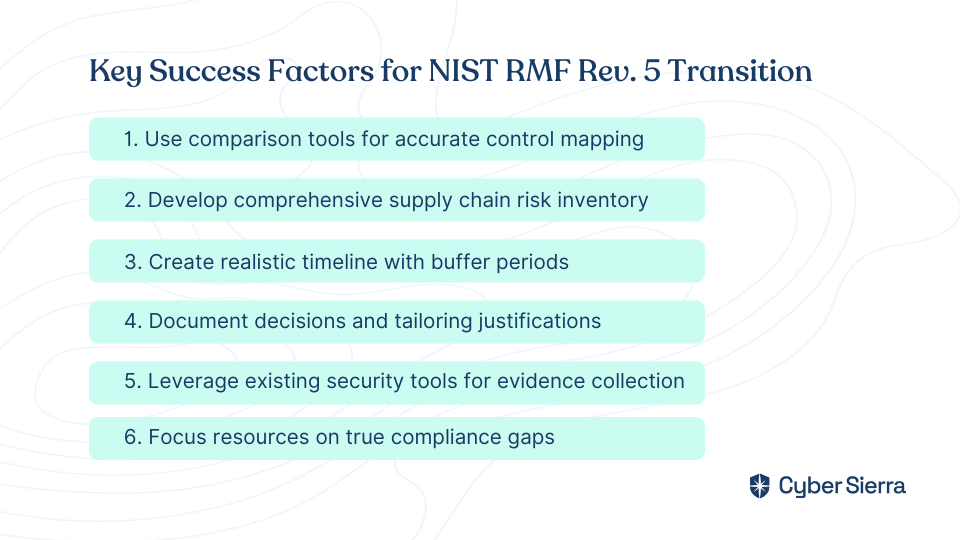
- Focus resources on addressing true gaps
Common Pitfalls and How to Avoid Them
Pitfall 1: Assuming Direct Control Mapping
As emphasized earlier, assuming Rev. 4 controls map directly to Rev. 5 is dangerous. Always verify mappings, especially for privacy controls which have undergone significant restructuring.
Solution: Use comparison tools and conduct thorough mapping exercises with subject matter experts.
Pitfall 2: Overlooking Supply Chain Risk
The new SR control family represents NIST's recognition of supply chain attacks as a critical threat vector.
Solution: Develop a comprehensive inventory of your vendors and supply chain dependencies, and assess them against the new SR controls.
Pitfall 3: Ignoring Compliance Deadlines
Procrastination creates last-minute compliance scrambles that compromise quality and increase stress.
Solution: Create a realistic timeline with buffer periods and regular progress checkpoints.
Pitfall 4: Inadequate Documentation
Poor documentation creates problems during assessments and audits.
Solution: Document all decisions, especially tailoring justifications and compensating controls, as you go through the transition process.
Conclusion: A More Resilient Security Posture
Transitioning from NIST RMF Rev. 4 to Rev. 5 is undeniably a significant undertaking, but with a structured approach, it doesn't have to be overwhelming. By understanding the key differences, conducting a thorough gap analysis, effectively using baselines and mapping tools, and leveraging your existing technology stack, you can make the process significantly more efficient.
Remember that this transition isn't just about compliance—it's an opportunity to strengthen your organization's security and privacy posture by incorporating the latest best practices in supply chain risk management and privacy protection.
By following this actionable guide, you'll not only satisfy RMF requirements more efficiently but also build a more modern, outcome-focused, and resilient security program that's better equipped to handle today's evolving threat landscape.
Frequently Asked Questions
What is the main difference between NIST RMF Rev. 4 and Rev. 5?
The main difference is a philosophical shift from an impact-based framework to a more flexible, outcome-based approach. Rev. 5 focuses on the desired security and privacy outcomes rather than just the impact level of a system. This change, along with the introduction of 20 control families (up from 18) and numerous new controls, makes the framework more adaptable to diverse technologies and environments, with a stronger emphasis on privacy and supply chain security.
Why were new control families for supply chain and privacy included in Rev. 5?
The new Supply Chain Risk Management (SR) and Personally Identifiable Information Processing and Transparency (PT) families were added to address the modern threat landscape and integrate privacy more fundamentally into security frameworks. The SR family directly responds to the rising threat of supply chain attacks, while the PT family elevates privacy from an appendix in Rev. 4 to a core component, reflecting the growing importance of data privacy.
What is the most critical first step for transitioning to NIST RMF Rev. 5?
The most critical first step is to conduct a thorough gap analysis between your current Rev. 4 implementation and the new Rev. 5 requirements. A gap analysis provides a clear roadmap for your transition. By systematically comparing your existing controls against the new and updated ones, you can identify where your gaps are, prioritize your efforts, and avoid redundant work, ensuring your transition is methodical and efficient.
How can I make the transition to Rev. 5 more efficient?
You can make the transition more efficient by leveraging your existing technology stack—such as your SIEM, EDR, and MFA solutions—to meet many of the new and updated control requirements. Instead of starting from scratch, map your current security tools to the Rev. 5 controls to identify which requirements are already met. This allows you to focus time and resources only on the true gaps.
What is NIST SP 800-53B and why is it important for Rev. 5?
NIST SP 800-53B is a separate document that provides the official security and privacy control baselines (Low, Moderate, High, and Privacy) for information systems. In previous revisions, baselines were included in the main SP 800-53 document. For Rev. 5, they were moved to SP 800-53B for easier updating. Using the correct baseline from this document is a critical step, as it defines the starting set of controls your system must implement.
Do I have to replace all my Rev. 4 documentation?
No, you do not have to replace all your documentation, but you must update it significantly to reflect the changes in Rev. 5. Much of your existing work can be carried over, but your System Security Plan (SSP) and supporting policies must be revised. This involves updating control mappings, incorporating new controls (like SR and PT), and ensuring the language reflects the outcome-based approach of Rev. 5.
Have you recently transitioned to NIST RMF Rev. 5? What challenges did you face, and what strategies helped you overcome them? Share your experiences in the comments below.
