



7 Compliance Challenges That Traditional GRC Tools Can't Solve — And What to Do Instead


Join thousands of professionals and get the latest insight on Compliance & Cybersecurity.
Summary
- With data breaches increasing 72% from 2021-2023, traditional GRC tools are failing due to their reliance on manual, point-in-time assessments that create security gaps.
- Key challenges of legacy GRC include siloed operations, inflexibility with new regulations, and neglected third-party risks, which lead to dangerous blind spots and compliance fatigue.
- To build a resilient program, organizations must shift to an integrated strategy that includes automation, Continuous Control Monitoring (CCM), and robust Third-Party Risk Management (TPRM).
- Modern platforms like Cyber Sierra help unify compliance frameworks, automate evidence collection, and provide the real-time visibility needed to move beyond reactive, check-the-box compliance.
Ever feel like you're cast as the "bad guy" forcing change because regulators are breathing down your neck? Or that "the issues are easy to solve, but company politics and corporate culture gets in the way"?
For many CISOs and compliance managers, the GRC landscape feels like a constant battle against spreadsheets, manual tracking that has become a "huge time suck," and the challenge of proving compliance to auditors who keep asking for the same artifacts.
Governance, Risk, and Compliance (GRC) is a structured approach to align IT with business goals while managing risks and complying with regulations. But traditional GRC tools are no longer sufficient in a rapidly evolving landscape with increasing regulatory complexity. With a 72% increase in data breaches from 2021 to 2023, it's clear that legacy, point-in-time approaches are failing.
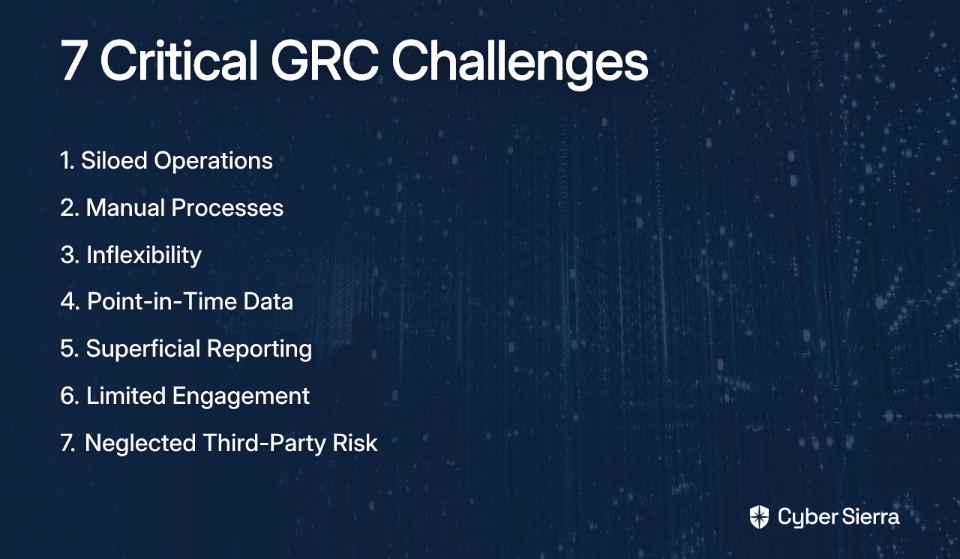
This article breaks down seven critical compliance challenges that traditional GRC tools cannot solve and outlines what to do instead to build a modern, resilient compliance program.
1. Siloed Operations Create Dangerous Blind Spots
The Problem
Traditional GRC tools often operate in isolation. Your organization might use one tool for ISO 27001, another for SOC2, and spreadsheets for HIPAA, leading to a fragmented view of risk.
This siloed approach results in inconsistent data, duplicated efforts, and an inability to assess aggregate risk, creating dangerous blind spots. This directly reflects the user pain of "confusion at what the hell is going on in the org."
According to research from CyberSierra, these disconnected systems make it nearly impossible to gain a comprehensive view of your organization's compliance posture, leaving you vulnerable to unseen threats.
What to Do Instead
Adopt an integrated platform that centralizes all GRC functions. The goal is to consolidate governance, risk, and compliance processes to reduce data inconsistencies and redundancy.
A modern solution should manage multiple compliance frameworks (SOC2, ISO 27001, GDPR, HIPAA, PCI DSS) from a single dashboard, providing one source of truth. As noted by Risk3sixty, a unified GRC approach significantly reduces the effort required to maintain compliance across multiple standards.
Platforms like Cyber Sierra's GRC solution are designed to break down these silos by unifying multiple frameworks and providing a holistic view of your compliance posture.
2. The Grind of Manual Processes and "Compliance Fatigue"
The Problem
Legacy GRC systems are heavily dependent on manual data collection, endless evidence requests, and periodic updates via spreadsheets.
This is not only inefficient and prone to human error but leads to what the industry calls "compliance fatigue." Security teams are perpetually overwhelmed, and audit preparation becomes a frantic, last-minute fire drill.
One Reddit user lamented that "manual tracking has already become a huge time suck, and we know it's not going to scale as we grow," highlighting a common pain point for growing organizations.
What to Do Instead
Embrace automation to reduce manual tasks and errors. Modern GRC software is essential for automating processes, from data collection to report generation.
Automation allows teams to achieve audit readiness much faster, similar to the Reddit user who, with an automated tool, was "audit ready in just 1 month" for a SOC 2 Type 2.
Zazoon.com emphasizes that as regulatory complexity increases, manual approaches will become completely unsustainable, making automation not just a nice-to-have but a necessity.
Automation is at the core of modern GRC platforms like Cyber Sierra, which streamline data collection, risk assessments, and reporting to free up your team for more strategic initiatives.
3. Inflexibility in a World of Constant Change
The Problem
The regulatory landscape is in constant flux. Traditional tools are often rigid and struggle to adapt to new regulations or evolving business models.
This inflexibility forces CISOs and their teams to manually "crosswalk" controls between frameworks, a process that is slow, cumbersome, and stifles innovation and business agility.
As regulations like the EU's Digital Operational Resilience Act (DORA) emerge, older systems simply cannot keep pace with the changing requirements.
What to Do Instead
Choose a scalable GRC solution built for change. An effective platform must accommodate organizational growth and easily adapt to new compliance requirements.
The solution should support not only standard frameworks but also custom control frameworks tailored to your business needs. This flexibility allows you to respond quickly to emerging regulations without overhauling your entire compliance program.
According to Risk3sixty, a successful GRC tool should grow with your company and adapt to changing business requirements seamlessly.
4. The Illusion of Security with Point-in-Time Data
The Problem
Legacy tools are built around point-in-time assessments (e.g., quarterly reviews, annual audits). This creates a false sense of security.
The reality is that critical misconfigurations and vulnerabilities can emerge and be exploited in the gaps between these audits. Decisions are often made using outdated information, rendering incident response slow and ineffective.
For example, the time between discovering a vulnerability and exploiting it continues to shrink—attackers don't wait for your next scheduled assessment to strike.
What to Do Instead
Shift from periodic checks to Continuous Control Monitoring (CCM). This approach provides ongoing, near real-time visibility into the status of your security controls.
By integrating with your live security systems, you can detect exceptions, anomalies, and policy violations as they happen, not months later during an audit. This continuous visibility enables proactive risk management rather than reactive firefighting.
This is precisely the problem Cyber Sierra's Continuous Control Monitoring (CCM) module solves. It transforms security from a periodic check-the-box exercise to a continuous, automated process, providing a single source of truth for all controls and enabling proactive risk management.
5. Superficial Reporting That Hides the Truth
The Problem
Many traditional GRC tools generate reports that are superficial. They might show a "green" compliance status but lack the granular detail to reveal underlying weaknesses.
This provides misleading insights and makes it impossible for leadership to prioritize remediation efforts effectively. You can't fix what you can't see clearly.
As noted in CyberSierra's research, these high-level reports fail to provide the actionable intelligence needed for effective decision-making, leading to misallocated resources and persistent vulnerabilities.
What to Do Instead
Demand actionable intelligence, not just data. Utilize tools with AI-powered data analytics that can filter through the noise and highlight the most critical risks.
Your GRC platform should generate comprehensive reports and detailed audit trails that provide true transparency and support data-driven decision-making. This level of insight helps you focus resources on the most impactful security improvements.
Zazoon.com emphasizes that modern GRC solutions must incorporate advanced analytics to provide meaningful insights from vast amounts of compliance data.
Cyber Sierra's Threat Intelligence platform complements its GRC capabilities by providing a comprehensive security scorecard and vulnerability scanning, transforming raw data into actionable insights for remediation.
6. Limited Engagement and a Disconnected Security Culture
The Problem
Traditional GRC tools are often complex, clunky, and used only by a small, specialized team. This alienates the rest of the organization.
When compliance is seen as a burdensome task owned by one department, a weak security culture develops. This ties into the user pain of navigating "an obscene amount of politics" because other departments see GRC as a blocker, not a partner.
One Reddit user noted that "engineers by default think you are an idiot and you will work up from there," highlighting the uphill battle GRC professionals face in gaining organizational buy-in.
What to Do Instead
Foster an ethically compliant and security-aware culture from the top down. As AWS notes, engaging senior executives in setting policies is a critical step.
Deploy user-friendly tools that promote collaboration and shared responsibility. When GRC platforms are accessible and intuitive, they're more likely to be embraced across the organization.
Invest in training and awareness campaigns to sensitize all employees to their role in cybersecurity. Building this culture is a key part of modern GRC. Cyber Sierra's Employee Security Training module helps create a strong "human firewall" through interactive training and simulated phishing campaigns, making security everyone's job.
7. The Elephant in the Room — Neglected Third-Party Risk
The Problem
Perhaps the biggest failure of traditional GRC tools is their inability to manage vendor and supply chain risk effectively. They often lack dedicated Third-Party Risk Management (TPRM) capabilities.
This leaves organizations blind to critical risks introduced by their partners. As one Reddit user lamented about managing TPRM for a mid-sized organization: "our small team of 4 are facing significant demands in responding to risk assessments, typically ranging 100-300 questions per assessment." This highlights the unmanageable scale of manual TPRM.
With high-profile supply chain attacks like SolarWinds, the question becomes critical: "If SolarWinds, a widely trusted platform by all can be compromised, what do u think u can do?" The answer lies in better tools and approaches.
What to Do Instead
Integrate a robust TPRM program into your GRC strategy. This involves automating vendor risk assessments, prioritizing vendors based on risk level, and performing continuous monitoring of their security posture.
Move beyond static, point-in-time questionnaires to a model of near real-time, 24/7 visibility into vendor compliance. This continuous monitoring approach helps you detect changes in vendor risk profiles before they impact your organization.
Cyber Sierra's TPRM platform is designed to tackle this challenge head-on. It automates vendor assessments and provides continuous monitoring, giving you proactive insights into third-party risks that questionnaires alone can never provide.
Moving from Reactive Compliance to Proactive Resilience
The limitations of traditional GRC—silos, manual processes, inflexibility, point-in-time data, superficial reporting, poor engagement, and neglected third-party risk—are no longer acceptable in today's threat landscape.
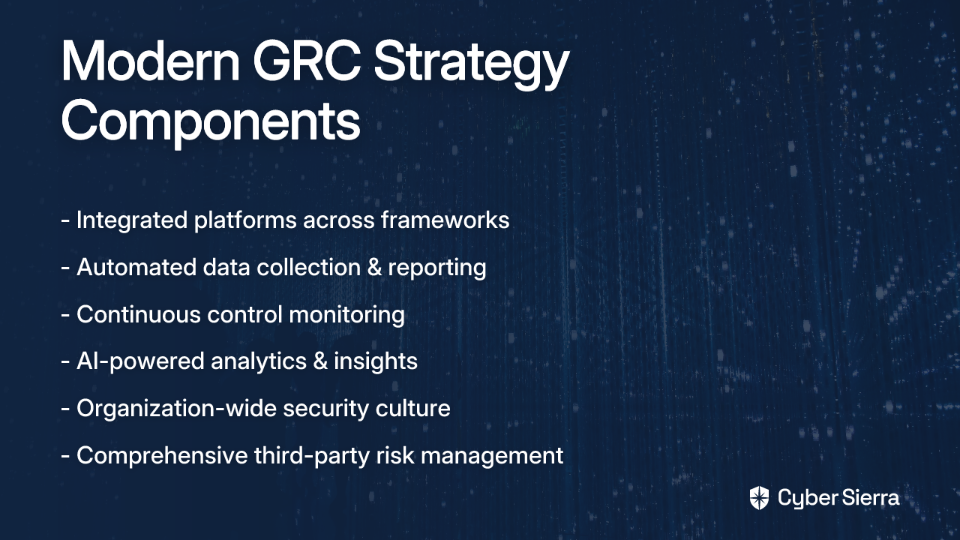
The path forward requires a fundamental shift to a modern GRC strategy that is integrated, automated, continuous, and intelligent. It's about breaking down silos, embedding security into the culture, and extending visibility across the entire supply chain.
Stop wrestling with outdated tools that create more problems than they solve. It's time to move from a posture of reactive compliance to one of proactive cyber resilience.
Frequently Asked Questions (FAQ)
What is Governance, Risk, and Compliance (GRC)?
Governance, Risk, and Compliance (GRC) is a structured strategy for aligning an organization's IT operations with its business objectives while managing risks and meeting regulatory requirements. It integrates governance, risk management, and compliance activities into a unified program to improve decision-making, reduce redundancies, and ensure the organization operates ethically and securely.
Why are traditional GRC tools no longer effective?
Traditional GRC tools are no longer effective because they cannot handle the complexity and speed of the modern digital landscape. Key failures include creating data silos, relying on inefficient manual processes, being too rigid to adapt to new regulations, and providing only periodic, point-in-time security snapshots. This outdated approach leaves organizations vulnerable to unseen threats and overwhelmed by "compliance fatigue."
How does a modern GRC platform solve these challenges?
A modern GRC platform solves these challenges by providing an integrated, automated, and continuous approach to compliance. It centralizes all compliance frameworks into a single dashboard, automates data collection and reporting to eliminate manual work, and offers Continuous Control Monitoring (CCM) for real-time visibility. This allows organizations to manage risk proactively, adapt quickly to change, and build a resilient security culture.
What is Continuous Control Monitoring (CCM) and why is it important?
Continuous Control Monitoring (CCM) is an automated process that provides ongoing, near real-time visibility into the effectiveness of your security controls. It is important because threats don't wait for your annual audit. By constantly monitoring your systems for misconfigurations and policy violations, CCM allows you to detect and remediate issues as they happen, shifting your security posture from reactive to proactive.
Why is managing third-party risk a critical part of GRC?
Managing third-party risk is critical because your organization's security is interconnected with that of your vendors and supply chain partners. A breach in a third-party system can directly impact your data and operations. Traditional GRC often overlooks this risk, but a modern approach requires a robust Third-Party Risk Management (TPRM) program to continuously assess and monitor vendor security, preventing your supply chain from becoming a security liability.
Ready to transform your GRC program? Discover how Cyber Sierra's all-in-one platform automates compliance, provides real-time visibility, and simplifies risk management. Schedule a demo today.
