



5 PDPA Compliance Software for Companies Managing Cross-Border Data Transfers

Join thousands of professionals and get the latest insight on Compliance & Cybersecurity.
Summary
- Singapore's PDPA now requires organizations to independently assess foreign data protection laws for cross-border transfers, making manual compliance tracking with spreadsheets risky and inefficient.
- Key obligations include detailed record-keeping for every transfer and binding all third-party vendors to specific security requirements through contracts.
- For organizations managing PDPA alongside other frameworks like ISO 27001, an integrated platform like Cyber Sierra automates evidence collection and vendor risk management to streamline compliance.
Managing cross-border data transfers under Singapore's Personal Data Protection Act (PDPA) has quietly become one of the more demanding compliance challenges for regional enterprises. The regulatory burden isn't just about ticking boxes — it involves assessing the adequacy of foreign data protection laws, maintaining detailed transfer records, and ensuring every third-party vendor handling personal data is contractually bound to the right obligations. Doing this manually, across multiple jurisdictions and dozens of vendors, is a recipe for gaps.
The right PDPA compliance software can close those gaps. But as practitioners have noted, the smartest move is often "something with simple APIs and clear audit logs over flashy dashboards" — tools that deliver legal coverage without creating unmanageable engineering overhead. This article covers five platforms built to handle exactly that.
The Growing Challenge of PDPA and Cross-Border Data Transfers
Under the latest PDPA amendments and the Cross Border Personal Data Transfer (CBPDT) Guidelines, the compliance landscape has shifted. The old whitelist regime — where transfers to approved countries were automatically permissible — is gone. Organizations are now responsible for independently assessing whether a recipient country provides adequate data protection before any transfer occurs. That assessment burden now sits with the data controller.
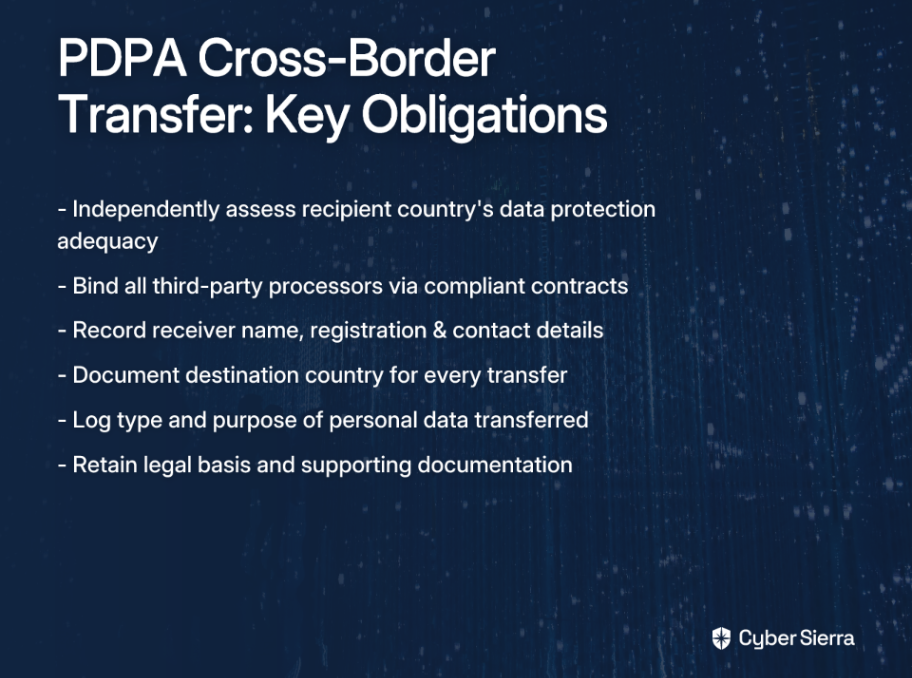
Beyond jurisdiction-level adequacy checks, businesses must meet a range of operational obligations:
- Security responsibilities. Organizations must ensure that security principles are upheld throughout the transfer process, even after data leaves local infrastructure.
- Contractual obligations. Every third-party data processor receiving personal data must be bound by contracts that explicitly cover personal data processing and security requirements.
- Record-keeping requirements. Data controllers must maintain detailed records for every cross-border transfer, including:
- Receiver's name, registration details, and contact information
- Destination country of the transfer
- Type of personal data transferred
- Purpose of the transfer
- The legal condition relied upon for the transfer, along with supporting documentation (e.g., consent records, privacy notices)
Managing these obligations manually — across a vendor base of dozens or hundreds of third parties — is prone to error and consumes significant compliance bandwidth. That's where purpose-built PDPA compliance software becomes operationally essential.
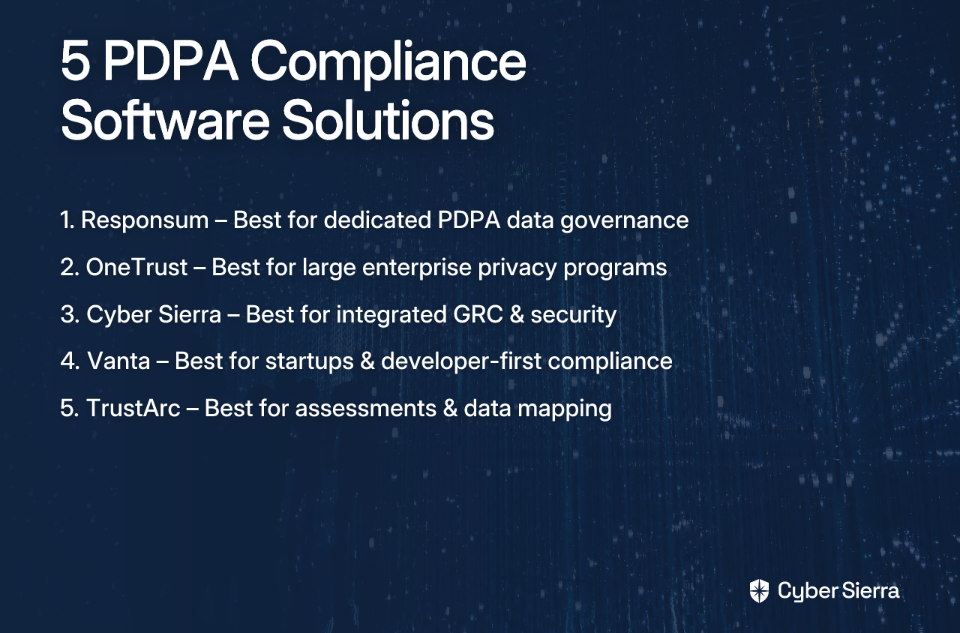
5 PDPA Compliance Software Solutions for Cross-Border Data Transfers
The platforms below each address different dimensions of PDPA compliance, from consent management and data mapping to vendor risk assessment and continuous control monitoring. Here's how they stack up.
1. Responsum
Best for: Organizations seeking a dedicated PDPA compliance platform with strong data governance features. Supported frameworks: PDPA, GDPR, UK GDPR, ISO 27001, NIST, NIS2, DORA, EU AI Act. Deployment: Cloud-based SaaS.
Responsum is a privacy-focused platform designed specifically to help organizations manage their PDPA obligations end-to-end. For teams that need clear workflows around consent, Data Subject Access Requests (DSARs), and breach response, it provides a structured environment without the overhead of a broader enterprise GRC suite.
Its cross-border transfer module is particularly relevant here — it enables teams to monitor vendor data practices and document transfer conditions, directly supporting the CBPDT record-keeping requirements outlined above.
Key features:
- Consent management. Tracks and documents valid consent signals across data collection touchpoints, a core PDPA requirement.
- Access and correction request handling. Automates DSAR workflows, including rectification and deletion requests, with configurable response timelines.
- Security and breach management. Provides tools to detect, assess, and report data breaches in line with PDPA notification timelines.
- Third-party data compliance monitoring. Monitors vendor data practices to support secure and compliant cross-border transfers.
- Compliance documentation and auditing. Maintains audit-ready records and policy documentation, reducing the manual effort of evidence collection.
2. OneTrust
Best for: Large enterprises with the resources to leverage a comprehensive, enterprise-grade privacy management suite. Supported frameworks: GDPR, CCPA, PDPA, and other global privacy regulations. Deployment: Cloud-based platform.
OneTrust is a market leader in privacy and data governance, offering deep functionality across consent management, data mapping, and Third-Party Risk Management (TPRM). It's a powerful platform for organizations managing complex, multi-jurisdictional privacy obligations — but as practitioners often point out, it's "great if you've got deep pockets and a team that knows how to use it." Implementation and ongoing management require meaningful investment.
For companies already operating at scale with dedicated compliance teams, OneTrust's breadth is a genuine asset. For leaner teams, the configuration overhead may outweigh the feature depth.
Key features:
- Consent management tools. Streamlines consent collection and documentation across web and mobile touchpoints, with built-in audit trails.
- Data mapping and inventory management. Visualizes data flows and maintains records of processing activities — essential for demonstrating PDPA compliance to regulators.
- Third-party risk management. Includes dedicated modules for vendor due diligence and ongoing monitoring to ensure data processors meet contractual and regulatory obligations.
- Audit and compliance reporting. Generates detailed reports for internal governance and external auditors, supporting cross-border transfer documentation requirements.
3. Cyber Sierra
Best for: Organizations needing an integrated cybersecurity and compliance platform that automates evidence collection and vendor risk management across multiple frameworks. Supported frameworks: PDPA, GDPR, ISO 27001, PCI DSS, NIST. Deployment: Cloud-based platform.
Cyber Sierra is an AI-enabled cybersecurity platform that goes beyond standalone privacy management. Where most PDPA compliance software focuses on consent and DSARs, Cyber Sierra addresses the broader Governance, Risk, and Compliance (GRC) challenge — integrating continuous security monitoring, automated evidence collection, and vendor risk management into a single platform. It's recognized as a Sample Vendor in the Gartner® Hype Cycle™ for Cyber-Risk Management, 2024, and is accredited by the Cyber Security Agency of Singapore (CSA).
For teams managing PDPA alongside ISO 27001, SOC 2, or other frameworks, this unified approach directly addresses the compliance fatigue that comes from running parallel programs across siloed tools.
Key features:
- Continuous Control Monitoring (CCM). Provides near real-time visibility into control effectiveness, replacing manual evidence gathering with automated monitoring and clear audit logs — exactly what teams looking for reliable compliance trails need.
- Third-Party Risk Management (TPRM). Automates vendor assessments, due diligence workflows, and continuous monitoring — directly supporting the contractual obligations and transfer record-keeping requirements under the CBPDT Guidelines.
- GRC automation. Streamlines risk assessments, policy management, and compliance reporting across multiple frameworks simultaneously, reducing duplicated effort when managing PDPA alongside other regulatory requirements.
- Unified security posture view. Integrates compliance with threat intelligence and employee security training, giving Chief Information Security Officers (CISOs) a holistic view rather than fragmented data from disconnected tools.

4. Vanta
Best for: Startups and technology companies pursuing rapid, audit-ready compliance with strong developer integrations. Supported frameworks: SOC 2, GDPR, HIPAA, PDPA. Deployment: Cloud-based SaaS.
Vanta has built a strong reputation in compliance automation, particularly among fast-growing tech companies. Its value proposition centers on speed to audit-readiness and deep integrations with the cloud and SaaS tools that engineering teams already use. For cross-border data transfer compliance, its TPRM capabilities are the most relevant — particularly the AI-powered vendor review workflows.
Vanta claims its AI-assisted security reviews can reduce vendor assessment time by up to 50%, which matters when managing a growing vendor base across multiple jurisdictions.
Key features:
- Automated security checks. Continuously monitors systems for control gaps and deviations from compliance requirements.
- AI-powered security reviews. Leverages AI to assess third-party vendors and surface critical risks, accelerating due diligence for cross-border transfer partners.
- Automated evidence requests. Simplifies the collection of compliance evidence from vendors through automated follow-up workflows.
- Vendor discovery. Automatically identifies third-party services, including shadow IT, to ensure comprehensive coverage of data transfer risks.
5. TrustArc
Best for: Enterprises requiring robust privacy assessments, data mapping automation, and vendor risk management across multiple jurisdictions. Supported frameworks: GDPR, CCPA, PDPA, and other global privacy regulations. Deployment: Cloud-based SaaS.
TrustArc provides a comprehensive privacy compliance suite with particular depth in assessment workflows and vendor risk management. Its Data Mapping and Risk automates vendor discovery and assigns jurisdictional risk scores — a meaningful capability for teams managing cross-border data transfers where the destination country's regulatory posture directly affects transfer eligibility.
For organizations that prioritize thorough documentation and privacy impact assessments as a core part of their compliance program, TrustArc offers a structured environment to manage both.
Key features:
- Privacy assessments and impact assessments. Helps organizations evaluate and document the risks associated with specific personal data processing activities before they begin.
- Vendor risk management. Enables ongoing monitoring of third-party data handling practices, supporting the contractual compliance obligations required under the PDPA's CBPDT framework.
- Data Mapping and Risk Manager. Automates vendor discovery and scores jurisdictional and processing risks — directly relevant for assessing whether a receiving country meets the PDPA's adequacy standard.
- Regulatory compliance updates. Keeps teams informed of evolving regulatory requirements across jurisdictions, reducing the risk of non-compliance due to outdated policies.
Streamline Your Cross-Border Data Compliance
Navigating Singapore's PDPA transfer rules doesn't have to be a manual, high-risk effort. While the requirements for assessing foreign laws and maintaining detailed transfer records are demanding, the right approach transforms this burden into a streamlined, automated process.
To move forward with confidence, focus on these key takeaways:
- Assess your vendors systematically. You are responsible for vetting every third-party processor and binding them with compliant contracts. A manual, spreadsheet-driven approach is too error-prone to be reliable.
- Automate your record-keeping. The PDPA requires auditable proof for every cross-border transfer, including its purpose and legal basis. Automation is essential for maintaining this level of detail without draining your team's resources.
When you’re ready to close those gaps for good, an integrated GRC platform like Cyber Sierra can automate the entire lifecycle, from vendor assessments to continuous control monitoring. Explore Cyber Sierra's platform.
Frequently Asked Questions
What are the main requirements for cross-border data transfers under Singapore's PDPA?
Organizations must assess the recipient country's data protection adequacy, bind third parties with compliant contracts, and maintain detailed records of each transfer. This includes documenting the data type, purpose, legal basis, and receiver details for every transaction.
Why is software essential for managing PDPA cross-border data transfers?
Software is essential because it automates the complex record-keeping and vendor monitoring required by the PDPA. Manually tracking transfers, assessments, and contractual obligations across multiple vendors is highly inefficient and prone to critical compliance gaps and errors.
How do I choose the best PDPA compliance software for my business?
Choose software based on your specific needs. Consider factors like company size, existing security frameworks (e.g., ISO 27001), and the need for features like consent management, vendor risk automation, or integrated GRC capabilities for a holistic view of compliance.
What is the difference between a dedicated privacy tool and an integrated GRC platform?
Dedicated tools focus on specific privacy tasks like DSARs and consent. Integrated GRC platforms like Cyber Sierra manage PDPA alongside other frameworks (e.g., ISO 27001, SOC 2), automating evidence collection and vendor risk for a unified compliance program.
What are the penalties for non-compliance with PDPA transfer rules?
Penalties for non-compliance can be severe, including financial fines of up to 10% of an organization's annual turnover in Singapore or S$1 million, whichever is higher. Reputational damage and operational disruption are also significant risks to consider.
