



The Complete Guide to Handling Repeat Phishing Test Failures in Large Organizations


Join thousands of professionals and get the latest insight on Compliance & Cybersecurity.
You've just reviewed the latest phishing test results, and there they are again - the same names, failing the same tests, month after month. As a security professional in a large organization, few challenges are more frustrating than dealing with employees who repeatedly fall for phishing simulations despite your best training efforts.
"Why don't they get it?" you wonder, as pressure mounts from leadership to improve those metrics while maintaining employee morale. The situation becomes even more perplexing when you notice that many of these repeat offenders have limited system access privileges, yet they continue to pose a significant risk vector.
Why Good Employees Fail Phishing Tests: Beyond Apathy
Before implementing a remediation framework, it's crucial to understand that repeat failures rarely stem from simple apathy. Research shows that human factors are implicated in up to 60% of breaches, but the root causes are more nuanced than mere carelessness.
Common reasons include:
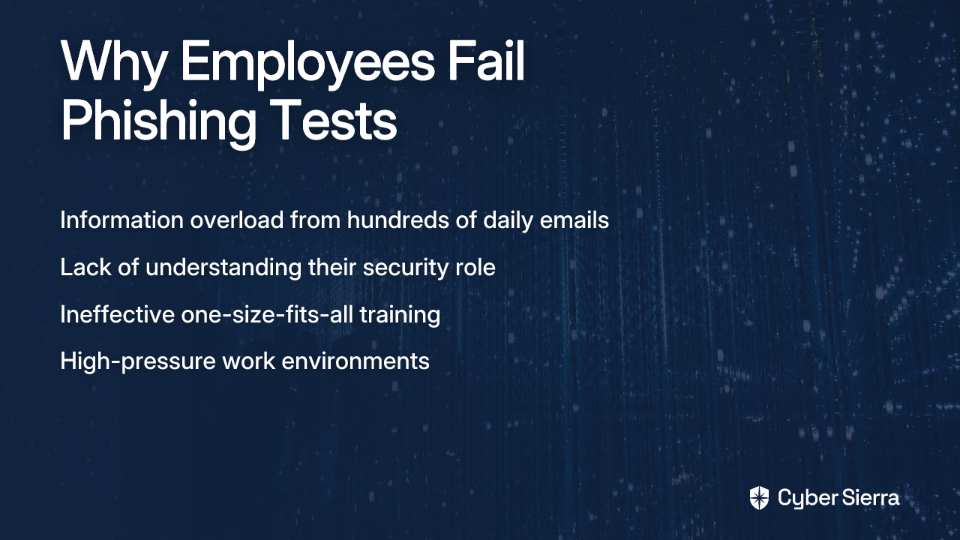
- Information overload: Employees processing hundreds of emails daily are prone to making quick, instinctive decisions rather than analytical ones.
- Lack of contextual understanding: Many employees don't see themselves as targets or understand how their role fits into the organization's security posture.
- Ineffective training approaches: Static, one-size-fits-all training often fails to address individual learning styles and specific vulnerabilities.
- Environmental factors: High-pressure work environments or cultures that prioritize speed over security can inadvertently encourage risky behaviors.
As one security professional noted in an online forum, "I almost want to talk to everyone individually to understand why they click and how we can continue to arm them." This insight-driven approach is precisely what large organizations need to transform their weakest links into a robust human firewall.
The Tiered Remediation Framework: From Nudge to Intervention
Implementing Zero Trust Architecture (ZTA) principles to your human security elements means creating a structured, escalating response framework that balances education with accountability. Here's a comprehensive tiered approach suitable for organizations with 1000+ employees:
Tier 1: First Failure - The Nudge
Actions:
- Automated immediate feedback at point of failure
- Assignment of targeted microlearning module (5-10 minutes)
- Record of failure in security awareness platform
Communication Template:
"We noticed you interacted with a simulated phishing email. This is a learning opportunity to help protect you and our organization. Please complete this brief training module that specifically addresses this type of phishing attempt."
Key Consideration: Research from KnowBe4 indicates that "point-of-failure training does not work" in isolation; it must be part of a broader strategy that reinforces key concepts over time.
Tier 2: Second Failure - The Coach
Actions:
- Managerial check-in (informal conversation)
- Assignment of comprehensive role-specific training module (15-30 minutes)
- Increased frequency of simulated phishing tests for this employee
Conversation Guide for Managers:
"I noticed you've had some difficulty with recent phishing tests. This isn't about blame—these attacks are increasingly sophisticated. Let's review the last scenario together and discuss what might have made it seem legitimate."
Involving the Right People: At this stage, the conversation should remain between the employee and their direct manager, with security teams providing guidance and resources as needed.
Tier 3: Third Failure - The Intervention
Actions:
- Formal documented meeting with manager and security representative
- Mandatory in-depth training session (45-60 minutes)
- Notification to HR (informational only at this stage)
- Consider implementing additional multi-factor authentication (MFA) requirements
Formal Conversation Template:
"This is our third conversation about phishing test failures. While I understand these simulations can be challenging, these failures represent a pattern that creates risk for our organization. Today, we'll review specific strategies to help you identify these threats and discuss the importance of vigilance in your role."
HR's Role: HR should be notified but primarily in an informational capacity. The FAIR methodology (Factor Analysis of Information Risk) can help quantify the potential impact of the employee's behavior and justify the escalating response.
Tier 4: Fourth Failure - The Consequence
Actions:
- Formal HR involvement and documentation in performance record
- Mandatory extended training program with assessment (2-3 hours)
- Implementation of email screening or temporary restrictions based on risk profile
- Regular check-ins with security team
Special Considerations for Employees with Limited Access: For employees with minimal system privileges, focus more on education than restriction. Their access may be limited, but they can still serve as entry points for social engineering attacks that later escalate to higher-privilege targets.
For employees in high-risk roles (finance, executives, IT admins), consider implementing EDR (Endpoint Detection and Response) solutions with enhanced monitoring after repeated failures.
Tier 5: Fifth Failure - The Critical Response
Actions:
- Final written warning with clear performance expectations
- Potential reassignment of duties to limit security exposure
- Executive-level notification for high-risk roles
- Consideration of termination based on role criticality and risk
Policy Language Example:
"Employees who fail five or more phishing simulations within a 12-month period demonstrate a persistent inability to maintain basic security awareness. This represents a significant risk to organizational security and may result in reassignment of duties or termination of employment, particularly for roles with access to sensitive systems or data."
Advanced Strategies: Gamification, Targeted Campaigns, and Culture Building
Beyond the basic framework, large organizations should implement these advanced strategies to address systemic issues:
Gamification for Engagement
Security professionals report that "gamification works great in many cases, especially for remediation. It helps with engagement and proficiency improvement." Organizations implementing gamified security awareness training have seen up to 86% reduction in phishing incidents organization-wide.
Effective elements include:
- Leaderboards showing departments with highest reporting rates
- Achievement badges for correctly identifying threats
- Points systems that reward consistent vigilance
- Team competitions that foster positive peer pressure
Targeted Educational Campaigns
Create specialized training for different employee segments:
For Limited-Access Employees: Despite having minimal system privileges, these employees often show the highest failure rates. Design campaigns that use accessible language and examples relevant to their daily work, emphasizing how social engineers can exploit even seemingly unimportant positions.
For Executives and High-Risk Roles: Research on targeted campaigns like "Spear Phishing in a Barrel" demonstrates that executives need specialized awareness programs addressing sophisticated attacks tailored to their position. These campaigns should focus on business email compromise and whaling attacks specifically targeting leadership.
Building a Security-Conscious Culture
The most effective approach combines the tiered remediation framework with a positive security culture:
- Report Recognition Programs: Create formal recognition for employees who successfully identify and report real or simulated phishing attempts.
- Regular Communication: Share anonymized stories of both failures and successes to normalize vigilance without shame.
- Security Champions: Identify and empower security-minded employees across departments to serve as peer resources.
Governance and Measurement: Policy, HR Alignment, and Metrics
Policy Development
Develop a comprehensive phishing response policy that includes:
- Clear escalation paths: Document each tier of the framework with specific actions and responsibilities.
- Consistent application: Ensure the policy applies equally to all employees regardless of rank.
- Legal compliance: Review policies with legal counsel to ensure alignment with employment laws (noting that U.S. employers typically have more discretion than those in Europe).
- Executive endorsement: Secure formal sign-off from leadership to prevent backlash.
HR Alignment
HR involvement should be carefully structured:
- Tier 1-2: HR awareness only, no formal documentation
- Tier 3: Informational notification to HR
- Tier 4-5: Formal HR involvement with performance documentation
Template for HR Documentation:
"Employee has demonstrated a persistent pattern of security awareness deficiencies despite multiple interventions and training opportunities. This represents a performance concern relating to the essential job function of maintaining basic information security practices."
KPIs for Program Effectiveness
Track these key performance indicators (KPIs) to measure program success:
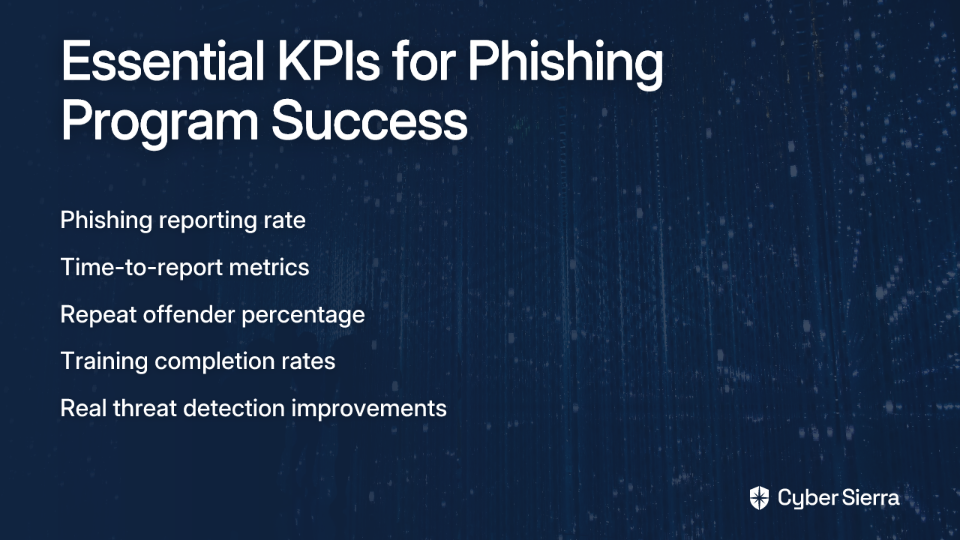
- Phishing reporting rate: Percentage of simulated phishing emails reported to security
- Time-to-report: Average time between email delivery and employee reporting
- Repeat offender rate: Percentage of employees failing multiple tests
- Remediation completion rate: Percentage of assigned training completed within deadline
- Real threat detection improvement: Increase in actual phishing attempts reported
Building a Resilient Human Firewall
The most effective approach to handling repeat phishing test failures balances accountability with support. By implementing this tiered framework with clear escalation paths, large organizations can:
- Address individual behavior through progressive interventions
- Identify systemic issues through metric analysis
- Foster a culture of security awareness through positive reinforcement
- Maintain appropriate HR involvement while respecting employee dignity
Remember that the goal isn't to punish but to transform your human element from a vulnerability into a security asset. As organizations continue to implement advanced technical controls like Zero Trust Architecture and EDR solutions, the human firewall remains both your greatest vulnerability and your most adaptable defense.
By following this comprehensive framework, security teams can effectively address the frustration of repeat phishing test failures while building a more resilient organization-wide security posture that stands up to increasingly sophisticated social engineering threats.

Frequently Asked Questions
What is a tiered remediation framework for phishing failures?
A tiered remediation framework is a structured, escalating response plan for employees who repeatedly fail phishing tests, moving from gentle educational nudges to more serious interventions and consequences with each failure. It provides a consistent and fair process that balances education with accountability. The framework typically includes multiple tiers, starting with automated micro-learning, progressing to manager coaching, formal meetings with security, and eventually, HR involvement for chronic failures.
Why should we use a formal framework instead of just providing more training?
A formal framework is crucial because "more training" alone is often ineffective for repeat offenders. It addresses the root causes of failure by combining targeted education with increasing levels of accountability, ensuring the issue is taken seriously at all levels of the organization. A documented, escalating process helps quantify risk and justifies interventions for employees who fail to improve, protecting the organization more effectively than ad-hoc training alone.
How should we handle executives who repeatedly fail phishing tests?
Executives who repeatedly fail phishing tests should be handled with a combination of high-touch, specialized training and clear communication about the significant risk they represent. Because they are high-value targets for sophisticated attacks like whaling, remediation should involve one-on-one coaching and simulations tailored to their roles. The conversation should be framed around protecting them and the company, emphasizing the unique threats they face rather than being purely punitive.
What is the role of HR in a phishing remediation framework?
HR's role in a phishing remediation framework should be structured and escalate over time, starting with informational notifications and progressing to formal involvement in performance management for persistent failures. In the initial stages, HR is kept aware but not directly involved. For subsequent failures, HR becomes an active partner, helping to document the issue as a performance concern and ensuring all actions align with company policy and employment law.
How can we build a positive security culture while implementing a framework with consequences?
You can build a positive security culture by focusing on positive reinforcement for good behavior, not just consequences for failures. This means celebrating employees who report suspicious emails and framing the entire program as a supportive effort to protect everyone. When you balance the remediation framework with initiatives like a "catch of the day" program and gamification that rewards reporting, the framework is seen as a necessary tool for accountability, not a punitive weapon.
What's the most important metric to track for a phishing program's success?
While the repeat offender rate is critical for gauging the remediation framework's effectiveness, the single most important metric for overall program success is the phishing reporting rate. A high reporting rate indicates a strong security culture where employees are engaged and actively participate in the organization's defense. It proves that your training and cultural initiatives are successfully turning employees into a human firewall, which is the ultimate goal.
