



How to Build Security Culture Without Fear-Based Tactics


Join thousands of professionals and get the latest insight on Compliance & Cybersecurity.
You've just rolled out a new cybersecurity training program. The policy states clearly: "Employees who click on phishing emails will be required to take remedial training. Repeated failures may result in disciplinary action." Your intention is to protect the company, but instead, you've created a culture of anxiety where mistakes are hidden, not reported, and security becomes everyone's burden rather than everyone's responsibility.
Sound familiar? You're not alone.
In many organizations, security compliance is mandated rather than motivated, making training feel like a chore. The fear of termination becomes the primary motivator, creating a toxic environment where security is viewed as the enemy rather than a shared goal.
"When you lead with fear, people disengage. Empowerment drives change," explains Dr. Jessica Barker, a human-centered security specialist. This insight cuts to the core of our cybersecurity challenge: the human element.
Consider this sobering statistic: 82% of data breaches involve a human element, according to Verizon's Data Breach Investigations Report. Yet too many organizations respond by doubling down on punitive measures rather than rethinking their approach.
What if we viewed this statistic not as evidence of human liability, but as our greatest opportunity for building resilience? What if we could transform security culture from fear-based compliance to empowered participation?
What is Security Culture (And Why Fear Fails)?
Before we can build a better security culture, we need to understand what it actually is.
Security culture encompasses "the ideas, customs, and social behaviors that influence the security posture of a group," according to KnowBe4. More practically, it's the set of shared values, attitudes, and behaviors that protect organizational assets—your people, data, and systems.
So why do fear-based approaches fail so spectacularly?
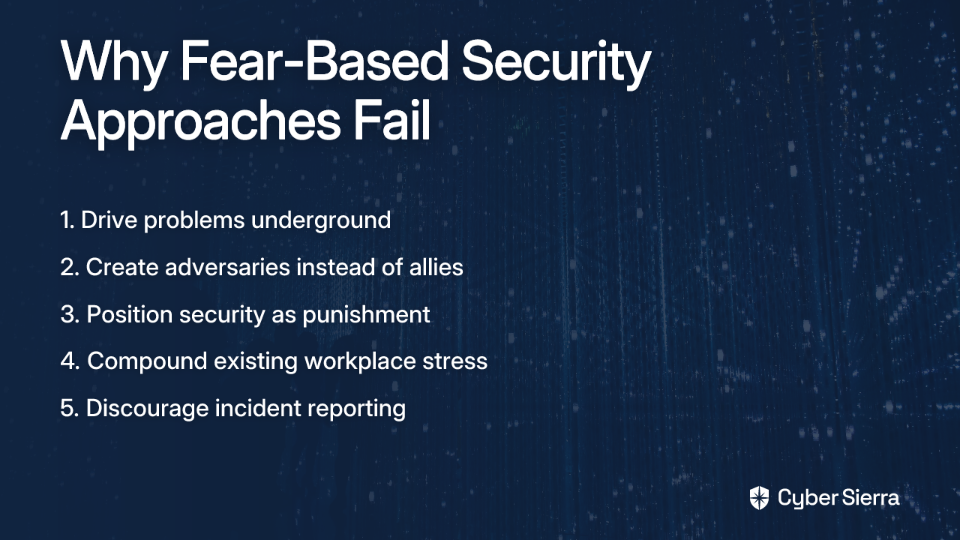
Psychologically, fear-based tactics create several counterproductive outcomes:
- They drive problems underground: When employees fear punishment for security mistakes, they're less likely to report incidents promptly. This creates dangerous security blind spots.
- They create adversaries, not allies: A punitive approach positions the security team as enforcers rather than enablers, fostering an "us versus them" mentality.
- They compound existing stress: Cyber attacks already generate anxiety. Adding internal punishment only makes this worse, potentially leading to burnout or disengagement.
As one security professional on Reddit puts it: "A culture of cooperation and mutual respect goes a hell of a lot further than a culture of fear."
The Foundations of a Positive, People-Centric Security Culture
Building a positive security culture requires understanding both its components and the psychology that drives human behavior.
The Seven Dimensions of Security Culture
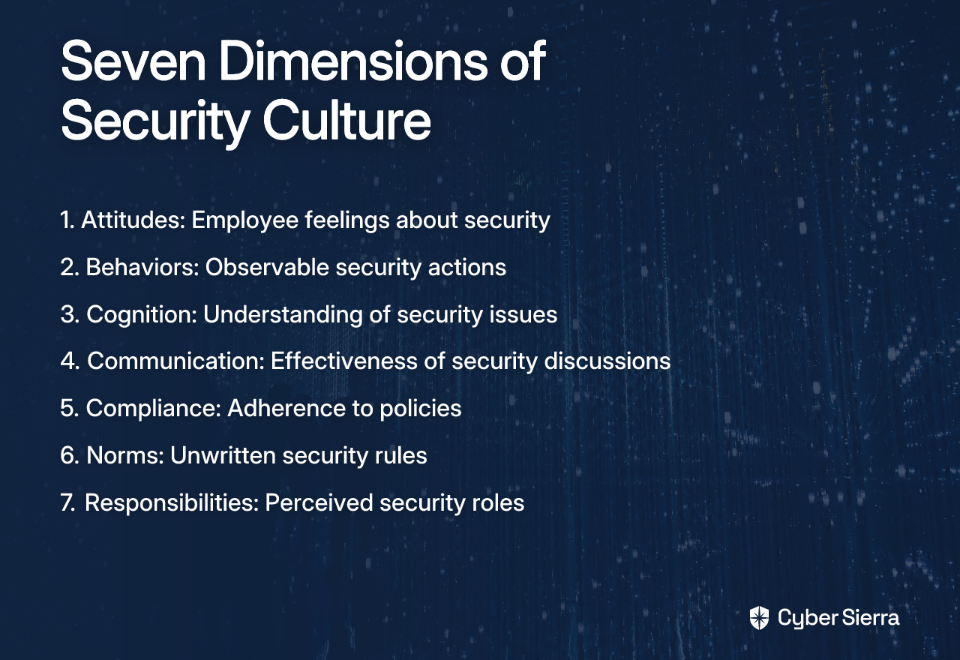
To systematically improve your culture, start by understanding its seven dimensions, as identified by KnowBe4:
- Attitudes: How employees feel about security measures
- Behaviors: The observable security actions employees take
- Cognition: Employees' understanding of security issues
- Communication: The effectiveness of security discussions
- Compliance: Adherence to written security policies
- Norms: The unwritten rules of security conduct
- Responsibilities: How employees perceive their role in security
This framework provides a comprehensive lens for assessing where your organization stands and where improvement is needed.
Understanding Cognitive Biases in Security
Our security decisions are heavily influenced by cognitive biases that often operate outside conscious awareness:
- Familiarity Bias: We tend to trust communications that seem familiar, making us vulnerable to well-crafted phishing emails that mimic trusted sources.
- Optimism Bias: The belief that "it won't happen to me" leads many to take unnecessary risks, thinking they're somehow immune to cyber threats.
These psychological factors help explain why traditional awareness training alone often falls short. Information without behavioral change strategies rarely translates to action.
A Step-by-Step Playbook for Building a Positive Security Culture
Let's move from theory to practice with a concrete playbook for transforming your security culture:

Step 1: Secure Leadership Commitment
The single most crucial factor in culture change is visible leadership commitment. When executives model good security behaviors and champion their importance, they signal that security is a shared organizational value, not just IT's problem.
As research from ISACA shows, organizations with strong leadership support for security initiatives are significantly more successful in developing positive security cultures. Leaders must walk the talk—using MFA, reporting suspicious emails, and openly discussing the importance of security.
Step 2: Assess Your Current Culture
You can't improve what you don't measure. Begin by assessing your current security culture:
- Conduct anonymous surveys to gauge employee attitudes
- Review incident reporting rates and patterns
- Analyze past security incidents for behavioral patterns
- Use the Security Culture Maturity Model to benchmark your organization
This baseline measurement is essential for tracking progress and targeting improvements.
Step 3: Engineer Training for Behavioral Change, Not Just Awareness
Traditional security training focuses on knowledge transfer, but knowledge alone doesn't change behavior. Instead, apply the BMAP Model for Behavior Change:
- Motivation: Use gamification (stars, badges, leaderboards) and positive reinforcement
- Ability: Make secure actions easy with practical tools like one-click reporting buttons
- Prompt: Implement regular simulated phishing campaigns as practice opportunities, not punitive tests
Replace hour-long compliance videos with micro-learning modules that deliver content in digestible chunks. Make training relatable by using real-world scenarios that connect to employees' everyday experiences.

Step 4: Make Security Human and Approachable
Security often suffers from an image problem—perceived as technical, intimidating, and disconnected from daily work. Counter this by:
- Branding Your Security Culture: Create a recognizable identity for your security program. This could be a mascot, a catchy slogan, or a visual theme that makes security initiatives more memorable.
- Using Storytelling: Frame security training with relatable narratives instead of abstract policies. Share anonymized stories about real incidents and how they were handled.
As one Redditor notes, "Poorly explained security measures lead to frustration and non-compliance." When employees understand the "why" behind security rules, compliance becomes more meaningful.
Step 5: Implement Positive Reinforcement & Feedback Loops
Replace punitive measures with positive reinforcement:
- Create a recognition program with tangible rewards for security-conscious behavior. As one security professional suggests, "Gift cards, pizza parties, recognition for going above and beyond" can be powerful motivators.
- Celebrate employees who report suspicious activities or potential security incidents.
- Use tools that provide real-time, constructive feedback when an employee makes a risky click, rather than mandatory remedial training.
Research from Aberdeen Group shows that organizations using positive reinforcement see substantially higher engagement with security initiatives than those relying on punitive approaches.
Step 6: Create a Community of Security Champions
Build a network of security advocates across departments:
- Recruit volunteers who are passionate about security to serve as departmental champions
- Provide them with additional training and resources
- Empower them to be the bridge between the security team and their colleagues
- Listen to their feedback about how security initiatives are perceived
This approach distributes security ownership throughout the organization rather than centralizing it in IT.
Measuring What Matters: Proving the ROI of a Positive Culture
To demonstrate the value of your cultural initiatives, shift from compliance metrics to behavioral ones:
- Track increases in voluntary reporting of security incidents
- Measure reduction in clicks on phishing simulations over time
- Monitor engagement with security resources and communications
- Survey changes in attitudes toward security
The business benefits are substantial. Organizations with strong security cultures are:
- 5.5 times more likely to have well-defined and consistently followed security policies
- 70% more likely to meet data protection compliance requirements
- Better positioned to detect and respond to incidents early, reducing potential damage
From Weakest Link to Strongest Defense
Building a positive security culture is not a quick fix but a continuous journey. By replacing fear with empowerment, communication, and positive reinforcement, you transform employees from perceived liabilities into your most valuable security assets.
The human element in cybersecurity is indeed substantial—but that's precisely why it represents our greatest opportunity. When people feel ownership rather than obligation, when they're motivated by purpose rather than punishment, they become active participants in your security program rather than its reluctant subjects.
Begin today by having an open conversation with your leadership team about your current approach. Assess where you stand using the seven dimensions framework, and commit to one small, positive change this quarter. The journey to a stronger security culture starts with recognizing that fear isn't the answer—empowerment is.

Frequently Asked Questions
What is a positive security culture?
A positive security culture is an environment where employees are intrinsically motivated to practice safe security behaviors. It's built on shared values, trust, and empowerment, positioning security as a collective responsibility rather than a compliance-driven chore enforced by fear.
Why do fear-based security policies fail?
Fear-based security policies fail because they drive security issues underground. When employees fear punishment for mistakes, they are less likely to report phishing attempts or accidental clicks, robbing the security team of crucial threat intelligence. This approach creates an "us vs. them" mentality, damaging trust and preventing genuine engagement.
How do you start building a positive security culture?
The most critical first step is to secure visible and active commitment from leadership. When executives champion security, use multi-factor authentication, and openly discuss its importance, they signal that it's a core organizational value. Following this, assessing your current culture with anonymous surveys provides a baseline for targeted improvements.
How should you handle employees who repeatedly fail phishing tests?
Instead of resorting to punishment, a positive approach seeks to understand the root cause. This involves engaging with the employee to see if there are workflow-related pressures, knowledge gaps, or specific types of lures that are particularly deceptive for their role. The goal is to provide personalized coaching and resources, treating failures as learning opportunities, not punishable offenses.
What are some effective alternatives to punitive security training?
Effective alternatives focus on positive reinforcement and engagement. These include gamification (leaderboards, badges), a "Security Champions" program to create advocates across departments, and recognition programs that reward employees for positive actions, such as reporting a suspicious email. These methods foster motivation and a sense of shared ownership.
How can you measure the success of a security culture?
The success of a security culture is best measured through behavioral and engagement metrics, rather than simple compliance checks. Key indicators include an increase in the voluntary reporting of suspicious emails, a decrease in click-rates on phishing simulations over time, higher engagement with training materials, and positive shifts in employee attitudes measured through surveys.
