How to Use Machine Learning to Predict Control Failures Before They Happen



Join thousands of professionals and get the latest insight on Compliance & Cybersecurity.
Summary
- While using machine learning to predict control failures offers a proactive alternative to reactive audits, it is challenging to implement due to complex data and high false positive rates.
- A successful framework requires a strong data foundation, selecting appropriate ML models like XGBoost or LSTMs, and integrating predictions into actionable operational workflows.
- Organizations that overcome these challenges can achieve significant ROI, with some companies saving over $30 million by preventing just one major failure.
- Cyber Sierra's Continuous Control Monitoring (CCM) platform provides the automated data collection and actionable intelligence needed to operationalize predictive insights.
You've invested in robust security controls, compliance frameworks, and regular audits. Yet somehow, critical control failures still catch you off guard, causing compliance violations, security breaches, and operational disruptions. If only you could predict these failures before they happen.
The promise of machine learning (ML) for predicting control failures sounds appealing on paper. But if you've attempted to implement predictive systems in the real world, you've likely encountered frustrating challenges: non-stationary data that varies across systems, high rates of false positives, and predictions that aren't operationally useful.
As one practitioner bluntly puts it: "predicting failures consistently, ahead enough to make an operational difference? Nope."
Despite these challenges, organizations that successfully implement ML-driven control failure prediction are achieving remarkable results. This article provides a practical framework for using machine learning to predict control failures before they happen, addressing common pitfalls along the way.
The Paradigm Shift: From Periodic Audits to Predictive Monitoring
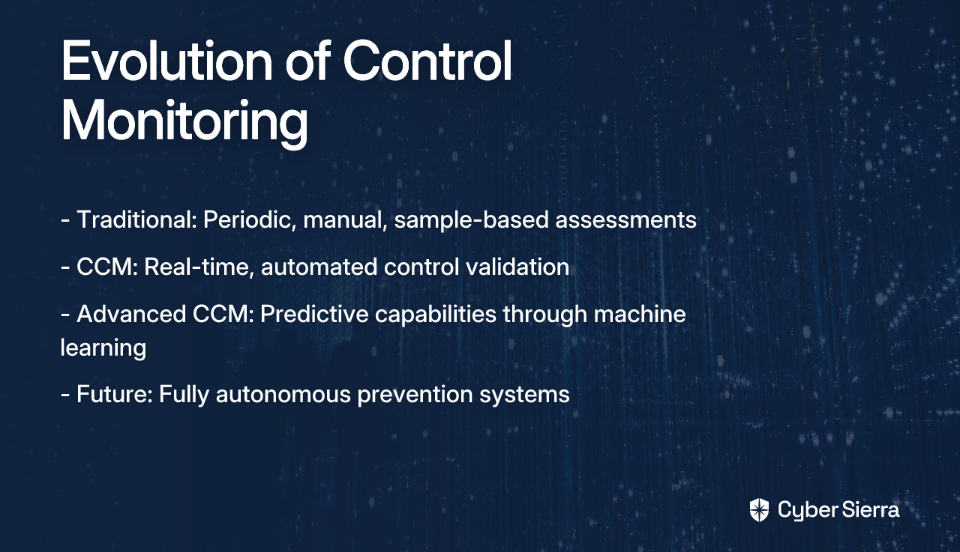
Traditional control monitoring relies on periodic, manual, sample-based assessments. This approach leaves dangerous blind spots between audit cycles, with control failures often discovered only after they've already caused damage.
Enter Continuous Control Monitoring (CCM) – a technology-driven approach that validates the effectiveness of organizational controls in real-time, rather than at scheduled intervals. As defined by MetricStream, CCM "automates the monitoring and testing of internal controls to identify anomalies, policy violations, and control failures in real-time."
But CCM alone, while valuable, is primarily reactive. It tells you when a control has failed. The real power comes when you add predictive capabilities through machine learning – transforming your security posture from reactive to proactive.
Acknowledging the Challenge: Why Predicting Failures is Harder Than It Looks
Before diving into solutions, it's important to acknowledge the very real challenges of predicting control failures:
The Data Problem
Security and operational data presents unique challenges that commercial ML solutions often gloss over:
- Non-Stationary Data: As one practitioner notes, "the data is non-stationary and will vary from machine to machine and even sensor to sensor." This means patterns change over time, making static models quickly obsolete.
- Dynamic Environments: "Industrial operation is a very dynamical environment," making it "really hard to generalize using only past data."
- Sensor Complexity: Modern control environments involve multiple data sources reporting on "different time scales with different sorts of sensitivity," creating a complex data fusion challenge.
The Model Problem
Even with quality data, developing accurate predictive models faces significant obstacles:
- The Plague of False Positives: "Most techniques if applied at face value will probably yield a lot of false positives," creating alert fatigue and undermining trust in the system.
- Actionability Gap: In many cases, "the mean time before failure is so large (years and years)" that predictions aren't operationally useful without extreme lead times.
- System Complexity: "The complexity of real equipment (which consists of multiple subsystems, each with its own distribution) makes it very difficult to anticipate failures" in a way that operations teams can act upon.
Given these challenges, it's no wonder that some practitioners believe that "when applied to real data, nothing really adds value over properly performed condition monitoring."
But this pessimism, while understandable, isn't the full story. Let's explore a framework for success.
The Practitioner's Framework for Predictive Control Failure
Success with ML-driven control failure prediction requires a holistic approach that addresses both technical and operational challenges:
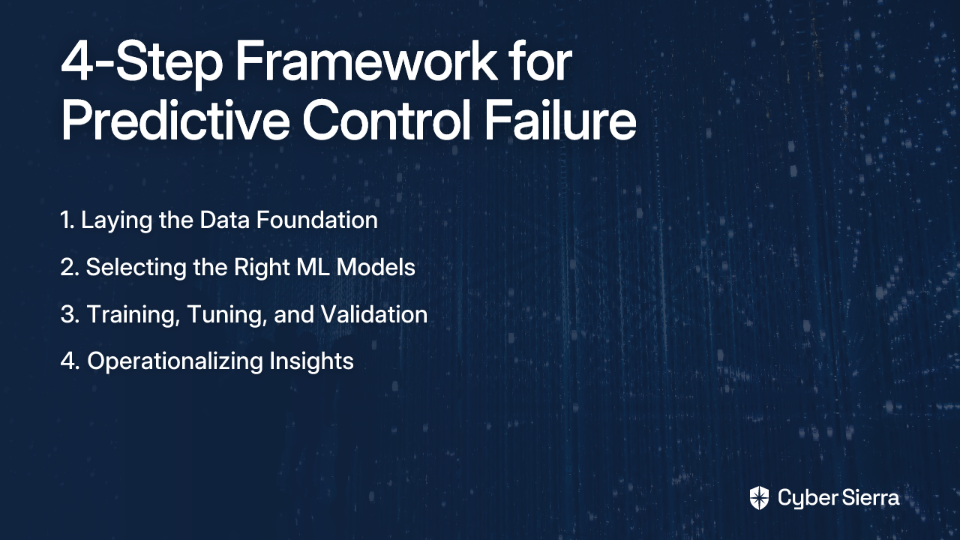
Step 1: Laying the Data Foundation
The foundation of any successful ML implementation is high-quality data. This is especially critical for control failure prediction:
- Engineer Your Features: "The best advice I can give is to get a good grip at the engineering aspects of the problem you are trying to model." Work closely with domain experts to identify meaningful indicators of potential control degradation.
- Handle Non-Stationary Data: Transform non-stationary data into stationary data through techniques like differencing, detrending, or seasonal adjustments. As noted in a comprehensive study on machine failure prediction, proper data preprocessing significantly improves model accuracy.
- Address Data Imbalance: Control failures are (hopefully) rare events, creating highly imbalanced datasets. Techniques like SMOTE (Synthetic Minority Oversampling Technique) can generate synthetic examples of the minority class to improve model training.
- Implement Sensor Fusion: When working with data from multiple sources, implement sensor fusion techniques to combine data with different time scales and sensitivities into a coherent input for your models.
Step 2: Choosing Your Weapon - Selecting the Right ML Models
No single model works best for all control failure prediction scenarios. Consider these options based on your specific needs:
- Traditional ML for Classification: XGBoost has shown "high effectiveness in predicting machine failures" according to research published in Smart Manufacturing and Service Engineering. Random Forest and Isolation Forest can also be effective, particularly for reducing false positives in anomaly detection.
- Deep Learning for Time-Series: Long Short-Term Memory (LSTM) networks have been shown to "outperform traditional machine learning methods" for time-series data, making them excellent candidates for control monitoring data with temporal patterns.
- Survival Models for Remaining Useful Life: When asked about estimating remaining useful life, one practitioner recommended survival models: "They give the probability of an event e.g., a fault occurring at a point in time." These models are particularly valuable when you need to forecast the probability of failure over extended time horizons.
Step 3: Training, Tuning, and Validation
Model performance depends heavily on proper training and evaluation:
- Hyperparameter Tuning: Don't settle for default configurations. Use techniques like grid search or Bayesian optimization to find the optimal parameters for your models.
- Beyond Accuracy: In imbalanced datasets common to control failure prediction, accuracy alone is misleading. Focus on metrics like precision, recall, F1-score, and Area Under the ROC Curve (AUC) to get a complete picture of model performance.
- Cross-Validation: Use time-based cross-validation methods that respect the temporal nature of your data, rather than random splitting which can lead to data leakage and overly optimistic performance estimates.
Step 4: From Prediction to Action - Operationalizing Insights
A prediction without action is just an interesting data point. Create clear pathways from prediction to intervention:
- Actionable Alerts: Structure alerts to include specific recommended actions, not just notifications that something might fail.
- Integration with Workflows: Ensure predictions feed directly into existing GRC and incident response workflows, rather than creating a separate system that may be ignored.
- Continuous Feedback Loop: Track which predictions led to successful interventions and which didn't, using this data to continuously improve your models.
The Proof is in the ROI: Real-World Success Stories
Despite the challenges, organizations are achieving significant returns on investment from ML-driven control failure prediction:
- PETRONAS saved $33 million by using AI-enhanced analytics for asset reliability, addressing 51 warnings and reducing unplanned downtime.
- Duke Energy saved over $34 million in a single early-catch event by deploying a no-code predictive maintenance solution.
These examples demonstrate that success is possible, but it requires choosing "providers with proven industry expertise" and avoiding the marketing hype that dominates the space.

Scaling Success with an AI-Powered GRC Platform
Building a predictive system from scratch requires significant expertise and resources. For organizations seeking a faster path to implementation, an AI-powered GRC platform can provide the infrastructure needed for effective control failure prediction.
Cyber Sierra's Continuous Control Monitoring (CCM) platform exemplifies this approach by providing:
- Central Controls Repository: A single source of truth for all controls with "near real-time updates," solving the data chaos problem that plagues many predictive initiatives. This creates the foundation of high-quality data necessary for accurate predictions.
- Automated Data Collection & Monitoring: The platform automates monitoring "across the technology stack, identifying anomalies without human intervention," which helps address the sensor fusion challenge that makes many predictive efforts fail.
- Actionable Risk Intelligence: Rather than just predicting potential failures, the platform delivers "data-driven analytics to optimize resource deployment and prioritize remediation," turning high-level predictions into concrete actions.
- GRC Integration: By integrating with Cyber Sierra's broader GRC capabilities, predictive insights can be mapped directly to compliance frameworks like NIST, ISO 27001, and PCI DSS, ensuring that predictions translate into compliance improvements.
Conclusion: From Prediction to Prevention
The ultimate goal of machine learning for control failure prediction isn't just to know what might break—it's to prevent problems before they occur.
Success requires a holistic approach that combines:
- Deep domain knowledge of the systems and controls you're monitoring
- Robust data preparation techniques to handle the unique challenges of control data
- Appropriate model selection based on your specific prediction needs
- A powerful platform to operationalize insights and drive action
By implementing this framework, you can transform your organization from a reactive posture—constantly putting out fires—to a proactive one that prevents incidents before they happen.
The skeptics aren't wrong about the challenges. Predicting control failures is difficult. But with the right approach, it's not just possible—it's transformative.
Frequently Asked Questions
What is predictive control monitoring?
Predictive control monitoring uses machine learning to analyze real-time data and forecast potential control failures before they happen. This approach builds upon Continuous Control Monitoring (CCM) by adding a predictive layer, allowing organizations to shift from a reactive security posture (fixing failures after they occur) to a proactive one (preventing them entirely).
Why is it so difficult to predict control failures with machine learning?
Predicting control failures is difficult primarily due to data and model challenges. The data from security and operational systems is often "non-stationary" (patterns change over time) and comes from complex, dynamic environments. This makes it hard to build static models. Furthermore, models can produce a high number of false positives, leading to alert fatigue and a lack of trust in the system.
How can I get started with predictive control failure analysis?
The best way to start is by laying a solid data foundation, which is the first step in the framework outlined in this article. This involves working with domain experts to identify meaningful indicators of control degradation, implementing techniques to handle non-stationary and imbalanced data, and ensuring you have high-quality inputs before attempting to build or select a machine learning model.
What are the best machine learning models for predicting control failures?
There is no single best model, as the ideal choice depends on your specific data and goals. However, effective models often include XGBoost for classification tasks, Long Short-Term Memory (LSTM) networks for analyzing time-series data with temporal patterns, and Survival Models for estimating the "remaining useful life" of a control over longer time horizons.
How does an AI-powered GRC platform help with predictive monitoring?
An AI-powered Governance, Risk, and Compliance (GRC) platform accelerates implementation and improves effectiveness. It provides a central controls repository to solve data chaos, automates data collection from various sources, and integrates predictive insights directly into remediation workflows. This turns a high-level prediction into an actionable task, bridging the critical gap between insight and intervention.
What is the business impact of successfully predicting control failures?
The primary business impact is a significant reduction in costs associated with security breaches, compliance violations, and operational downtime. As seen with companies like PETRONAS and Duke Energy, successfully predicting and preventing even a single major failure can result in tens of millions of dollars in savings, delivering a clear and substantial return on investment.
Ready to explore how AI-powered continuous control monitoring can help your organization predict and prevent control failures? Learn more about Cyber Sierra's CCM platform and discover how it can transform your security posture from reactive to predictive.