ISO 27001 Gap Analysis & Audit Readiness: A Practical Playbook


Join thousands of professionals and get the latest insight on Compliance & Cybersecurity.
Summary
- An ISO 27001 gap analysis is the essential first step to successful certification, comparing your current security practices against the standard to create a prioritized remediation plan.
- Follow a 4-step process: define your ISMS scope, assess controls, develop a risk-based remediation plan, and continuously gather evidence to stay audit-ready.
- With audits taking up to 6 months, understanding the difference between a major non-conformity (an audit failure) and a minor one is key to effective preparation.
- To overcome the challenges of manual evidence collection, leverage automation tools like Cyber Sierra's GRC platform for continuous control monitoring and year-round audit readiness.
You've spent months implementing your Information Security Management System (ISMS), only to discover during an audit that critical documentation is missing, controls aren't properly evidenced, and suddenly you're facing major findings that could derail your ISO 27001 certification timeline.
Sound familiar? You're not alone.
"There's a lot of clauses that say 'you don't need to document anything', but I find that it makes life a lot easier if you have something documented," notes one compliance manager in a recent discussion. This ambiguity is just one of many challenges organizations face on their ISO 27001 journey.
This practical playbook will guide you through conducting an effective gap analysis and preparing for a successful ISO 27001 audit, moving you from last-minute scrambling to year-round readiness.
What is an ISO 27001 Gap Analysis (and Why It's Non-Negotiable)?
An ISO 27001 gap analysis is a comprehensive assessment that compares your organization's current information security practices against the specific requirements of the ISO/IEC 27001:2022 standard. Think of it as your compliance roadmap – identifying precisely what policies, controls, and evidence you're missing to achieve certification.
Why It's Crucial for Your Organization:
- Identifies Compliance Shortcomings: Moves you from guesswork to a data-driven understanding of your current compliance posture.
- Creates a Prioritized Remediation Plan: Prevents wasted effort on low-priority items and helps focus resources where they're needed most.
- Saves Time and Resources: A structured analysis prevents costly rework and audit surprises, which can derail certification timelines.
- Solves the "Tribal Knowledge" Problem: Forces documentation of processes that often exist only in people's heads. As one practitioner observed, "even in companies with no documentation, they somehow manage to keep the lights on." This reliance on undocumented processes is a major organizational vulnerability.
The entire ISO 27001 audit process can take up to 6 months, making thorough preparation essential to avoiding certification delays.

The 4-Step Playbook for a Successful Gap Analysis
Step 1: Obtain the Standard and Define Your ISMS Scope
Before you begin, ensure you have access to the official ISO/IEC 27001:2022 standard. This is essential for understanding the specific clauses and Annex A controls against which you'll be measuring your organization.
Next, clearly document the boundaries of your ISMS:
- Which departments are included?
- What locations fall within scope?
- Which assets and technologies are covered?
This foundational step is what auditors will verify first. Ambiguity here can cascade into problems throughout your certification journey.
Step 2: Assess Current Security Controls
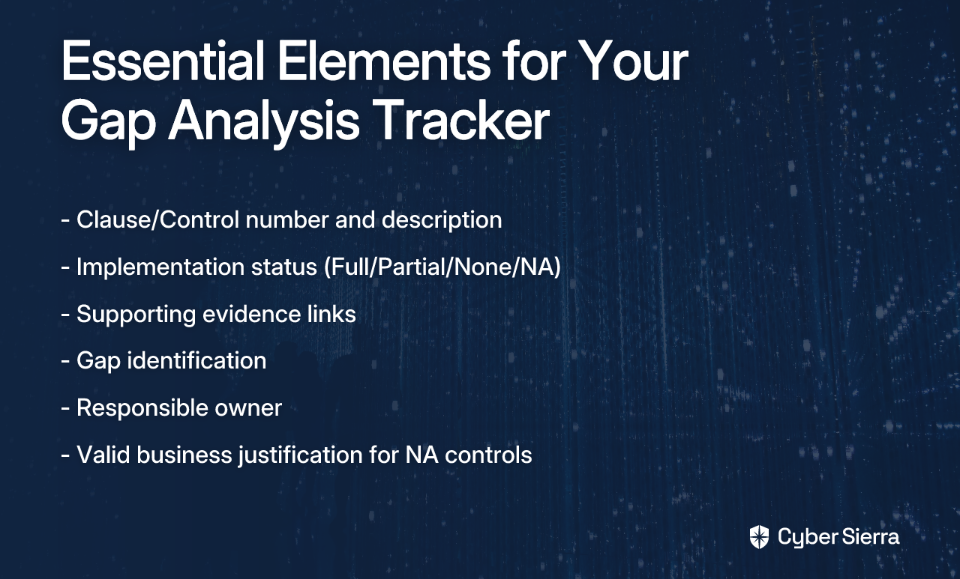
Systematically evaluate your existing practices against each ISO 27001 requirement. Use a structured approach with a spreadsheet or assessment tool that includes:
- Clause/Control number
- Requirement description
- Current implementation status (Implemented, Partially Implemented, Not Implemented, Not Applicable)
- Supporting evidence (link to policy, screenshot, etc.)
- Identified gap
- Responsible owner
Pro Tip: For any Annex A control marked as "Not Applicable," you must provide a valid business justification. Simply writing "NA" is insufficient and will raise red flags during an audit.
Step 3: Develop a Prioritized Remediation Action Plan
Consolidate all identified gaps into a single action plan. Don't treat all gaps equally – prioritize based on risk.
"If you follow ISO 27007, 27005, 19011 - you should assess real business risk," advises one auditor. This means considering risk scores, affected clauses, and potential business impact for each gap.
Your remediation plan should detail:
- Clear description of the remediation task
- Assigned owner responsible for completion
- Realistic deadline
- Resources required (budget, personnel, tools)
Step 4: Implement Fixes and Gather Evidence Continuously
Execute your action plan methodically. As you close each gap, collect and organize evidence demonstrating compliance. Remember, evidence collection should be an ongoing process, not a last-minute scramble before an audit.
Even when documentation isn't explicitly required by a clause, create it anyway. As one practitioner noted, "it makes life a lot easier if you have something documented." This is especially important for business continuity – what happens if the only person who knows a critical process "wins the lottery" or "gets hit by a bus"?
From Gap Analysis to Audit Readiness: Preparing for Scrutiny
Understanding the audit process demystifies what can otherwise feel like an intimidating evaluation.
Understanding the Audit Process
An ISO 27001 audit evaluates your ISMS to ensure it meets the standard's requirements. There are two main types:
Internal Audit (Clause 9.2): This mandatory self-check requires you to:
- Conduct audits at planned intervals
- Establish and maintain an audit program
- Select impartial auditors
- Report results to relevant management
- Retain documented information as evidence
External (Certification) Audit:
- Stage 1 Audit: A documentation review where the external auditor checks that your ISMS design is sound on paper.
- Stage 2 Audit: An operational effectiveness review where the auditor conducts interviews and verifies that your controls are actually implemented and working as documented.
Demystifying Audit Findings: Major vs. Minor
One common source of confusion is understanding what constitutes different types of audit findings. "Honestly, I don't understand how you give that as major. I give majors only when something can lead to ISMS collapse — like, real damage, not just 'missing doc,'" one auditor commented.
Here's clarity on the different findings:
Major Non-conformity: A critical failure in the ISMS that puts sensitive information at high risk. Examples include a complete absence of mandatory processes like risk assessment or internal audits. A major finding will likely result in audit failure.
Minor Non-conformity: An isolated lapse or deviation from a requirement that doesn't compromise the entire system. For example, a single server missing a patch or one new hire who hasn't completed security training. These must be fixed but won't typically cause you to fail.
Opportunity for Improvement (OFI): A suggestion from the auditor on how you could strengthen your ISMS. It's not a failure to meet a requirement but a best-practice recommendation.
The Modern Approach: Leveraging Automation for Continuous Compliance
While traditional, manual approaches to ISO 27001 compliance can work, they come with significant challenges:
- Resource constraints (time, budget, personnel)
- Complex documentation requirements
- Difficulty coordinating with vendors
- Point-in-time compliance snapshots that quickly become outdated
This is where compliance automation platforms like Cyber Sierra can transform your approach from periodic compliance checks to continuous compliance monitoring.
Key Benefits of Automation:
Reduced Manual Overhead: Automate repetitive tasks like evidence collection, freeing your team to focus on strategic security improvements.
Continuous Compliance Monitoring: Gain real-time visibility into your compliance posture through Cyber Sierra's Continuous Control Monitoring (CCM) module, which automatically tests controls against ISO 27001 requirements and alerts you to gaps.
Audit-Ready Documentation: Automatically generate reports and maintain a verifiable audit trail, eliminating the pre-audit documentation scramble.
From Certification to Continuous Security
Achieving ISO 27001 certification isn't just about the certificate. It's about building a culture of security and enhancing your organization's cyber resilience.
By following this practical playbook – conducting a thorough gap analysis, creating a structured remediation plan, understanding the audit process, and leveraging automation – you can transform ISO 27001 compliance from a stressful periodic project to a continuous state of security and readiness.
Frequently Asked Questions
What is the first step in preparing for an ISO 27001 audit?
The first and most crucial step in preparing for an ISO 27001 audit is conducting a thorough gap analysis. This analysis compares your current security practices against the ISO 27001 standard's requirements, identifying specific areas where you fall short. It forms the foundation of your remediation plan and ensures you focus resources effectively, preventing last-minute surprises during the audit.
How long does an ISO 27001 gap analysis typically take?
The duration of an ISO 27001 gap analysis can vary from a few weeks to several months. The timeline depends heavily on the size and complexity of your organization, the defined scope of your Information Security Management System (ISMS), and the maturity of your existing security controls. Smaller organizations with some controls already in place may complete it faster than large enterprises starting from scratch.
What is the difference between a major and a minor non-conformity?
A major non-conformity represents a critical failure in the ISMS that could lead to its collapse, while a minor non-conformity is an isolated lapse that doesn't compromise the entire system. For example, completely lacking a mandatory risk assessment process would be a major finding, likely causing an audit failure. In contrast, a single employee having missed a security training session would be a minor finding, which must be corrected but won't derail certification on its own.
Do I need to document every single process for ISO 27001?
While the ISO 27001 standard does not explicitly require every single process to be documented, it is a highly recommended best practice. Auditors find it much easier to verify compliance when processes are clearly documented. More importantly, documentation prevents reliance on "tribal knowledge" (information held by only a few key individuals), which strengthens business continuity and makes your ISMS more resilient and easier to maintain long-term.
How can automation help with ISO 27001 compliance?
Automation helps by reducing manual effort, providing continuous monitoring of controls, and generating audit-ready documentation on demand. Compliance automation platforms, like Cyber Sierra, can automatically collect evidence from your tech stack, test controls against ISO 27001 requirements in real-time, and alert you to new gaps as they arise. This transforms compliance from a periodic, stressful project into a continuous, manageable state of readiness.
What happens after we get ISO 27001 certified?
ISO 27001 certification is not a one-time achievement; it marks the beginning of a continuous improvement cycle. After your initial certification audit, you will undergo annual surveillance audits to ensure your ISMS remains effective and compliant. You must continue to conduct internal audits, management reviews, and risk assessments to maintain and improve your security posture, demonstrating an ongoing commitment to information security.
Stop treating ISO 27001 as a compliance checkbox. Embrace it as an opportunity to strengthen your security posture while reducing the resource burden through automation. Discover how the Cyber Sierra GRC platform can make you audit-ready, all year round.