



Supply Chain Attacks in CI/CD Pipelines: The New Cloud Security Nightmare



Join thousands of professionals and get the latest insight on Compliance & Cybersecurity.
You've built a robust CI/CD pipeline to automate your cloud deployments. Your team is shipping features faster than ever. But behind this efficiency lurks a growing threat that keeps security professionals awake at night: your pipeline has become the perfect target for sophisticated supply chain attacks.
"Supply chain attacks in the cloud are getting wild lately," as one security professional put it in a recent discussion. "Attackers are targeting CI/CD pipelines and dependency chains to slip malicious code into cloud deployments."
This isn't just another security buzzword. A supply chain attack involves injecting malicious code into a trusted component of your software development lifecycle, compromising your final product and potentially affecting thousands of downstream customers. And your CI/CD pipeline—with its privileged access, automation, and trusted position—sits at the heart of this vulnerable chain.
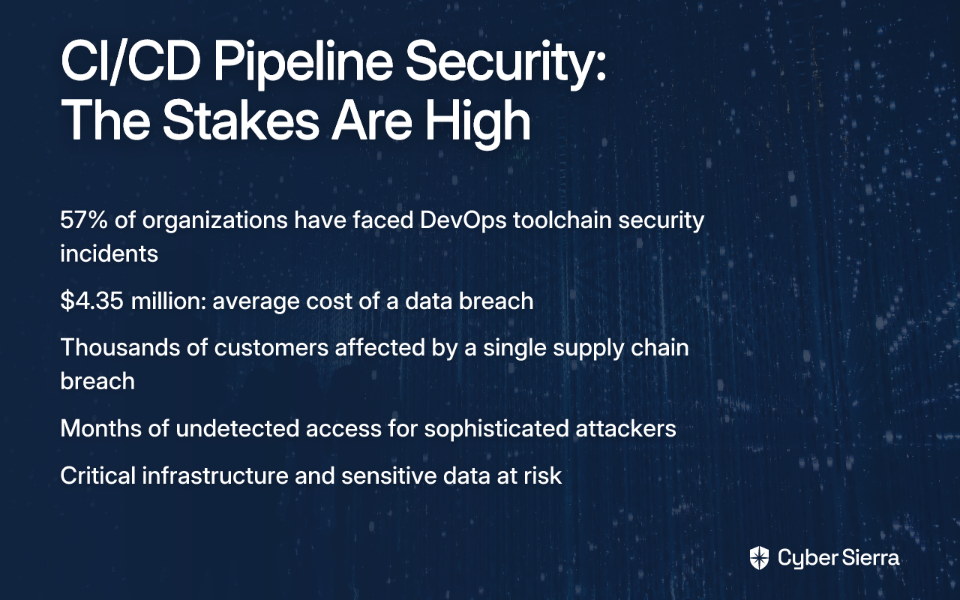
The stakes are enormous. Since 2020, 57% of organizations have encountered security incidents related to their DevOps toolchains. With the average data breach costing a staggering $4.35 million, these aren't risks you can afford to ignore.
As one security auditor bluntly stated, "I have done over 50 Cloud sec audits and you won't believe the amount of cloud resources just hanging out there on the www to be found and attacked." This article cuts through the noise to examine why your CI/CD pipeline is a prime target, how these attacks unfold, and most importantly, how to build a robust defense.
The Ticking Time Bomb: Why Your CI/CD Pipeline is a Prime Target
CI/CD pipelines have become the beating heart of modern development workflows. They automate building, testing, and deploying applications, dramatically accelerating software delivery. But this critical role makes them particularly attractive to attackers for several key reasons:
- Privileged Access: CI/CD systems typically operate with elevated permissions to deploy code, access secrets, and modify production environments. According to the OWASP CI/CD Security Cheat Sheet, these pipelines often hold "the keys to the kingdom"—making a successful breach catastrophically damaging.
- Trust by Default: Development teams implicitly trust the output of their pipelines. Code that passes through CI/CD checks is assumed to be safe, making it the perfect vehicle for introducing malicious code that flies under the radar.
- Automation Amplifies Attacks: The automated nature of CI/CD means that a single compromised component can instantly affect all downstream systems and customers—potentially spreading malware to thousands of targets simultaneously.
- Security Takes a Backseat: As one frustrated security professional explained, "Developers are being given priority so if it makes their jobs at all more difficult, my advice gets ignored, so nearly everything is simply set to default settings." This prioritization of convenience over security creates dangerous blind spots.
- Complex Dependency Chains: Modern applications rely on hundreds or thousands of dependencies, creating a broad attack surface. The "rise of dependency confusion, malicious code injection, and compromised open-source repositories is alarming," as noted in another discussion thread.
Anatomy of a Pipeline Breach: Learning from Real-World Attacks
To understand the severity of the threat, let's examine some high-profile CI/CD supply chain attacks and their devastating consequences.
The SolarWinds Breach: The Landmark Attack
The 2020 SolarWinds hack remains the textbook example of a catastrophic supply chain attack. Attackers infiltrated SolarWinds' build process and inserted a backdoor (SUNBURST) into the Orion software updates. These compromised updates were then digitally signed and distributed to approximately 18,000 customers, including government agencies and Fortune 500 companies. The attack remained undetected for months, giving attackers persistent access to some of the most sensitive networks in the world.
What made this attack particularly insidious was that it exploited the trust relationship between SolarWinds and its customers. The malicious code came through an officially signed update from a trusted vendor, bypassing most security controls.
The tj-actions and reviewdog GitHub Actions Attack: A Modern Nightmare
A more recent and directly relevant example involves the compromise of popular GitHub Actions. This sophisticated attack, detailed by the OpenSSF, reveals the modern attacker's playbook:
- Initial Compromise: Attackers exploited flawed contributor management processes to gain write access to the popular
reviewdogrepository. - Tag Redirection: In a move that exploits what one developer called "the mutable nature of version tags in GitHub Actions," the attackers redirected the commonly used
v1tag to point to their malicious commit. Users who specified this tag in their workflows were unknowingly executing the attacker's code. - Credential Theft and Propagation: The malicious code extracted secrets and access tokens from CI environments, then used these stolen credentials to compromise additional repositories, including
tj-actions. - Log-Based Exfiltration: Instead of making suspicious network connections that might trigger alerts, the attackers cleverly dumped stolen secrets directly into CI logs, making the attack harder to detect.
What's particularly chilling about this attack is how it leveraged the fundamental trust placed in these components and the cascading effect as one compromise led to another. As one security researcher put it, this feels "like something out of a spy movie, but it's all happening in our digital backyard."
The Attacker's Playbook: Top CI/CD Security Risks
Understanding the common attack vectors is essential for building effective defenses. The OWASP Top 10 CI/CD Security Risks provides a framework for identifying the most critical threats:

- Dependency Chain Abuse: Attackers inject malicious code into dependencies used by your application or CI/CD tools themselves. This is the "dependency confusion" threat that many developers worry about, where attackers exploit the way package managers resolve dependencies to deliver malicious packages.
- Poisoned Pipeline Execution (PPE): This involves modifying the pipeline's execution flow to inject malicious commands, often by manipulating build configuration files like
Jenkinsfileor.github/workflows/ci.yml. - Inadequate Identity and Access Management (IAM): As one professional noted, "Also seeing a rise in cloud misconfigurations being exploited - especially around IAM permissions and API security. The whole 'identity is the new perimeter' thing is real." Weak IAM makes CI/CD systems vulnerable to unauthorized access and privilege escalation.
- Insufficient Credential Hygiene: Poor management of secrets, tokens, and keys—including hardcoded secrets in pipeline configurations or leaking them in logs—gives attackers easy access to sensitive systems.
- Insecure System Configuration: Default or misconfigured SCM platforms, CI/CD servers, or build agents create vulnerabilities. This aligns with the observation that "nearly everything is simply set to default settings" due to development priorities trumping security concerns.
- Improper Artifact Integrity Validation: Failure to verify the digital signature or hash of build artifacts allows tampered artifacts to be deployed undetected.
A Defense-in-Depth Blueprint for Securing Your Pipeline
Protecting your CI/CD pipeline requires a comprehensive, defense-in-depth approach. Here's a practical blueprint for hardening your pipeline against supply chain attacks:
1. Lock Down Your Dependencies & Code
Pin Dependencies to Full-Length Commit SHAs: The single most important lesson from the tj-actions attack is to avoid using mutable tags like v1 or latest. Instead, pin dependencies to immutable, full-length commit SHAs. As the OpenSSF recommends, this prevents attackers from redirecting references to malicious code.
Vet and Audit Dependencies:
- Use tools like Renovate or Dependabot to keep dependencies updated
- Integrate the OpenSSF Scorecard into CI workflows to assess the security posture of dependencies
- Consider using Software Bills of Materials (SBOMs) to maintain visibility into your dependency chain
Secure Source Code Management:
- Require pull request reviews before merging; avoid auto-merge rules
- Enable branch and tag protection rules in GitHub/GitLab to prevent unauthorized changes
- Regularly audit repository access permissions and remove stale accounts
2. Harden Identity and Access Management (IAM)
Enforce the Principle of Least Privilege (PoLP): Grant users, services, and build agents only the minimum permissions necessary. As SecureSlate notes, overprivileged CI/CD environments dramatically increase the blast radius of any compromise.
Mandate Multi-Factor Authentication (MFA): Require MFA for all users with access to your SCM and CI/CD platforms. This simple step significantly reduces the risk of credential theft.
Secure Secrets Management:
- NEVER hardcode secrets in your pipeline configurations or repositories
- Use dedicated secret management tools like HashiCorp Vault, AWS Secrets Manager, or Azure Key Vault
- Implement short-lived tokens instead of persistent credentials where possible
- Regularly rotate secrets and access keys
Isolate Workflows: Use features like GitHub Environments to protect secrets and require manual approvals for deployments to sensitive environments.
3. Achieve End-to-End Integrity and Visibility
Validate Artifact Integrity:
- Generate cryptographic hashes (e.g., SHA-256) for all build artifacts and verify them at each pipeline stage
- Consider implementing a framework like in-toto to create a cryptographically verifiable record of your entire supply chain
- Sign your artifacts and verify signatures before deployment
Implement Runtime Security and Monitoring:
- Monitor CI/CD runners for unusual behavior using tools like StepSecurity's Harden-Runner
- Centralize logs from all CI/CD components into a SIEM for analysis and anomaly detection
- Scan build logs for leaked secrets using tools like GitGuardian
- Implement comprehensive monitoring of your CI/CD workflows to detect unusual patterns or behaviors
4. Continuous Monitoring and Threat Hunting
Integrate Security Tools into Your Pipeline:
- Implement Static Application Security Testing (SAST), Dynamic Application Security Testing (DAST), and Software Composition Analysis (SCA) directly in your pipeline
- Use infrastructure-as-code scanning tools to detect misconfigurations before deployment
- Regularly audit your cloud configurations with Cloud Security Posture Management (CSPM) tools
Map and Monitor Your Supply Chain:
- Create a comprehensive map of your dependencies and their sources
- Establish a vulnerability disclosure process for your own projects
- Participate in coordinated vulnerability disclosure programs
Conclusion: Shifting Left and Building a Resilient Future
Supply chain attacks targeting CI/CD pipelines represent one of the most significant cloud security challenges organizations face today. As one security professional observed, "Often it's not the cloud that is the problem but a fundamental lack of ability to deploy cloud projects with good security built in."
The most critical defensive actions you can take today include:
- Pinning dependencies to immutable commit SHAs instead of mutable tags
- Enforcing least privilege across all CI/CD components
- Implementing robust secrets management
- Ensuring end-to-end visibility with comprehensive logging and monitoring
- Treating your CI/CD pipeline with the same security rigor as your production environment
Remember that technology alone isn't enough. Organizations must cultivate a security-first culture where security is a shared responsibility, not an afterthought or impediment to development. As the Cloud Security Alliance emphasizes, this cultural shift is essential for long-term resilience.
The sophistication of these attacks will only increase. What feels like "something out of a spy movie" today will become commonplace tomorrow. But with a defense-in-depth approach that addresses people, processes, and technology, you can turn your CI/CD pipeline from your greatest vulnerability into a secure foundation for your cloud infrastructure.

Frequently Asked Questions
What is a CI/CD supply chain attack?
A CI/CD supply chain attack is a cyberattack where malicious code is injected into a trusted component of your software development and deployment pipeline. This compromises the final software product. Instead of attacking your production systems directly, attackers target less secure elements like third-party dependencies, build tools, or source code repositories. Once inside, they can use the trusted, automated nature of the CI/CD pipeline to distribute malware, steal data, or gain persistent access to your systems and your customers' systems.
Why is my CI/CD pipeline such a high-value target for attackers?
Your CI/CD pipeline is a high-value target because it has privileged access to your most sensitive systems, is implicitly trusted by your development team, and its automation can rapidly spread a compromise. These pipelines often hold "the keys to the kingdom," including secrets, API keys, and deployment credentials for production environments. Attackers know that a single breach in the pipeline can give them widespread access, allowing them to inject malicious code that will be automatically built, tested, and deployed without raising suspicion.
What is the single most effective way to prevent CI/CD supply chain attacks?
The single most effective defense is to pin your dependencies to full-length, immutable commit SHAs instead of using mutable tags like v1 or latest. This practice directly prevents tag-hijacking attacks, like the one seen with tj-actions, where attackers redirect a common tag to point to their malicious code. By using an immutable commit hash, you ensure your pipeline always pulls the exact, verified version of a dependency, making it impossible for attackers to secretly swap it out. While a multi-layered defense is crucial, this one change significantly reduces a major attack vector.
How does the principle of least privilege (PoLP) apply to CI/CD security?
The principle of least privilege (PoLP) in CI/CD means that every component—from user accounts to build agents and deployment scripts—should only have the absolute minimum permissions required to perform its specific task. For example, a build agent that only needs to build code shouldn't have permissions to modify production infrastructure. By strictly limiting permissions, you contain the "blast radius" of a potential compromise. If an attacker gains control of one part of the pipeline, PoLP ensures they cannot easily move laterally to access more sensitive systems or escalate their privileges.
What are some essential tools for securing a CI/CD pipeline?
Essential tools for securing a CI/CD pipeline include secret management solutions (like HashiCorp Vault), Software Composition Analysis (SCA) scanners (like Dependabot), and static analysis security testing (SAST) tools. A robust security toolkit should be integrated directly into your pipeline:
- Secret Management: Tools like AWS Secrets Manager or Azure Key Vault prevent hardcoded credentials.
- SCA & Dependency Management: Dependabot or Renovate automate dependency updates, while the OpenSSF Scorecard helps vet their security posture.
- Code & IaC Scanning: SAST tools scan your code for vulnerabilities, and tools like Terrascan check your infrastructure-as-code for misconfigurations.
- Monitoring: StepSecurity's Harden-Runner can monitor CI/CD runner behavior for anomalies.
What is a Software Bill of Materials (SBOM) and how does it improve security?
A Software Bill of Materials (SBOM) is a formal, machine-readable inventory of all software components, dependencies, and libraries included in a piece of software. An SBOM provides complete visibility into your software supply chain. When a new vulnerability is discovered in an open-source library (like Log4j), you can instantly query your SBOMs to see which of your applications are affected. This allows for rapid risk assessment and remediation, turning a days-long manual search into a minutes-long automated query. It's a foundational element for managing dependency risk at scale.
