



How Third Party Risk Management Software Stops Supply Chain Breaches

Join thousands of professionals and get the latest insight on Compliance & Cybersecurity.
Summary
- Traditional vendor vetting with annual questionnaires is ineffective against modern supply chain threats, as demonstrated by the SolarWinds attack which impacted over 250 organizations.
- The solution is to shift from periodic audits to continuous, automated monitoring of vendor security, providing real-time visibility into your supply chain.
- Key steps to building a modern program include tiering vendors by risk, integrating continuous monitoring into contracts, and connecting alerts to your incident response plan.
- A dedicated platform like Cyber Sierra's TPRM automates vendor assessments and provides a unified, near real-time view of third-party risk.
After a major supply chain attack, the board doesn't want to hear about complexity. They want to know why it happened, who's responsible, and what's being done to make sure it never happens again. For Chief Information Security Officers (CISOs), that conversation is one of the most uncomfortable in the profession — because the honest answer is that traditional vendor vetting was never built to catch what SolarWinds-style attacks exploit.
The problem isn't negligence. It's architecture. Most organizations still rely on point-in-time assessments, annual questionnaires, and compliance certifications to gauge vendor security. But as one security professional put it bluntly: "Very little you can do realistically. Can try and vet partners and vendors but hard to know for sure how secure they really are." That's not cynicism — it's a systems problem.
Modern Third-Party Risk Management (TPRM) software changes that equation. This article breaks down why legacy vendor vetting fails, what TPRM platforms actually do to close the gap, and how to build a continuous monitoring program that holds up under board scrutiny.
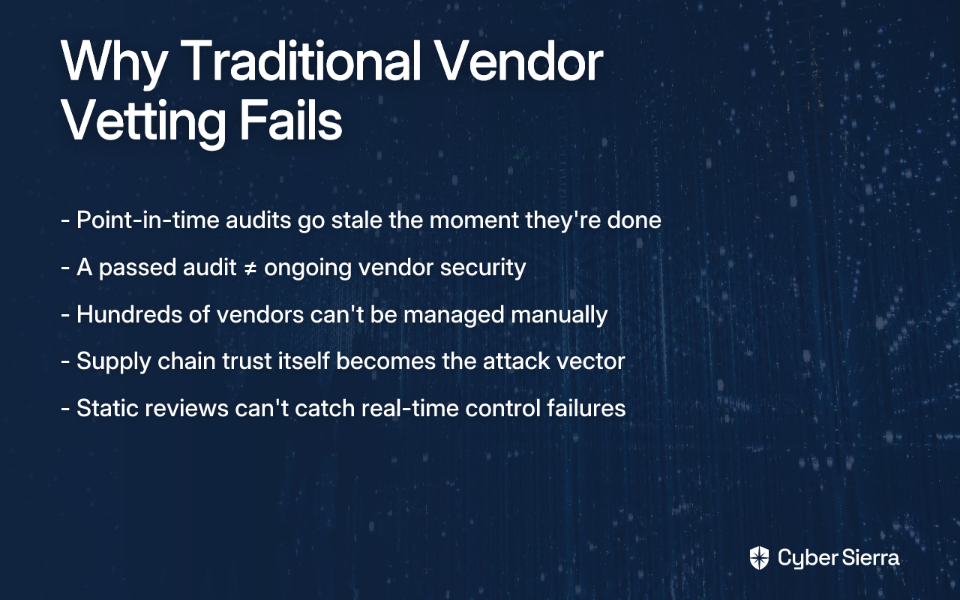
Why Traditional Vendor Vetting Fails in a Post-SolarWinds World
The SolarWinds breach wasn't a failure of due diligence in the conventional sense. SolarWinds was a trusted vendor. Its software was signed, certified, and widely deployed across government agencies and Fortune 500 companies. When threat actors compromised the Orion software build process and pushed a malicious update, they didn't bypass vendor security reviews — they weaponized them. Organizations had vetted SolarWinds. They trusted it. That trust became the attack vector.
According to Venminder's analysis, the breach is estimated to have affected over 250 government agencies and businesses. The damage wasn't from a single vulnerability — it was from the systemic assumption that a passed audit equals ongoing safety.
That assumption is the core failure of static Third-Party Risk Management. As Panorays observes, "previously, vendor assessments were static and periodic... a reactive risk management approach is insufficient" in modern supply chains. The audit is just a baseline — and the moment it's completed, it starts going stale.
The scale of the problem makes this worse. Modern enterprises don't rely on five or ten vendors. They rely on hundreds — each with their own contractors, cloud dependencies, and software supply chains. Managing that manually is unsustainable. One IT manager described it directly: "We were onboarding vendors weekly, and the certs, risk docs, and endless follow-ups became a full-time job."
That's not a workflow problem. That's a signal that manual TPRM doesn't scale.
How Modern TPRM Software Reduces Supply Chain Risk
Modern third-party risk management software doesn't just digitize the questionnaire process. At its best, it fundamentally changes how organizations detect and respond to vendor-side risk. Here's what that looks like in practice.
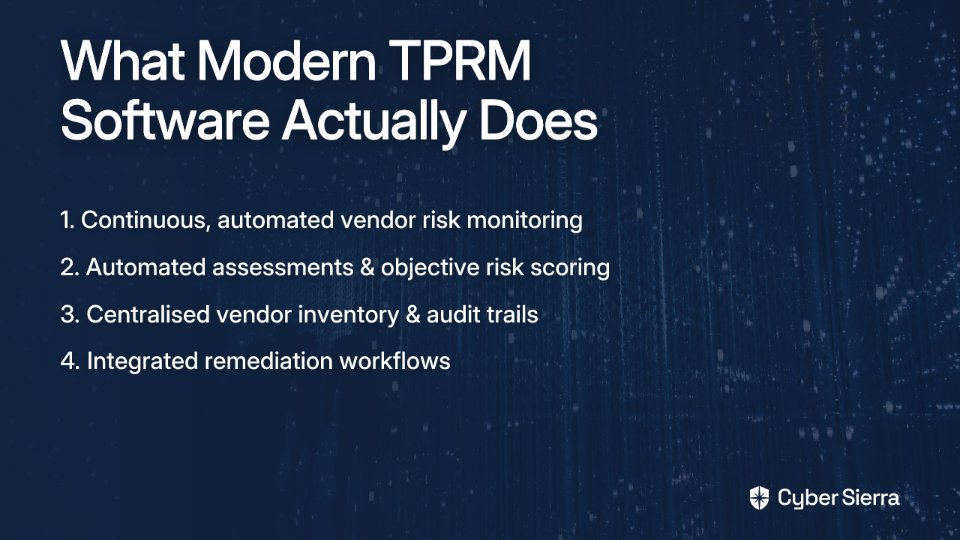
Continuous, Automated Risk Monitoring
The single biggest limitation of annual vendor reviews is timing. A vendor can pass an assessment in January and suffer a significant control failure in March — and you won't know until the next review cycle. Continuous monitoring closes that window.
Modern TPRM platforms track vendor security posture on an ongoing basis, monitoring external attack surfaces, flagging data leaks, and alerting teams to changes in security ratings. According to Panorays, this approach provides "immediate alerts about vulnerabilities and unusual activities," enabling proactive response rather than post-breach damage control. That's the operational shift from reactive to preventive — which is exactly what boards are now demanding.
Automated Vendor Assessments and Risk Scoring
Manual questionnaire management is where TPRM programs quietly collapse. Tracking which vendors have responded, chasing outstanding submissions, and then manually reviewing answers across dozens of documents is time-intensive and error-prone. Automation eliminates most of that overhead.
Leading platforms automate the distribution, collection, and scoring of vendor assessments. Some incorporate AI-assisted features that help vendors complete questionnaires faster and flag inconsistent or incomplete responses automatically. Risk scores are generated from objective data — not gut feel — allowing teams to rank vendors by actual risk level and prioritize accordingly. This is especially valuable when vendor inventories run into the hundreds.
Centralized Vendor Inventory and Audit Trails
One of the most common CISO pain points is the absence of a unified view. Vendor data lives in spreadsheets, email threads, shared drives, and disconnected tools. When an auditor asks for proof of vendor due diligence — or when an incident forces a rapid review — finding that information is an archaeological dig.
TPRM software consolidates all vendor records, contracts, assessment histories, and remediation notes into a single platform. That creates a defensible audit trail and a genuine single source of truth. It also addresses a frustration many compliance teams know well, as one professional shared on Reddit: "Your last audit is the last baseline you have, and any changes from that moment go through the process and get documented in detail." A centralized system ensures those changes are actually captured.
Integrated Remediation Workflows
Identifying a vendor risk is only half the job. The other half is resolving it — and that's where many programs stall. Without structured workflows, risk findings sit in inboxes, get flagged as "in progress," and never reach resolution.
Effective TPRM platforms include built-in workflows for tracking remediation from detection through closure. Tasks can be assigned, deadlines set, and progress monitored — all within the same tool that surfaced the risk. According to UpGuard, leading platforms offer "comprehensive workflows for managing risks throughout their lifecycle, from detection to resolution." That lifecycle management is what turns risk visibility into risk reduction.
How to Build a Continuous TPRM Program
Deploying TPRM software is a technology decision. Building a continuous TPRM program is an organizational one. The two need to happen together.
CISA's supply chain guidance recommends that organizations conduct thorough assessments to understand their supply chain vulnerability exposure and implement strategies aligned with frameworks like NIST SP 800-161, the Cyber Supply Chain Risk Management (C-SCRM) standard. That formal grounding is important — especially when presenting a program to the board.
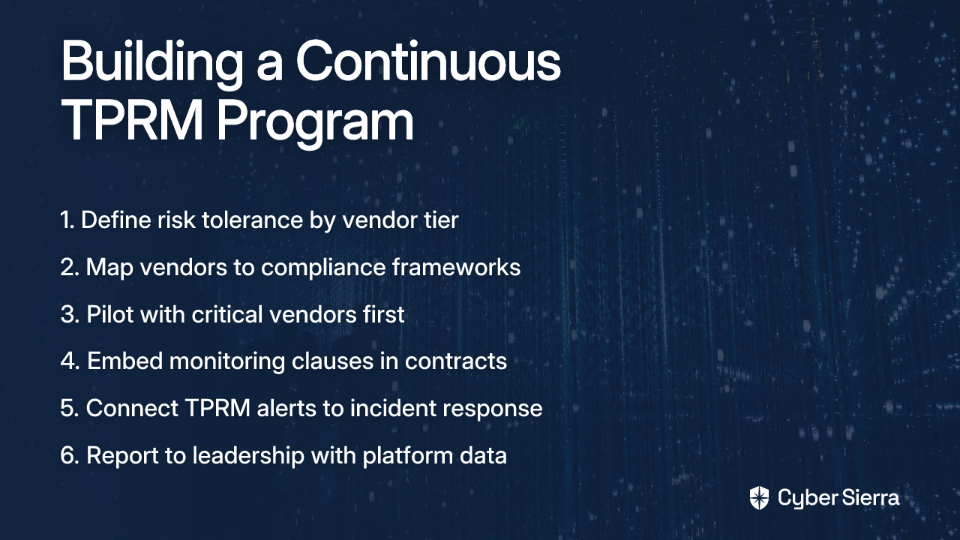
Here's how to operationalize it:
The goal isn't to build a perfect system on day one. It's to replace the illusion of periodic safety with genuine, ongoing visibility.
Shift From Questionnaires to Continuous Visibility
Relying on last year's vendor questionnaire to answer this year's board-level security questions is a high-stakes gamble. The truth is, traditional, point-in-time audits create a false sense of security that sophisticated attackers are happy to exploit.
Building a resilient Third-Party Risk Management program doesn't have to be complex. It starts with two fundamental shifts:
- Move beyond the annual audit. A passed questionnaire is a snapshot, not a guarantee. Real security requires continuous visibility into your vendors' actual security posture.
- Automate to get ahead of risk. Manual tracking doesn't scale. A TPRM platform automates vendor assessments and provides real-time alerts when a vendor's risk profile changes.
Here’s one action you can take today: list your top five most critical vendors. When was the last time their security was truly validated, not just attested to on a form?
If that question gives you pause, it might be time to see how automation can provide a better answer. Cyber Sierra's platform gives you a unified, near real-time view of third-party risk without adding complexity. Book your TPRM demo and see how you can move from reactive check-ins to proactive resilience.
Frequently Asked Questions
What is Third-Party Risk Management (TPRM) software?
TPRM software is a tool that automates and centralizes the process of managing risks from vendors. It replaces manual, point-in-time assessments with continuous monitoring, automated risk scoring, and integrated remediation workflows to provide real-time visibility into supply chain security.
Why is traditional vendor vetting no longer effective?
Traditional vendor vetting is no longer effective because it relies on static, periodic assessments like annual questionnaires. These audits go stale quickly and can't detect real-time security failures, leaving organizations vulnerable to supply chain attacks like the SolarWinds breach.
How does continuous monitoring in TPRM work?
Continuous monitoring works by automatically and consistently tracking a vendor's security posture. TPRM platforms scan external attack surfaces, check for data leaks, and monitor security rating changes, providing immediate alerts on new vulnerabilities without waiting for an annual review cycle.
What are the first steps to building a TPRM program?
The first steps are to define your risk tolerance and tier vendors based on their criticality. Start by piloting the program with your most critical vendors, map them to relevant compliance frameworks, and begin integrating continuous monitoring into your vendor management process and contracts.
How can TPRM software help with board reporting?
TPRM software helps with board reporting by providing a centralized, data-driven view of vendor risk. It generates objective risk scores, maintains a defensible audit trail, and offers clear metrics on risk reduction, allowing leaders to report on supply chain security with confidence.
